
Idea 1
The Transformative Power of Real Conversation
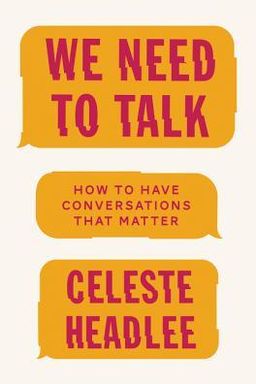
When was the last time you truly listened to someone—without thinking about your next reply or glancing at a screen? In We Need to Talk, journalist and TED speaker Celeste Headlee argues that genuine conversation, not just communication, is the key to repairing our fractured relationships, communities, and culture. Her central claim: real conversation is a survival skill—something that once helped humans thrive but is now eroding in the face of technology, distraction, and polarization.
Headlee contends that while we communicate constantly—through texts, emails, and social media—we rarely converse. A conversation, she says, involves listening, empathy, vulnerability, and curiosity. It’s the mutual act of turning together, not just talking at each other. When we stop doing that, misunderstanding flourishes, empathy declines, and communities fail to connect. The author’s message is both personal and universal: better conversations lead to better lives, stronger workplaces, and more compassionate societies.
Why This Matters
Headlee opens the book with a striking example—the 1982 crash of Air Florida Flight 90—caused in part by poor communication in the cockpit. Her insight is that lives depend on how well we converse, not just transmit information. From hospital miscommunications costing thousands of lives to the everyday misunderstandings that destroy relationships, she shows that the stakes of our conversational failures are higher than we imagine. Having spent two decades interviewing presidents, authors, and scientists on live radio, she reflects on the many connections lost simply because she wasn’t listening.
The Core Idea: Conversation as a Human Superpower
What makes conversation more than a social nicety? Headlee points to evolutionary biology. Humans evolved to speak, listen, and cooperate—our survival depended on trust and dialogue. Unlike other species, we can explain, empathize, negotiate, and deliberate through words. Yet, in an era of technology, we’ve neglected this skill. Research cited throughout the book—such as from MIT’s Sherry Turkle (Reclaiming Conversation) and psychologist Daniel Kahneman—shows how overuse of digital communication reduces empathy and weakens attention spans. Headlee warns that our dependence on texting and emails gives us an illusion of connection while undermining authentic communication.
A Call to Rethink What It Means to Talk
Headlee distinguishes between communication and conversation: communication exchanges information, while conversation builds relationships. This difference is crucial for workplaces, families, and communities. Her experience—both as a journalist and as a mother—shows that empathy arises only when people see each other as human beings, not job titles or usernames. In a story about her son’s teacher, she discovers the transformative power of one honest, emotional face-to-face exchange after weeks of unproductive emails.
What You’ll Learn in This Summary
Throughout the book, Headlee walks through sixteen principles that improve conversation—from being present rather than multitasking, to asking questions, to staying out of trivial details. You’ll learn why interruptions and logic-driven arguments derail genuine dialogue, how to avoid the trap of conversational narcissism, and why humility—admitting “I don’t know”—often makes you more trustworthy. Her advice emerges from decades of professional interviewing and research, but it applies to everyone who wants to speak and listen better.
A Practical and Emotional Blueprint for Reconnecting
At heart, We Need to Talk is Headlee’s attempt to restore empathy and understanding through mindful conversation. She translates complex social research into everyday examples—like why we repeat ourselves, how cognitive bias creeps into discussions, and why silence and brevity can be more powerful than words. Her claim echoes voices like Stephen Covey (The 7 Habits of Highly Effective People) and Brené Brown (Dare to Lead): connection depends on vulnerability and presence.
This summary will explore ten major ideas from Headlee’s book: conversation as survival, the difference between communication and conversation, why you can’t outsmart a bad conversation, how to set the stage for productive dialogue, the value of curiosity and apology during tough talks, breaking habits like multitasking, narcissism, and repetition, and finally, the power of listening and sometimes, silence. Together, these lessons form a manifesto for reclaiming one of humanity’s oldest and most endangered arts—the ability to truly talk and understand one another.