
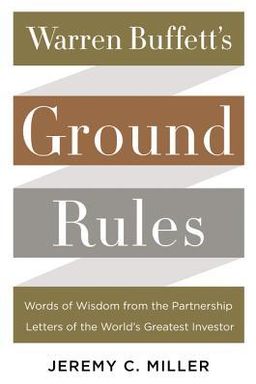
Warren Buffett''s Ground Rules cover

Warren Buffett''s Ground Rules

by Jeremy C Miller

Discover the investment wisdom of Warren Buffett through his partnership letters, offering a deep dive into strategies that have built unparalleled fortunes. Jeremy C. Miller distills Buffett''s insights into actionable advice for investors eager to grow wealth with patience, precision, and principled investing.

The Buffett Partnership Blueprint

How can you design an investment approach that endures across decades, outperforms the market, and keeps both discipline and humanity intact? Warren Buffett’s partnership philosophy offers that blueprint. His letters between 1956 and 1970 reveal not just how he beat the Dow by roughly 10 percentage points annually, but how he built a system of trust, alignment, and reason—principles that still underpin his later success at Berkshire Hathaway.

Buffett teaches that enduring success in investing depends on three structural pillars: clearly defined ground rules, rational methods rooted in value, and a temperament that resists both greed and fear. He begins by treating investing as a partnership between equals, setting behavioral and performance expectations before any money changes hands. In doing so, he models a disciplined framework for any long-term investor.

Ground Rules: Trust by Design

From the start, Buffett’s partnerships ran on explicit agreements—his famous Ground Rules. Partners received carbon copies spelling out that no return was guaranteed, that performance would be judged relative to the market (the Dow), and that a three- to five-year horizon was required. Withdrawals would follow rational formulas, and Buffett himself had most of his family wealth invested alongside theirs. These rules created transparency and prevented short-term opportunism, a major flaw in many modern fund structures.

The principle is timeless: before investing—either alone or with others—you must define how success is measured, when it’s judged, and how incentives align. This is not bureaucracy; it is behavioral risk management, ensuring trust withstands volatility.

Ben Graham’s Shadow: The Mr. Market Model

Buffett inherited his intellectual foundation from Benjamin Graham. At the center stands Mr. Market, a metaphor for market psychology: an emotional business partner who quotes arbitrary prices daily. Your job isn’t to second-guess his mood swings but to assess true business value. When Mr. Market offers irrational prices—either cheap or inflated—you act rationally and independently. This mindset shields you from herd behavior and transforms volatility from threat into opportunity.

(Note: Behavioral finance, via Kahneman and Tversky decades later, scientifically confirmed this concept—investors overreact to noise and systematically misprice uncertainty.)

Methods: Generals, Workouts, and Controls

Buffett’s system divides investments into three categories—Generals, Workouts, and Controls. Generals are undervalued stocks bought on intrinsic value; Workouts are event-driven arbitrage plays like mergers; Controls are positions large enough to influence operations directly. Each type plays a distinct role in balancing return predictability, risk, and liquidity. Together, they form a flexible ecosystem of capital allocation: deep value for upside, arbitrage for steady income, and ownership for control.

This taxonomy also mirrors portfolio design principles today: allocate across different sources of return rather than blindly across sectors. You adjust the mix based on your size, temperament, and opportunity cost—a habit Buffett refined as Partnership assets expanded from under $100,000 to over $40 million.

Evolution: From Net-Nets to Compounders

Early in his career, Buffett pursued Graham-style net-nets—cheap stocks selling below liquidation value. But as his capital grew, he shifted toward owning "wonderful businesses at fair prices," aided by Charlie Munger’s insistence on quality and durability. This evolution from cigar-butts to quality compounders shows how size and insight reshape opportunity. Smaller investors can exploit obscure mispricings; large ones must rely on sustained internal returns of solid franchises like American Express or Disney in their prime.

Discipline: Conservatism, Measurement, and Sitting Out

Buffett redefines conservatism as fact-based reasoning, not herd consensus. A concentrated position with clear data and low probability of permanent loss may be more conservative than broad diversification into mediocrity. He tests conservatism by performance in down markets, treating outperformance during declines as proof of discipline. This philosophy held when Go-Go funds like Jerry Tsai’s chased glamour stocks in the 1960s—Buffett instead closed his fund to new money and eventually liquidated it, choosing principle over popularity.

Performance Yardsticks and Incentives

Buffett’s governance model linked pay directly to performance: partners received the first 6% of returns, and only gains above that paid Buffett a 25% share. No fixed fee existed—he earned when results were superior. This structure ensured operational honesty and skin in the game, preventing asset-gathering incentives that plague modern finance. Performance was measured over three to five years versus the Dow, not by single-year numbers. Buffett’s multi-year discipline kept volatility in perspective and preserved credibility.

Taxes, Size, and Long-Term Compounding

Buffett teaches that taxes affect but should not dictate decisions. Deferrals act as interest-free loans, yet refusing to sell inferior assets merely to avoid taxes is worse. The objective is maximum after-tax compounding, a concept he reinforced when suggesting muni bonds near Partnership dissolution. He also recognized size as both asset and constraint—small partnerships can exploit overlooked bargains; large ones must adapt or stop growing to avoid dilution of returns. In fact, his willingness to shut down BPL when opportunities shrank embodies rational capital stewardship.

Legacy: The Principles Endure

These Partnership lessons—clarity of rules, value over emotion, alignment of incentives, measurement over time, and patience—scaled directly into Berkshire Hathaway. For investors or managers today, the Buffett Partnership remains both technical template and moral compass: performance without prediction, alignment without manipulation, and integrity without spectacle.

You emerge from these letters with a map for rational investing: define your rules, think independently, compound patiently, measure clearly, and have the discipline to sit out when madness reigns. The Buffett Partnership was not merely a success—it was a system of reason turned into wealth.


Ground Rules and Alignment

Buffett’s Ground Rules were his bedrock. He insisted that every partner understand what success meant, how to measure it, and how capital withdrawals worked before joining. The aim was not just legal clarity but psychological discipline—he wanted rational partners, not speculators.

Principles of Mutual Trust

He set seven rules: no guaranteed return, transparent market-value accounting, comparisons against the Dow, multi-year evaluation, no forecasting, and family co-investment. Each rule mitigated short-term emotion. Buffett emphasized judging results across years, not quarters, and rejecting the idea that market timing was service-worthy. He would rather lose clients than cater to impatience.

Why Structure Matters

By structuring performance pay so he earned only beyond a 6% hurdle, Buffett turned alignment into architecture. His no-fixed-fee model ensured he prospered only when partners did. Liquidity terms and co-investment further reinforced shared risk. This disciplined framework remains state-of-the-art compared to modern active funds with 2% management fees detached from merit.

Buffett’s lesson

Investment partnership is a moral contract as much as a financial one—its success depends on honesty, structure, and a shared definition of fairness.

For your own decisions, demand clarity on benchmark, time horizon, and incentives. Investing without alignment is speculation disguised as management.


The Value Lens: Mr. Market and Rational Behavior

Central to Buffett’s method is Benjamin Graham’s teaching embodied in Mr. Market—a fictional business partner whose emotional price offers are opportunities, not guides. Your job is to assess intrinsic value based on logic and evidence, then act only when Mr. Market misprices.

Behavior and Independence

Buffett underscores that markets are voting machines short-term and weighing machines long-term. You must distinguish between temporary sentiment and underlying worth. If falling prices tempt you to sell, your equity allocation is too high. If a drop excites you to buy, you understand Graham’s principle. The Letters repeatedly remind partners that forecasting macro cycles is useless—only business valuation matters.

Application

Start by valuing companies as if you were buying them outright. Identify a margin of safety before acting. When fear depresses price below value, you buy. When exuberance inflates price above value, you hold or sell. This mental model, extended by Buffett, transforms volatility into profitability and immunizes you against herd psychology.

Core mindset

Markets may determine when you are right; your analysis determines whether you are right.

For every investor today, mastering Mr. Market is mastering yourself—resisting moods, thinking as an owner, and acting from conviction rather than crowd emotion.


The Compounding Engine

Buffett called compounding the most powerful force in investing. Its two levers—rate and time—multiply wealth beyond intuition. Understanding this transforms how you treat risk, patience, and small percentage differences.

Mathematics of Growth

Each year your gains join principal, generating new gains. This feedback loop looks slow early but accelerates exponentially. Buffett dramatized it with examples: Columbus’s $30,000 at 4% from 1492 to 1962 would reach $2 trillion, the Mona Lisa at 6% becomes unthinkably vast, illustrating how time dominates all else.

Protecting the Rate

A 1% drag from fees or taxes compounds into massive shortfalls over decades. That’s why Buffett minimizes turnover, avoids taxes when rational, and favors low-cost index solutions for most people. He treats time like capital—it’s earned only by keeping it invested efficiently.

Your Application

If decades remain before you need funds, prioritize consistency and edge, not prediction. The partnership compounded at 24% annually; Berkshire later sustained ~21%. The lesson is humility: small edges, compounded patiently, beat frantic attempts to double instantly. You win when you let the mathematics work unhindered.

Buffett’s philosophy of compounding teaches that wealth is built less by clever timing than by refusing interruption—steady return, long horizon, minimal friction.


Conservative Thinking and Concentrated Action

True conservatism, Buffett insists, arises from reasoning and data—not from popularity. Conventional wisdom confuses widespread consensus with safety, but crowd comfort can hide mediocre opportunity. Real conservatism means thinking independently, judging probability, and focusing capital where facts are clear.

Rethinking Risk

Buffett’s Ground Rule 7 allowed up to 40% of capital in one security if analysis justified high confidence. He viewed the Noah approach—owning two of everything—as false diversification. If ten mediocre holdings replace one great one, risk actually rises. Conservatism is about probability-weighted outcomes, not number of positions.

Measuring Real Conservatism

Judge conservatism by performance in down markets. Losing less during declines proves resilience and logic. In the 1960s, Buffett’s disciplined portfolio outperformed glamour-driven rivals when bubbles burst. He closed his fund rather than chase speculative fads—a demonstration that sitting out can be an active form of defense.

Buffett’s creed

Conservatism = correct facts + sound reasoning, not popularity.

In your practice, limit holdings to what you truly understand. Accept temporary unpopularity in exchange for durable probability—Buffett’s version of courage under reason.


Measurement, Scale, and Long-Term Adaptation

Buffett taught partners to measure not by short-term results but by multi-year relative performance. His chosen yardstick—the Dow—anchored expectations. A losing year could still count as success if the Partnership lost less. This logic preserves discipline amid noise.

Multi-Year Horizons

Three to five years is Buffett’s minimum horizon. Randomness dominates shorter periods; patience reveals true skill. Averages smooth volatility, proving method rather than luck. This statistical patience contrasts sharply with modern quarterly obsession and forms part of Buffett’s behavioral moat.

Size and Limitations

As BPL grew to $43 million, opportunities shrank. Buffett recognized diminishing returns from scale and stopped new admissions. His principle: when capital exceeds imagination, performance deteriorates. Unlike funds chasing asset growth, he chose integrity over empire building.

Continuous Rational Adjustment

He later shifted toward Berkshire with different strategy scales—Controlling businesses rather than trading securities. This adaptive reasoning exemplifies intellectual flexibility: principles remain, methods evolve with size and opportunity.

For you, success means defining benchmarks, measuring patiently, and scaling thoughtfully. Growth is only virtuous when efficacy persists; Buffett turned limitation into discipline.


Taxes, Indexing, and Simplicity of Action

Buffett consistently reminds that taxes and complexity should not drive your strategy. Simplicity compels better compounding; indexing often beats active management after fees and friction. But taxes still matter as a secondary lever—handled intelligently, not obsessively.

Taxes as Tools

Deferred capital gains are effectively interest-free loans from the government. Yet clinging to underperforming assets just to avoid tax is irrational. Buffett’s policy: focus on after-tax compounding, replacing weak ideas even at tax cost when expected return improvement justifies it. His later advocacy for tax-free municipal bonds reflected selective pragmatism, not avoidance.

Indexing versus Active

Buffett praises John Bogle’s indexing model for ordinary investors. Most managers lack persistent advantages, and high fees destroy compounding. He even allocated his own estate 90% to S&P 500 index funds, 10% to short-term Treasuries. Still, he leaves room for true skill: measured over years, with incentives aligned, and strategy disciplined.

Buffett’s counsel

Keep friction low, compounding high, and alignment intact. Simplicity preserves power long after cleverness has failed.

In your choices, prefer clear, low-cost vehicles unless you have proven skill. Taxes and fees may be invisible each year, but over decades they separate mediocrity from mastery.

Dig Deeper

Get personalized prompts to apply these lessons to your life and deepen your understanding.

Go Deeper

Get the Full Experience

Download Insight Books for AI-powered reflections, quizzes, and more.