
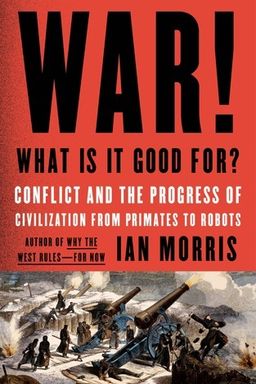
War! What Is It Good For cover

War! What Is It Good For

by Ian Morris

Ian Morris delves into the paradox of war, revealing how conflict, despite its devastation, has historically led to peace, prosperity, and societal organization. By examining the evolution of warfare from primates to robots, Morris challenges conventional views, presenting war as an unexpected catalyst for human progress.

War as the Engine of Civilization

Why does violence decline even though tools of destruction grow deadlier? The book’s central claim is paradoxical: war, over millennia, has been the midwife of peace. By forcing small groups to merge into larger, organized societies, war created Leviathans—powerful states that curbed private violence, built bureaucracies, and fostered trade and law. It’s a thesis that spans from chimpanzee raids in Gombe to the nuclear standoff of the Cold War, arguing that, through grim necessity, humankind’s most destructive impulses built the frameworks for safety and prosperity.

The argument begins with data and deep time. Archaeological evidence from mass graves at Alken Enge or Crow Creek and ethnographic data from tribal societies (Yanomami, Dani, Enga) show that in pre-state worlds, 10–20% of adults died violently. By contrast, in the blood-soaked twentieth century—with its world wars and genocides—about 1–2% of the population perished from violence. This suggests something profound: the rise of states, however coercive, systematically reduced routine killing. The statistical narrative echoes Norbert Elias’s Civilizing Process and Steven Pinker’s The Better Angels of Our Nature, situating Morris’s work in a lineage of evidence-based optimism tempered by moral caution.

The Caging of Humanity

The story starts when domestication fixes people to the land. Hunter-gatherers could once flee bad neighbors, but farmers could not abandon crops and fields. This shift created cages where war rewarded incorporation instead of slaughter. The stationary bandit (Mancur Olson’s metaphor) replaces the raider: rulers discover that protecting subjects maximizes taxation. Sargon’s empire, Rome’s pax and roads, or Ming China’s bureaucracy—all reflect this calculus. Individuals lost autonomy, but entire populations gained predictable peace. Caging and conquest became the twin motors of early state formation.

Geography and the Lucky Latitudes

Geography determined where the first cages appeared. Only a few regions, the “lucky latitudes” between 20° and 35° north, had clusters of domesticable crops and animals. Southwest Asia’s wheat and sheep, East Asia’s millet and pigs, Mesoamerica’s maize—these ecological jackpots launched dense populations that demanded hierarchies. Here, war became productive rather than merely predatory. Morris links this materialist logic to Jared Diamond’s insight in Guns, Germs, and Steel: the east–west axis of Eurasia allowed faster spread of technology, giving the Old World an enduring developmental lead.

War’s Dialectic: Destruction and Integration

Every military revolution—from bronze spears to nuclear warheads—reshaped society. Bronze allowed organized armies and bureaucracy; iron empowered mass infantry; gunpowder demanded fiscal-military states; nuclear science birthed global deterrence. These waves form a cycle: new technology escalates conflict, conflict forces larger administration, and the new Leviathan enforces domestic tranquility. Counterproductive interludes (Rome’s fall, feudal Europe, or post-dynastic China) punctuate the pattern, reminding you that peace is reversible. The logic of Leviathan is long-term; short-term, it is Darwinian brutality.

Moral Ambivalence

Morris refuses to romanticize this process. He concedes that Leviathans like Hitler’s Germany or Stalin’s USSR commit atrocities dwarfing tribal raids. Yet the robust data—across millennia—show average humans today die violent deaths far less often than our ancestors. The paradox, then, is ethical: peace has been built atop mountains of corpses. It recalls Cicero’s grim trade-off—“perpetual peace bought at the price of a few products.” Rulers pursue safety not from altruism but greed and calculation; yet the unintended consequence is a world where random homicide declines and life expectancy soars.

From Leviathan to Globocop

When this logic scales globally, it yields what Morris calls the “globocop” thesis: international stability depends on a hegemon strong enough to deter wars but restrained enough not to exhaust itself. The historical chain—Rome’s empire, Britain’s Pax, America’s Cold War policing—replays the same tension. Technology and geography change the cast, but the function stays constant: power must break chaos to secure peace. In that sense, war never truly ends—it changes shape. From nuclear deterrence to drones to digital conflict, Leviathan persists as both guardian and potential destroyer. The question that closes the book is timeless: can humanity sustain order long enough for intelligence, perhaps posthuman or machine-augmented, to make violence obsolete?


From Beasts to Farmers

Human violence has biological roots but cultural solutions. Morris begins at the evolutionary baseline, contrasting Jane Goodall’s Gombe chimpanzee wars with bonobo cooperation. Among chimps, scarcity and male coalitions breed violent raids; among bonobos, female alliances and abundant food encourage reconciliation. Ecology, not moral superiority, explains the difference. When applied to humans, this yields a key idea: context and institutions shape whether our aggressive potential erupts or is tamed.

As early Homo species learned to cook and form pair bonds (following Wrangham’s argument that fire changed diets and gender roles), cooperation became essential. Cultural learning amplified it. Yet the same intelligence that built villages also birthed warfare. Lawrence Keeley’s War Before Civilization and Napoleon Chagnon’s Yanomami studies reveal that foragers often fought deadly feuds. Violence was not an aberration—it was a survival adaptation where no larger authority could enforce peace.

Caging and State Formation

The invention of agriculture multiplied humanity’s numbers and fixed us to territory. Carneiro called this the circumscription theory: as arable land filled, people could no longer walk away from aggression. War became the tool for political unification. The result was a social cage that simultaneously constrained freedom and enabled prosperity. Archaeological records from Mesopotamia—Uruk’s walls, Sargon’s standing army—show the transformation of raiding into taxation. Citizens now owed allegiance, labor, and obedience to a state Leviathan able to suppress everyday killing.

The Stationary Bandit Logic

Mancur Olson’s idea of the stationary bandit captures the logic perfectly: roving plunderers destroy production, whereas stationary rulers tax it sustainably. By staying put and protecting subjects, leaders trade short-term loot for long-term gain. The Assyrians, Romans, Chinese dynasties, and medieval lords all followed variations of this pattern. Violence didn’t vanish—it professionalized. Over centuries, the bandit turned into the bureaucrat, and the battlefield into a managed system of coercion where the cost of rebellion outweighed the prize. You thus inherit a world where farming, not foraging, made war systematically productive—and paradoxically, peaceable.


War’s Technological Revolutions

Morris calls history’s key turning points military revolutions—moments when new tools of killing rewired politics and economy. Early on, defensive and offensive innovations ran in an evolutionary race. Jericho’s walls led to siegecraft; bronze swords to disciplined armies; iron weapons to mass levies. Each advance demanded organization—and rewarded states that mastered logistics and taxation. Offense and administration matured together.

From Chariots to Cavalry

By 1600 B.C., chariots and composite bows revolutionized warfare across the Old World, as seen at Kadesh. Only wealthy states could afford teams and bronze fittings, spurring bureaucratic centralization. Later, iron tools democratized weaponry: ordinary farmers became soldiers (as in Assyria or Greece). When steppe herders mastered horseback riding, the Eurasian frontier turned into a perpetual contest of mobility versus mass. Civilizations alternated between defending walls and sweeping outward, birthing vast empires and subsequent collapses.

Gunpowder and the Global Leap

Gunpowder’s migration from China to Europe altered the global balance. European fortification density and inter‑state rivalry rewarded experimentation. By 1500, cannon and handheld guns were standard; by 1600, disciplined volley fire (Count William Louis, Gustavus Adolphus) and naval line‑ahead tactics turned war into an industrial process. Financing such forces demanded credit systems—the Dutch public debt markets and England’s 1694 Bank of England—marking the fiscal‑military state’s birth. War and capitalism became twins.

From Steam to Steel to Silicon

The gunpowder revolution bled into maritime and industrial revolutions: caravels made the Atlantic a highway for empire; galleons and muskets conquered continents; then ironclads, railways, and telegraphs transformed logistics. By the twentieth century mechanization and explosive chemistry yielded global wars of steel and oil. The twenty‑first pushes further—drones, robotics, cyberwarfare—yet the pattern endures: each innovation demands new institutions. Drill created bureaucracy; nuclear deterrence created international diplomacy; AI may force ethical governance. War’s technology, in short, builds civilization as collateral.


Empires, Collapse, and Rebirth

State building by war reaches natural limits. After Rome and Han China, global regions entered what Morris calls an age of counterproductive wars: conflicts that destroyed states faster than they built them. Steppe migrations, pandemics, and fiscal collapse from A.D. 200 onward unraveled classical empires. The result was feudal fragmentation—private violence replacing state monopoly. Adam Smith’s term “feudal anarchy” captures this regression. Yet new Leviathans eventually arose: Tang, Abbasid, and later European monarchies reconstituted order, repeating humanity’s cyclical recovery.

Guns, Trade, and Empire

The fifteenth to nineteenth centuries formed another upswing as gunpowder empires (Ottoman, Mughal, Russian, and European) tamed the steppes and oceans. Artillery and ships gave agrarian states dominance over nomads and sea lanes. Europeans, leveraging both, forged global empires under the banner of commerce and Christianity. The “invisible hand” of markets, as Adam Smith knew, required an invisible fist—navies, forts, and occasionally genocide. The Atlantic triangular trade united global economies but chained twelve million Africans to slavery. Productive war now operated at a planetary scale.

Costs of Empire

Empires pacified large territories yet inflicted immense suffering. In the Americas, disease exterminated up to half of indigenous populations. In Asia, company rule enriched shareholders while triggering famines and rebellions. Burke’s denunciation of the East India Company illustrates early moral backlash against imperial excess. Still, infrastructure, schools, and global trade networks grew under imperial order—the pattern of violent creation followed by enforced peace repeated. By 1900, Leviathan had become global, but the seeds of anti‑imperial revolt and industrialized destruction were already sown.


Industrial Warfare and Its Discontents

Industrialization multiplied both productivity and lethality. From 1789 to 1945, war became total: nations mobilized entire populations and economies. Napoleon’s levée en masse previewed the pattern; World War I’s trenches and World War II’s blitzkriegs perfected it. Norman Angell’s pre‑1914 faith that economic interdependence made war irrational collapsed at Verdun’s slaughter. Modern technology didn’t civilize politics—it intensified it.

World Wars as Systemic Shock

1914 arose not from inevitability but miscalculation: rigid alliances, mobilization timetables, and fear turned crisis into catastrophe. Industrial mass killing—artillery, gas, tanks—confounded generals and societies. By 1918, states collapsed (Russia, Austria‑Hungary, Ottoman). The sequel, 1939‑45, fused ideology and machinery. Blitzkrieg’s speed, strategic bombing’s terror, and the Holocaust’s bureaucracy revealed industry’s double edge: efficient death and logistics indistinguishable in method.

The Nuclear Ceiling

Hiroshima ended that logic. With nuclear weapons, total war became suicidal. The Cold War’s “mutual assured destruction” (MAD) paradox replicated Leviathan at a planetary level: two superpowers deterred apocalypse by being ready to cause it. Proxies in Korea, Vietnam, and Afghanistan displaced direct conflict. Occasionally humanity teetered on annihilation—Stanislav Petrov’s 1983 restraint mattered as much as any treaty. Violence declined not because humans improved morally, but because technology made large‑scale war self‑terminating. The Leviathan had gone nuclear.


The Digital and Robotic Battlefield

The computer has now entered war’s genetic code. Remotely piloted drones, precision missiles, and algorithmic decision‑loops compress time and distance, redefining both battlefield and ethics. A Reaper drone costs a tenth of an F‑35, yet loiters for weeks, streaming live data across continents. By 2011 drones had logged over a million combat hours, symbolizing a new phase where soldiers sit oceans away from targets. The same networks that connect consumers connect combatants.

Automation and Decision Speed

The OODA loop—observe, orient, decide, act—shrinks as machines take over decisions. The X‑47B’s autonomous carrier landing (2013) proved code could replace pilots in complex environments. Militaries experiment with “loyal wingman” systems: one human командs several unmanned aircraft. The problem shifts from capability to trust. As one researcher warns, we barely understand our algorithms—should we let them kill?

Defensive Innovations and Second Nuclear Age

Meanwhile, antimissile defenses (Iron Dome, U.S. Midcourse Defense) intercept rockets in flight, encouraging belief that limited war can be controlled. Yet this illusion may erode deterrence: if leaders think strikes are survivable, they may gamble. The Second Nuclear Age features smaller arsenals spread among more states, raising miscalculation risks (India‑Pakistan tensions, North Korea). As defenses improve, uncertainty increases—a dangerous arithmetic.

Toward Machine‑Governed Conflict

The robotics revolution, combined with cyberwar, shifts power toward states that master AI, sensors, and data. NGOs demand bans on lethal autonomous systems, but strategic competition—echoing every prior arms race—makes restraint fragile. Morris’s warning mirrors earlier cycles: once again technical progress forces moral lag. You live in an interim era when violence is increasingly remote, algorithmic, and unequal. The risk is not extinction but accident—a misinterpreted line of code replacing Archduke Princip’s bullet as the trigger of the next crisis.


Pax Americana and Global Fractures

After 1945, American power played the role once held by empires: the global policeman, or globocop. Its navy patrolled sea lanes, its economy fueled reconstruction, and its nuclear umbrella restrained rivals. Yet since 1991 the order has strained under economic and strategic paradoxes. The “Chimerica” partnership—America consuming, China producing—embodied interdependence and imbalance. By the 2000s, China’s explosive growth shifted manufacturing east while financing U.S. debt, subsidizing the very globocop meant to contain it.

The Western Pacific Tension

China’s rise remilitarized its near seas through asymmetric tools: missiles, submarines, and cyberwarfare aimed at pushing U.S. forces outward. The RAND scenario that by 2013 China could dominate skies over Taiwan dramatized this shift. Allies like Japan and Australia face the Mars–Venus dilemma—security tied to Washington, prosperity to Beijing. Canberra’s defense papers swung between enthusiasm and retrenchment, signaling the indecision of smaller powers trapped between Leviathans.

New Risks: Climate and Demography

Beyond geopolitics lie slower crises. The National Intelligence Council warns of “tectonic shifts”: aging populations, water shortages, urban booms, and resource pressures concentrated in an arc from North Africa to Central Asia. Environmental stress acts like an invisible accelerant on political collapse. Drought, famine, and migration may undermine fragile states faster than any warship. Planning must integrate these layers—climate change is now a security variable, not a separate sphere.

Holding the Line

The strategic prescription is pragmatic: the United States must sustain credible deterrence and fiscal health long enough for new technologies to reshape incentives toward peace. A premature retreat by the globocop invites fragmented regional arms races; overextension risks imperial burnout. The book closes on this knife edge: if Leviathan endures, algorithms and perhaps shared intelligence could make war obsolete; if it falters too soon, humanity may replay its oldest pattern—order through destruction.

Dig Deeper

Get personalized prompts to apply these lessons to your life and deepen your understanding.

Go Deeper

Get the Full Experience

Download Insight Books for AI-powered reflections, quizzes, and more.