
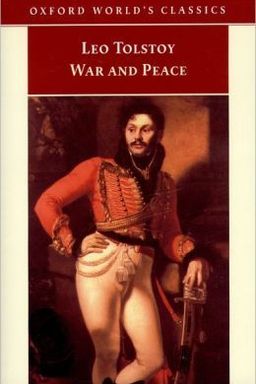
War and Peace cover

War and Peace

by Leo Tolstoy

War and Peace by Leo Tolstoy is a monumental novel that intricately weaves the lives of aristocratic families amidst the backdrop of the Napoleonic Wars. It delves deep into themes of love, war, and the enduring human spirit, offering timeless lessons in empathy, resilience, and the transformative power of forgiveness.

Power, Society, and the Human Theatre

If you enter Tolstoy’s War and Peace, you walk into a vast human theatre where private gestures—salons, marriages, duels, feasts—mirror public events—wars, reforms, retreats. Tolstoy’s core argument is that society and history are built not by 'great men' but by ordinary collisions of vanity, duty, love, and fear. The novel’s hundreds of characters are not decoration: together they show how moral choice, social ritual, and historical necessity weave the pattern of life.

Society as stage and mirror

You begin in Anna Pávlovna’s salon in 1805, a miniature world where gossip acts as diplomacy. Conversations about Napoleon, marriage, or religion are political theatre—tests of loyalty and moral posture. Anna orchestrates talk like a conductor, policing tone and content to maintain power. Prince Vasíli trades favors, Elèn wields beauty as currency, and Pierre Bezukhov’s naive honesty exposes how sincerity is punished when society treats truth as disturbance. (This opening scene already prefigures Tolstoy’s thesis: history’s shifts begin in drawing rooms before turning into armies.)

Private ideals and their collisions

Pierre and Prince Andréy illustrate the struggle for authentic life inside ritualized worlds. Pierre wants moral clarity but is easily bent by flattery and appetite—from Kurágin’s debauches to Masonic vows. Andréy moves from disgust for social futility to seeking meaning in war and later to a deeper compassion as he faces death. Natasha Rostóva’s luminous spontaneity, her fall into seduction, and her recovery through service display Tolstoy’s opposite tendency: emotional truth can purify when intellect fails.

War as revelation, not spectacle

Tolstoy strips military grandeur bare. At Braunau, men polish boots without soles. At Austerlitz and Borodinó, fog and miscommunication govern outcomes more than plans or genius. Kutúzov’s weary patience contrasts with Napoleon’s theatrical will; Bagratión’s calm presence steadies men better than Weyrother’s perfect map. You learn that moral clarity on the field matters more than strategic elegance. Captain Túshin’s four guns, Timókhin’s ambush, and the soldiers cheering under fire show heroism as work performed despite chaos, not glory claimed afterward.

History as mass motion

Later the book expands its lens. Napoleon’s invasion of Russia, the burning of Moscow, and the retreat expose Tolstoy’s philosophy: history is continuous, collective movement. No single man—Napoleon, Kutúzov, Rostopchin—controls outcomes. Cities burn not from villainy but from structures: wooden houses, abandonment, foreign soldiers. Armies melt from attrition, weather, and lost supplies, not from a single decisive act. Tolstoy converts physics’ idea of infinitesimal motion into a historical principle—events flow from countless micro-wills integrated across time.

Inner transformation and moral law

While history unfolds outside, inner conversions occur inside captivity and grief. Pierre’s crisis after the execution turns into enlightenment through Platón Karatáev—a peasant who lives charity and patience instead of preaching them. Andréy finds compassion in a medical tent beside his enemy Anatole Kurágin. Natasha rediscovers purpose by caring for her mother. These awakenings reveal Tolstoy’s belief that goodness survives not in systems but in ordinary acts. The Masonic lodges, reform committees, and rational projects fail because form without humility breeds pride.

The larger method: moral realism

Tolstoy’s realism rests on integration: political theory meets domestic sincerity, strategy meets appetite, and metaphysics meets daily bread. A duel exposes honor as vanity; a dance reveals social truth; a peasant sharing a potato demonstrates divine order. The cumulative argument is startlingly modern: history must be studied through laws of social interdependence, not heroic narratives. You learn to look at how people cooperate, err, and forgive—not merely at those who command.

In short

Tolstoy replaces the 'great man' myth with a moral physics of interconnected lives. Power arises in salons and kitchens as much as in palaces; heroism grows in fatigue and compassion. You finish the book understanding that human greatness lies not in command or fame but in the quiet harmony between sincerity, labor, and love—a realism that binds individual conscience to the unfolding law of history.

(For comparison: where philosophers like Hegel saw history as the progress of Spirit, Tolstoy sees it as the arithmetic of lived acts. His truth is empirical and moral, not abstract—history moves because each person chooses or fails to choose rightly in moments of ordinary life.)


Salons and Social Mathematics

Tolstoy begins with the social laboratory: Anna Pávlovna’s salon. Here you see how elite manners manufacture opinion and even politics. Anna’s greeting about Genoa and Lucca sets the formula—political statements masquerading as gossip. Prince Vasíli trades patronage; Elèn converts beauty into influence; Mortemart screens moral judgment as fashion commentary. You learn that persuasion in this world multiplies through ritual and seating charts more than reason.

Soft power and symbolism

Anna’s ability to veto a statement (“If you don’t say this means war, you are no longer my friend”) functions like diplomacy itself—soft power wrapped in affectation. Marriages are treaties; seating is rank ordering. Ideology becomes identity performance: hating or admiring Napoleon marks moral status. Tolstoy teaches you that civilizations are sustained by symbolic acts long before armies move.

Pierre’s dissonance with etiquette

Pierre disrupts the pattern by speaking plainly. His defense of Napoleon’s equality reforms sparks scandal because truth that lacks ornament is indecent in fashionable society. This tension recurs—later at other salons when his sincerity meets social pressure. Tolstoy transforms Pierre’s awkwardness into a moral instrument: the naive exposes the corrupt logic of custom.

Marriage as social calculus

Prince Vasíli’s pursuit of matches—Anatole with Princess Márya, Pierre with Elèn—illustrates society’s arithmetic. Love operates as a transaction to stabilize wealth and reputation. Anna Pávlovna’s orchestration of events proves that feeling itself is a managed variable. This makes salons the embryonic field of Tolstoy’s later critique of history: the same quantitative logic governing marriage and favor also lies behind mass politics.

Insight for readers

Tolstoy’s study of superficial sociability is not satire alone. He asks you to see in these polite scenes the early equations of power—how consensus replaces truth and how private talk manufactures public history.

When you analyze modern institutions through Tolstoy’s lens, the lesson holds: every bureaucracy or political network recreates Anna Pávlovna’s salon—conversation arranged, dissent suppressed, and reputations traded as currency.


Individuals in Search of Meaning

Behind Tolstoy’s grand crowds stand personal struggles for moral direction. Pierre, Andréy, and Natasha represent distinct paths to meaning—intellectual, practical, and emotional. Each fails by mistaking form for substance, and each grows when suffering reorients them toward truth.

Pierre: Ideals versus appetite

Pierre enters life clumsy and kind yet swept by social momentum. The duel with Dólokhov, guilt over his marriage, and his Masonic initiation chart his cycle from moral theory to disillusionment. Through Freemasonry he learns ritual discipline but finds hypocrisy among Brothers—Osip Alexéevich alone reminds him purification must precede reform. His later philanthropic reforms fail when stewards manipulate him, proving generosity without system breeds harm. Only captivity and Karatáev’s folk wisdom teach him inner freedom detached from self-importance.

Andréy: Duty into compassion

Prince Andréy begins proud of intellect and action. War and domestic failure push him toward despair; he tells Pierre 'Never marry' because he sees freedom only in duty. His encounter with a wounded enemy turns ideology into empathy. When he dies after Borodinó, forgiving Anatole, you witness Tolstoy’s formula: suffering transforms pride into universal love. Andréy’s moral clarity—'Compassion, love for brothers'—is born from pain, not doctrine.

Natasha: Feeling as salvation

Natasha personifies emotional truth. Her youth at the Rostóvs’—the dance, impulsive kiss, household warmth—provides ethical contrast to Petersburg’s artificiality. Her later seduction by Anatole and suicide attempt expose vulnerability to external glamour. Yet through repentance and caregiving she renews herself, aligning with Tolstoy’s recurring principle: love expressed in daily duty heals moral failure.

Common trajectory

For all three, meaning arises when grand projects collapse. Philosophy gives way to pity, pride yields to tenderness, and passion becomes service. Tolstoy’s psychology of grace is secular but sacred in effect.

Viewed together, their arcs teach you that ethical insight comes through concrete living—the exchange of bread, forgiveness, or patience—not through intellectual mastery or heroic resolve.


War as Chaos and Revelation

Tolstoy’s war chapters dismantle the romantic myth of battle. From Braunau to Borodinó, he portrays military life as improvisation, confusion, and endurance. Leaders talk about strategy; soldiers face mud, hunger, and fear. You begin to sense war as moral testing ground—where systems fail and humanity either shrinks or expands.

Command and presence

Two styles drive the field: Weyrother’s theoretical precision and Bagratión’s embodied calm. Plans on paper fracture under fog and delay. Kutúzov’s apparent idleness conceals insight—he reads fatigue and mood better than maps. Tolstoy’s juxtaposition of councils and redoubts teaches that leadership is psychological; presence steadies more than calculation.

The soldier’s sensory truth

You march with Rostóv through fog, panic, and a dying horse. You crouch with Túshin commanding four guns out of sheer routine and faith. You feel chaos at the Augesd dam where men drown beneath wagons. Tolstoy’s detail (“left… left… left,” smoke covering whole valleys) demonstrates that war’s truth belongs to sight and sound, not proclamations. Courage is local: Captain Túshin, Timókhin’s ambush, and Denísov’s cry show that ordinary gestures save armies.

History’s correction

Austerlitz’s defeat breeds civic myths—Bagratión the hero, Kutúzov blamed. Tolstoy watches Moscow rewrite failure into patriotic song. This diagnosis explains why collective memory distorts; society needs moral coherence more than factual truth. Warfare thus creates legend and erases the small acts that truly hold armies together.

Your takeaway

War exposes human systems to disorder; survival depends on adaptability, compassion, and steady attention. Glory is noise; perseverance is substance.

(Note: In contrast to Clausewitz, who saw war as organized rational policy, Tolstoy insists it is chaotic and humane—a crucible of character more than of strategy.)


History, Power, and Causation

Tolstoy’s later volumes evolve into philosophical inquiry: how does history move? His answer replaces heroic causation with collective determinism. He borrows mathematics—the infinitesimal—to argue that events depend on continuous integration of countless small wills.

The Achilles analogy

Just as calculus resolves the paradox of motion by summing infinitesimals, history must sum human motives, actions, and accidents. Instead of 'Napoleon caused Borodinó,' you study peasants’ rumors, soldiers’ hunger, clerks’ delays, generals’ vanity—the micro-elements that combined into large outcomes. History becomes an organic field, not a plot written by genius.

Power as relationship

You learn that power resides not in individuals but in the chain connecting commander and followers. Orders work only when morale, logistics, and context align. Tolstoy visualizes a cone: the apex issues commands that only matter through layers below. This relational model redefines leadership from divine capacity to social cooperation.

Freedom versus necessity

Tolstoy distinguishes inner freedom (moral conscience) from historical necessity (conditions constraining action). People feel free yet act under endless dependencies—customs, seasons, other wills. Hence history must seek laws—the regularities governing mass action—rather than fictional decisive causes. It’s a methodological and moral correction: causation is distributed, accountability remains.

Resulting worldview

You end understanding that greatness lies in alignment with collective necessity. Kutúzov succeeds because he senses mass will; Napoleon fails because he mistakes commands for creation. Tolstoy’s history is moral physics—laws of empathy, patience, and accumulation guiding nations.

(Parenthetical comparison: where Hegel’s dialectic moves by synthesis, Tolstoy’s motion aggregates by empathy and chance—a naturalistic model of human flow.)


Compassion, Suffering, and Renewal

The final movement of Tolstoy’s book fuses private transformation with national recovery. When devastation peaks—Moscow burns, armies melt, loved ones die—characters experience conversion through compassion. Out of torment arises a renewed domestic world.

Pierre’s liberation

In captivity Pierre witnesses executions where murder is mechanized. His realization—evil can be systemic, not personal—destroys old rationalism. Karatáev’s gentle presence rebuilds moral sensibility. Sharing a potato, singing, or stitching becomes theology in practice. Pierre’s new peace after release translates into social usefulness: repaying debts, marrying Natasha, and acting without self-display.

Natasha’s healing and domestic rebirth

Natasha’s grief for Andréy finds consolation through service to the countess and friendship with Princess Márya. These acts of care restore vitality. In the epilogue she becomes wife and mother devoted not to social ambition but to the rhythm of family—Tolstoy’s emblem of moral stability. Emotionally, her recovery proves compassion’s cyclical power: pain transformed into nurturing.

Collective serenity

Kutúzov embodies the same moral equilibrium at scale. His refusal to chase glory, his tears for soldiers, and his patience under court pressure echo the domestic virtues multiplied to national level. The war ends not with triumph but with endurance, empathy, and quiet resolve—a peace founded on spiritual maturity rather than victory.

Final lesson

Tolstoy closes where he began: power is moral, history collective, and happiness domestic. Survival depends on compassion exercised through ordinary care—the potato, the dance, the patient ear amid chaos.

You learn that meaning endures not in monuments or plans but in living continuity—the daily mercy that converts suffering into renewal.

Dig Deeper

Get personalized prompts to apply these lessons to your life and deepen your understanding.

Go Deeper

Get the Full Experience

Download Insight Books for AI-powered reflections, quizzes, and more.