
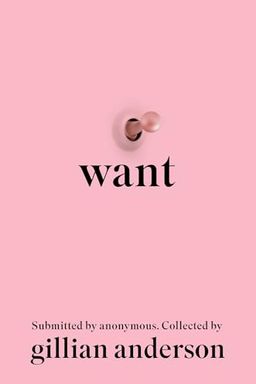
Want cover

Want

by Gillian Anderson

A collection of sexual fantasies and confessions submitted anonymously by women from around the world.

An Atlas of Female Fantasy

What happens when you invite women across the world to say the unsayable? In Want, Gillian Anderson curates an anonymous, global archive of sexual fantasies—about 800,000 words of letters—then steps back to let you hear the voices without moralising or medicalising them. She frames the project as cultural continuity with Nancy Friday’s My Secret Garden (1973) while situating it firmly in the present, amid Sex Education, Fifty Shades of Grey, Euphoria, and Normal People. The bet is simple: fantasy is a private technology of agency, survival, and play; when you collect enough of it, you see the patterns in what people long for and why.

Anderson is explicit about her role. She is not your analyst; she is your curator. She asked for demographics (nationality, sexual identity, income range) but intentionally did not include a gender identity question, then selected voices across an immense spectrum: transgender women, non-binary contributors, asexuals, widows, teenagers, mothers, disabled writers, and women into their seventies from Libya to Lithuania. The letters feel like field notes from your interior life—vivid snapshots rather than data points in a lab.

Curatorial stance

“What I can do, though, dear reader, is present them to you, so that you may savour these extraordinary letters without a filter.”

How the collection works

Anonymity is the collection’s engine. Many writers confess desires they have never told a partner, friend, or therapist. You feel the relief in the tone—some entries tremble with shame, others sing with audacity. Anderson herself enters as participant as well as editor, submitting a letter to test whether her voice belongs among the rest (it does). This dual posture—host and co-witness—keeps the collection from becoming voyeuristic; it reads instead like a voluntary, communal unmasking.

The core argument

The book argues that fantasy is a safe, self-authored stage where you can explore power, tenderness, identity, and taboo without real-world risk. In imagination, you hold the pen: you cast the actors, script the limits, and edit the scene. The letters repeatedly distinguish imagined surrender from real harm; you choose to be overwhelmed, and in that choice lies control. Across cultures, you also see convergences: the desire to be desired, the thrill of transgression, the pull of care and safety, and the hunger for novelty.

What you’ll encounter

First, you meet power-play in many keys—submission as respite from decision fatigue, dominance as rehearsal for authority you don’t get to hold at work, and ritualised scenes where consent is explicit and aftercare is an aphrodisiac of its own. Then you pass through the territories of taboo and shame, where culture, law, and religion shape what feels “forbidden” (a Venezuelan woman hides her love for women; someone raised evangelical imagines intimacy with a pastor’s wife). You also find kink’s ordinary spread—from spanking to tentacles to adult breastfeeding—and see how the internet mainstreams vocabulary and normalises niche desires.

Beyond bodies: groups, gaze, and care

You’ll notice fantasies of abundance—threesomes and crowds—that repair feelings of scarcity or invisibility, set against exhibitionist and voyeurist set pieces (a cinema, a glass-walled room, a clinical teaching theatre). Equally present is quiet: the sections on tenderness show how many people simply want to be kissed, held, or safely adored. Aftercare becomes a structural motif—a way to metabolise roughness, honour limits, and return to baseline with warmth.

Fantasy as identity lab

The collection treats fantasy as rehearsal and self-education. Writers question orientation, try on gender through strap-on play, body-swap to experiment with mobility and agency, or lucid-dream their way into novel configurations (a Swiss woman meets Pedro Pascal nightly in her dreams; a Mestiza Ecuadorean writer imagines life with a penis and the privileges attached). Juxtaposed with this is the “orgasm gap,” a reminder that many women know their bodies best alone and use fantasy to blueprint more satisfying shared sex.

Ethics and editorial lines

Anderson keeps a steady ethical frame. She excludes letters that would be criminal or gratuitously triggering, while still acknowledging fantasies that blur consent or involve captivity. The repeated reminder: fantasy isn’t a manifesto for action; it’s a sandbox for feeling. By printing these letters, she reduces the shame that isolates people; by curating rather than diagnosing, she invites you to treat your own imagination as information rather than indictment.

Taken together, Want is less a peepshow than a cartography. It maps where your mind goes when it’s honest and unafraid, and it offers a language—spanning domination and devotion, robots and rituals, crowds and mirrors—for asking, in your life, for what you actually want. (Note: Like Friday’s work, this book democratizes desire; unlike much clinical sexology, it privileges first-person texture over theory.)


Authorship, Safety, and Agency

The letters converge on one truth: fantasy is where you call the shots. Anderson emphasises fantasy as a private act of memory and imagination—an interior studio where you rehearse, revise, and reclaim pleasure. Because you control the script, even submissive scenes become expressions of agency. The Argentine writer who imagines teasing, edging, and finally being “filled” chooses every beat and trusts an invented partner to pause and resume on her cue.

Control inside surrender

In many letters, surrender feels like relief: decision-making stops; the body speaks. Yet the consent frame never dissolves—you, the fantasiser, can rewind or rewrite mid-scene. This paradox—choosing to be dominated—recurs in explicit ways (safe words, aftercare) and in subtler forms (a lover who “just knows” when to stop). It’s cinema you direct from the audience, heart pounding while your hand stays on the dimmer switch.

Rehearsal for life

Fantasy is also practice. A Mestiza Ecuadorean writer imagines being a man to understand how another body and social role might feel. A Swiss woman lucid-dreams Pedro Pascal nightly—repetition turns dream choreography into muscle memory of what she enjoys. Virgin writers script first times where consent is explicit and learning is gentle. When reality is constrained—by marriage, stigma, disability—fantasy becomes your simulator. (Note: This mirrors therapeutic “imaginal rehearsal” used in sex education and trauma recovery.)

Writing as liberation

Several contributors say putting desire into words is itself arousing or healing. The act of naming wants reduces shame and increases clarity. You learn your own language for pace, touch, roles, and limits. That clarity can travel outward—into conversations with partners, choices about toys, and boundaries you’ll actually enforce.

Safety without silence

A consistent ethical line runs through the collection: imagination is not instruction. Some letters explore blurred-consent scenarios or captivity; the editor includes them with caution, reiterating that in fantasy you retain authorship. When fantasies feel dangerous, that’s often because they metabolise cultural prohibitions, not because you truly want harm. The book’s tone encourages you to listen to the feeling beneath the image—longing to be chosen, to be unburdened, to be seen—then decide what, if anything, to translate into practice.

Practical use

If you’re curious where to start, do what these writers did: write a letter to yourself. Script consent explicitly. Try different paces. Swap perspectives—giver and receiver—and see how your preferences shift. When you notice a theme (slowness, praise, restraint), turn it into clear language you could share. Fantasy, in this book, isn’t an escape from truth; it’s a way to tell the truth safely enough that you can act on it, if you wish, with care.

Key principle

In fantasy, you hold both the leash and the release; authorship is the bedrock of safety.


Power Paradoxes

Power—taking it, yielding it, playing with it—dominates the middle of the book. Many writers who shoulder responsibilities by day crave surrender at night; others want to try on authority they can’t easily wield in public. Anderson notes how performing Stella Gibson (The Fall) expanded her own sexual confidence; several letters describe similar linkages between roles and arousal. The throughline is not pathology but permission: fantasy legitimises both dominance and submission as experiments in relief, identity, and trust.

Provocative refrain

“Degradation, humiliation, danger. I want all of it.” (CH. 106/115)

Day-to-night reversals

Letters spotlight domestic inversions: a high-powered professional (CH. 114) wants to be tied up and commanded; a meticulous planner longs to be used without deciding anything. The release is cognitive and erotic—when you surrender the burden of choosing, arousal rises to fill the quiet. Conversely, shy or marginalised contributors script scenes where they direct lovers confidently, orchestrating ritualised pleasure to embody competence they’re denied elsewhere.

Institutions and scripts

Authority figures—bosses (CH. 109), teachers (CH. 171), clergy—carry built-in asymmetries that spark erotic charge. Some letters stage careful negotiations within those frames: a supervisor moves from spanking to anal play, checking consent at every step (CH. 110: “Just tell me to stop and I’ll do it”). Rituals—doorbell scenes (CH. 127), kitchen-island choreography (CH. 154)—combine predictability and edge, teaching your nervous system that excitement and safety can co-exist.

Consent and aftercare

The book treats aftercare like punctuation—good scenes end with warmth, water, food, cuddling. It’s not a sentimental add-on; it’s infrastructure that lets you return to baseline regulated and eager to play again. Even “rough and ready” letters circle back to tenderness, a rhythm that becomes a model: stretch, then soothe.

How to apply it

If you recognise these dynamics in yourself, ask the diagnostic questions the letters suggest: Am I escaping decision fatigue or exploring an unlived authority? What boundaries anchor me—safe words, time limits, roles? What aftercare restores me? Then try low-stakes tests: guided role-play, negotiated restraints, or simply narrating what surrender or control would look like for you. (Note: This reframes “kinky” impulses as ordinary nervous-system needs, aligning with modern consent-based BDSM literature.)


Taboo, Shame, and Context

Shame still shadows desire, half a century after My Secret Garden. Anderson opens by naming women’s lingering shame; many letters echo it. What counts as taboo shifts with culture: a Venezuelan writer hides her attraction to women; someone raised evangelical fantasises about a pastor’s wife; another sets a scene in a church to amplify the thrill. The point isn’t scandal—it’s context. Places and rules sharpen edges; transgression intensifies sensation.

Culture writes the margins

Geography, religion, and law tune desire’s frequency. Under conservative norms, even a tender same-sex kiss becomes illicit and therefore electric. In liberal contexts, taboos drift elsewhere—toward power-play, age gaps, or public watching. The letters demonstrate that taboo isn’t a fixed category; it’s the negative space your culture draws around sex. Fantasy wanders there because the stakes feel high and the privacy absolute.

Editorial guardrails

Anderson excludes criminal or gratuitously triggering material but still includes fantasies that blur consent or stage captivity. She keeps reminding you: imagination is not a legal blueprint. In your head you remain sovereign; you can end the scene with a thought. That distinction matters ethically and therapeutically—it allows curiosity without confession to crime or harm.

The shame paradox

Paradoxically, the very act of disclosure in these pages dissolves shame for many writers. What felt monstrous turns ordinary when you see it echoed by strangers on other continents. Anonymity plus publication equals recognition without exposure. Readers report relief: they are not alone; their minds are not broken.

Working with taboo

If a fantasy embarrasses you, follow the book’s implicit method. Ask what the image organises—power, attention, safety, freedom from rules—and whether a non-taboo route could deliver the same feeling in life. You might discover you want worship more than sin, or privacy more than scandal. Treat fantasy as a compass, not a commandment.

Core reminder

Taboo changes with context; the needs beneath it—being wanted, being safe, being free—are remarkably constant.


Kink, Fetish, and Archetypes

Want treats kink not as fringe but as a common dialect of desire. Anderson defines it broadly: consensual practices that deviate from a culture’s default script. In these letters you’ll find everyday BDSM and also niche fascinations—tentacles, adult breastfeeding/hucow play, wetting/diaper scenes, armpit and hair fetishes, bloated-belly interests, even arousal keyed to door handles. The editor’s point is normalising: kink is a toolset, not a diagnosis.

The internet’s role

Modern porn and forums expand your vocabulary and community. Fifty Shades mainstreamed certain BDSM terms; online spaces let people name very specific interests and find peers anonymously. More words mean clearer consent and less shame. When someone writes “edging” or “aftercare,” you know the choreography. When they say “nurturing milk play,” you grasp both content and tone.

Types, objects, and shorthand

The book also dwells on archetypes and props. Authority figures—teachers (CH. 171), bosses (CH. 109), medical professionals (CH. 120’s dental chair), soldiers (CH. 181)—operate as narrative shortcuts to asymmetry, competence, or taboo. Toys matter too: CH. 104 opens with oils, beads, and a rabbit vibrator, demonstrating how objects anchor scenes. In CH. 180, a near-future fantasy imagines male sex robots stored in a walk-in closet, “programmed” with playlists to deliver precise, safe, and tireless attention, highlighting how tech can turn control itself into an aphrodisiac.

Interpreting your “type”

When a uniform, age, or device keeps showing up, ask what it symbolises. A uniform might mean safety and competence; an older lover, patience and praise; a robot, reliability and zero judgment. The letters teach you to decode the feeling under the symbol—then decide whether you want the symbol, the feeling, or both in real life.

Practice notes

Start small, negotiate clearly, and prioritise aftercare. If you’re curious about a niche, learn its etiquette and communities first. Try role-play with verbal scripts, introduce a single object before a whole scene, and reflect afterward on what worked. (Note: This aligns with sex-positive frameworks that centre consent literacy over shock value.)

Normalising move

Kink is another language of desire; fluency—not spectacle—is what makes it satisfying.


Multiples, Spectacle, and the Gaze

A major cluster of letters craves “more”: more hands, eyes, mouths; more choreography and spectacle. CH. 140 notes that group fantasies are among the most common in the archive. They amplify sensation and abundance while repairing scarcity—of attention, novelty, admiration. At the same time, many fantasise about the gaze itself: being watched, watching others, or staging sex as performance with rules and applause.

Group permutations

Letters describe day-long orchestrations where the writer is focal point (CH. 151), vacation threesomes to spike a long-term relationship (CH. 152), lesbian ensembles and pirate-crew adventures (CH. 112), and masked parties with an “endless line” motif (CH. 141). Underneath the bodies is an emotion: to be shared without jealousy, to be adored publicly, to belong to a community of touch. CH. 142 even names ethical non-monogamy as a fantasy of transparent affection and negotiated freedom.

The watchers and stages

Exhibitionist letters set scenes in cinemas (CH. 163), on live stages (CH. 165), or behind glass with an applauding audience (CH. 168). Others eroticise clinical observation: a woman climaxes while medical students take notes (CH. 159), turning being-seen into validation and education at once. Private life gets theatrical too—doorbell deliveries (CH. 164), foot-fetish displays (CH. 121). The gaze here is currency; being looked at means being valued.

Why abundance excites

Multiple partners multiply feedback. Every look or touch mirrors desire back to you, compounding arousal. Spectacle raises stakes and relinquishes secrecy, transforming shame into performance. The crowd can also distribute pressure—no single partner has to carry your entire pleasure; the group becomes an orchestra you conduct or that carries you.

Safety frames

Across these letters, rules make ecstasy possible: no-touch zones, blindfolds, consent checkpoints, aftercare rituals. If you’re drawn to groups or exhibitionism, the book suggests pre-negotiation, defined roles, spectator etiquette, and explicit boundaries about recording and privacy. (Note: This mirrors best practices in swingers’ and play-party communities.)

Essence

Abundance and the gaze aren’t just about sex; they’re about confirmation—seeing yourself seen.


Tenderness and Erotic Safety

Against the noise of roughness, a quiet chorus insists: safety is the sexiest thing. Chapters 183–206 gather letters where care is the fantasy. Some writers want little more than kissing (CH. 184); others imagine magical-university “Sleepy Time Tea” rituals (CH. 191), or being mothered to heal shame (CH. 192). The refrain is consistent: trust, eye contact, slow touch, gentle pace—these are not the warm-up; they are the point.

When care is arousal

Long-term neglect, trauma, or simply stress make tenderness feel transgressive. After months or years of being unseen, being carefully attended to is radical. The letters render care with sensual detail—blankets, baths, food after sex, whispered praise. Even writers who also love rough scenes insist on aftercare as non-negotiable, a bridge that turns intensity into intimacy.

Defining line

“Is it crazy that my wildest sexual fantasy is to feel safe?” (CH. 188)

Emotional lifelines

For many, fantasy is not garnish; it’s survival. A Scottish woman in a sexless marriage due to her husband’s depression credits erotica and fantasy with keeping her from suicidal despair. A recent widow uses TV and imaginative erotica to steady her days. Another survivor scripts trust into every adult encounter to rebuild a shattered link between safety and desire. These are not escapist trifles; they are coping technologies.

Bringing tenderness into life

If you crave care, make it concrete. Ask for prolonged kissing before anything else. Name the aftercare you want—water, food, warmth, words. Use eye contact as a barometer, slowing down if it breaks. Build rituals around arrival and departure from intensity. Tenderness scales—with or without rough play—and makes sex repeatable, not depleting. (Note: Trauma-informed sex education treats these practices as best-in-class, not optional niceties.)


Exploration and the Orgasm Gap

The book links curiosity to inequity: the “orgasm gap” pushes many women to invent better sex in their heads. Anderson notes that women often climax more reliably alone because they know their bodies best (CH. 129). Fantasy then becomes a lab for technique, orientation, and communication—an R&D department for pleasure you can later beta-test in bed.

Orientation as rehearsal

Some letters track bisexual or queer longing within straight marriages. A woman pines for her neighbour Edith (CH. 130); others script strap-on scenes (CH. 135–136) to learn what wielding penetrative power might feel like. Virgin writers (CH. 109, 145) imagine being guided through first times gently and competently, rehearsing communication and boundary-setting. Fantasy provides low-risk reps until the language feels natural.

Embodiment across constraints

Disability-focused letters (CH. 124) use body-swapping, mechanical aids, and perspective shifts to reclaim agency, exploring active and passive roles unconstrained by physical limits. Another contributor imagines a near-future with robots (CH. 180), prioritising programmability and safety over romance to guarantee orgasm. These scenes ask permission to want what works.

Closing the gap

Many fantasies foreground choreography—sequence, tempo, toys, multiple partners—to engineer reliable climax (see CH. 119’s “businessman” ritual where taste, timing, and touch are scripted meticulously). Others fantasise a rotating cast of skilled lovers (CH. 141) to escape partner-rut. The lesson isn’t promiscuity; it’s precision. You can borrow the precision without the cast.

From lab to life

Translate your best scenes into requests: tempo you like, types of touch, praise that lands. Use fantasy to identify missing ingredients—connection, technique, consent—and then ask for one at a time. The book frames this as practical feminism: closing the gap by knowing, naming, and negotiating your pleasure. (Note: This echoes sex-ed research on communication as the lever for mutual orgasm.)


Self-Love and Mirror Play

A surprising genre in Want casts the self as both lover and beloved. CH. 203 imagines stepping through a mirror into an identical self who knows every tender spot; CH. 137 dreams a body with both penis and vagina, making love to oneself in perfect synchrony. These letters don’t read as narcissism; they read as radical self-acceptance: “In the moment of making love to myself… everything I do is perfect.”

Why self-as-partner matters

When shame or clumsy partners have taught you to doubt your body, self-focused fantasy repairs trust. There’s no misreading, no awkwardness—only curiosity and kindness. CH. 204 depicts a meditative sexual experience where the writer realises she is loving herself; that insight reframes solo sex as care, not consolation. For disabled contributors (CH. 124), perspective-shifting into or out of one’s body becomes a way to experience competence and grace.

Techniques to try

Mirror-play can anchor presence—watching your own face soften, noticing breath and posture. Guided imagery helps too: script a scene where your double touches you exactly right, then map those moves onto your hands. Lucid-dream practices (sleep journals, reality checks) can increase the frequency of erotic dreams you can steer. The point isn’t to avoid partners; it’s to arrive to them already fluent in your own body.

From self to shared

Many writers use self-fantasy to generate language they later share—“slower than that,” “stay with this edge,” “tell me I’m magnificent.” Partners benefit when you know what you want. And even if you never disclose the mirror or the double, the confidence it produces often radiates outward, changing how you move and ask.

Bottom line

Self-focused fantasy is not retreat; it’s rehearsal for intimacy grounded in knowledge and care.

Dig Deeper

Get personalized prompts to apply these lessons to your life and deepen your understanding.

Go Deeper

Get the Full Experience

Download Insight Books for AI-powered reflections, quizzes, and more.