
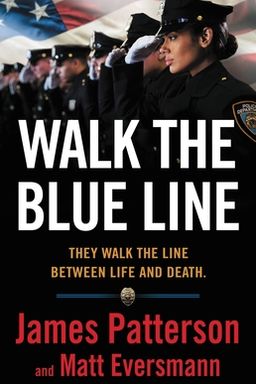
Walk the Blue Line cover

Walk the Blue Line

by James Patterson and Matt Eversmann

Walk the Blue Line is a riveting collection of real-life stories from U.S. law enforcement officers. It explores the intense challenges and profound transformations they experience, offering readers a deep dive into the human side of policing. Through gripping narratives, the book reveals the courage and resilience required to walk the line between life and death.

Walking the Blue Line: The Human Stories Behind the Badge

What does it really mean to protect and serve when every shift could mean the difference between life and death? In Walk the Blue Line, James Patterson and Matt Eversmann peel back the layers of public perception to reveal the deeply human side of American policing. The book argues that police officers are far more than their uniforms — they are mothers, fathers, veterans, teachers, mentors, and at times, broken souls who keep showing up even when the world turns against them. Patterson contends that to truly understand modern law enforcement, we must view it not through headlines or politics, but through the lived experiences of those who wear the badge.

Through dozens of firsthand accounts from officers across the country — from homicide detectives and SWAT team members to patrol deputies and bomb technicians — the book paints an unflinching, emotional portrait of life on the front lines. These are not sanitized stories, but visceral moments that capture adrenaline, fear, trauma, humor, and resilience. Each officer’s voice adds another dimension to a story that’s often told only from the outside in.

Protect. Serve. Defend.

The narrative is divided into three sections — “Protect,” “Serve,” and “Defend” — aligning with the core ideals of policing. In “Protect,” we meet tactical specialists and first responders who face chaotic, violent scenes most people only see in movies. Their stories, like Jake’s SWAT entry gone wrong or Jock Condon’s life-and-death confrontation with an armed intruder, illuminate the razor’s edge decisions required in moments of crisis. Patterson invites you to experience the intensity of those decisions: whether to shoot, hold fire, or talk someone down when seconds count.

“Serve” dives into the quieter but emotionally grueling world of community policing. Here, the focus shifts from adrenaline to endurance. Through the eyes of officers like Laura McCord or Nicole Powell, readers see the caretaking side of law enforcement — the officers who pull children from abusive homes, help overdose victims, or talk someone off the ledge. These stories reveal that policing isn’t only about physical courage; it also demands compassion, communication, and deep resilience. The public rarely applauds these quiet acts of service, yet they are what build trust — or heal it — between police and their communities.

The Emotional Costs of the Job

“Defend” explores the psychological and moral battlefield — the internal wars officers fight long after their shifts are over. Veterans like Jared Arceneaux and Jim Foster describe PTSD, moral injury, and the heavy toll of witnessing human suffering. Jock Condon’s struggle with trauma and his eventual therapy captures a central theme of the book: healing is not weakness, but a form of courage. These stories expose the hidden epidemic of depression, alcoholism, and suicide among officers, pleading for a culture that values mental health as much as tactical readiness. (Psychologists call this “compassion fatigue,” a condition more common in first responders than any other profession.)

At the same time, “Defend” also examines how officers defend not only citizens but the very concept of justice in an era of scrutiny. Sheriff Leon Lott reminds us that true community policing isn’t “cops versus the people” but “cops with the people,” working side by side to create safer neighborhoods. This redefinition of defense — from confrontation to collaboration — is one of the book’s most hopeful through-lines.

Why These Stories Matter

Patterson and Eversmann’s central argument is that storytelling can humanize a profession often reduced to numbers and politics. Too often, we hear only of the worst moments — the corruption, the misconduct, the tragedy. By amplifying the voices of everyday officers, the authors aim to restore balance to the conversation. They don’t ask readers to ignore the system’s problems but to understand the individuals caught within it. As in Walk in My Combat Boots, their previous collection about soldiers, the authors adopt an oral-history structure that allows raw honesty to shine through without editorial polish.

Ultimately, Walk the Blue Line challenges you to rethink what bravery looks like in everyday life. Sometimes, it’s sprinting toward gunfire to save a hostage. Sometimes, it’s knocking on a door to deliver terrible news. And sometimes, it’s quietly showing up again the next morning, even when your body aches and your faith in humanity is thin. Through its mosaic of stories, the book becomes a mirror — showing what it means to be human under pressure and why empathy, above all, remains the most powerful tool an officer can carry.


The Realities of Protection

The “Protect” section drops you directly into the chaos and calculation of frontline policing — the moments when theory dissolves and only instinct remains. These are stories of tactical units, SWAT teams, and first responders, where courage and control must coexist in the same heartbeat. Patterson’s narrative reminds you that “protection” means more than shielding the public — it also means surviving the moral weight of life-and-death choices.

Split-Second Lives

Jake, a young SWAT officer, embodies the book’s lesson that bravery is less about fearlessness than discipline. During a drug raid, bullets start tearing through walls — a suspect with an AK-47 fires blindly through a door. Jake resists the urge to shoot back blindly. He recalls that “there’s a potential lawsuit attached to every bullet.” This moment of restraint reveals the unseen calculus of law enforcement: every round must be justified, every move recorded, every misstep publicly judged. Jake’s lesson is clear — heroism is measured not only by the danger faced, but by the control maintained under fire.

Compare this with Jock Condon’s nightmarish call in the American Midwest, where he entered a home alone at 2:00 a.m. after shots were fired. Expecting a gunman behind every door, Condon instead found a drunk, unarmed man bleeding out after mistakenly breaking into the wrong house. In that moment, Condon’s job shifted from warrior to medic, from fear to compassion. He literally sealed the man’s chest wound with his own finger until medics arrived. (Trauma experts often speak of this transition as “operational adaptability” — the ability to move between violence and empathy without hesitation.)

The Cost of Control

These stories dismantle the Hollywood fantasy of omnipotent officers. They show tactical mastery and human fragility intertwined. Jake admits that during training, he cried from exhaustion — then went back the next day because quitting wasn’t an option. When he later trains others, he emphasizes “thinkers, not just tough guys”: people who can reason through fear. The unwritten rule of their profession, he says, is that empathy saves lives just as surely as marksmanship. (In contrast, books like David Grossman’s On Combat also explore how emotional regulation keeps warriors humane.)

Protection also means self-protection — not from danger, but from dehumanization. As Jake says, “People think they want robots doing this job, but when you’re stopped speeding to see your dying grandmother, you don’t want a robot pulling you over. You want a human.” In moments like these, Walk the Blue Line invites you to ask: could I hold that balance — between strength and compassion — when everything is at stake?


Navigating Trauma and Transformation

PTSD, moral injury, and emotional trauma weave through the book as constant undercurrents. For many officers, as in Jock Condon’s story, the battlefield doesn’t end when the suspect surrenders — it follows them home. Condon’s descent into flashbacks while euthanizing an injured deer feels almost cinematic, yet it exposes a universal truth: repressed trauma finds its own way out. In therapy, his psychologist gives him a metaphor — trauma as weight. “If you’re carrying five pounds, you can fix that. If you’re carrying five hundred, it’ll kill you.”

The Courage to Ask for Help

The book reframes vulnerability as a form of strength. Condon’s act of reaching out to a fellow deputy for help becomes a kind of second heroism — one that saves his life. From there, he begins supporting other veterans and officers through peer programs, preaching what he calls “the gospel of asking.” It’s a message increasingly echoed across first-responder mental health movements (see also Bessel van der Kolk’s The Body Keeps the Score): trauma unaddressed metastasizes; healing requires connection.

Contrast Condon’s openness with the silent suffering described by Jared Arceneaux, a Louisiana officer and former SWAT member, who internalizes his near-death encounter with a gunman because he fears looking weak. Patterson uses the parallel to show both progress and peril: the old-school mentality of “rub some dirt on it” versus a new ethos of emotional honesty.

Redefining Bravery

This redefinition — from stoicism to vulnerability — is perhaps one of the book’s quietest but most radical shifts. True bravery, it suggests, is not just entering gunfire but confronting your mind afterward. It calls for what trauma scientists term “post-traumatic growth”: the ability to create meaning from pain. The more these officers share their stories, the lighter their burdens become — and the more the community begins to understand the people behind the badge. By juxtaposing therapy sessions with tactical heroics, Walk the Blue Line argues that emotional fitness is not optional gear. It’s as essential as a bulletproof vest.


Serving the Broken and the Forgotten

The “Serve” section steps away from gunfights and sirens into the complicated, messy heart of human suffering. These stories underscore that service is rarely glamorous. Officers serve the people who fear them, who insult them, and sometimes, who break their hearts. Patterson and Eversmann bring readers into homes of abused children, addicts, and the hopeless — the places where compassion must coexist with enforcement.

When Empathy Hurts

Laura McCord’s encounter with twelve-year-old Trevor — the boy whose mother was shot by his stepfather — captures the unbearable intimacy of tragedy. McCord doesn’t chase suspects or brandish weapons; she simply sits beside a child whose world has collapsed. The detective gives Trevor a stuffed purple gorilla and helps him face the truth his child’s mind can’t accept: “Your mommy didn’t make it.” Later, McCord buys a gorilla charm for her bracelet to remember them both. This isn’t just sentimentality; it’s a coping ritual, a way to transform grief into purpose. (Psychologists call this “meaning-making,” a practice common among trauma responders.)

The Human Cost of Compassion

Similarly, Nicole Powell’s stories from New Orleans reveal another facet of service — persistence in systems that often fail the people they’re built to help. From rescuing suicidal men to mentoring abused women, she learns that “being heard” can be as life-saving as being rescued. Her mentorship from Sgt. Davillier, who corrects her reports with a red pen to make her better, and her survival through Hurricane Katrina show moral endurance more than physical heroism. Service, she learns, is continuity — showing up when others collapse.

Through these accounts, Patterson communicates that every act of compassion influences public safety. Officers who still see humanity in the people they arrest — like Hana Batit befriending a suicidal homeless man or Lou Delli-Pizzi buying an apple pie for a suspect — restore a fragment of trust between law enforcement and civilians. “Kindness,” one officer says, “is tactical. It can save your life.”


Defending Integrity in a Divided Culture

Not all battles in policing are fought with weapons. The “Defend” section focuses on moral endurance — the fight to protect integrity, dignity, and justice in a culture that often vilifies authority. Officers like Orlando Sanchez and Leon Lott embody this struggle: standing firm amid corruption, political pressure, and community distrust. The book redefines “defense” as a moral, not merely physical, act.

Fighting for the Soul of Policing

Sanchez’s story begins in gang-ridden Chicago, where violence was normal and his own father ended up incarcerated. Becoming a cop, he thought, would be redemption. Yet the same neighborhoods that once feared him now accused him of betraying them. When his justified shooting of an armed suspect becomes fodder for racial controversy, Sanchez confronts a painful irony: as a dark-skinned Latino, he’s labeled a “racist cop.” His reflection — that effective policing is cultural, not racial — echoes thinkers like Bryan Stevenson (Just Mercy), who argue that empathy across experience is the path to justice.

Leon Lott, the South Carolina sheriff honored as National Sheriff of the Year, takes a proactive stance. Rather than waiting for public trust, he builds it — placing officers in schools, initiating senior programs, and redefining community policing as co-ownership: “We don’t work for the community; we work with it.” His humor and self-awareness — recalling how citizens once called his department “cops without legs” because they never left their cars — make him both relatable and radical. Defense, in his view, means listening. It’s a strategy of humility, not dominance.

Holding the Line Between Cynicism and Hope

As tension between police and the public escalates nationally, the officers’ stories reveal an emotional fatigue bordering on despair. Yet they keep showing up — not out of blind loyalty, but belief in service as a necessary good. As Patterson’s mosaic unfolds, “Defend” becomes both a noun and a verb: an occupation and a moral verb — to guard the fragile trust that lets society function. The question he leaves with you is haunting: can we expect moral perfection from those we won’t even see as human?


Lessons on Humanity, Heroism, and Healing

In its closing chapters, Walk the Blue Line coalesces into more than an anthology — it becomes a moral meditation. Across hundreds of voices, one truth echoes: policing is an amplification of human nature. Every flaw, fear, kindness, and bias that exists in society beats louder behind a badge. Patterson’s goal isn’t to absolve or glorify; it’s to reveal. And once you hear these stories, you can’t unhear them.

The Human Condition Under Pressure

Whether it’s Drew Nicoletti flying a helicopter through a storm to rescue a wounded deputy or Detective Jim Foster watching addicts and survivors find redemption, each narrative demonstrates that heroism is typically quiet and improvisational. These are people improvising compassion under chaos. They suffer moral whiplash: comforting a mother one hour, exchanging gunfire the next. That dissonance — to feel deeply and act decisively — defines the job’s psychological paradox.

The Healing Power of Storytelling

By ending on redemption arcs — like Tiffany Hall, a former prostitute who turns advocate, or officers who help victims become survivors — Patterson reinforces a quiet thesis: storytelling heals. Officers reclaim meaning by narrating their experiences; communities regain empathy by hearing them. This echoes Viktor Frankl’s idea in Man’s Search for Meaning that even in suffering, humans can choose to transform pain into purpose. Every testimony in Walk the Blue Line functions as both confession and cure.

In giving voice to those who walk the proverbial line, Patterson and Eversmann invite readers — civilians, critics, and officers alike — to see one another differently. The “blue line,” it turns out, isn’t just a divide between police and public; it’s a shared boundary between fear and faith, chaos and compassion, violence and humanity. The act of walking it — with courage, humility, and empathy — may be the closest any of us come to true heroism.

Dig Deeper

Get personalized prompts to apply these lessons to your life and deepen your understanding.

Go Deeper

Get the Full Experience

Download Insight Books for AI-powered reflections, quizzes, and more.