
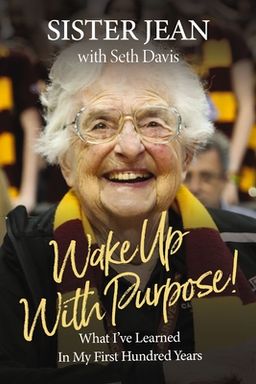
Wake Up With Purpose! cover

Wake Up With Purpose!

by Sister Jean Dolores Schmidt With Seth Davis

The team chaplain for Loyola’s men’s basketball team recounts experiences from her more than 100 years of existence.

Wake Up with Purpose

What would change if you began each day with five minutes of quiet, a simple prayer, and one specific intention? In Wake Up With Purpose!, Sister Jean Dolores Schmidt—Loyola Chicago’s beloved 100-plus-year-old chaplain—argues that a joyful, resilient life isn’t an accident of longevity or luck. It’s the harvest of daily purpose, humble service, adaptable faith, and team-minded living. Across a century that spanned world wars, Vatican II, civil rights upheavals, and a viral Final Four run, she contends that you can stay young by staying useful—anchored in belief, yet flexible enough to keep learning, laughing, and leading.

Sister Jean’s core claim is disarmingly practical: build a life you can renew each morning and review each evening. That means simple rituals (a 5 a.m. alarm, Scripture on an iPad, the Jesuit Examen), a bias toward action (say yes and figure it out), and a fierce gentleness that favors encouragement over fear. Her story—from Bay Area kid to BVM sister, classroom teacher, principal, college dean, community builder, and finally chaplain-celebrity—shows how purpose compounds when you entwine belief with skills, community, and courage.

What the book covers

You’ll see how belief begins at home and matures in adversity; how a neighborhood’s diversity can teach radical acceptance long before it’s fashionable; why dreams only take root when you make plans; and how adaptability turns detours into callings. You’ll also step courtside to discover why Sister Jean treats basketball as a catechism of life—competition forges character, teams reveal truth, and a locker room can teach more about love and leadership than a lecture hall. Her mantra “Worship, Work, Win” is not about magical thinking; it’s about aligning heart (values), hands (effort), and head (strategy) in everything you do.

Why this matters now

In a noisy age of polarization, burnout, and performative outrage, Sister Jean’s wisdom feels like fresh air. She marries conviction with curiosity—remaining a devoted Catholic while championing inclusion; staying tradition-rooted while adopting the iPad and Zoom; praying for wins while celebrating sportsmanship and study hall. She shows you how to hold complexity without cynicism: oppose war yet honor soldiers; insist on standards yet lead with mercy; fight for change yet protect community spirit. If you’ve wondered how to age joyfully, lead without a title, or bring a steady presence to chaotic seasons (pandemics, protests, mergers), this book reads like a century-tested field guide.

How to read this summary

First, you’ll explore how belief and quiet anchor your mornings and soften your nights. Then you’ll learn Sister Jean’s lifelong practice of acceptance—of neighbors, of difference, of people’s mistakes, and of your own limits. You’ll move from dreams to execution—how a third grader’s vocational spark became a specific plan at Mount Carmel and a decades-long vocation in classrooms and gyms. Next comes her superpower: adaptability. From blackouts and bomb drills in 1941 to Vatican II’s reforms, from civil rights sit-ins to a college affiliation, she models how to change without losing your center. You’ll also step into her favorite classroom—the basketball court—where she scouts opponents, blesses referees, and turns culture into competitive advantage. Finally, you’ll sit with her counsel on aging well: choose happiness, forgive quickly, keep serving, and let God surprise you.

Big idea to carry forward

“Happiness is a choice. Purpose is a practice. And both are contagious.” (Compare to Viktor Frankl’s Man’s Search for Meaning, which argues that meaning—not pleasure—sustains us in suffering.)

If you want a life that remains hopeful under pressure and useful to others, this book offers a simple, sturdy blueprint: start with belief, build with service, stretch with change, and finish each day with gratitude. And yes—cheer for your team, then shake hands with the other side.


Start With Belief

For Sister Jean, belief isn’t a dogma you recite; it’s a daily stance you assume. She grew up in San Francisco in the 1920s where faith was as ordinary as breakfast. Her mother told her when infant brother Ed stopped coughing after their grandmother’s funeral that “Grandma cured him.” Her father painted the night sky as God’s canvas. Those childlike moments seeded an adult conviction: if you keep your faith, you never have to grow old—because faith keeps you curious, humble, and hopeful.

Quiet rituals that steady your day

Each morning at 5 a.m., she sits up fast, thanks God out loud, and opens the day’s Gospel on her iPad. She reads the USCCB’s reflection, contemplates in silence, and then looks out at “her piece of Lake Michigan,” praying for sailors and hotel guests she’ll never meet. Before bed, she lists one good thing she did so she can “wake up happy” again. This simple frame—morning intention, nightly review—mirrors the Ignatian Examen (gratitude, petition, review, response, hope for tomorrow). You can do it in five minutes and feel different all day. (Compare to James Clear’s Atomic Habits on the compounding power of small, repeatable routines.)

Belief that bends, not breaks

Her trust isn’t naïve. She’s buried parents and brothers, watched students march into batons in Selma, and taught through air-raid drills and blackouts after Pearl Harbor. She doesn’t demand that God prevent sorrow; she asks Him to meet people in it. When a couple lost a newborn, she told them it’s fine to be mad at God—anger can be a form of faith because you’re still in conversation. Later, she nudged them to love their next child as an individual, not a replacement. Belief helps you suffer without turning bitter.

“Showing up” as theology

Her grandmother Kate attended almost every parish funeral, even for strangers—“because not everyone has family.” That became Sister Jean’s ethic: presence is prayer. It’s why she kept her office in the student union with the door literally open. Students came for algebra help and left with courage. When eighth-grader Roger went blind, he still took the Bellarmine-Jefferson scholarship exam—with a sister reading questions aloud—and aced it. That win came from a school that showed up with him, not just for him.

A belief that includes your neighbors

Her parents weren’t doctrinal about “diversity,” but they lived it. Their Castro District block mixed Mormons who tithed until breakfast skipped, French families, and Japanese twins who bookended the class photo. Years later, her childhood parish, Most Holy Redeemer, became one of the world’s foremost inclusive Catholic communities for LGBTQ people. Her father’s counsel—“People may believe in a different kind of God, but it’s still the same God”—formed a spacious faith that could bless Muslims next door and bless referees before tip-off.

Practice it today

Start or end your day with three moves: name one gratitude, one person you’ll quietly serve, and one anxiety you’ll hand to God. Repeat. (Parker Palmer calls this living “undivided”—actions aligned with values.)

If belief for you has felt abstract or polarizing, Sister Jean’s version brings it home. Make it quiet, specific, embodied—and let it widen your circle, not narrow it.


Acceptance, Every Day

Sister Jean’s second lifelong practice is acceptance—of people’s differences, people’s mistakes, and the maddening unpredictability of life. Acceptance isn’t passive; it’s neighborly. Growing up in San Francisco’s Castro District, her block stitched together Irish Catholics, French families, Mormons, Chinese and Japanese neighbors. Kids of every background played touch football together, and nobody fought. That normalcy of difference trained her eyes to look first for dignity, not defect.

Accepting people as they are

When an older girl, Ann-Marie, became pregnant, ten-year-old Jean asked her mother how that could be without marriage. Her mom replied simply: “She’s going to have the baby, and she’s going to be a very good mother.” Not a lecture—just mercy. Years later, she would resist “gotcha” religion. Peter denied Jesus; Paul persecuted the Church. People make mistakes—so help them choose joy next time. That’s also how she handled a young altar boy who skimmed from the collection basket: require repair, retain dignity, and never break relationship.

Community as a spiritual discipline

During the Depression, her father set up a “Blue Jamboree” in their garage—radio blaring through a megaphone—so neighbors could share songs and soup. When the phone was cut off for lack of coins, a neighbor offered theirs “any time you need it.” That ethic—bring something when you visit, even in want—shaped the way Sister Jean still runs her office: her door becomes a porch; conversation becomes care. (Compare to Priya Parker’s The Art of Gathering on designing spaces for belonging.)

Openness without losing convictions

She later embraced Vatican II’s spirit—shedding the habit for contemporary clothes to be more approachable—while holding firm to her Church and a pro-life ethic. She welcomes disagreement, but pushes for proportion: “You can’t be tough on everybody.” On campus, she backed Black student groups (MuCuba), added Black theology courses, and adjusted curricula after listening to student activists. She also set humane boundaries: protest, yes; but keep learning, keep graduating. Acceptance looks like doors open and standards intact.

Interfaith friendships that form character

At Loyola, she delighted in a deep friendship with Omer Mozaffar, the Muslim chaplain, and mentored Wesam Shahed, a Muslim student who—under the Lu Wolf costume—became her game-day sidekick. They pushed her wheelchair together, traded jokes, and built a quiet model of faiths in friendship. When Muslim fathers sought safe housing for their daughters at Mundelein, she helped arrange rooms with nuns. Hospitality wasn’t a photo op; it was policy.

A stance for today’s polarization

Listen first, argue civilly, and change structures where needed. You can host protest and preserve finals week. You can say “masks protect others” and still be kind to skeptics. Acceptance is strong and soft at once.

For you, this means practicing porchlight leadership: keep the light on, keep the rules clear, and keep your heart warm. That’s how communities survive hard times—and how they deserve their celebrations.


Dreams Need Plans

“A dream without a plan is just a dream.” Sister Jean repeats this like a drumbeat. In third grade she decided to become a Sister of Charity of the Blessed Virgin Mary (BVM) after admiring her teacher, Sister Mary Patrize. Cute resolve isn’t vocation. So as a teenager she clerked in the bookstore, supervised study halls, and taught a first-grade class when a teacher had to leave. She wrote to the BVMs for permission to enter Mount Carmel in Dubuque, Iowa, then embraced a postulant’s 5 a.m. wake-ups, chores, silence, and philosophy classes. Dream → letter → training → vow.

Teach with joy, lead with love

Her first fifth-grade classroom at Saint Vincent’s (Chicago) taught her to be firm at the door and fun once seated. When fractions stumped students, she lifted a boy named Patrick upside down—“This is inversion!”—and the room lit up. She learned from calm principals who spoke softly to be heard and found discipline that doesn’t humiliate. Her north star: fear is a lousy motivator. She preferred to build competence and pride—memorizing fifty lines of poetry a month, public speaking, and yes, sports.

Make competition a classroom

At Saint Charles in North Hollywood, she built a full sports program from scratch—girls and boys basketball, track, football, even yo-yo. She coached, scheduled practices, and once begged a bishop for a post-confirmation blessing before a semifinal. They won. But the real wins were character: boys practiced against girls to toughen their passing; the best pitcher melted in the finals and learned to breathe; the class “bench clown” grew into a primary school teacher. Sports became her “theology of teamwork.” (John Wooden, whom co-author Seth Davis has written about, preached similar virtues of industriousness and enthusiasm.)

Serve the outliers

Her classroom welcomed students like Roger, who lost his eyesight in fifth grade, and Arlen, who had seizures. She trained peers for emergencies, arranged exam accommodations, and refused to sideline them. Roger later earned a PhD and taught at LA City College. Another student, Tommy Maeder, sandbagged a reading test to avoid a harder level; she put him in charge of a remedial group to awaken his leadership. Decades later he called to say he had retired—from teaching eighth grade.

Raise the bar, then build the ladder

Sister Jean ran a pre-dawn and Saturday program to win high school scholarships for her eighth graders. Competitors complained that her class “won too many.” Her answer was simple: put in the hours. It’s a blueprint you can steal: (1) name the goal publicly, (2) create extra practice reps, (3) measure progress, (4) celebrate every step, and (5) involve parents, pastors, and principals so the system supports the kids, not the other way around.

Your action step

Take one dream you’ve named and write the first three ladders under it: who can mentor you, what hours you’ll carve weekly, and one public milestone you’ll aim for in 90 days.

Dreams dignify you; plans change you. Sister Jean shows that execution can be tender, playful, and exacting all at once—especially when you remember you’re coaching people, not just performance.


Adaptability Is Superpower

If purpose is her compass, adaptability is Sister Jean’s engine. She calls it her “superpower,” and for good reason. In 1941 she moved from Chicago to a barely-built school in Los Angeles, teaching in a feed and fuel store and windowless halls during wartime rationing. She managed blackouts, bomb drills, and frightened children with calm clarity: “Your mom will take care of you, we will take care of you, and God will take care of you.” Both brothers shipped out with the Navy; one saw the Hiroshima mushroom cloud. Life didn’t get easier; she got steadier.

Change the medium, keep the mission

At Saint Charles, she filmed a civics class on TV at Bob Hope’s studio when the university station broke, dyeing her habit trim blue because white bled on camera. Later at Mundelein College, she taught “new math,” oversaw summer sessions, and helped launch a Degree Completion Program so mothers could finish degrees between school drop-off and pickup. When Vatican II opened options, she stopped wearing the habit so students would approach her more easily—same call, different clothes.

Listen for reform, then pilot it

Under President Sister Ann Ida Gannon, Mundelein hired consultant Norbert Hruby to audit itself. Jean served on the library committee, visiting Notre Dame and others, then helped win a $1 million grant. She shifted from semesters to ten-week terms, then invented Weekend College before adult learning was trendy. She learned what many leaders forget: reform sticks when it’s co-designed by those it affects.

Hold tensions without breaking

Through the sixties and seventies, she shepherded students passionate about civil rights, women’s rights, and anti-war protests. When Kent State students were killed, some faculty wanted to shut down the college. She chose a middle path: keep the school open, help protesters plan responsibly, and ensure they still graduate. She added Black studies and Black theology, empowered MuCuba, yet later adjusted open-choice curricula when alumnae felt they’d missed the humanities. She kept learning, then kept tuning.

Merge without losing your soul

When Mundelein’s enrollment slid, she helped orchestrate its affiliation with Loyola. It meant building-wide repurposing, off-campus housing for sisters, and many hard feelings. She worked quietly with Loyola presidents (Raymond Baumhart, John Piderit, Michael Garanzini) to preserve Mundelein’s archives, Peace Studies, and the Gannon Center for Women. Her advice captures the art of organizational change: “You can’t make everybody happy. Keep moving until you find your balance.”

Keep learning, even in pain

She broke a hip (twice), got shingles, and moved into The Clare—then learned Zoom, wrote scouting emails, and kept office hours. She launched SMILE (Students Moving into the Lives of the Elderly) to connect undergrads with seniors. During COVID, she phoned, emailed, and Zoom-prayed with players and ACE and Arrupe students daily. Adaptability looked like cheerful stubbornness in service of others. (Think of Atul Gawande’s Better: relentless iteration in imperfect systems.)

Your takeaway

Name your nonnegotiables (mission, people, integrity). Flex everything else (tools, timelines, titles). That’s how you change rooms, jobs, even eras—without changing who you are.

In your world—new boss, new platform, new policy—ask Sister Jean’s question: How can I keep the mission and change the method? Then try one small pilot this week.


Life Is a Team Sport

“So long as there’s a winner and a loser, I’d much rather win.” Sister Jean loves competition because it forces character into the open. She was a Notre Dame football fan as a kid, then a CYO coach who scheduled daily basketball practices and track meets “where my job was to tell the kids to run.” But it’s as Loyola Chicago’s men’s basketball chaplain that she turned a gym into a classroom for purpose, culture, and joy.

Worship, Work, Win

Her three-word credo hangs on the weight room wall. It’s not superstition. She prays for safety and a Rambler victory, then emails scouting reports to coaches and players with matchups and tendencies (“Be careful of #5; he looked good in warmups”). She blesses referees’ hands—and asks God to help them see clearly. She’s funny and fearless, the rare chaplain who folds box-out reminders into a pregame prayer.

Culture beats talent (and invites talent)

When Porter Moser arrived in 2011, he rebuilt from the roots: student outreach, midnight madness, jackets thrown, sleeves rolled. He taught “competitive reinvention” and renamed film sessions “Get Better Tapes.” He recruited guys who fit—Donte Ingram, Clayton Custer, Ben Richardson, Marques Townes, freshman Lucas Williamson, and a point-center in Cameron Krutwig—then let them lead. The reward: the 2018 “Sister Jean” Final Four run, with back-to-back nail-biters (Donte’s buzzer beater vs. Miami; Clayton’s soft bounce vs. Tennessee; Marques’s dagger vs. Nevada) and a comfortable Elite Eight win over Kansas State.

Winning the right way

Those wins weren’t flukes; they were culture cash-outs. Ben Richardson limped after turning his ankle on a ref’s foot—but sprinted for a steal and assist that swung momentum. Clayton passed up hero shots to feed the hot hand. Fans became participants; students found identity. Two years later, in a pandemic bubble, the Ramblers upset #1 seed Illinois to reach another Sweet Sixteen. Through it all, Loyola led the nation in men’s basketball graduation rate and built habits of service (Misericordia night, freshmen move-in, SMILE). (Compare to Pete Carroll’s Win Forever on linking culture, competition, and care.)

Sports as catechism

Sister Jean preaches what sports prove: skills serve the team; teams serve the mission; missions serve the community. After games, the Ramblers shake opponents’ hands and thank fans. She’s delighted by sweaty hugs after wins—and gracious goodbyes when coaches move on (Porter to Oklahoma; Drew Valentine promoted at 29). She prays to win, then to be good sports if they don’t. Because the real scoreboard is a transcript, a resume, a family, a city.

Transfer this to your team

Write a three-word credo for your group. Pair it with simple rituals (start-of-day huddle; end-of-week “assists” shoutouts). Scout your obstacles. Celebrate sweaty, not shiny.

If you lead a classroom, a company, or a family, you can steal Sister Jean’s playbook: compete hard, love harder, and keep the main thing the main thing.


Age Joyfully, Serve Daily

Sister Jean turns aging from a decline narrative into a discipleship path. Her rule: stay useful. She still keeps office hours in the student center (“My number one title is ‘friend to many’”), answers her own email, and takes more selfies than a pop star—because every selfie is a student choosing connection. She embraces technology enough to pray daily Mass from Toronto on her iPad and deliver scouting via email and Zoom. When her hip breaks and shingles slow her down, she changes her gait, not her goal.

Choose happiness, practice gratitude

She ends each night by thanking God for one good thing she did and begins each dawn with a specific intention. Happiness, she insists, is a choice that becomes a skill. She notices how joy multiplies (the city throwing her a 100th birthday; Cubs first pitch; bobbleheads; an avalanche of letters from strangers) when you show up for others first. (Shawn Achor’s The Happiness Advantage makes the same claim empirically.)

Hold convictions, keep learning

She can be “old-fashioned” (supports standardized tests as one tool; opposes premarital sex; keeps abortion out of politics) and fiercely future-facing (advocates for undocumented student scholarships, Muslim students’ housing, and Black history in the core). She worries about social media’s cruelty and celebrates students’ mental health openness. Her bias is pastoral: protect dignity, reward effort, and widen access—all without dropping standards.

Make quiet your ally

She delights that Loyola’s no-talking floor in the library is always packed. Quiet isn’t absence; it’s presence. In a world of push alerts and outrage cycles, she urges you to schedule five-minute pauses to breathe, pray, or just think. During COVID, she found new ways to gather (calls, emails, Zoom prayers) and kept Jeopardy at 3:30 p.m. as her small daily delight. Purpose pairs best with pacing.

Face death as the last trust

Her epilogue is tender and unsentimental. Judgment isn’t a public shaming; it’s you and God. When you fear dying, admit it; then keep loving. She imagines heaven as a place where “if you’re the new kid on the block, somebody will help you out.” Until then, she asks to be remembered as someone who loved God, students, sports, and her BVM community—and did the work in front of her.

  • Do this now: pick one student, colleague, or neighbor to check on this week. Write or call, not just text. Ask a specific question. Then schedule five minutes of quiet tomorrow morning.

Sister Jean’s final word

“We all want big miracles, but there are lots of small miracles happening all around us—if we pay close enough attention.”

Aging well isn’t about avoiding limits; it’s about amplifying love. Wake up with purpose, then go to bed grateful. Repeat, as long as you’re blessed with breath.

Dig Deeper

Get personalized prompts to apply these lessons to your life and deepen your understanding.

Go Deeper

Get the Full Experience

Download Insight Books for AI-powered reflections, quizzes, and more.