
Idea 1
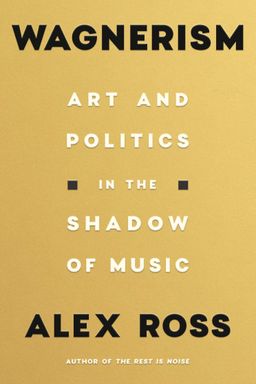
Wagnerism: Art, Myth, and Modern Imagination
How can one composer become a world symbol? In Wagnerism: Art and Politics in the Shadow of Music, Alex Ross examines how Richard Wagner—a 19th-century German artist—expanded far beyond opera into an almost planetary myth. Ross argues that Wagner did not merely create music; he crafted a cultural system. His theatrical ambitions, philosophical polemics, and monumental style seeped into every corner of modernity: literature, painting, politics, religion, psychology, and cinema.
Death and the Birth of a Cult
The story begins with Wagner’s death in Venice (1883), a “turning point” that marks the transformation from man to myth. The composer’s body becomes the focus of theatrical mourning: gondolas playing Siegfried’s Funeral Music, Cosima lying beside the coffin, pilgrims collecting ivy from his grave. In this spectacle you see the creation of Wagnerism—a movement where art merges with ritual. His death freezes him as symbol, and people begin projecting modern anxieties and desires onto his image. Across continents—from Boston to Buenos Aires—devotees reshape Wagner into moral prophet, national hero, or revolutionary theorist.
Music as Creation and Political Myth
Ross traces Wagner’s art to its most intricate example: The Ring of the Nibelung, a musical universe where sound becomes a cosmology. The Ring’s mythic prelude, slowly emerging from an E-flat drone, creates a world both musical and political: the Rhine’s gold stands for natural resource; the Ring itself for exploitative power. Alberich’s renunciation of love inaugurates a cycle of domination and corruption, while Wotan’s treaties and contracts bind gods in bureaucratic paralysis. Nietzsche saw the Ring as tragedy of a god who thirsts for power—an allegory for modern institutions trapped in their own systems. Wagner transforms old German myths into critiques of capitalism and alienation.
Art, Desire, and the Modern Mind
In Tristan und Isolde, Wagner achieves another revolution: harmonic ambiguity turns longing into structure. The unresolved “Tristan chord” launches Symbolism, inspiring poets like Baudelaire and Mallarmé to treat music as a model for consciousness. Tristan’s endless yearning parallels modern interiority—the attempt to express what cannot be resolved. Opera becomes psychological mirror rather than heroic myth. (Compare this to Joyce and Woolf later using Wagnerian motifs to map the flux of thought.)
Wagnerism as Cultural Mirror
After his death, Wagner’s work enters every arena—politics, feminism, mysticism, cinema. You see Meistersinger turn from local art-defense into nationalist slogan; Parsifal become a ceremony for occultists and Theosophists; and the Ring inspire both d’Annunzio’s proto-fascist aesthetics and socialist mass spectacles. His art thus acts as moral Rorschach test: it can sanctify compassion or justify conquest. In Russia, he helps ignite modernist theater and ballet; in America and Britain, his music becomes civic ritual and architectural inspiration. Jewish, Black, feminist, and queer artists reinterpret him to claim inclusion within cultures that excluded them—Du Bois hears Lohengrin as revelation, Olive Fremstad and Willa Cather turn Wagnerian heroines into emblems of vocation, and early gay theorists identify male bonds in Wagner’s world as alternative ideals.
Modernism, Film, and the Afterlife
As modernism evolves, Wagner becomes both exemplar and challenge. Appia, Craig, and Fuller reinvent stagecraft from his Gesamtkunstwerk ideal. Gropius and Brecht rework it into architecture and critical theater. Later, Nazi Germany distorts his legacy for propaganda, while postwar artists (Chéreau, Boulez) expose its social critique. Cinema absorbs Wagnerian sound and image—from Apocalypse Now’s helicopter march to John Williams’s leitmotif grammar in Star Wars. Filmmakers like Malick and Herzog turn his music into spiritual and ecological meditation: nature wounded yet divine.
The Wound and the Wonder
Ross ends with moral ambivalence—the spear that wounds can also heal. Wagner’s music can thrill and harm, inspire empathy or domination. His legacy teaches that art’s power lies not in purity but in its contradictions. Understanding Wagnerism means understanding modernity itself: how beauty and violence coexist, and how myth can both poison and redeem culture. The journey Ross traces—from Venice to Bayreuth, from Nietzsche to Malick—reveals a single truth: great art is never innocent, and its afterlives mirror the world that claims it.