
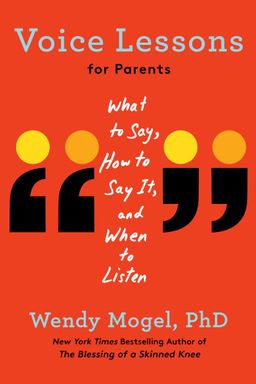
Voice Lessons for Parents cover

Voice Lessons for Parents

by Wendy Mogel

Voice Lessons for Parents by Wendy Mogel empowers parents to enhance their communication skills, focusing on tone, timing, and honesty. This insightful guide provides practical strategies for engaging with children effectively, from toddlers to teens, ensuring meaningful and productive dialogues.

The Music of Connection

Why do some conversations with your child feel effortless and others derail into silence or shouting? Wendy Mogel’s central claim is that tone, presence, and attention are the invisible architecture of every healthy parent-child relationship. The voice you use—your pitch, rhythm, volume, and even your pauses—can either build trust and language or stoke anxiety and conflict. Conversation, she argues, is not only about words. It is the daily practice through which children learn empathy, self-control, and meaning.

Across the book, Mogel shows how your communication evolves as your child’s brain and identity evolve—from the sing-song Parentese of infancy to the quiet mentorship of adolescence. Her framework mirrors a developmental arc: first, the infant brain learns language and safety through rhythm and sound; next, young children develop conversation through routines and curiosity; later, voice and tone become tools for boundary-setting, empathy, and resilience. Throughout, technology is treated as both helper and hazard, and each chapter provides concrete methods for preserving human conversation in a distracted age.

Language as Biology and Relationship

In early life, your words sculpt your child’s brain. Mogel draws on neuroscience—synaptic blooming, pruning, and studies of premature infants exposed to their mothers’ voices—to show that a nurturing tone can literally grow neural circuitry for language and emotional regulation. Parentese, the lilting speech adults instinctively use with babies, is not silly chatter but a sophisticated teaching tool. By exaggerating rhythm, melody, and emotion, you give structure to sound—the scaffolding for thought. (Developmental linguist Catherine Snow anticipated this in the 1970s.)

Even as children grow older, your tone still acts as a barometer of safety. A calm voice lowers stress hormones; shouting, sarcasm, or distracted replies signal unpredictability. The message: you are safe, you are seen, must underlie every interaction before the message about chores or manners can land.

The Art of Voice and Presence

Mogel’s research overlaps with vocal physiology and performance psychology. She teaches that authority doesn’t require volume—it requires grounded resonance. A slower, lower voice commands more attention than rising pitch or speed. The so-called “as if” technique borrowed from actors helps you act calm even when you are not, allowing your tone to reset the emotional climate in a room. It is radical in its simplicity: by controlling your delivery, you regulate not only your emotions but your child’s.

In models from Wendy Mogel’s own therapy practice, parents who lowered pitch and moderated tempo saw immediate behavioral change. Ruby’s mother, once a hurried whisperer, watched her preschooler calm down as she practiced slower breathing, golden pauses, and steady sentences. These are not manipulations—they are shared regulation skills you offer to your child.

Conversation as Moral Education

Every stage of development offers a specific conversational task. For toddlers, narrating routines builds vocabulary and trust. For elementary children, curiosity and descriptive questions teach them to expand their inner worlds. For tweens and teens, your voice becomes a model for ethical reasoning—how you say no, how you listen, and how you explain complex realities like death or sex all encode lessons in respect and truth-telling.

Mogel’s conversational templates (“Acknowledge, give Context, show Empathy”) allow parents to assert authority without humiliating. She reframes discipline as dialogue—teaching through tone instead of control. “Say no with ACE” isn’t a formula but a moral stance: empathy and firmness coexist when your voice communicates both love and limit. That consistent tone becomes the background melody of family life.

Technology and the Crisis of Attention

Modern parenting, Mogel warns, unfolds in an economy of distraction. Smartphones dilute presence, producing what Linda Stone calls “continuous partial attention.” She cites the father on Bluetooth ignoring his toddler’s joy at a cable car: a quiet modern tragedy. The remedy isn’t puritanical abstinence but stewardship of attention—ritual phone-free zones, print over screens, silence as an active practice. Silence, she says, grows a child’s inner life and self-talk. It teaches solitude, patience, and resilience against the dopamine storms of digital life.

Developmental Separation and Ongoing Dialogue

By adolescence, every conversation becomes a negotiation between connection and independence. Mogel reframes teenage rebellion as spiritual mentorship: teenagers are “spirit guides” revealing your own impatience and control issues. Their pull toward peers and risk isn’t betrayal—it’s biology’s way of preparing them for autonomy. The task then is transformation: shifting from manager to consultant, from talking at to listening with. She reminds you that “nothing a teenager says is personal, permanent, or predictive.” Treat separation as dialogue, not rejection.

The music of connection, then, runs from womb to college dorm. It begins as lullaby, expands into daily conversation, stretches through conflict, and quiets into mutual respect. Through tone, timing, and truth, you model how words can carry affection without agenda. That is the heart of Mogel’s message: your voice is the medium through which your child learns humanity itself.


Language Roots and Early Connection

Mogel begins where language begins: with rhythm, melody, and mutual gaze. The infant’s brain is designed to detect pattern and emotion before meaning. When you speak in an exaggerated, sing-song tone—the scientific term is Parentese—you align with your baby’s natural learning system. The payoff is measurable: infants exposed to rich Parentese show stronger language development and emotional attunement later in childhood.

How Parentese Builds Thinking

Parentese helps children chunk language into meaningful sounds. Think of the slow, bright phrase “That’s a biiig bubble!” Complete with wide eyes and stretched vowels, you’re teaching that words carry cadence, not just content. As synapses bloom and prune within the first three years, repeated patterns of friendly speech strengthen auditory and emotional pathways. Mogel draws on the Harvard incubator studies: premature babies exposed to recordings of their mothers’ voices developed larger auditory centers—proof that connection literally wires the mind.

Everyday Exercises

  • Narrate routines: “Now we wash your toes with slippery soap!” creates both vocabulary and shared joy.
  • Describe senses: “This apple crunches loudly,” expands perception through descriptive language.
  • Sing lullabies: rhythm entrains heartbeat, steadying nervous systems (NICU studies confirm their physiological benefit).
  • Encourage father talk: when dads carry babies facing outward, they naturally label the external world differently, enriching vocabulary diversity (research by Lynne Vernon-Feagans).

Screen time undermines this process. The American Academy of Pediatrics recommends against screens before age two for good reason: language grows through feedback loops, not one-way exposure. Babies who hear only half of a phone call or cartoon miss the facial mimicry and pause-response cycles their brains expect.

These early acts—speaking, singing, naming—are investments in future thought. As Mogel writes, every sentence you speak becomes another wire in the architecture of meaning. You are not just comforting your baby; you are building the brain that will one day hold her inner voice.


Voice, Authority and Emotional Climate

By preschool and elementary years, how you use your voice becomes the thermostat for the household. Mogel calls it a delivery system for safety and authority. Children respond more to tone than words; a calm, low voice signals containment, while high, rapid tones communicate panic. The parent's task is to speak as the anchor, not the storm.

Practicing Vocal Control

Her core exercise is a three-step technique: relax shoulders and jaw, breathe deeply, and lower your pitch while slowing your tempo. This combination projects confidence without volume. Pausing after a question—rather than filling silence—gives the child space to respond and models patience.

Body language amplifies this message. Sit at eye level, keep a calm face, and use light, grounded touch when seeking connection. These signals align physiology with empathy. In one case from Mogel’s practice, a mother learned that by adjusting her posture and tone, her once-defiant daughter began to comply without argument. Authority, Mogel reminds, is not domination but steadiness.

Handling Escalation and Recovery

  • If you notice your voice rising, do a HALT check: hunger, anger, loneliness, or tiredness. Address the body before the battle.
  • When tension peaks, lower pitch rather than volume—children follow tone, not argument.
  • After a slip, repair quickly: “I spoke sharply because I was tired; I still love you and I’m sorry.” This builds trust through modeling humility.

You need not feel calm to act calm; practice the “as if” stance until habit takes over. The reward is immediate: a household where speech becomes a teacher of composure. The tone you choose becomes the atmosphere your child breathes.


Creating Conversations that Build Trust

Once children can talk, the challenge shifts from talking to them to talking with them. Mogel frames conversation as the cathedral of childhood—a sacred daily ritual that builds trust and curiosity. You craft the structure through tone, timing, and small conversational habits that teach respect and empathy.

Templates for Real Dialogue

Instead of generic check-ins like “How was school?” try specific, sensory noticing: “Your drawing has wild clouds—what’s happening in that scene?” Follow up with expansion (“And what did the frogs do next?”) and end with graceful closure (“Let’s revisit this later.”). These openers, expanders, and closers create rhythm and signal that conversation is voluntary, not extraction.

When enforcing limits, use ACE: Acknowledge, give Context, show Empathy. “I know you want to stay overnight, but you have an early game. I get that it’s disappointing.” This preserves dignity and authority simultaneously. Each small conversation becomes a deposit in what Mogel calls the “bank of goodwill”—trust you’ll draw upon when rules tighten later.

Handling Gender Differences

Boys and girls process speech and emotion differently. Many boys prefer side-by-side conversation—fixing something, driving, or walking—over direct eye contact. They need few words, clear instructions, and respect for their pace. Girls often crave expressive dialogue and emotional validation. They tune to tone acutely, so sarcasm or inconsistency can wound more than disagreement. For mothers and daughters, Mogel prescribes measured honesty: straightforward comments instead of half-truths or performative praise.

The larger point is fairness through difference: adapt your conversational rhythm to the child’s nature. Connection doesn’t mean sameness—it means meeting them where language feels safe. When you listen as much as you advise, you become not a manager of behavior but a curator of trust.


Modern Distractions and the Practice of Silence

In the digital era, communication competes with devices engineered to steal attention. Mogel insists that presence is now a moral act. Silence, once seen as emptiness, becomes an essential counterweight to overstimulation. She blends psychology, neuroscience, and everyday discipline to teach parents how to protect moments of quiet.

Why Quiet Matters

Ed Tronick’s still-face experiment showed how infants react with distress when caregivers go emotionally blank. A child’s nervous system expects reciprocal attention; even brief digital distraction mimics emotional absence. Over time, screen-preoccupied parenting teaches children that devices outrank them. Mogel calls this the “public failure of presence.”

Silence, by contrast, nourishes inner speech. In the absence of noise, children practice self-talk—the seed of self-regulation and creativity. Sherry Turkle’s work supports this: solitude builds imagination, while constant device use erodes it.

Practical Quiet Stewardship

  • Designate phone-free rituals: car rides, bedtime, meals. These become symbolic sanctuaries of attention.
  • Prefer print over screens during downtime. Books invite curiosity without fragmentation.
  • Model patience: resist rescuing during frustration. Let children struggle and notice their competence rising.

When you guard silence and attention, you give your child a portable sanctuary—a skill to be alone without loneliness. Amid the noise of digital culture, that may be the most valuable inheritance you offer.


Guiding Teenagers Through Separation

Adolescence invites both fear and awe. Mogel’s phrase “spirit guides in disguise” captures the paradox: teens drive parents mad while teaching them patience and humility. She translates developmental psychology into practical compassion—helping you understand separation as a necessary, healthy unfolding rather than rebellion.

The Biology of Separation

Puberty triggers neurological rewiring toward independence. Teens pivot their loyalty from family to peers, test risk boundaries, and build self-definition by contradiction. Past cultures marked this transition through rituals or work responsibilities; today it’s prolonged by academics and technology. Mogel urges you to treat rule-bending as practice for adulthood rather than a moral verdict.

Obstacles of the Modern World

Two forces jeopardize healthy separation: the surveillance of technology and the pressure of college admissions. Constant tracking, location apps, and texts make both parties overconnected, turning anxiety into control. The college race adds another tangle—shared micromanagement under the illusion of love. Mogel warns that overhelping delays maturity.

Strategies for Healthy Independence

  • Shift role from controller to guide. Praise consistency, not perfection.
  • Set clear boundaries for texting and tracking; let them breathe from constant oversight.
  • Use conditional freedom: “Show reliability this month and curfew extends next.”

Above all, don’t take volatility personally. Every sarcastic remark is a rehearsal for independence, not a prophecy of character. Mogel’s core reminder—nothing they say is personal, permanent, or predictive—restores perspective during stormy years.

If you let go with grace, teens often return with gratitude. The journey through separation becomes reciprocal: as they learn who they are, you learn who you’ve become in their presence.


Hard Topics and Everyday Ethics

Mogel confronts the traditionally taboo subjects—sex, death, money, and consent—reminding parents that protection and morality grow through conversation, not avoidance. The goal is steady honesty calibrated to developmental readiness.

Teaching Consent Early

Consent begins in toddlerhood when you ask before wiping a face or respect a request to “stop.” These micro-lessons teach bodily autonomy and respect. Modeling is key: stop tickling when told to, apologize when you overstep, and reinforce the idea that everyone—child or adult—deserves boundaries.

Sex, Death and Money as Practice Conversations

These topics unfold best as a series of talks, not one dramatic event. For sex, use accurate anatomy and keep emotional tone calm; for death, use direct language (“Grandpa died”) while reassuring safety; for money, involve children in budgeting, distinguishing wants from needs, and building habits of giving. Each discussion reinforces dignity, security, and moral reasoning.

These dialogues, Mogel insists, are how children learn that honesty is not danger but comfort. When you speak about difficult realities with calm candor, you give your child a model for ethical courage: telling the truth without shame.


Allies, Sleep, and Restoration

The book concludes by widening the circle around the family and returning to basic biological health. Mogel introduces the term “trustees”—teachers, nannies, coaches—and reframes them as partners, not adversaries. She also restores attention to sleep and crisis response as silent pillars of family communication.

Working with Trustees

Approach all who care for your child with humility and clarity. Set explicit expectations with nannies (hours, phone use, spending). Respect teachers’ expertise and begin meetings with appreciation rather than complaint. Avoid texting complex grievances—schedule real conversations instead. Administrators and coaches respond best to curiosity and partnership, not micromanagement. These alliances protect your child far more effectively than surveillance or control.

Sleep and Mental Health

Nine hours of sleep are not indulgence but prevention. Chronic deprivation mimics depression and erodes academic and emotional stability. If your teen’s behavior shifts, check sleep first. In crisis, listen as negotiators do—give steady attention, reflect back feelings, and guide toward small physical reliefs (water, shower, walk). Professional help should follow any sustained withdrawal, hopelessness, or self-harm signs. Consultation can begin with parents alone.

Partnerships and restoration share a theme: presence. Trustees extend your net of care; sleep and calm speech restore your capacity to use it wisely. Together they complete Mogel’s message—connection as daily stewardship of attention, tone, and truth.

Dig Deeper

Get personalized prompts to apply these lessons to your life and deepen your understanding.

Go Deeper

Get the Full Experience

Download Insight Books for AI-powered reflections, quizzes, and more.