
Idea 1
A Middle Way for Tibet’s Future
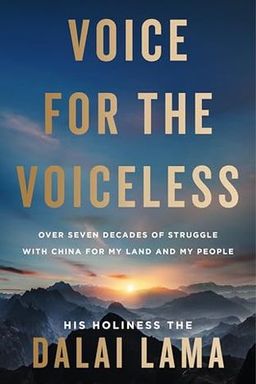
What do you do when your deepest values collide with overwhelming force—and you still have to chart a future? In Voice for the Voiceless, the Dalai Lama argues that the survival of Tibet as a people—with its language, faith, and high‑plateau culture—depends not on conquest or capitulation, but on disciplined nonviolence and realistic dialogue. He contends that Tibet’s best path is a “Middle Way”: seeking genuine autonomy within the People’s Republic of China (PRC), rather than independence or the current repressive status quo. But to reach it, you must understand how power, legitimacy, and human dignity interact over decades—and why refusing to hate is a strategic choice, not a sentimental one.
This book is both a memoir of statecraft under occupation and a manual for staying human under pressure. You’ll trace the arc from China’s 1950 invasion, through a coerced 1951 agreement and the 1959 Lhasa uprising that forced a 23‑year‑old monk‑leader into an exile that still endures. You’ll then follow three major waves of attempted dialogue—with Mao’s lieutenants in the 1950s, Deng Xiaoping’s "+everything but independence" opening in the 1980s, and the nine rounds of talks ending in 2010—each rich in lessons about asymmetric negotiation, trust, and the fragile currency of political will. Finally, you’ll enter the Dalai Lama’s inner workshop: the practices he uses to metabolize suffering into resolve, and the practical design of the Middle Way—language rights, religious freedom, environmental stewardship, and self‑governance—mapped against China’s own constitution.
Why This Matters To You
Even if you never set foot in Lhasa, you live downstream from Tibet. The plateau—often called the "Third Pole"—feeds the Indus, Brahmaputra, Mekong, Yangtze, and Yellow Rivers, lifelines for hundreds of millions across South and East Asia. Decisions made with or without Tibetans reverberate through food security, flood cycles, and climate feedbacks. And beyond rivers, Tibet is a test case for 21st‑century pluralism: Can a powerful state create a truly multi‑nation home, or will it choose assimilation enforced by digital surveillance? Your sense of justice—and your future weather—are entangled here.
The Core Claim
The Dalai Lama’s core argument is stark: stability cannot be engineered by silencing identity. “If you keep people permanently unhappy, you cannot have a stable society,” he writes. Legitimacy in Tibet doesn’t flow from concrete poured or GDP tallies—it flows from Tibetan consent to a shared future. The Middle Way therefore proposes a concrete package—within the PRC’s constitution and its Law on Regional National Autonomy—that safeguards Tibetan language, religion, culture, environment, and local governance across all Tibetan areas (Ü‑Tsang, Kham, and Amdo), while Beijing retains sovereignty and responsibility for foreign affairs and defense. It’s not a slogan; it’s a design.
What You’ll Learn in This Summary
- How the 1950 invasion and the coerced Seventeen‑Point Agreement shaped a young monk into a head of state—and why the 1959 escape set a new global voice in motion.
- How Tibet rebuilt in exile—schools, a parliament‑in‑exile, cultural institutions—and why India’s shelter mattered as much as any resolution at the UN.
- What really happened in the three phases of dialogue: the hope, the crowd‑swelling fact‑finding delegations, Hu Yaobang’s remarkable 1980 mea culpa in Lhasa—and the wall Tibetans kept hitting.
- A precise look at the Middle Way’s clauses—language, religion, migration policy, environment, education, public security—and the legal hooks inside the PRC constitution (with comparisons to arrangements like Hong Kong’s Article 31 and Inner Mongolia’s unification of sub‑units).
- A toolkit of inner practices—widening perspective, refusing hatred, choosing optimism—that you can use when your cause outlives the news cycle.
The Stakes—and the Signal China Could Send
Tibet sits at the fault line of two competing models of power. One treats diversity as a liability to be disciplined into sameness; the other treats it as an engine of durable legitimacy. A breakthrough in Tibet—real autonomy under the PRC flag—would signal to China’s own citizens and to its neighbors that Beijing chooses magnanimity over fear. After Tiananmen in 1989 and again after the 2008 plateau‑wide protests, the Dalai Lama publicly affirmed nonviolence, condemned bloodshed, and kept asking for talks. The response—tightening controls, mass boarding of Tibetan children into Mandarin‑only schools, criminalizing Tibetan symbols—has made reconciliation harder, not easier. Yet he insists hope remains because people‑to‑people bridges are growing—Chinese dissidents, artists like Ai Weiwei, and scholars like Wang Lixiong have engaged him candidly.
A Line to Carry With You
“As long as space endures, as long as sentient beings remain, until then, may I too remain, and dispel the miseries of the world.”
Read this summary to learn how a refugee leader reframed power as the capacity to refrain—how to keep dignity, invite dialogue, and still design for the day when your adversary finds the courage to say yes. Then ask yourself: in your own conflicts, where is your Middle Way?