
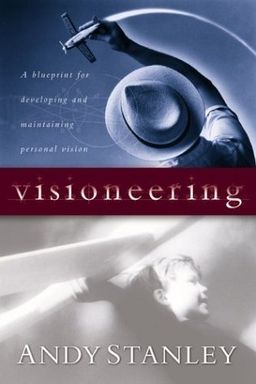
Visioneering cover

Visioneering

by Andy Stanley

Visioneering by Andy Stanley provides a compelling guide to developing a personal vision aligned with God''s purpose. Through practical insights, learn to cast vision, overcome obstacles, and stay focused on a divine path, ultimately leading to a life of clarity and fulfillment.

Visioneering: Turning Divine Dreams into Reality

What would it look like to live your life on purpose—intentionally steering toward outcomes you believe not only could be, but should be? In Visioneering: Your Guide for Discovering and Maintaining Personal Vision, Andy Stanley argues that every person was created with a God-given vision for their life. But few ever realize it because they fail to identify, cultivate, and guard that vision. His message is simple and profound: vision gives direction, meaning, and motivation—and for a life of significance, you must become a ‘visioneer’.

Stanley defines visioneering as the process of engineering a vision: taking a divinely inspired idea and shaping it into reality through faith, planning, perseverance, and moral integrity. Drawing deeply from the biblical story of Nehemiah—an ordinary man who rebuilt the walls of Jerusalem despite impossible odds—Stanley crafts a guide for anyone who wants to move from vague dreams to purposeful living. His formula encapsulates the theme: VISIONEERING = INSPIRATION + CONVICTION + ACTION + DETERMINATION + COMPLETION.

Why Vision Matters

Stanley insists that everyone ends up somewhere in life, but only a few end up somewhere on purpose. Those few have vision—a clear mental picture of what could and should be. Vision is what transforms the daily mundane into meaningful work. It turns ordinary actions into part of a divine mission. Without it, life devolves into reaction rather than creation. Vision, he writes, “brings order to chaos” and gives us the courage to face hardship.

To illustrate, Stanley begins with the story of Orville and Wilbur Wright. What set them apart from other dreamers who imagined flying was their conviction that they not only could fly but should. That conviction drove them through years of setback and ridicule until they finally turned a childhood spark into history. For Stanley, this captures the essence of visioneering: not wishing for something, but committing to its realization through disciplined, patient faith.

The Spiritual Core of Vision

Unlike secular self-help authors, Stanley grounds visioneering in Christian theology. For believers, personal vision is not self-generated or independent of God’s will. It flows from divine design. Referencing Ephesians 2:10—“We are His workmanship, created in Christ Jesus for good works”—Stanley emphasizes that every human is a product of God’s vision. God imagined you before you were born, embedded purpose in your soul, and prepared good works for you to walk in. Therefore, crafting a life vision is not about chasing personal success; it’s about aligning your life with the Creator’s mission. To “visioneer,” then, is to discover and cooperate with God’s unique plan for your life.

The book’s first core idea is that our visions must reflect what God wants to accomplish through us. We surrendered the right to live directionless lives at the Cross. Vision is a stewardship of divine intent. When we neglect it, Stanley warns, we end up chasing empty goals—wealth, status, or comfort—that leave us wondering whether our lives counted for anything. The fulfillment we crave comes only from participating in God’s greater vision.

Nehemiah: A Case Study in Visioneering

At the heart of Visioneering is Stanley’s retelling of Nehemiah’s story. Nehemiah, a Jewish cupbearer to the Persian king, was devastated by news that Jerusalem’s walls lay in ruins. His grief became a divinely planted burden—an inner tension between what was and what could be. From this concern, a vision was born. Through prayer, preparation, planning, and perseverance, Nehemiah led his people to rebuild in just fifty-two days. His journey—from emotional burden to concrete action—becomes Stanley’s blueprint for turning divine inspiration into lasting impact.

Stanley identifies twenty "Building Blocks of Vision" drawn from Nehemiah’s experience, covering everything from recognizing a concern to maintaining focus, handling criticism, and acting boldly even after success. These building blocks serve as both theological principles and practical tools. Each chapter of the book explores one or more of them, helping readers move systematically from awakening to achievement.

Where the Journey Leads

Stanley divides the visioneering journey into distinct phases: birth, preparation, pursuit, challenges, and maintenance. Early chapters emphasize that vision begins with a divinely stirred concern and develops slowly—often painfully—through seasons of waiting. Later sections show how prayer, strategic planning, and courage turn that vision into actionable steps. The middle chapters highlight opposition, sacrifice, and criticism: inevitable trials that refine faith and test moral integrity. Finally, Stanley shows how success brings its own dangers—distraction, pride, and drift—and how only humility and continual dependence on God can sustain a vision to completion.

Ultimately, Visioneering is not about building kingdoms, companies, or even ministries—it’s about building lives that glorify God. Every vision begins and ends with Him. As Stanley reminds, “The end of a God-ordained vision is God.” His goal is not to make us successful, but faithful—to see our dreams fulfilled in a way that draws people’s eyes to the divine Source behind it all. That’s the essence of visioneering: participating in what God wants to do through your one precious life.


A Vision Begins as a Concern

Andy Stanley’s first building block of vision is simple but profound: a vision begins as a concern. It rarely arrives with fanfare or clarity. Instead, it starts as an inner stirring—a brokenhearted awareness that something is not as it should be. Nehemiah’s story makes this tangible. When he heard that Jerusalem’s walls were destroyed, he wept. That tears moment was not weakness; it was conception. God often births visions in the soil of concern.

From Burden to Vision

In 587 BC, the Babylonians had sacked Jerusalem. Seventy years later, though exiles had returned, the city remained defenseless. When Nehemiah learned this, his emotional response became spiritual fuel. He fasted, prayed, and waited. As Stanley notes, emotion is divine fertilizer for vision. Many of God’s assignments begin when ordinary people can no longer tolerate ordinary problems. Dr. Martin Luther King Jr.’s dream was born from a burden for justice. World Vision began when Bob Pierce could not ignore one hungry child. God still leverages heartbreak to birth hope.

Waiting: The Maturation of Vision

Stanley challenges our impulse to act immediately. Nehemiah waited four months before approaching the king. Why? Because time matures both the vision and the visionary. Like a child in the womb, a vision must develop unseen before it’s ready to live. In that waiting, God tests motive, patience, and faith. Stanley compares this to Moses’ forty-year desert exile and Paul’s early years of seclusion before ministry. Premature visions are like premature births—fragile and unable to survive.

During waiting, three things happen: the vision deepens, the visionary strengthens, and God works unseen circumstances into readiness. Those months for Nehemiah were not wasted—they were preparation. Stanley encourages readers to ask, “What breaks my heart and won’t let me go?” and “What is God teaching me while I wait?” Vision clarity often emerges only through delay.

Authenticating a God-Given Vision

Stanley shows how to discern between good ideas and divine visions. Two criteria guide this: first, a true vision will increasingly feel like a moral imperative—an “I must” rather than an “I’d like to.” Second, it will align with God’s broader work in the world. Genuine visions never clash with God’s revealed character or mission. As Stanley writes, “At Calvary, we lost the right to design our own plans.” Thus, divine vision is always connected to God’s redemptive purposes, whether it’s raising children, starting a business, or mentoring a friend.

In practice, this means investigating before initiating. Leaders often feel pressured to act fast, but as Nehemiah illustrates, vision does not necessarily require immediate action. It requires consecration. Waiting is not passivity; it’s cooperation with divine timing.

In a world obsessed with urgency, this first step feels counterintuitive. But Stanley insists, if your dream truly comes from God, it can survive delay. If it can’t, it was only a good idea. What starts as a whispered concern may one day become your life’s monument to God’s faithfulness—but only if you learn to wait until both you and your vision are ready.


Praying and Planning: The Vision’s Foundation

In chapter two, Stanley turns to Nehemiah’s secret strategy: before acting, pray and plan. These twin disciplines form the engineering core of visioneering. Between sensing a burden and stepping forward, Nehemiah spent four months praying for opportunities and simultaneously planning for them. That combination of spiritual dependence and practical preparation is the heartbeat of Stanley’s method.

Prayer as Expectant Preparation

Nehemiah didn’t pray for God to rebuild the wall himself; he prayed for a chance to do it. This, says Stanley, marks the difference between dreamers and visionaries. Dreamers ask God to act. Visionaries ask for opportunities to act with God. It’s the difference between saying “Lord, change them” and “Lord, use me.” Prayer isn’t a last resort—it’s an alignment exercise that keeps the visionary’s eyes open to divine openings. “We see what we’re looking for,” Stanley writes, echoing Jesus’ command to watch and pray. Prayer keeps our minds expectant and our hearts tuned to God’s timing.

Planning with Trust

While praying, Nehemiah drafted a detailed plan—a step-by-step outline assuming success. He knew what to ask for when the moment came: royal permission, timber, military escorts, letters of passage. When the king finally opened the door, Nehemiah was ready. His preparation transformed divine opportunity into tangible progress. As Stanley puts it, “Pray for opportunities and plan as if you expect God to answer.”

Stanley illustrates this principle through modern stories: Michael, a man who drove an old beat-up car for years to save money so he’d be ready when his entrepreneurial opportunity arrived. Or Stanley himself, who years before founding North Point Community Church wrote a constitution for a church that didn’t yet exist. Both show the same truth: preparation is faith in motion. Planning doesn’t replace dependence on God—it expresses it. (This echoes Stephen Covey’s teaching in The 7 Habits of Highly Effective People about beginning with the end in mind but with higher divine purpose.)

The Discipline of Readiness

Stanley cautions that many visions die not from opposition but from unpreparedness. “Opportunity apart from preparation,” he writes, “results in missed opportunity.” The window of divine timing often opens quickly. Those who have prayed and planned can step through it confidently; those who merely wish get left wondering what happened. The right question, he says, is not “When will God?” but “When God does, will I be ready?”

By merging prayer and planning, Stanley reframes faith as partnership. You pray as if success depends entirely on God, and you plan as if it depends on you. This balance guards against both paralysis and presumption. Visioneering, he concludes, begins on your knees with a notepad in hand. Faithful planning doesn’t make you less spiritual—it makes you ready for God’s answer.


When God Is How

Every true vision, Stanley argues, will eventually collide with the question how. And it’s precisely at that junction that many visions die. Chapter four presents one of his most hopeful truths: What God originates, He orchestrates. The “how” is never a problem for God—only for us.

The Danger of the How Question

Stanley tells the story of Chris, a high-school student who wanted every classmate to hear the gospel. He had no idea how that would happen. His small acts of faith—befriending a new student named Mark—eventually led to a miraculous chain of events: Mark’s conversion, his growth, and a year later, Mark sharing his story before the entire student body at a school assembly. Chris’ vision happened after he had already graduated. God handled the how.

Stanley notes that most believers surrender their what because they can’t see the how. When plans fail or resources are lacking, they assume God has withdrawn. But divine visions require divine orchestration. The pattern throughout Scripture—Moses with the Red Sea, David with Saul, the disciples feeding the 5,000—confirms this truth: your obedience activates God’s orchestration. Your how is His specialty.

Faithful Dependence

Stanley reminds readers that God isn’t waiting for your strength; He’s inviting your dependence. Like Peter walking on water, you remain stable only as long as your eyes stay on the Caller, not the conditions. The visionary’s job is to obey the next visible step. God handles the invisible choreography. Charging ahead “Navy SEAL–style,” as he says, often leads to disaster. The waiting season, though frustrating, refines faith into trust.

Stanley also shares the story of his wife Sandra’s long preparation before launching a women’s mentoring ministry. They prayed and waited a year—a decision that seems absurd in church culture. But when the time came, the program exceeded expectations. “God’s work, done in God’s way, in God’s time, is always successful,” he writes, echoing Hudson Taylor’s missionary maxim.

If you’re overwhelmed by unknowns, Stanley’s advice is clear: stop obsessing over how and focus on who. The who is God, and He never struggles with logistics. Your responsibility is obedience; His is outcome. By clinging to that truth, you move from anxiety to expectancy. Faith, then, becomes freedom—the freedom to let God write the unwriteable parts of your story.


Faith: The Vision’s Essential Ingredient

In the fifth building block, Stanley declares faith to be the essential ingredient in any divine vision. Pursuing God’s purpose always stretches belief to its breaking point. But faith is not wishful thinking; it’s confidence that God is who He says He is and will do what He promises. Vision without faith, he insists, is fantasy.

Faith as Worship

According to Stanley, “Embracing a vision before anything happens is an act of worship.” When Nehemiah faced the Persian king, his heart was pounding. Yet in that fragile moment he prayed silently—his reflexive trust revealing years of cultivated faith. And when the king granted everything he asked, Nehemiah’s response was gratitude, not self-congratulation: “Because the good hand of my God was on me.” Faith honors God; success is only borrowed proof of His faithfulness.

The Stretching of Faith

Faith grows through tension. Stanley shows that God often gives a vision too big for our current capacity precisely to expand that capacity. Like a muscle, faith strengthens under stress. He cites biblical examples—Abraham leaving his home, Noah building an ark, Gideon facing an army larger than his own. Each was tested by impossibility. Like them, your faith will be “work-shopped” before it’s celebrated. The harder the trial, the greater the potential for God’s glory.

Faith’s Greatest Enemy: Self-Sufficiency

Stanley warns that success itself can corrode faith faster than failure. Once the vision begins to bear fruit, we’re tempted to coast on our ability. “Few things distort our perspective like success,” he writes. Many leaders, like the businessman Jack he counseled, begin by trusting God but end up acting as if they alone sustain success. True faith stays dependent even when circumstances look stable. God develops that depth through seasons of uncertainty, teaching you to pray what Nehemiah prayed: “O God, strengthen my hands.”

Stanley concludes with a tender metaphor: his five-year-old son leaping into his arms from a high wall. The boy jumped because his confidence in his father outweighed his fear of falling. That moment, Stanley says, mirrors divine delight. “The higher the wall, the greater the honor.” Great visions cultivate that kind of courage—the courage to jump, knowing your Father will catch you.


Going Public: Casting a Vision That Compels

At some point, every vision must move from your heart to others’ ears. In chapters seven and eight, Stanley explores the art of visioncasting—communicating God’s vision in a way that captures imagination, mobilizes action, and honors timing. His model comes from Nehemiah’s electrifying speech to the people of Jerusalem.

The Four Components of a Compelling Vision

Stanley identifies four ingredients: (1) the problem, (2) the solution, (3) the reason something must be done, and (4) the reason it must be done now. Nehemiah used each masterfully: “You see the bad situation we’re in—the city is in ruins. Come, let us rebuild the wall… that we may no longer be a disgrace.” He stated the problem bluntly, offered a clear solution, evoked moral urgency (“we are a reproach”), and highlighted divine timing—God had moved the king’s heart. The people responded, “Let us arise and build.” True visioncasting stirs agreement of mind, emotion, and will.

Why Heart Matters More Than Hype

While many equate leadership with charisma, Stanley asserts that the real driver is conviction. “You cannot effectively cast your vision until you’re convinced not only it could be but that it should be.” Vision becomes contagious when moral passion infuses your voice. Like Ron Blue, the financial advisor who envisioned clients giving a billion dollars annually to Christian causes, deeply held “whys” make visions infectious. People don’t commit to objectives—they commit to beliefs.

Timing and Divine Momentum

Stanley warns against unveiling a vision too soon. Even the right words at the wrong time can fall flat. Nehemiah waited until after surveying the city privately. When he finally spoke, he could answer questions, counter objections, and point to God’s providence. Every vision has an appointed time—leaders must sense when God’s hand is evident enough to inspire faith. In Stanley’s words, “People will sacrifice for something when they see that God is in it.” You are not selling hype; you are narrating evidence of the divine at work.

In practice, this means linking earthly tasks to eternal purposes. Building walls or businesses or churches becomes sacred when seen as advancing God’s reputation. When you communicate that connection clearly and live it consistently, people don’t ask “Why?” anymore—they ask “How soon can we start?”


Vision Has Its Price

Stanley’s tenth chapter hits a sobering truth: every great vision demands sacrifice and risk. You can’t dip one toe in purpose; both flippers must hit the water. Like Nehemiah’s builders who left farms and families to labor under threat, true visionaries commit fully, even when success is uncertain.

The Cost of Commitment

Nehemiah’s followers risked livelihoods and lives to rebuild. Stanley parallels their courage with modern stories: Karen Bennett moving into an abandoned Atlanta nightclub to serve inner-city children; Andy and Sandra Stanley withholding four months’ salary to build their young church. Sacrifice, he notes, is how God separates wishers from workers. A vision that costs nothing accomplishes nothing. “He who shrinks back,” Stanley writes, “spends his life wondering.”

Leading by Example

Stanley emphasizes that leaders must never expect others to risk more than they do. Nehemiah left the palace before asking others to leave home. Leaders compel not by authority but by authenticity. When followers see sacrifice, they trust that the vision matters. This principle shaped Stanley’s leadership: he publicly announced his own financial sacrifice to rally North Point Community Church toward its first million-dollar campaign. People responded because they saw his skin in the game.

Sacrifice as Worship

Ultimately, sacrifice is not fundraising—it’s faithraising. Stanley calls giving something valuable for a divine purpose an act of worship: “When we sacrifice for what God has put in our hearts to do, we are saying, ‘You are worthy of my allegiance.’” Financial, emotional, or relational costs are not losses; they’re reminders that the reward is bigger than the risk. Sacrifice deepens commitment, enlarges joy, and reorders priorities. When hands open, hearts follow.

By embracing sacrifice, you move from admirer to participant. Stanley’s refrain sums it up: “Physical sacrifice results in spiritual renewal.” It’s how vision seeps into character until both become indistinguishable. If you’re not sure whether you’re fully committed, look at what you’re willing to give up. Vision is worth the price.


Moral Authority: The Power of Walking Your Talk

Few themes in Visioneering are more pivotal than moral authority—the credibility earned by living what you teach. Stanley argues that influence flows not from position, charisma, or intelligence, but from integrity. “People obey position,” he writes, “but they follow character.” Nehemiah’s moral authority made him unstoppable; his life spoke louder than his title.

What Is Moral Authority?

Moral authority is the alignment between belief and behavior. It’s when people sense that you truly live what you proclaim. Nehemiah refused the lavish food allowance allotted to him as governor, while previous leaders exploited the people. His restraint shamed corrupt officials into repentance. He could confront injustice without hypocrisy because his integrity was visible. Stanley summarizes this with Building Block #14: Abandon the vision before you abandon your moral authority.

Character, Sacrifice, and Time

Moral authority is hard-earned through three ingredients: character (doing what’s right as God defines right), sacrifice (putting others before yourself), and time (proving consistency). Stanley contrasts Nehemiah’s example with stories of modern failures—leaders who built platforms faster than character. Once lost, moral authority is almost impossible to recover. It’s better to build slowly on character than quickly on charisma.

Stanley illustrates moral influence through Mother Teresa, whose integrity transcended religion or politics. Her speech at a U.S. National Prayer Breakfast convicted powerful leaders without hostility. Like Nehemiah, her life was her argument. Similarly, Stanley recounts personal stories—from his wife Sandra walking away from compromising modeling jobs to young Lane Jones’s classmate defending pro-life convictions after surviving rape. Moral authority turns ideals into evidence. People can debate your ideas, but not your integrity.

For Stanley, maintaining moral authority means never using God’s call to justify moral shortcuts. If keeping your reputation means slowing your progress, slow down. A compromised vision may succeed materially but fail eternally. “Your ability to finish well,” he warns, “depends more on your character than your gifts.” For the visioneer, credibility is currency—and once spent, it’s gone.


Distractions and Divine Focus

Late in Nehemiah’s journey, Stanley highlights a danger more subtle than opposition: distraction. The wall was nearly complete when enemies invited Nehemiah to “meet” in Ono—a false opportunity meant to derail him. His response became legendary: “I am doing a great work and I cannot come down.” Stanley builds an entire chapter around that phrase because every visionary faces the temptation to climb down from their calling.

Three Common Distractions

Stanley names three: good opportunities, criticism, and fear. The first is the hardest to recognize, because good is the enemy of great. Many visions die not from evil temptations but from overcommitment to side projects. He tells the story of Vicky, an actress who passed up lucrative roles to stay home with her daughter. She resisted distraction by remembering: “I am doing a great work.” Her daughter later thanked her with a homemade card repeating those same words.

Criticism is the second distraction. Nehemiah’s rivals circulated lies that he wanted to crown himself king. He refused to defend himself publicly, praying instead, “Now, O God, strengthen my hands.” Stanley calls this the secret to spiritual resilience: vent to God, not to critics. Your job is to build; His is to vindicate. Time and success will silence accusations better than arguments.

The third is fear—especially fear of failure. Nehemiah refused to hide in the temple when threatened with assassination. Fear tempts us to self-protect at the expense of purpose. Stanley bares this personally: as a struggling student, he almost avoided applying to Dallas Theological Seminary out of fear. Only when he faced that “what if” did his God-given vision for ministry move forward. Courage, he reminds, isn’t the absence of fear; it’s choosing why over why not.

Focus as Worship

Stanley reframes focus as an act of devotion. Every no that guards the main thing is a yes to God’s assignment. The mantra “I cannot come down” is not stubbornness; it’s sacred prioritization. When your purpose is divine, even small distractions become spiritual battles. Staying the course requires daily recommitment and internal boundaries against hurry, pride, and fear. In modern life, where every notification offers a new Ono, that ancient reply remains the wisest prayer of focus.


The End of the Line: God’s Glory is the Goal

Stanley closes with his most expansive truth: the end of every God-ordained vision is God Himself. Success is not the wall standing—it’s the worship kneeling. When Nehemiah’s wall was finished, the people didn’t hold a ribbon-cutting ceremony; they repented, praised, and renewed their covenant. Their focus shifted from building for God to beholding God. That’s the destination of all visioneering.

When God Shows Up

After the wall’s completion, Israel spontaneously gathered to hear Scripture read for hours. They wept, confessed, and rediscovered forgotten festivals. The people realized that only God’s intervention had made the seemingly impossible possible. Likewise, Stanley reminds that every vision includes a moment when effort meets grace and human focus collapses into awe. These moments recalibrate perspective: God is not just the author of vision—He’s the audience. Achievements are temporary; His glory is eternal.

From Vision to Transformation

Each vision God gives has a dual purpose: to accomplish something through you and to transform something within you. The process of pursuing a dream reshapes the dreamer. The delays refine patience, the risks deepen trust, and the breakthroughs teach worship. “More important than the fulfillment of your vision,” Stanley writes, “is the fulfillment of God’s vision for you.” That vision is Christlike maturity—doing what pleases God because of who He is, not for what He gives.

A Life that Points Back to God

Stanley ends with modern stories that echo Nehemiah’s legacy: Truett Cathy dedicating Chick-fil-A to honor God despite economic downturn, or Billy Graham attributing a lifetime of impact to God’s grace alone. Each demonstrates the book’s closing axiom: divine success redirects attention from human effort to heavenly authorship. When people see your wall—your marriage, business, art—and say, “This work was accomplished with the help of your God,” your vision has reached its true end.

In the end, visioneering is less about reaching goals and more about revealing God. The process may build walls, churches, or companies, but its ultimate purpose is to build faith. As Stanley concludes: “The end of a God-ordained vision is God.” When He is glorified, the visioneer’s work is complete—and their soul, at rest.

Dig Deeper

Get personalized prompts to apply these lessons to your life and deepen your understanding.

Go Deeper

Get the Full Experience

Download Insight Books for AI-powered reflections, quizzes, and more.