
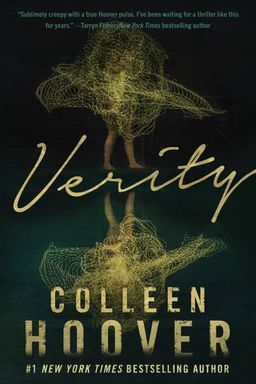
Verity cover

Verity

by Colleen Hoover

In Colleen Hoover''s ''Verity,'' nothing is as it seems. Dive into a world of deception, obsession, and shocking revelations that will leave you questioning every truth. As Lowen Ashleigh unravels a chilling secret, she must confront dark truths and face a haunting decision. Gripping and unpredictable, this thriller keeps you guessing until the very end.

The Darkness Beneath Truth and Fiction

Have you ever wondered what happens when someone’s obsession with truth, love, and storytelling spirals into darkness? In Verity, Colleen Hoover turns that question into a chilling psychological puzzle. Through the eyes of struggling writer Lowen Ashleigh, Hoover dives into a web of manipulation, grief, trauma, and forbidden desire. The book blurs the line between fact and fiction so deeply that you're forced to ask not only what’s real—but who deserves to be believed.

At its surface, Verity is a contemporary thriller about a young writer who gets an unexpected job: finishing a famous author’s best-selling suspense series after the author, Verity Crawford, is left incapacitated from a devastating accident. But very quickly, Hoover reveals that this is not merely a story about a job or ambition—it’s about the corrosive nature of secrets, the psychology of guilt, and how storytelling itself can become a lethal weapon. Lowen’s journey is both literal and symbolic. She arrives at the Crawfords’ isolated Vermont mansion to work, only to find herself losing control of her reality. The deeper she reads into Verity’s unfinished autobiography, the closer she comes to discovering the monstrous heart of a family tragedy.

The Marriage of Horror and Desire

Hoover builds the novel around the dual tension of attraction and fear. Lowen’s growing passion for Jeremy Crawford, Verity’s husband—and her discovery of Verity’s possible crimes—create a moral quicksand. You’re pulled into the forbidden heat between two damaged people while simultaneously feeling the claustrophobic dread hovering above them. Hoover isn’t simply telling a romantic thriller; she’s exploring how desire can hide behind empathy, how sexuality can be both healing and destructive. The mansion becomes a metaphor for the human psyche—a place full of locked rooms, secrets, and illusions.

Truth as a Weapon

At the center of the novel lies a question that shatters every assumption: is Verity truly a monster, or is she a victim of her husband’s violence and Lowen’s misconceptions? Through Verity’s handwritten ‘autobiography’—a twisted confession of jealousy, infanticide, and obsession—Hoover destabilizes truth itself. Every chapter of the manuscript forces Lowen (and you) to reconsider what storytelling means. Is writing an act of self-expression—or a calculated performance? Verity’s words feel too vile to be fiction yet too constructed to be fact. Hoover traps readers inside that ambiguity, forcing them to confront how narratives shape perception. (As Gillian Flynn does in Gone Girl, Hoover makes readers question if the most horrifying truths are manufactured.)

Why It Matters to You

Hoover’s book isn’t only an exercise in psychological suspense—it’s also a mirror to the reader’s own moral intuition. How far would you go to protect yourself from someone you loved? How much truth can you handle before you begin rewriting your own version? Verity invites you not just to read a thriller but to participate in the act of analysis: watching a lie become believable, and watching people unravel under the weight of silence. It challenges you to see that everyone crafts a narrative—not only authors—and that sometimes, those stories are deadly.

By merging horror, love, and creative madness, Hoover transforms writing into survival. The result is a haunting meditation on what happens when storytelling stops being art and starts becoming confession. This summary will unfold the layers of that descent—from trauma and secrecy to manipulation, power, and redemption—revealing why Verity is both an experience of terror and a study of how truth collapses when too many versions of it exist at once.


Lowen’s Descent Into the Crawfords’ World

Lowen Ashleigh is our gateway into the world of controlled horror and quiet obsession. When she witnesses a fatal Manhattan accident and meets Jeremy Crawford moments later—a grieving husband with an aura of tragedy—her life changes. Hoover paints Lowen as a woman already fractured by past trauma: her mother’s death, her financial precarity, and a lingering isolation typical of an introverted writer. New York to Vermont becomes not just a relocation, but a symbolic descent from visibility into invisibility. For Lowen, the mansion is both refuge and trap.

Isolation and the Writer’s Psychology

Hoover uses Lowen’s profession to amplify the novel’s psychological weight. Writers, she suggests, are the perfect vessels for manipulation because they rearrange reality for a living. Lowen’s job—to finish Verity’s successful thriller series—forces her into intimacy with the dead woman’s thoughts. Every piece of fiction she reads blurs into autobiography, until the act of writing feels synonymous with intrusion. She becomes addicted to Verity’s words—papers filled with disturbing truths about motherhood, jealousy, and murder. By the time she realizes her obsession, she’s already too deep inside Verity’s world to escape.

Jeremy: A Man of Grief and Shadows

Jeremy Crawford is portrayed as both victim and predator. Early on, his vulnerability—the loss of his twin daughters and his wife’s incapacitation—elicits sympathy. Yet his calm, controlled demeanor hides a crushing rage. He becomes Lowen’s emotional mirror: two lonely souls seeking solace amid death. But Hoover complicates that intimacy. Jeremy’s compassion toward Verity—and his protective presence toward Crew, their son—mix with an undertone of erotic tension that seeps into Lowen’s every thought. He’s haunted, charming, dangerous. Hoover makes him the novel’s moral barometer, yet she ensures your compass never stabilizes.

The House as Character

The Crawfords’ Vermont mansion is another protagonist. Hoover infuses it with gothic elements—a red door symbolizing blood and passion, an office overflowing with manuscripts, windows that distort perspective. It isolates Lowen while seducing her. In literature, haunted houses often reflect internal decay (think of Jane Eyre’s Thornfield Hall or Shirley Jackson’s Hill House). Here, Hoover reimagines the trope in modern psychological form: the mansion doesn’t just contain ghosts, it creates them through obsession. Lowen’s need for truth becomes the haunting itself. In stepping into Verity’s space, she inherits her madness—and her story.


Verity’s Manuscript: Fiction as Confession

One of the most powerful pillars of the story is Verity Crawford’s secret manuscript—found hidden among boxes in her chaotic office. It starts as a curiosity and becomes a moral catastrophe. In it, Verity recounts her relationship with Jeremy: predatory, erotic, and vividly twisted. Through her supposed autobiography, Hoover explores how personal narrative can distort both reader and writer.

The Psychology of Confession

Confessions are meant to cleanse, yet Verity’s writing corrupts. Each chapter reveals grotesque thoughts about maternity—resenting her unborn twins, competing for Jeremy’s attention, even attempting abortion out of jealousy. Her ‘truths’ challenge the limits of empathy. For Lowen, reading transforms into voyeurism, a ritual of degradation. Hoover uses the document to question authenticity: can a writer’s words ever represent truth, or do they only reflect what she wants others to believe? Verity’s manuscript blurs therapeutic journaling with calculated manipulation.

Motherhood as Horror

Underlying the manuscript is a perversion of motherhood—an inversion of instinct and nurture. Verity sees her twins, Chastin and Harper, not as children but as rivals for Jeremy’s love. Hoover delves into the taboo notion of maternal hatred, reminiscent of Lionel Shriver’s We Need to Talk About Kevin. The scenes of verbal and physical violence—especially Verity’s chilling attempts to harm Harper—push the reader beyond discomfort toward reflection on real-world pressures of perfection and mental illness. The manuscript becomes less about confession and more about control: Verity uses her narrative to dominate, using words as both weapon and shield.

The Confusion Between Truth and Lies

By the time Lowen reaches later chapters, she no longer distinguishes reality from fiction. Hoover crafts this confusion deliberately. Verity’s voice alternates between victim and villain, forcing readers to see how storytelling itself can reshape morality. Every revelation carries a shadow of doubt. You become complicit in Lowen’s curiosity—unable to stop reading while despising yourself for it. That tension is what defines modern psychological thrillers: not clarity, but the fear born of too much understanding.


The Crawford Family’s Tragic Spiral

Behind the psychological games lies an emotional implosion—a family consumed by trauma. Hoover reveals that tragedy doesn’t merely happen to the Crawfords; it perpetuates itself through grief, guilt, and silence. Every member becomes a symbol of survival gone wrong.

Jeremy and His Shadowed Grief

Jeremy’s sorrow over his daughters’ deaths governs his morality. Initially noble, his empathy gradually fractures into obsession. His love for Crew—the surviving child—turns possessive, and his sense of justice mutates into vengeance. Hoover pushes the reader toward uncomfortable empathy: Jeremy is a good man undone by unbearable loss. Yet his inability to process pain breeds violence. By the novel’s end, his grief transforms into moral blindness—culminating in the fatal act against Verity that shocks both reader and protagonist.

Crew: Innocence Amid Horror

Crew Crawford, only five, represents the novel’s haunting residue of innocence. His presence reminds you that children absorb trauma without speaking it. His quiet observations—the turtle scene, his statements about hearing his mother talk—function as eerie windows into unseen truths. Hoover skillfully uses Crew to link the spiritual and psychological realms. You begin to see that although Crew survives externally, internal damage ripples beneath his silence. He symbolizes how even innocence can harbor inherited darkness.

Verity and Jeremy’s Fatal Love

Their relationship embodies addiction masquerading as love. It begins with lust and ends in violence—a full circle of consumption. Hoover portrays intimacy as both cure and poison. Verity’s obsessive passion—for attention, possession, expression—becomes Jeremy’s downfall. Theirs is not the love that redeems, but the love that annihilates. This mirrors the archetype seen in Daphne du Maurier’s Rebecca, where the dead wife controls the living long after her death. Hoover modernizes the motif: Verity doesn’t haunt Jeremy through memory; she haunts him through her words, written, read, and ultimately fatal.


Lowen and Jeremy’s Forbidden Connection

Hoover tests the morality of desire through Lowen and Jeremy’s evolving intimacy. Their attraction starts with empathy—their shared pain—and mutates into complicity. As Lowen uncovers Verity’s horrifying manuscript, attraction becomes justification. If Verity is a monster, isn’t loving Jeremy an act of rescue?

Love as Escape and Contamination

Their sexual tension escalates while surrounded by death. Hoover juxtaposes scenes of sensuality with scenes of decay—Verity’s lifeless body upstairs, Lowen’s trembling guilt. As in Wuthering Heights, passion and destruction coexist. When Jeremy and Lowen finally consummate their relationship, Hoover ensures the reader feels both relief and unease. Their union isn’t romantic—it’s reactionary. They anchor each other against madness but simultaneously sink deeper into it. Love becomes a coping mechanism, not salvation.

Complicity in Violence

The climax reveals their moral collapse: Lowen helps Jeremy kill Verity, believing the woman is alive and dangerous. This moment flips the novel’s central question—what does justice mean when truth is uncertain? Hoover doesn’t allow catharsis. Their act of ‘protection’ blurs into murder, their loyalty into delusion. In helping Jeremy, Lowen finally becomes the creature Verity once was: a storyteller rewriting reality to survive.

The Aftermath of Desire

Their eventual life together—even pregnancy—proves that survival doesn’t equal peace. Hoover leaves readers disturbed by the idea that love built on secrecy always demands more lies. Lowen chooses silence, believing truth is too cruel for Jeremy to bear. The reader becomes complicit in that silence, questioning whether mercy or denial truly saves anyone.


The Final Twist: Truth’s Collapse

In its breathtaking final chapter, Verity detonates the story's entire foundation. Lowen discovers a hidden letter written by Verity, claiming her ‘autobiography’ was a writing exercise—a fabrication meant to perfect her villains. She accuses Jeremy of attempted murder. Suddenly, everything shifts. You realize truth is not shattered—it was never stable to begin with.

Two Versions, One Reality

Hoover’s masterstroke is presenting two irreconcilable truths. Either Verity is an abusive murderer, or she’s an innocent author destroyed by her husband’s misinterpretation. Both versions make sense; both are horrifying. The reader must decide which narrative to believe, knowing that belief itself shapes morality. Hoover isn’t giving resolution—she’s exposing how human perception transforms fiction into fact.

The Power of Narrative Control

This conclusion reframes the entire book as meta-commentary on storytelling. Whoever controls the story controls reality. Lowen and Jeremy’s decision to destroy evidence epitomizes how love manipulates truth for survival. Hoover asks: is silence merciful, or complicit? Readers realize that literature’s most dangerous tool isn’t horror or romance—it’s interpretation.

Ambiguity as Emotional Aftershock

The novel ends without closure. You’re left in paralysis between empathy and judgment. That lingering uncertainty is Hoover’s intended aftershock. By denying absolute resolution, she ensures Verity lives in your mind long after the last page is turned—a haunting exploration of the stories we tell to justify our sins.

Dig Deeper

Get personalized prompts to apply these lessons to your life and deepen your understanding.

Go Deeper

Get the Full Experience

Download Insight Books for AI-powered reflections, quizzes, and more.