
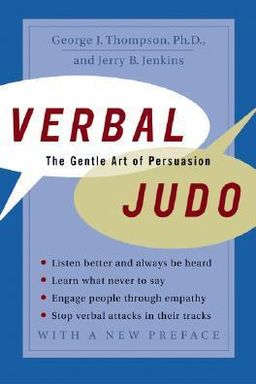
Verbal Judo cover

Verbal Judo

by George J Thompson and Jerry B Jenkins

Verbal Judo is your tactical guide to mastering communication, drawing on police experience to reveal effective techniques for defusing tension, avoiding miscommunication, and building empathetic, respectful relationships. Transform your conversations with these powerful strategies for achieving your communication goals.

The Gentle Art of Persuasion

How can you stay calm when someone is shouting in your face, insulting your dignity, or challenging your authority? In Verbal Judo: The Gentle Art of Persuasion, Dr. George J. Thompson argues that the greatest power you possess isn’t physical force or clever debate—it’s the ability to redirect the energy of conflict through words. Drawing from his experiences as an English professor, martial artist, and police officer, Thompson contends that skillful communication is a discipline comparable to judo itself: instead of resisting an opponent’s attack, you learn to move with it, deflecting aggression and transforming confrontation into cooperation.

Thompson’s central thesis is deceptively simple: words are weapons, and the tongue, not the fist, determines your success in almost every encounter. He saw this firsthand during his years patrolling the streets, where poor communication could endanger lives. Through teaching tens of thousands of police officers and professionals, he developed a system of verbal tactics that allow you to stay calm, clarify intent, and motivate voluntary compliance—whether you’re dealing with a customer, a coworker, a teenager, or a criminal suspect. His aim isn’t to manipulate but to communicate with respect, empathy, and purpose so that both parties can win.

Why This Book Matters

Conflict is inevitable, Thompson reminds us—whether in traffic, at home, or at work. What determines your success is how you speak and listen when under pressure. Most people react emotionally, giving what Thompson calls “the greatest speech you’ll ever live to regret.” Verbal Judo teaches you to avoid those verbal sucker punches by mastering the arts of persuasion, empathy, and calm professionalism. It’s a way to “dance where others stumble”—to convert hostility into understanding and chaos into cooperation.

The Core of Verbal Judo

Thompson structures his philosophy around several key concepts that mirror physical judo techniques:

  • Mind-mouth harmony – a discipline that keeps your thoughts and words aligned under stress.
  • Mushin – the “still center” or calm state of mind drawn from samurai training, which allows responsiveness without emotion.
  • Deflection and redirection – techniques like “strip phrases” (“I ’preciate that, sir, but…”), which let insults glance off you instead of hitting home.
  • Empathy – understanding others’ perspectives to absorb tension and steer their behavior.

These principles lead to practical models like the Five-Step Hard Style (Ask, Set Context, Present Options, Confirm, Act), LEAPS (Listen, Empathize, Ask, Paraphrase, Summarize), and the Five Universal Truths of human interaction, all of which translate ancient wisdom and street-tested tactics into everyday communication tools.

Why “Gentle” Wins

The word judo literally means “gentle way,” a reference that Thompson uses to argue that persuasion is not weakness but mastery through adaptation. Unlike aggressive Verbal Karate—language used to strike, insult, or control—Verbal Judo seeks cooperation by working with another’s energy, not against it. This subtle reversal means that when you stay calm, flexible, and respectful, you remain in control. Like the veteran cops Thompson admired, you maintain professionalism even when provoked and turn crises into opportunities for understanding.

What You’ll Learn

In the sections that follow, you’ll learn how to read different personality types (“Nice, Difficult, and Wimps”), employ empathy as emotional armor, use verbal tactics like paraphrasing and strip phrases to survive confrontation, apply structured persuasion models such as the Five-Step Hard Style and LEAPS, and master tone, language, and body presence (“ethical presence”) in high-stress encounters. You’ll also explore how to blend assertiveness and dignity in your communication—so you can “take crap with style” without ever losing respect for yourself or others.

Ultimately, Thompson’s work stands as both philosophy and field manual—a guide to speaking truth with tact, mastering self-control, and treating others with respect even when they don’t deserve it. In a world that often confuses anger with strength, Verbal Judo invites you to discover that calmness is the sharpest blade of all.


Mind-Mouth Harmony: Staying Centered

George Thompson insists that before you can control a situation, you must first control yourself. He borrows the samurai concept of mushin—the “still center”—to describe the calm, disinterested mindset required for effective communication. In judo, physical strength means little if you lose composure. Similarly, in conversation, if someone can upset you, they own you. Mind-mouth harmony means keeping your thoughts, emotions, and words aligned, no matter what provocation arises.

Mushin and the Flexible Mind

Thompson describes mushin as the ability to stay calm, read an opponent, and redirect aggression rather than resist it. He likens this to being a willow tree instead of an oak: bending under pressure instead of breaking. The English equivalent, he says, is disinterested—not “uninterested” but impartial and open. A flexible mind perceives nuance and survives storms, while a rigid one misreads people and sparks confrontation. In communication, disinterested professionalism means you observe without personal bias and respond tactically rather than emotionally.

Deflection Over Confrontation

Thompson learned the value of deflection after years of snapping back at insults. He quotes an old samurai: “When man throws spear of insult at head, move head! Spear miss target.” The Western “sticks and stones” cliché fails because verbal wounds linger. Deflection, not denial, is what saves your dignity. He developed strip phrases—short, disarming replies like “I ’preciate that, sir,” “I understan’ that,” or “Oyesss”—to let insults slide off while pivoting back to purpose: “I ’preciate that, sir, but I need to see your license.” These small linguistic shields protect your composure and keep interactions professional.

Respond, Don’t React

Reacting means being controlled by emotion; responding means remaining in control of the situation. Thompson often tells the story of his canine police dog, calm at home but ready for duty when the collar went on. Likewise, your “professional collar” lets you act tactically in chaos. Strip phrases and calm responses put emotional armor around your professionalism, ensuring you sound good, not just feel good. When anger rises, remind yourself of Thompson’s mantra: “When your mouth opens, your ears slam shut.” Staying still inside ensures your words cut tension instead of fuel it.

By mastering mushin and mind-mouth harmony, you gain something rare—control under fire. Like a samurai waiting out a storm or a negotiator who redirects rage into reason, you learn the art of peace through words. It’s not stoicism; it’s strategy. Your calm invites cooperation, your flexibility disarms hostility, and your words become tools, not weapons.


Empathy: The Most Powerful Word

Thompson calls empathy the most powerful word in the English language. It’s not sympathy, softness, or agreement—it’s the ability to see through another’s eyes. Derived from Greek and Latin roots (em means “to see through,” pathy means “eye of the other”), empathy turns tension into cooperation. When you empathize, you step out of your feelings and into the other person’s. That single act absorbs volatility like a sponge.

Empathy Under Pressure

Thompson’s most gripping example is a suicidal man sitting in a bathtub, threatening to pull in an electric heater. While other officers pleaded, “You’ve got your whole life ahead of you,” Thompson stepped into the man’s perspective: “You picked the hundred and fifth most painful way to die.” He described the horror in detail, promising to show the man quicker, less painful methods—if he first stepped out. The shock of being understood snapped the man’s suicidal trance. Lies aside, empathy—not logic or kindness—saved his life. Thompson understood that when crisis hits, people don’t want comfort; they want to feel understood.

Everyday Empathy

Empathy also diffuses smaller conflicts. He shares a story of a father who calmed his furious teenage son by granting what he called “a 24-hour reprieve.” Instead of scolding, the father simply said, “I understand how hurt you are. Give it a day.” The next evening, the son had cooled down and reconciled with his girlfriend. Empathy buys people time to think without influence of rage or pride. Thompson emphasizes: give others space, not lectures.

Seeing Through the Other’s Eyes

Empathy isn’t agreement—it’s tactical understanding. You think like your boss, your spouse, or your child so you can speak their language. When you truly see through their lens, conflict shifts to problem-solving. Thompson’s insight parallels that of psychologist Carl Rogers, who argued that genuine listening unlocks the capacity for change. (Note: Both view empathy as active engagement, not emotional indulgence.) Practicing empathy transforms confrontation into cooperation, making it the purest form of Verbal Judo.

Empathy doesn’t mean surrender. It’s a disciplined choice to move with people rather than against them, to earn compliance rather than demand it. If you can empathize even when under attack, Thompson guarantees, “You can dance where others stumble.”


The Five-Step Hard Style of Persuasion

At the heart of Verbal Judo lies a clear roadmap for persuasion called the Five-Step Hard Style. Born on the streets of Kansas, it replaced Thompson’s youthful habit of command-and-confront with a structured system for generating voluntary compliance. These five steps—Ask, Set Context, Present Options, Confirm, and Act—blend ancient rhetoric, modern psychology, and samurai discipline into a repeatable process for influence.

1. Ask: Ethical Appeal

Begin with respect. Thompson recalls softening his tone to ask a drunk driver to step out of his car: “Sir, would you do that for me?” Asking signals cooperation, not coercion, and invokes professional authority rather than ego.

2. Set Context: Reasonable Appeal

People want to know why. When you explain reasons—policy, safety, fairness—most resistance dissolves. “Of ten drivers who refuse a lawful request,” Thompson notes, “seven comply when you simply tell them why.” This step shows reasoning power and calms curiosity.

3. Present Options: Personal Appeal

Choices empower people. Thompson’s example remains legendary: telling a suspect, “You can go home tonight and sleep in your bed, or come with us and eat jail food.” He left the decision—and dignity—with the offender. Threats breed rebellion; options inspire cooperation.

4. Confirm: Practical Appeal

Before acting, confirm resistance: “Is there anything I can say or do to earn your cooperation?” This pleasant but decisive question signals your final effort while alerting your partner that action is next. It’s respectful face-saving—a chance to yield gracefully.

5. Act: Determined Action

If persuasion fails, act decisively—but without anger or drama. Whether enforcing discipline at home or arresting a felon, you respond calmly and professionally. “Repetition reveals weakness; variance shows strength,” Thompson teaches. The hard style means grace under fire.

These steps transfer seamlessly from street patrols to boardrooms and living rooms. They turn emotional standoffs into orderly dialogues. The brilliance of Thompson’s model isn’t its complexity but its rhythm—ethical respect, rational explanation, empowered choices, confirmed resolution, and honorable action. It’s persuasion that dignifies both sides.


Reading People: Nice, Difficult, and Wimps

Thompson simplifies humanity into three communication archetypes—Nice People, Difficult People, and Wimps—cutting through cultural, racial, and social distinctions. Knowing which type you’re dealing with lets you adapt your communication style and prevent escalation.

Nice People

Nice People cooperate easily. They do what you ask because they value harmony. But Thompson warns never to take them for granted. “Treat them as important,” he says, “or you’ll lose them.” In leadership, reward cooperation with genuine respect—not canned gratitude (“Thank you for shopping here”). His fix? Speak personally: “I appreciate your patience; your cooperation made this easier for everyone.”

Difficult People

Difficult People resist authority on principle. They live by “Why?”—a word Thompson calls “the most American question.” Coping with them means embracing curiosity instead of irritation. When challenged, answer questions with candor: give context, show what’s in it for them, and redirect their energy. “Difficult People built this country,” Thompson says. “You need them. The challenge makes you better.” (This perspective echoes Dale Carnegie’s notion in How to Win Friends and Influence People that arousing cooperative desire builds influence.)

Wimps

Wimps are hidden Difficult People. They agree to your face but undermine you behind your back. “If complaints ever surprise you,” Thompson warns, “they came from a Wimp.” Handle Wimps by confronting them courteously and directly, stripping their cover without humiliation—“Excuse me, I’d like to know what you just said.” Exposure disarms backstabbers. Ignoring them empowers them; direct civility defeats them.

By learning to identify these types, you act tactically instead of emotionally. Nice People need appreciation, Difficult People need reasoned control, and Wimps need exposure. Recognizing which personality you face is the first step in applying verbal judo instead of verbal karate.


Verbal Judo vs. Verbal Karate

One of Thompson’s most memorable contrasts is between Verbal Judo and Verbal Karate. The difference lies in intent: Verbal Judo is persuasion through respect and tact; Verbal Karate is verbal aggression—hitting with words that wound and divide. Where Judo seeks understanding, Karate seeks victory. Thompson bluntly admits he was once a master of verbal karate, proud of his ability to “tell people off,” only to realize he left behind wrecked relationships and endless regret.

The Verbal Combat Zone

He recalls his own shift from commanding people to reasoning with them. When he ordered suspects to “Get out of the car,” he provoked confrontation; when he asked respectfully and explained the law, he gained compliance. Verbal Karate might feel powerful in the moment, but it always loses strategically. His phrase “the greatest speech you’ll ever live to regret” defines every angry outburst that burns bridges.

The Gentle Way in Practice

Verbal Judo means using words to redirect behavior—the gentle way. When his teenage daughter Kelley demanded a car, Thompson deflected rather than denied: “What if you had to maintain it yourself?” That redirection led her to propose a practical compromise—a bike that served both. Small adaptations like this demonstrate that persuasion isn’t domination but guidance. He notes, “You control by directing, not by forcing.”

Presence Before Words

The first “force option” isn’t speech but presence—how you show up. Calm demeanor disarms anger before a single word is spoken. Whether as a cop or parent, your posture, tone, and trustworthiness carry more weight than your message. Thompson’s law: “It’s not enough to be good; you’ve got to look good and sound good, or it’s no good.” Control begins with perception.

Ultimately, Verbal Judo transforms communication from a contest into collaboration. Anger may seem powerful, but calm persuasion wins—and keeps you proud of what you said long after the moment has passed.


The Five Universal Truths of Human Interaction

In Thompson’s final chapter, he distills decades of teaching into five universal human truths—principles that transcend culture, gender, and background. These truths answer how all people want to be treated, and applying them virtually guarantees smoother relationships at work, home, and anywhere power dynamics exist.

1. Everyone Wants Dignity and Respect

No one responds positively to humiliation. Disrespect triggers revenge. Verbal Judo starts here: treat others with dignity even when you don’t respect their actions. A professional must show REspect—respect given back—not necessarily admiration. This is the Golden Rule compressed to a single syllable.

2. Everyone Prefers Being Asked, Not Told

Requests imply partnership; commands imply hierarchy. Whether with a colleague or teenager, “Would you…” invites cooperation better than “Do this.” Asking honors autonomy and de-escalates tension.

3. Everyone Wants to Know Why

Explanation reduces resistance. Thompson’s research found that simply offering reasons lowers anger in seventy percent of people. In corporations or families, clarity builds trust faster than authority.

4. Everyone Prefers Options Over Threats

Choice is respect. Options let people save face and maintain control. Threats corner them and cause rebellion. As Thompson says, “Give choices, not ultimatums.”

5. Everyone Values a Second Chance

Humans err. Allowing people to make amends sustains relationships and restores dignity. Professional communicators understand that redemption strengthens rather than weakens authority.

Thompson adds an acronym—SAFER—for when these truths must yield to action: Security threats, Attack, Flight risk, Excessive repetition, and Revised priorities. Words fail, but respect must never.

These five truths are universal because they describe human nature, not situational etiquette. When you can live them, you embody Verbal Judo’s ultimate purpose: to use words to create peace, empathy, and understanding in a world desperate for all three.

Dig Deeper

Get personalized prompts to apply these lessons to your life and deepen your understanding.

Go Deeper

Get the Full Experience

Download Insight Books for AI-powered reflections, quizzes, and more.