
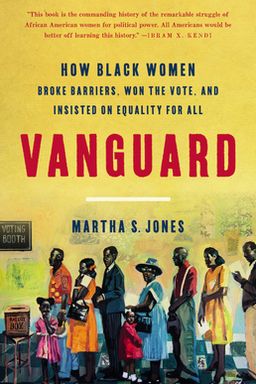
Vanguard cover

Vanguard

by Martha S Jones

Vanguard explores the pivotal role of African American women in the United States'' struggle for justice. Through defying racism and sexism, they forged a path toward a biracial democracy, winning voting rights and challenging societal norms. Discover the remarkable individuals and grassroots organizations that fought for equality and transformed the landscape of American democracy.

Black Women as America's Political Vanguard

How does a group long excluded from formal power come to lead the nation’s most consequential democratic struggles? In Vanguard, historian Martha S. Jones argues that Black women have shaped the United States' democratic life more deeply than most history books admit. She calls them the nation’s “vanguard” because they do not merely fight for inclusion—they redefine what inclusion means. Their politics fuses race, gender, and citizenship into one moral and institutional project, pressing the country to make freedom real for all.

Jones constructs a sweeping two-century narrative—from Jarena Lee’s 1820s sermons to Stacey Abrams’s twenty-first century campaigns—showing how Black women built political agency from the ground up. They learned governance in churches, framed ideologies in print and on podiums, tested citizenship through the courts, and built lasting institutions like the National Association of Colored Women (NACW). Across generations, they prove that democracy’s moral energy and organizational muscle often begin at the margins.

From Spirit to Structure

The earliest vanguard figures found their training grounds not in legislatures but in sanctuaries. Within the African Methodist Episcopal and AME Zion churches, women like Jarena Lee and Julia Foote challenged male hierarchies, winning preaching licenses and offices of deaconess. Their petitions, sermons, and eventual ordinations transformed the church into an incubator of democratic skill—teaching women the use of rhetoric, parliamentary procedure, and institution building. Religion thus became a disguised political academy, a place where moral conviction and administrative skill overlapped.

Jones shows how this training translated outward: churchwomen turned editors, founders, and civic organizers. Their sanctified journeys prepared them to navigate politics beyond the pulpit. By the late 1800s, women like Frances Ellen Watkins Harper, Mary Ann Shadd Cary, and Maria Miller Stewart were using print and public performance to raise civic consciousness across race and gender lines.

Print, Podiums, and Public Life

Long before Twitter or radio, Black women used two transformative technologies—the printing press and the lecture platform—to amplify their politics. Stewart became the first American woman to address a mixed political audience; Sarah Mapps Douglass and Shadd Cary extended the written word’s reach through abolitionist newspapers. Print created networks that turned local activism into transregional discourse. Public performance added visibility, though at great cost—jeering mobs, arson, and misquotation (as in the posthumous distortion of Sojourner Truth’s Akron speech). Yet, women persisted, mastering respectability politics and performance simultaneously to disarm prejudice and force moral reckoning.

Reconstruction and Institutional Expansion

The Civil War and Reconstruction opened a brief but generative window. Service as nurses, teachers, recruiters, and writers gave women moral standing and political insight. Harriet Tubman, Charlotte Forten, Susie King Taylor, and Harriet Jacobs linked daily relief work to national reform, demanding protections that would give freedom substance. But Reconstruction’s collapse and Jim Crow’s rise made self-organizing necessary. Clubwork and schooling became tools of cultural defense. The NACW, founded in 1895, embodied a century’s worth of experience by codifying the credo “Lifting as we climb”—uplifting the race while demanding collective progress and female leadership.

From Clubs to the Ballot

When Black women entered suffrage politics, they faced impossible dual pressures—racism within white-led feminism and sexism within Black political circles. Frances Harper’s 1866 plea that “we are all bound up together” sums up this intersectional dilemma. Leaders like Mary Church Terrell, Ida B. Wells, and Adella Hunt Logan fought to align the NACW with national suffrage networks while maintaining independence. Their activism anticipated the “intersectionality” Kimberlé Crenshaw would later theorize—but here it was lived, not labeled.

Jones emphasizes that suffrage victories were partial. The 19th Amendment enfranchised women in theory, but states weaponized literacy tests, poll taxes, and intimidation to exclude them. Maggie Lena Walker and the NACW countered with voter education campaigns, civic night schools, and lawsuits. The paradox of “formal right without practical power” haunted Black women until the Voting Rights Act of 1965—and continues, Jones suggests, in voter suppression laws today.

Political Power as Moral Defense

For Jones, voting is not just procedure but protection. Nannie Helen Burroughs called the ballot “her weapon of moral defense”—a shield against sexual violence and social degradation. The claim that governing equals safeguarding connects Harriet Jacobs’s testimony under slavery to Fannie Lou Hamer’s suffering in 1960s Mississippi prisons. To vote was to claim bodily dignity and compel the state to honor its duty of protection.

Bureaucracy, Direct Action, and Global Reach

In the twentieth century, politics diversified beyond petitions. Mary McLeod Bethune used New Deal programs to build administrative authority, founding the National Council of Negro Women and advising Roosevelt’s “Black Cabinet.” Diane Nash and Fannie Lou Hamer’s direct action echoed that heritage—translating institutional know-how into disciplined protest. Meanwhile, Bethune and Eslanda Robeson internationalized the struggle, arguing at early UN sessions that racial justice is a human rights issue, not just a domestic grievance. Some, like women in the Garveyite UNIA, pursued autonomy through Pan-African solidarity—a reminder that Black feminism’s reach has always been both national and global.

The narrative ends not in closure but in continuity: Shirley Chisholm’s presidential run, Barbara Jordan’s constitutional voice, Loretta Lynch’s leadership at the Justice Department, and Stacey Abrams’s voter mobilization all stand on foundations laid by unnamed women’s clubs, church petitions, and suffrage schools. The book’s lasting insight is simple but transformational: democracy advances when those excluded from its promises insist on reshaping the very meaning of citizenship for everyone.


Faith as a School for Politics

If you trace Black women’s political training, you find its earliest lessons in faith communities. The church was not only sanctuary—it was an institution of governance and rhetorical power. Jones devotes early chapters to African Methodist denominations, where women carved routes to public leadership by reframing devotion as duty to justice. Their pew-side organizing modeled democratic method long before they had any legal vote.

From Sacred Calling to Civic Authority

Jarena Lee’s 1819 sermon in an AME congregation—delivered without permission but validated by Bishop Richard Allen—represents this shift. To claim divine calling was to demand institutional recognition, forcing male authorities to confront women’s authority as both moral and procedural truth. Jones calls such moments “performances of equality.” Over time, petitions for preaching licenses evolved into formal recognition: the Daughters of Conference (AME) and Sisters of Zion (AME Zion) used parliamentary petitions and allies like Rev. Nathan Ward to advance their cause. As debates spread through denominational newspapers, women learned advocacy, alliance-building, and exposure to power’s backlash.

The Church as Democratic Laboratory

What seems devotional becomes political apprenticeship. Eliza Ann Gardner’s campaign to revise AME Zion’s disciplinary language—purging “he” and “male” pronouns from ecclesial law—reveals how word choices can embody equality. These revisions opened executive offices and deaconess appointments to women, transforming spiritual equality into administrative equity. The church became America’s first “citizenship classroom” for countless women who would later chair clubs, edit newspapers, and run political campaigns.

When you watch women balance service roles—teaching Sunday school, raising funds, organizing missions—transform into power bases, you see a central pattern of Vanguard: moral performance becomes governance practice. The altar rail teaches the skills that later enlarge democracy’s boundaries.


Print, Podium, and the Politics of Voice

In 19th-century America, before women had a political franchise, they made their words perform citizenship. Jones tracks this mastery of media as both technology and rhetoric. From Maria Stewart’s addresses in Boston to Mary Ann Shadd Cary’s Provincial Freeman, Black women redefined visibility and respectability as weapons of persuasion.

Print as Power

Print culture gave women who were excluded from legislatures a way to legislate ideas. Stewart’s pamphlets united piety and politics; Douglass’s correspondence networks linked women’s reading clubs into editorial boards; Shadd’s newspaper extended debates on education, emigration, and self-help to transnational audiences. Each used the page to weave communities across distance and class. The circulation of ideas built constituencies—an early version of viral organizing.

The Platform and Its Perils

Public speech, however, risked body and reputation. At Pennsylvania Hall in 1838, mobs burned the building after interracial women dared speak on abolition. Frances Harper endured ridicule and ejection from railroad cars; Truth faced distortion when male editors reshaped her oration into dialect. Yet the very risks made their protest legible—a kind of talk-back to power that fused intellect with embodied defiance.

Insight

For Black women, print and performance were acts of governance—they decided whose stories counted as public truth.

Communication Networks as Organizing Infrastructure

Newspapers and lecture circuits functioned like connective tissue linking scattered communities. Advertisements for Harper’s lectures, Shadd’s editorials, and letters to The Liberator created a decentralized press network decades before national civil rights organizations. These media channels allowed ideas to survive repression and avoid institutional gatekeeping. In doing so, Black women turned communication itself into a political structure—a truth as relevant in the digital age as it was in 1830s Boston.

Jones reminds you that every lyric, tract, or address was administrative labor: editing copy, funding printing, booking venues, recruiting allies. The work of words built the organizational muscle that later powered Reconstruction relief and national suffrage campaigns.


Reconstruction to Club Power

War and emancipation radicalized gendered civic life. The Civil War brought new statuses—teacher, nurse, recruiter—that Black women wielded to justify a share in citizenship. After 1865, they translated service into organization, turning ephemeral relief work into permanent institutions.

From Service to Political Claim

Mary Ann Shadd Cary’s recruitment for the 29th Connecticut Volunteers tied military service to civic entitlement: soldiers earned amendments, and their women recruiters claimed a say in defining freedom. Harriet Jacobs and Charlotte Forten used their wartime writings to pressure policymakers, merging biography with advocacy. These women grasped that freedom required institutional embodiment—schools, churches, aid societies—not just emancipation proclamations.

The Club Movement as Continuity

Out of Reconstruction’s collapse grew a new architecture of perseverance: the club movement. By 1895, the National Association of Colored Women united hundreds of local chapters under leaders like Josephine Ruffin, Ida B. Wells, and Mary Church Terrell. Their slogan “Lifting as we climb” blended collective service and political self-assertion. Clubs provided social welfare where the state failed, ran schools and settlement homes, and pushed for suffrage laws. When legislatures wavered, clubs acted as both social safety net and political caucus.

Internal debates animated this network. Some preferred quiet uplift, others confrontation. Terrell pushed open suffrage alliances; Margaret Murray Washington favored grassroots independence. Their disagreement embodied a strategic duality—work within systems when possible, build outside alternatives when not. This tension kept the movement agile and grounded in Black women’s realities.

By converting service ethics into civic infrastructure, the clubwomen did more than survive Jim Crow—they built the organizational logic that would sustain 20th-century federal activism and civil rights campaigns.


Suffrage’s Paradox and Moral Purpose

Suffrage chapters in Vanguard read as a lesson in persistence amid betrayal. The early women’s rights movement often erased or sidelined Black reformers; yet Black women expanded the meaning of citizenship by binding liberty to justice. Jones positions suffrage not as an endpoint but as one milestone in a broader moral project.

Alliances and Exclusions

Black women faced brutal contradictions. White allies like Stanton and Anthony appealed to racism to win white Southern support, while men in reconstruction politics sometimes downplayed women’s rights as secondary. Frances Harper’s 1866 appeal—'we are all bound up together'—rebuked both camps. Mary Ann Shadd Cary’s localized voting test in Washington, D.C., typified strategic pragmatism: when national promises failed, exploit municipal entry points. Such tactics demonstrate how legal strategy served as moral pedagogy—forcing America to confront who counted as citizen.

The 19th Amendment’s Unfinished Work

After 1920, formal enfranchisement collided with local repression. Mississippi’s poll taxes, Alabama’s registrars, and Georgia’s procedural tricks kept most Black women disenfranchised. Jones narrates Maggie Lena Walker’s dignified defiance—organizing voters, paying taxes, and facing humiliation at segregated registration lines—as a ritual of resistance. Clubs turned exclusion into civic schooling: night classes, mock elections, and citizenship leagues trained communities to endure until federal intervention finally arrived in the 1960s.

The Ballot as Moral Defense

For Nannie Helen Burroughs and later Fannie Lou Hamer, suffrage was bodily security. Burroughs said the ballot defends against moral degradation; Hamer embodied that claim through her testimony of assault when trying to register. In both, you see that voting was not abstract participation—it was protection. Jones reframes participation as self-preservation, where state power, once deadly, must be repurposed for defense of the vulnerable.

By the Voting Rights Act’s passage, Black women had articulated a philosophy of citizenship that fused freedom, safety, and collective duty—a redefinition of democracy rarely credited to them but essential to sustaining it.


Institutions, Direct Action, and Global Reach

Twentieth-century chapters of Vanguard expand the map of power. Jones shows that Black women’s political genius lies in multiplicity—building institutions, commanding bureaucracies, mastering protest logistics, and imagining international solidarities. The diversity of method is itself the political philosophy: democracy requires many doors.

Building an Administrative State

The New Deal created expansive bureaucratic infrastructure, and Mary McLeod Bethune rushed in. By leading the National Youth Administration’s Minority Affairs division, she infused federal programs with racial justice goals. Jane Bolin’s judgeship and Crystal Bird Fauset’s election marked additional 'firsts' that reshaped civic imagination. Yet, as Jones notes, these triumphs coexisted with exclusions—the Social Security Act’s omission of domestic and agricultural workers intentionally limited Black women's economic security. Even as they climbed, structure restricted their reach.

Direct Action as Institutional Continuation

The sit-ins, Freedom Rides, and Selma campaigns did not abandon club or church strategies; they updated them. Diane Nash’s methodical coordination of training, bail funds, and march routes carried the procedural discipline of earlier reformers into a new, televised era. Women like Septima Clark and Fannie Lou Hamer built citizenship schools that turned literacy and law into bridges toward actual ballots. The invisible skills of governance—record-keeping, safety planning, alliance management—were the spine of successful protest.

Global and Alternative Routes

Even as some wielded domestic policy, others globalized justice. Bethune’s presence at UN planning sessions and Eslanda Robeson’s international activism redefined rights as global obligations. Meanwhile, women in Garvey’s UNIA built independent institutions—business leagues, women’s councils—that enacted sovereignty outside American politics. Jones connects these divergent strategies as complementary: whether through the state or against it, Black women crafted alternate paths to dignity.

Their versatility forecasts today’s multilayered activism, where lawsuits, nonprofits, demonstrations, and digital campaigns intersect. Multipronged politics, Jones insists, is not improvisation—it’s inherited strategy refined over centuries of adaptation.


The Vanguard’s Continuing Lineage

The final stretch of Vanguard brings the story full circle—showing how churchwomen’s petitions and clubwomen’s constitutions seed the political careers of Shirley Chisholm, Barbara Jordan, and Stacey Abrams. The lineage is neither metaphorical nor symbolic; it’s structural, encoded in organizations, networks, and habits of resilience.

From Firsts to Frameworks

Chisholm’s congressional win and presidential run (“Unbought and Unbossed”) embodied centuries of insistence on independent voice. Barbara Jordan’s leadership during the Nixon hearings carried the moral register of every pulpit-born orator before her. Lani Guinier’s derailed nomination in 1993 exposed modernized resistance to integrating Black feminist intellect into high office. Each name becomes a node in an evolving system of representation, not an isolated triumph.

Contemporary Reframing and Activist Inheritance

Stacey Abrams’s Fair Fight embodies Jones’s long arc—a combination of data-driven institution-building, legal vigilance, and grassroots trust. Like her predecessors, Abrams links historical trauma to present practice: the same fear that silenced grandmothers informs twenty-first-century vigilance about access. Jones situates such efforts in continuous motion: past as toolkit, not nostalgia.

Closing Insight

Each generation inherits not a fixed ideology but a repertoire—speech, organization, law, and faith—through which new struggles are waged.

From the Combahee River Collective to contemporary organizers in labor and voting rights movements, the vanguard persists. Jones’s closing lesson is generous: democratic renewal depends on those historically at the periphery. Black women’s politics, forged through endurance and imagination, continues to redefine justice for the nation and for the world.

Dig Deeper

Get personalized prompts to apply these lessons to your life and deepen your understanding.

Go Deeper

Get the Full Experience

Download Insight Books for AI-powered reflections, quizzes, and more.