
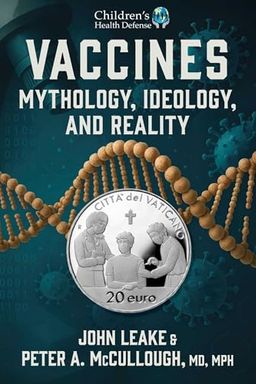
Vaccines cover

Vaccines

by John Leake And Peter A. Mccullough

An assessment of the history of vaccinations and an argument that the benefits of certain vaccines have been exaggerated by some.

Vaccines: Sacred Cow or Science?

When you hear the word vaccine, do you instinctively think rescue or risk–benefit math? In Vaccines, John Leake and Peter A. McCullough argue that modern societies have elevated vaccines from a medical tool into a sacred cow—an institution presumed above scrutiny—while the real drivers of infectious-disease decline were often cleaner water, better food, and basic sanitation. The authors contend that the world’s rush into genetic COVID-19 shots without rigorous, transparent debate represents the latest chapter in a longer history where enthusiasm, prestige, and profit sometimes outpaced evidence.

The book’s core claim is provocative: across three centuries, mass vaccination has repeatedly been propelled by powerful narratives, heroic personalities, and institutional interests, while crucial uncertainties about efficacy, safety, and alternatives were minimized. You’re invited to examine a sweeping record—from smallpox variolation in 1721 Boston and Edward Jenner’s cowpox claims, to Pasteur’s celebrity science and the Great Stink’s sanitary revolution; from influenza’s moving target to polio’s triumph shadowed by debacles; from the 1986 liability shield to the autism controversy; and finally to biosecurity, lab-origin debates, and the COVID-19 mRNA era.

What This Book Sets Out To Do

Leake and McCullough don’t argue that vaccines never work or that you should reject every shot. They argue you should reclaim your right to ask careful questions: What exactly reduced infectious mortality—was it vaccines, or water filtration, chlorination, pasteurization, nutrition, antibiotics, and housing (as public-health historians like Thomas McKeown argued)? When vaccines did help, did they do so as expected, or were effects mixed and context-dependent? And when policies turned mandatory—especially under legal shields—did incentives misalign with transparent risk–benefit analysis?

A Guided Tour of Contested History

You start in colonial Boston, where Cotton Mather and Dr. Zabdiel Boylston championed variolation during a deadly smallpox outbreak, while Dr. William Douglass and a young Benjamin Franklin’s newspaper raised red flags about spread and safety. Next, you follow Jenner’s famous 1798 cowpox story and the confusion over what vaccinia really was—cowpox, horsepox, or something else—and why later towns like Leicester beat smallpox not by mass vaccination alone, but with rapid detection and quarantine. You meet Louis Pasteur, whose legend looms large, but whose laboratory notebooks—later opened to historians—don’t always match the triumphant press conferences on anthrax and rabies (see Gerald Geison’s The Private Science of Louis Pasteur).

From there, you reframe the 19th–20th century decline of water- and air-borne killers: engineers like Joseph Bazalgette cleaned London’s Thames; John Snow and Filippo Pacini linked cholera to contaminated water; and Walter Reed, William Gorgas, and Carlos Finlay subdued yellow fever by controlling Aedes mosquitoes. You then enter the murkier story of influenza: Thomas Francis Jr. and Jonas Salk’s inactivated vaccine under wartime pressure; the ill-fated 1976 swine flu push; and 2009’s mild H1N1 ‘pandemic,’ which still triggered big vaccine orders. As NIAID’s Anthony Fauci later co-authored, mucosal respiratory viruses have repeatedly resisted lasting vaccine control, calling for humility about what injectable shots can deliver.

Schedules, Safety, and Trust

You’ll revisit the polio arc—from the 1955 Salk announcement celebrated like V-E Day to the Cutter incident’s 40,000 infections, then SV40 contamination, and Sabin’s oral vaccine trade-offs—plus the story of DTP’s whole-cell side effects, Japan and Sweden’s pivot toward acellular pertussis, and the United States’ 1986 National Childhood Vaccine Injury Act granting manufacturers sweeping liability protections. The authors insist this legal regime dampened incentives to improve safety while mandates expanded shots on the childhood schedule.

The Autism Dispute and the Courts

You’ll also step into the contentious Wakefield/Lancet saga, the U.S. Omnibus Autism Proceeding, and Dr. Andrew Zimmerman’s affidavit describing a subset of children with mitochondrial dysfunction for whom vaccines might contribute to regressive encephalopathy with features of autism—juxtaposed with public messaging that, the authors argue, shut down discussion rather than tested competing hypotheses. Whatever your priors, the book asks you to wrestle with data trends, incentives, and how a just system should handle plausible signals.

A recurring refrain

Science advances by scrutiny, not censorship. When liability and mandates replace consent and transparency, trust erodes—and safety innovations stall.

From Biodefense to mRNA

Finally, you encounter the ‘bioterror racket’ argument: after 2001’s anthrax mailings and the PREP Act’s liability shields, dual-use research expanded; Ralph Baric and Peter Daszak pursued chimeric SARS-like bat coronaviruses; and mRNA platforms (Moderna, BioNTech/Pfizer) promised speed. The book claims Moderna and NIAID collaborated years before 2020, and that early trial design, rapid authorizations, and adverse-event signal handling for COVID-19 shots fell far short of the standard needed to sustain trust in a product rolled out to billions.

Whether you agree with every conclusion, the stakes are clear: your family’s health decisions deserve honest accounting of benefits and risks; your community’s public health requires tools beyond a single technology; and your trust depends on institutions that welcome debate, disclose data, and put safety first.


The Myth That Vaccines Ended Plagues

Leake and McCullough open by challenging a conviction you may have absorbed without noticing: that vaccines were primarily responsible for the 20th century’s dramatic decline in infectious disease mortality. They argue the heavy lifting was done by sanitation, clean water, safer food, antibiotics, housing, labor protections, and better nutrition—then vaccines contributed variably, sometimes modestly, and often later.

What the Mortality Curves Really Show

The book plots a familiar figure (based on U.S. Vital Statistics): from 1900 to the late 1940s, deaths from many infectious diseases plummeted—decades before widespread vaccine use for most conditions (measles, diphtheria, pertussis) and well before the 1963 measles vaccine. In 1962, for example, with no measles vaccine yet licensed, 408 Americans died of measles (down from far higher early-century rates). By 1946, deaths from diphtheria (1,259), pertussis (1,241), and tetanus (585) were already a small fraction of earlier levels. Meanwhile, antibiotics (sulfa drugs in the 1930s; penicillin in the 1940s; erythromycin in 1952) beat back bacterial killers like pneumonia, diphtheria complications, and wound infections.

The authors highlight Stanford T. Shulman’s description of 19th–early 20th century hazards: sewer water in city pumps, milk contaminated with human and bovine tuberculosis, streptococci, diphtheria, and ‘summer diarrhea’, smoky air, crowding, and winter cold. As those exposures declined—thanks to filtration, chlorination, pasteurization, refrigeration, sewer construction, and housing norms—children’s immune systems got a fighting chance. Thomas McKeown’s thesis (The Origins of Human Disease) is invoked repeatedly: population health rose mainly because nutrition and living conditions improved; medicine came later.

Natural Selection and Case Fatality

The authors go further, suggesting that centuries of urban exposure may have exerted selection pressure for disease resistance—while improved nutrition reduced case severity. Consider measles: the U.S. case fatality rate fell from 21 per 1,000 cases (1911–12) to under 1 per 1,000 before vaccination (1953–62). By 1933, cancer—not TB or pneumonia—was the second leading cause of death, with heart disease first since 1910. In other words, infectious mortality receded as a proportion of all deaths before most vaccines arrived.

The authors’ caution

When you credit a single technology for a multi-factor public-health revolution, you risk poor policy: mandates where public works would help more; censorship where debate would improve safety; complacency where better hygiene, early treatment, and nutrition remain essential.

Why This Matters for You

If you believe vaccines alone tamed infectious disease, you may neglect the basics that still pay off: Vitamin A status with measles, wound hygiene for tetanus risk, air quality for respiratory illness, or simple handwashing during norovirus waves. You also may misread modern outbreaks. Leicester, England drastically reduced smallpox mortality via rapid case-finding and quarantine, even as vaccination waned—foreshadowing later ‘surveillance and containment’ strategies used in smallpox eradication (as microbiologist Derrick Baxby and medical historian Stuart Fraser documented). The authors aren’t nihilists; they’re urging you to expand your prevention toolkit and to judge each vaccine in its full context of risk, benefit, and alternatives.

Context From Other Thinkers

Public-health historians have long noted the sanitation revolution’s supremacy (see Steven Johnson’s The Ghost Map on John Snow; Steven Pinker’s Better Angels on modernity’s civilizing processes). Leake and McCullough place that insight front and center, then revisit vaccine history with a sharper critical lens than you may have seen in mainstream tellings. Whether you end in the same place, you’ll come away better equipped to separate correlation from causation—and to see how water pipes, sewers, milk standards, and labor law quietly saved more lives than headlines ever will.


Smallpox: Hype, Hindsight, and Leicester

If any disease made the vaccine idea sacred, it was smallpox. The book asks you to replay the tape with fresh eyes—from Cotton Mather’s 1721 Boston variolation campaign and Edward Jenner’s cowpox narrative to the 19th-century backlash and Leicester’s sanitation-plus-quarantine method. The motif is not denial of smallpox’s horror; it’s scrutiny of methods, numbers, and assumptions.

Variolation’s Early Gamble

During Boston’s 1721 outbreak, Mather (inspired by an enslaved man, Onesimus, and reports from Constantinople) and Dr. Zabdiel Boylston cut healthy skin and rubbed in smallpox pus, hoping for a milder case conferring protection. Dr. William Douglass—the only university-trained physician in Boston—warned about deaths and spread, while James and Benjamin Franklin’s Courant amplified satire and critique. The book stresses selection bias: the inoculated skewed wealthier and healthier; reported totals likely missed many mild, self-limited infections among the uncounted poor. The authors don’t deny that some inoculated survived less-severe courses; they question whether crude technique (dirty needles, unknown dose) reliably produced benefit without fueling contagion.

Jenner’s ‘Cowpox’ and the Identity Puzzle

In 1798, Edward Jenner published his famous pamphlet on vaccination with material from cowpox pustules, backed by his inoculation of a gardener’s boy, James Phipps. Yet Jenner did not have virology; he used ‘virus’ in the old sense: an infectious ‘poison’. He later floated—and then dropped—a ‘horse grease’ origin theory, and dismissed reports of vaccinated milkmaids still catching smallpox as ‘spurious cowpox.’ Critics like Charles Creighton argued Jenner defined ‘genuine’ cowpox post hoc: when protection occurred, the source was genuine; when not, it must have been spurious. William Woodville’s follow-up trials at London’s Smallpox and Inoculation Hospital were clouded by contamination concerns, as hospital settings often were rife with variola.

Modern virology didn’t fully resolve the puzzle: vaccinia (the eventual vaccine ‘strain’) proved serologically distinct from cowpox. Derrick Baxby chronicled how 19th-century vaccines may have been cowpox, horsepox, or attenuated smallpox—serially passaged through calves or arms—with variable properties. So when you ask ‘What exactly was given?’, the answer is: it evolved, and we still don’t entirely know.

Mandates, Failures, and the Leicester Method

When 1853 and 1867 British Vaccination Acts mandated infant vaccination, resistance grew, culminating in Leicester’s massive 1885 protest. Leicester then adopted meticulous sanitation, rapid case notification, isolation, and quarantine of contacts—vaccination optional. Forecasts of catastrophe didn’t materialize; over decades, Leicester’s smallpox mortality was among Britain’s lowest. Decades later, WHO’s smallpox eradication success pivoted from mass vaccination to ‘surveillance-containment’—a Leicester echo (Baxby; Fraser). Even Yugoslavia’s 1972 outbreak ended through classic quarantine, while most cases had previously been vaccinated.

Key implication

You can value vaccination as one tool and still see that logistics—finding cases fast, moving people safely, cleaning environments—often decide outcomes.

Why It Matters for You

If your mental model treats vaccination as a magic shield, you may overlook the layers that keep families safe when an infection lands: early recognition, supportive care, antibiotics for complications, and public-health basics. This section doesn’t ask you to romanticize the 18th century; it invites you to see that even the smallpox story—the vaccine poster child—was complex, contested, and ultimately won by a combined playbook that put containment and sanitation front stage.


Pasteur’s Prestige vs. Transparent Science

Louis Pasteur occupies a pantheon spot in popular memory: fowl cholera, anthrax, rabies, pasteurization, and the birth of immunology. Vaccines argues that the man’s genius coexisted with PR, secrecy, and appropriation that would be unacceptable today—and that we should learn from both sides of his legacy.

Fowl Cholera and Myth-Making

Legend says Pasteur discovered an attenuated vaccine when a culture was left on a bench while he vacationed; desiccation made it ‘gentle’. But later scholarship (Antonio Cadeddu) credits assistant Émile Roux with deliberate attenuation work, and notes others couldn’t reproduce Pasteur’s ‘air-attenuated’ method. This matters because reproducibility is science’s currency, not stories told to academies.

Anthrax at Pouilly-Le-Fort

Pasteur’s 1881 field trial—sheep live in the vaccine group, sheep die in controls—cemented his fame. Yet veterinarian Jean Joseph Henri Toussaint had earlier used chemical attenuation (phenol) to vaccinate animals successfully. Pasteur publicly insisted oxygen did the trick (honoring Jenner in London by name), but archival work (Gerald Geison) shows his lab turned to chemical methods too. He gave no patent recipe, kept foreign labs dependent on his institute, and often failed to credit Toussaint.

The deeper issue is not who wins a priority dispute; it’s whether the path from bench to field was candid. When you celebrate a method that others can’t reproduce, and which you yourself modified in private, you move from discovery to marketing. Pasteur the marketer helped build public support; Pasteur the scientist sometimes cut corners in how he told the story.

Rabies: Hype, Tragedy, and Alternatives

Pasteur’s treatment of 9-year-old Joseph Meister in 1885 created a sensation: post-exposure inoculations with desiccated rabbit spinal cords prevented clinical rabies. But the lab notebooks (opened decades later) show Pasteur lacked strong animal data before treating Meister, the natural attack rate after dog bites was far from 100%, and many treated people weren’t clearly exposed to rabies at all. The Swedish physician Axel Munthe, who worked at Pasteur’s clinic, observed that fear and misclassification inflated treatment counts. Meanwhile, the most decisive rabies controls in developed countries came from eliminating stray dogs and enforcing animal vaccination—public sanitation by another name (rabies was eradicated from the UK’s dogs by 1902).

Two truths to hold together

Pasteur’s contributions to microbiology and food safety were immense; at the same time, exalted narratives can mask method gaps. You deserve both the achievements and the audit trail.

What You Can Take Away

If you lead teams, you know charisma outpaces detail. Pasteur’s arc warns you to ask for protocols, not just press; to demand independent replication, not just demonstrations; and to value dog control and wastewater engineering as much as laboratory ingenuity. In other words: gratefully use what works, but insist the story matches the science.


Sewers, Mosquitoes, and Public Works

What actually tamed urban plagues? This book celebrates the unglamorous heroes: civil engineers, entomologists, and public-health officers who identified pathways and built barriers. If you want durable protection for your family, their playbook still pays out.

The Great Stink and the Thames

In 1858, a record heat wave turned London’s Thames into a fetid hazard. Parliament, choking on the odor, suddenly funded Joseph Bazalgette’s modern sewer network: 82 miles of mains and 1,100 miles of feeders, routing waste downstream of the water intakes. The medical establishment still fixated on miasmas, but the real killer—vibrio-laden water—didn’t care about theory. Bazalgette’s concrete and brick, not a lab assay, wiped out cholera in London (Robert Koch would later isolate Vibrio cholerae in 1883, vindicating earlier work by Filippo Pacini and the mapping of John Snow).

Yellow Fever: From Myth to Mosquito

For two centuries, yellow fever devastated port cities. Cuban physician Carlos Finlay first fingered Aedes mosquitoes in 1881; U.S. Army physician Walter Reed validated the vector at Camp Lazear in 1900 with harrowing human volunteer studies (Jesse Lazear died in the process). William Gorgas then used that knowledge to drain breeding sites, screen patients, and fumigate homes—ending outbreaks in Havana and enabling the Panama Canal. Vaccines arrived decades later (Max Theiler’s 17D in 1937), but sanitation and vector control already had the upper hand.

Milk, Air, and Work

Infant deaths from ‘summer diarrhea’ and TB plummeted when cities forced dairies to clean up, mandated pasteurization (Chicago, 1909; New York City, 1914), and enforced cold chains. Public-health acts curbed coal smoke (dimming bronchitis), and labor laws curbed overwork and squalor. In your home life, these lessons are evergreen: keep milk cold, food clean, air fresh; fix leaks; ventilate; clean hands; and never discount the ‘small’ engineering choices that keep microbes from winning.

A mindset shift

When you want fewer infections, think like a builder and a field epidemiologist: how is the pathogen moving, and how do I block the path?

Practical Takeaways for You

  • Invest in the boring stuff: safe water, good plumbing, trash control, clean indoor air.
  • Treat the vector: cover standing water, use screens, and act fast on outbreaks.
  • Expect vaccines to work best as complements—not substitutes—for these layers.

Influenza’s Moving Target Problem

If you’ve ever wondered why you can get the flu shot and still get the flu, the authors say: that’s the point—upper-respiratory viruses evolve fast, replicate in mucosa, and outrun slow, systemic antibody responses. The book walks you through a century of attempts—from Thomas Francis Jr. and Jonas Salk’s wartime inactivated vaccine to the 1957/1968 pandemics, the 1976 swine flu fiasco, 2009 H1N1, and even ferret gain-of-function studies on avian strains.

History in Fast-Forward

After the 1918 catastrophe (in which secondary bacterial pneumonia killed many), scientists chased a bacterial culprit (‘Pfeiffer’s bacillus’) for years before virology matured. Francis and Salk produced an egg-grown, formalin-inactivated influenza vaccine in the 1940s; trials involved psychiatric patients and, when outbreaks didn’t occur, even nasal virus challenges. The authors question both ethics and endpoints used to declare success. Later pandemics tell a pattern: 1957 vaccine supply ramped as cases were already declining; 1968’s monovalent vaccine lagged the peak; 2009’s H1N1 turned out milder than seasonal flu.

1976: A Masterclass in Overreach

At Fort Dix, one recruit (Private David Lewis) died after a march while ill; CDC linked a handful of isolates to ‘swine flu’ and, with political backing, pushed a mass program. Virologist J. Anthony Morris dissented, warning the evidence was thin and safety was unproven. Post-rollout, Guillain-Barré cases rose; deaths were reported; the program was suspended, then halted. Harvard’s Richard Neustadt and Harvey Fineberg later cataloged the policy errors: overconfidence from scant data, premature decisions, failure to revisit assumptions, and neglected implementation risks (The Epidemic That Never Was).

2009 and Beyond

In 2009, WHO’s pandemic declaration prompted governments to prepurchase vaccines and antivirals for a virus that hit older people lightly (suggesting prior immunity). The book argues that institutional incentives favored worst-case modeling over real-time humility. Then, around 2011–2012, Ron Fouchier and Yoshihiro Kawaoka engineered H5N1 to transmit among ferrets; the U.S. NSABB urged redactions, igniting a decade-long debate about gain-of-function, biosafety, and hubris.

A candid admission

In 2022, NIAID’s Anthony Fauci co-authored that ‘none of the predominantly mucosal respiratory viruses have ever been effectively controlled by vaccines’—because they replicate in local mucosa and outrun systemic adaptive responses.

How You Can Use This

Treat flu vaccination as one layer, not a force field. Keep a home kit for early symptom care; consider virucidal nasal sprays; sleep, hydrate, and ventilate. If you’re a policymaker or clinician, don’t oversell; invest in better indoor air, rapid at-home care pathways, and antibiotics access for secondary bacterial pneumonia. Humility about biology makes for stronger, not weaker, public health.


Polio, DTP, and the Liability Shield

Few words strike deeper fear than polio. Vaccines revisits the triumph with its shadows, then zooms out to DTP’s safety battles and the 1986 U.S. liability shield that reshaped incentives. Your takeaway isn’t to deny victories; it’s to value transparency when stakes are highest.

Polio’s Arc: Triumph and Turbulence

The authors emphasize that most poliovirus infections are asymptomatic; paralysis was rare and peaked in the mid-20th century as hygiene delayed exposure into later childhood or adulthood. The 1955 Salk announcement was electric—church bells and tears—then came the Cutter incident: a manufacturing failure seeded 40,000 infections, 200 paralyses, and 10 deaths, pausing the campaign. Later, simian virus 40 (SV40) contamination raised long-term safety questions (the Institute of Medicine reviewed this in 2002). Sabin’s oral vaccine proved easier to deploy and generated mucosal immunity but, rarely, reverted to neurovirulence—trade-offs that required constant vigilance.

DTP: Whole-Cell vs. Acellular

Pertussis (whooping cough) is brutal for infants but usually manageable beyond six months. The 1948 DTP combined toxoids and a whole-cell pertussis component; it reduced disease but had more adverse events (prolonged crying, high fevers, febrile seizures, hypotonic-hyporesponsive episodes). Lawsuits mounted in the U.S. and U.K.; Japan and Sweden paused or shifted toward acellular pertussis by the 1970s–1990s, seeking fewer side effects. The authors argue this is what a safety-first culture should do: improve design when signals appear.

1986: The National Childhood Vaccine Injury Act

Congress and President Reagan created a no-fault compensation program funded by an excise tax and—crucially—granted manufacturers liability protection. The Supreme Court’s Bruesewitz v. Wyeth (2011) upheld the shield, but Justice Sotomayor’s dissent (quoted here) warned that insulating design from tort pressure reduces incentives to innovate on safety. The authors echo that concern: without liability and with mandates, industry has weaker reasons to invest in safety enhancements, especially for rare but serious harms.

A citizen’s checklist

Ask for transparent absolute risk reduction, serious-adverse-event rates, and clear contraindications; expect post-market safety studies and freedom to defer or separate shots when reasonable.

What This Means for You

If you’re deciding for a child, you deserve tailored timing and the option to space or separate components (e.g., measles, mumps, and rubella individually). If you’re a clinician, you can welcome questions and still vaccinate—because trust grows with candid risk–benefit math, not pressure. And if you’re a policymaker, remember that legal shields can unintentionally dampen safety improvements that tort once demanded.


Autism, Wakefield, and the Vaccine Court

This is the book’s most charged terrain. The authors argue that public messaging settled the autism–vaccine question prematurely, while signals, court records, and subgroups warranted more nuanced science. Whether you agree, understanding the narrative helps you empathize with families and see where institutions lost trust.

The 1998 Lancet Paper and Aftermath

Gastroenterologist Andrew Wakefield and colleagues published a case series of 12 children with intestinal abnormalities and regressive developmental symptoms. Parents linked onset to MMR in 8 cases. The paper explicitly said it did not prove causation; it suggested further study and raised the idea of separating components. Years later, journalist Brian Deer accused Wakefield of undisclosed conflicts and data manipulation; the General Medical Council struck him off; The Lancet retracted. The authors claim these proceedings ignored detailed rebuttals and conflicts on the GMC panel, and they highlight how the word ‘fraud’ eclipsed the content: GI pathology in a subset and parental temporal associations.

The Omnibus Autism Proceeding (OAP)

More than 5,600 petitions were consolidated in the U.S. Court of Federal Claims. Three ‘test cases’ focused on narrow theories (MMR plus thimerosal; thimerosal alone; MMR alone). Pediatric neurologist Dr. Andrew Zimmerman originally opined against a general link but later told DOJ lawyers that vaccines could trigger regressive encephalopathy with autism features in a subset—especially children with mitochondrial dysfunction—citing a published case (Hannah Poling). According to Zimmerman’s affidavit, DOJ dropped him and used his first statement broadly in court. The Poling case was reportedly conceded and sealed.

Rising Prevalence, Unanswered Questions

CDC’s reported ASD prevalence has risen from 1 in 150 (2000) to 1 in 36 (2020 data published 2023) and 1 in 31 (2022 data published 2025). The authors cite recent observational analyses (e.g., Mawson & Jacob’s Florida Medicaid cohort) showing higher autism and neurodevelopmental diagnoses among vaccinated children versus unvaccinated, while acknowledging debate over confounding. They also flag data that a large minority meet criteria for ‘profound autism,’ challenging narratives that rising counts are only diagnostic expansion.

The book’s plea

Stop treating questions as heresy. Study subgroups rigorously; preserve informed consent; consider timing, spacing, and contraindications; and treat parents as partners, not adversaries.

How You Can Respond

Hold two ideas: vaccines have public-health value, and some children may be vulnerable to adverse neurologic outcomes. Those aren’t mutually exclusive. Fight stigma, fund GI and neuroimmune care for affected kids, and insist on transparent data. Trust is rebuilt when families see science asking their questions, not silencing them.


From Biodefense to mRNA—and COVID

The final chapters argue that biosecurity policy, dual-use research, and fast-moving biotech converged on COVID-19—with liability shields, centralized messaging, and compressed trials that left many citizens feeling coerced rather than convinced. You don’t have to endorse every claim to grasp the core point: durable public health depends on consent, not compulsion.

Policy and Research Context

After 2001’s anthrax letters, Congress passed the BioShield Act (2004) and the PREP Act (2005), granting countermeasures—including vaccines—liability protection during public-health emergencies. The authors argue this incentivized top-down campaigns. In parallel, Ralph Baric’s lab assembled chimeric SARS-like bat coronaviruses, while EcoHealth Alliance (Peter Daszak) proposed manipulating furin cleavage sites to study (or ‘defuse’) emergence. The book highlights timeline coincidences (e.g., a 2019 material transfer agreement shipping NIAID–Moderna ‘mRNA coronavirus vaccine candidates’ to Baric) to question preparedness vs. prescience.

The mRNA Rollout and Trials

mRNA vaccines (BioNTech/Pfizer; Moderna) encode spike protein using nucleoside-modified mRNA in lipid nanoparticles. The authors say pivotal trials counted symptomatic disease only after the second dose (e.g., Pfizer at day 7), didn’t track weekly PCR to capture infections or transmission, and unblinded early—blurring long-term safety and efficacy. They also note delays and legal battles to obtain post-market safety data, citing VAERS death reports and peer-reviewed autopsy compilations that, in their view, warrant precaution—especially for low-risk groups (young males with myocarditis signals).

Mandates, Messaging, and Trust

The book is especially critical of vaccinating those with recent COVID-19 infection, pregnant women without robust trial data, and children at near-zero mortality risk. As evidence of non-sterilizing performance mounted (breakthrough infections, onward transmission), many mandates persisted, deepening distrust. McCullough’s personal narrative (as a cardiologist) emphasizes early treatment options suppressed in favor of ‘vaccine-only’ messaging—framing a systems failure where one tool eclipsed all others.

The authors’ closing recommendations

Pull mRNA COVID-19 vaccines pending full safety review; investigate autism with the same urgency and transparency as outbreak response; and restore liability regimes or equivalent safety incentives.

What You Can Do Next

Regardless of your stance on COVID-19 shots, you can support policies that (1) require full data transparency, (2) protect medical dissent, (3) center informed consent, and (4) diversify our playbook: sanitation, indoor air, early outpatient protocols, and clear contraindications. Public health flourishes when people feel respected—not ruled.

Dig Deeper

Get personalized prompts to apply these lessons to your life and deepen your understanding.

Go Deeper

Get the Full Experience

Download Insight Books for AI-powered reflections, quizzes, and more.