
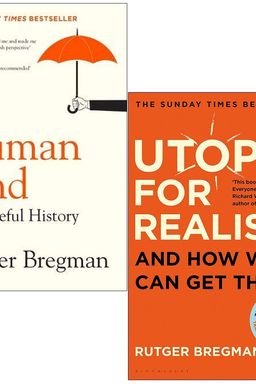
Idea 1
Building Realistic Utopias for a Better World
What if poverty was no longer inevitable, work became voluntary, and borders ceased to limit human potential? In Utopia for Realists, Dutch historian Rutger Bregman argues that it’s time to reclaim utopian thinking—not through naive dreaming, but by grounding bold ideas in evidence, economics, and common sense. He invites you to imagine a world beyond the present status quo, one where prosperity fuels purpose and progress is measured not just by GDP but by genuine well-being.
Bregman’s central claim is that humanity has achieved unprecedented wealth and health—we’ve arrived, in a sense, at the medieval dream of the Land of Plenty—but we’ve lost sight of what comes next. Material abundance has not delivered meaning, equality, or happiness. The time has come, he insists, to direct our collective imagination toward new frontiers: a universal basic income, a shorter workweek, and open borders. These are the pillars of a society that values people over profit and purpose over production.
A Case for New Utopian Thinking
Bregman begins by reclaiming the concept of “utopia.” He reminds us that all progress—from democracy to equal rights to the weekend—was once dismissed as unrealistic. Today, however, we’ve mistaken our comforts for endpoints. Our politics are paralyzed by pragmatism, our economies are obsessed with growth, and our imaginations have been colonized by cynicism. Bregman argues that we must once again dream about the possible, but unlike past utopians, we must base our ideas on real-world data and experiments.
The author identifies a paradox: humanity is thriving materially yet suffering existentially. Despite technological advances, rising GDP, and global peace, depression, loneliness, and inequality are soaring. Bregman challenges readers to rethink what “progress” means. Instead of measuring success by economic expansion, he asks us to consider well-being, leisure, and freedom as the new benchmarks of human development.
From the Land of Plenty to the Land of Purpose
According to Bregman, the Western world is still trapped in the myth of perpetual scarcity, even though we live in abundance. We obsess over productivity, efficiency, and consumerism, while meaningful work and time for reflection have been sacrificed. He draws on classic thinkers like Keynes—who predicted a 15-hour workweek by 2030—and on modern behavioral economics to illustrate that human motivation goes far beyond survival or wages. We want purpose, not busyness.
This is where his proposed utopian reforms come in. A universal basic income would eliminate poverty and empower people to pursue education, entrepreneurship, and creativity. A shorter workweek would distribute jobs more fairly, reduce burnout, and increase happiness. Open borders, the most controversial of his ideas, would not only reduce global inequality but also double world GDP, according to the studies he cites. These are not wild dreams, he insists—they are pragmatic policies supported by decades of research and small-scale trials.
Why Radical Ideas Matter Now More Than Ever
Underlying Bregman’s vision is an appeal to moral courage. Every major social advance began with radicals who refused to accept reality as given. While neoliberalism and short-term politics have robbed society of imaginative ambition, Bregman urges readers to adopt a long-term perspective. He argues that our problems—rising inequality, climate change, stagnant wages—stem not from lack of resources but from lack of vision. Just as Friedman and Hayek patiently nurtured the “utopian” dream of free markets before it became policy orthodoxy, today’s thinkers must champion a new social paradigm for the 21st century.
At its heart, Utopia for Realists is both a history of progress and a toolkit for reimagining reality. It synthesizes lessons from economics, psychology, and political philosophy to show that new systems are not only possible but already being tested—from Canadian basic income experiments to Utah’s success with “Housing First” for the homeless. The task now is to scale these ideas globally.
By blending optimism with practicality, Bregman reframes utopia as a challenge rather than a fantasy: a call to act as though the future is still open. He asks you not simply to hope for a better world—but to work toward one rooted in evidence, empathy, and imagination.