
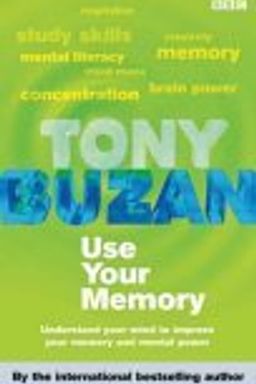
Use Your Memory cover

Use Your Memory

by Tony Buzan

Use Your Memory by Tony Buzan provides step-by-step guidance to transform your memory capabilities. With practical exercises and techniques like mnemonics and mind maps, this book empowers you to remember anything from daily tasks to complex information effortlessly. Unleash your brain''s potential and revolutionize how you store and recall memories.

Unlocking Your Mind’s Full Potential

How would your life change if you could think, learn, and remember faster—without feeling overwhelmed? In Use Your Head, Tony Buzan argues that the average person uses only a fraction of their brain’s capacity because traditional education has taught us how to memorize, not how to think. Buzan contends that by understanding how your brain naturally processes information—through images, associations, and patterns—you can unlock abilities you never knew you had.

This book is both a manual and a manifesto for the mind. Buzan draws on neuroscience, psychology, and practical strategies to teach you how to read faster, remember longer, think more creatively, and study more efficiently. He introduces revolutionary tools like Mind Mapping and the Organic Study Method, which integrate visual, logical, and associative thinking into a single flow of learning.

The Brain: A Universe in Miniature

Buzan begins by painting a stunning picture of the brain’s magnificence. With over 10 billion neurons and trillions of interconnections, your brain’s potential patterns could fill a line of zeros longer than any number written by science. To emphasize this, Buzan cites figures comparing the brain’s connections to the total number of atoms in the universe. This living network is capable of unimaginable creativity, yet most people have never been taught how to use it.

He connects this to the groundbreaking research of Roger Sperry and Robert Ornstein, who discovered that the left and right halves of the brain operate differently but complement each other. The left deals with logic, words, and analysis, while the right handles color, images, imagination, and music. Genius arises when we integrate both hemispheres—think Einstein calculating relativity while daydreaming about riding on a sunbeam.

Overcoming the Boundaries of Learning

Despite such extraordinary ability, most people perform well below potential because of what Buzan calls mental miseducation. Schools teach recognition (identifying letters, words, and formulas) but seldom teach assimilation, integration, or recall. We learn to pass exams, not to master skills for life. As a result, our natural enthusiasm for learning is replaced by fear, boredom, and self-doubt—the mental equivalent of tying the brain’s shoelaces together.

Buzan’s answer is to show readers how to rediscover their innate learning ability. By using the brain’s natural language—imagery, rhythm, and association—we can study faster, recall more accurately, and actually enjoy the process. Whether you’re a student, a teacher, or a lifelong learner, his approach replaces anxiety with creative curiosity.

From Information Overload to Mental Flow

The book’s later chapters guide readers from theory to practice: how to read efficiently, how to build powerful memory systems, how to note ideas creatively, and how to apply all of this with the Buzan Organic Study Method. You’ll learn why shorter study periods (20–40 minutes with breaks) outperform long hours of “swotting,” how to turn disorganized notes into mind maps that mirror how the brain actually works, and how to plan reviews that lock new knowledge into long-term memory.

Ultimately, Use Your Head isn’t just about learning better—it’s about thinking better. It’s a blueprint for understanding yourself as a dynamic thinker capable of integrating logic and imagination, analysis and intuition. Once you understand the incredible organ behind your eyes and use its rhythms effectively, Buzan promises, the act of studying stops being drudgery. It becomes an exhilarating expression of the human mind’s natural brilliance.


The Two-Brain Revolution

According to Buzan, the discovery that we have not one brain but two—each specializing in unique yet complementary functions—marks a turning point in our understanding of intelligence. The left hemisphere processes language, logic, and analysis; the right handles rhythm, color, spatial awareness, and imagination. In most educational systems, only the left side is developed—producing what Buzan calls “half-brained learners.”

Left and Right in Harmony

True genius, Buzan argues, comes when both hemispheres work together in synchrony. Historical examples prove this: Leonardo da Vinci balanced art and science, sketching anatomical drawings alongside architectural plans. Albert Einstein played violin to stimulate abstract thought. They both used logic and imagination, analysis and imagery. This balance produces synergy—each hemisphere enhancing, not competing with, the other.

Why This Matters to You

When you rely only on linear, verbal processing, your thought patterns become narrow and stressful. When you activate both sides, learning becomes faster and more fun. For example, visualizing information through color coding or mind maps transforms facts into an interconnected “image of understanding.” (Psychologist Betty Edwards, author of Drawing on the Right Side of the Brain, later corroborated this idea.)

Integrating the Whole Mind

To use both hemispheres, combine words with images, numbers with color, logic with emotion. Instead of memorizing, imagine. Instead of rote repetition, create associations. The brain is, in Buzan’s words, “a keyboard on which hundreds of millions of melodies—acts of behavior—can be played.” You play it best when your whole mind participates.


Relearning How to Read

Buzan devotes an entire section to the art of reading—not just glancing at words, but interacting with them dynamically. Most people, he explains, were taught to read in a way that cripples comprehension and speed. Traditional phonics or “look and say” methods teach recognition but not integration or recall. Reading becomes laborious, like trudging step by step rather than gliding across meaning.

How the Eye Actually Reads

Using diagrams, Buzan shows that the eyes don’t move smoothly along each line; they jump in micro-movements called fixations. Poor readers fixate on every single word, regressing and back-skipping out of anxiety. Skilled readers, by contrast, take in groups of three to five words at a time with minimal regression. This not only increases speed—often to over 1,000 words per minute—but also enhances comprehension, because the brain grasps whole ideas instead of fragments.

Techniques for Faster Understanding

To retrain your eyes and brain, Buzan recommends using visual aids—a finger, pen, or pointer—to guide movement. This simple trick keeps eyes focused and builds a smooth rhythm, much like a conductor leading an orchestra. He also suggests alternating between high-speed “mass reading” (flipping pages rapidly to train awareness) and slower, deliberate sessions for comprehension. Even a metronome can help establish tempo and prevent mental drift.

Reading is not about seeing every word; it’s about seeing meaning. A faster reader doesn’t skim—they think in patterns. As Buzan puts it, “the faster we go, the more impetus we gather and the more we concentrate.”


Memory as a Living System

Memory, Buzan insists, is not a filing cabinet where facts are stored—it’s a living process of association and rhythm. He combines psychology and practical exercises to reveal how memory rises, falls, and strengthens through repetition and review. His key discovery? Understanding isn’t the same as remembering. You can grasp an idea perfectly yet forget it minutes later unless your mind consolidates it properly.

The Forgetting Curve

Drawing on Hermann Ebbinghaus’s research, Buzan notes that recall rises briefly after learning as the brain “sets” connections, then drops sharply—losing up to 80% within 24 hours. But well-timed reviews can reverse the curve. Reviewing 10 minutes after study, then one day later, then one week and one month later, locks material into long-term memory. Each review is like reinforcing a bridge before it collapses.

Mnemonics and the Power of Imagination

Buzan revives classic memory systems—the number-rhyme and link techniques from ancient Greece—and gives them new life. The secret is to connect ideas through vivid, absurd imagery. The sillier, louder, or more colorful the image, the deeper it sticks. Linking “shoe” with “feather” by imagining a giant feather sprouting from your sneaker creates far stronger recall than repetition alone. Emotion and exaggeration awaken the brain’s natural glue for memory.

As Buzan sums up: “The brain loves colors, movement, and pleasure; give it these, and it will never forget.”


From Words to Patterns: The Mind Map

Perhaps Buzan’s most famous invention, the Mind Map, was born from frustration with traditional note-taking. Linear notes—paragraphs or bullet lists—use up time, obscure relationships, and hide key ideas in a sea of text. Mind maps reflect how the brain actually thinks: in radiant association, branching from a central concept to subtopics, images, and details.

How to Build a Mind Map

Start with a central image that captures your topic’s essence. From there, draw main branches labeled with major themes—verbs and nouns, not long phrases. Add secondary lines for specific details. Use color, symbols, and curved branches to keep it organic. The goal isn’t prettiness but clarity. Because each map is unique and visually distinctive, it becomes easy to recall later. You’re building an external “hologram” of understanding.

Why It Works

Each branch in a mind map mimics a neuron linking to others. It engages both brain hemispheres—language and logic on one side; imagery and color on the other. When used for essays or speeches, it replaces hours of outlining. Buzan’s students at Oxford reportedly cut writing time by two-thirds while improving their results. (Modern creativity coach Edward de Bono echoed similar principles in his concept of lateral thinking.)

In effect, the mind map transforms messy notes into living thought-structures. Where linear writing traps ideas, mapping lets them grow.


The Organic Study Method

Buzan’s Organic Study Method synthesizes everything in the book into a single disciplined—but flexible—system. It has two main phases: Preparation and Application. Instead of forcing a one-size-fits-all routine, it adapts to any subject. Whether you’re tackling higher mathematics or reading literature, the structure remains the same: engage curiosity first, then layer understanding.

Preparation: Setting the Foundation

Start by browsing the entire book to get a sense of its “terrain.” Then decide on time and amount—study only what fits in the next 20–40 minutes. Before reading, jot down what you already know about the topic using a mini mind map. Next, list questions and goals—what you want to get from the book. These steps prime the brain, turning passive reading into a quest for answers. As Buzan notes, “A mind searching for meaning retains far more than a mind waiting to be told.”

Application: The Four Views

The study stage has four parts: Overview (scanning visuals and summaries), Preview (reading beginnings and endings of sections), Inview (filling in gaps), and Review (revisiting key material). This mimics assembling a jigsaw puzzle—starting with the border, then the color regions, then filling in the details. Breaks and brief reviews between sessions reinforce understanding and recall.

In the end, your completed mind map becomes both your study record and review tool. It’s not a trace of your reading; it’s a mirror of your thinking.


Learning as a Joyful Discipline

For Buzan, learning is not a mechanical act but a celebration of thought itself. He concludes with an almost poetic afterword: studying should be “delightful and flowing,” not painful or forced. When you view your brain as a creative partner instead of a problem, even complex tasks become fulfilling challenges.

Celebrating Completion

He even suggests celebrating after each study session—literally rewarding your brain for its performance. This positive reinforcement builds motivation and turns learning into a habit of joy. “If you associate the completion of study tasks with celebration,” Buzan writes, “the probability of your studying again becomes far greater.”

By integrating both hemispheres, honoring rhythm and rest, and engaging curiosity, learning becomes organic—a flow state rather than a struggle. You’re no longer a passive receiver of knowledge. You’re an active creator of understanding. In doing so, you realize what Buzan wanted all along: that your mind is infinitely better than you think.

Dig Deeper

Get personalized prompts to apply these lessons to your life and deepen your understanding.

Go Deeper

Get the Full Experience

Download Insight Books for AI-powered reflections, quizzes, and more.