
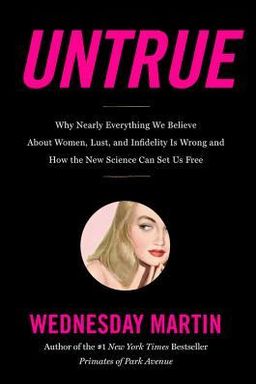
Untrue cover

Untrue

by Wednesday Martin PhD

Untrue by Wednesday Martin PhD challenges the myths surrounding women''s sexuality, revealing they are naturally adventurous and not inherently monogamous. Through science and history, the book empowers women to embrace their true desires and autonomy, challenging societal norms.

Untrue: Women, Desire, and the Myths of Monogamy

What if everything you've been told about female desire is wrong? In Untrue, Wednesday Martin argues that women’s sexuality is not passive, moral, or naturally monogamous. It is dynamic, strategic, and deeply shaped by culture, history, and ecology. Her core claim is provocative: infidelity and nonmonogamy are not deviant exceptions—they are data points in a broad, adaptive story of female sexual agency.

Drawing from evolutionary biology, anthropology, primatology, psychology, and interviews with hundreds of women, Martin reframes cheating and desire as reflections of autonomy and circumstance rather than moral failure. You are asked to see women who stray not as broken promises but as informants about social constraint, shifting opportunity, and the power of choice. Throughout, Martin meshes science and social critique, showing that female sexuality responds dynamically to regulation and freedom, often more so than men's.

Unlearning the "Natural" Script

For years, Western science portrayed women as naturally monogamous caregivers—a tidy story grounded in the assumption that eggs are costly and men are designed for sexual variety. Martin dismantles this with data from Sarah Blaffer Hrdy, Meredith Chivers, Marta Meana, and Lisa Diamond. Hrdy’s langurs mate multiply to protect infants from infanticide. Chivers finds that women’s arousal is strikingly non-specific—heterosexual women respond physiologically to nearly all kinds of sexual stimuli, hinting at a broad erotic spectrum. Meana reveals that habituation kills desire, not lack of libido. Diamond’s longitudinal studies show that orientation for many women is fluid, not fixed. Together, they suggest that female sexuality is both adaptive and opportunistic.

Sex, Ecology, and Constraint

Martin weaves fieldwork like Brooke Scelza’s Himba study—where women in constrained marriages have high rates of extramarital births as strategic choices—into broader patterns. Female sexual behavior flexes with context: scarcity, kinship systems, and technology. In the Himba case, "omoka" births (children born from lovers, not husbands) are not shameful but ecologically sensible, increasing provisioning and offspring survival. You see similar adaptation in modern contexts like Ashley Madison—Alicia Walker’s data shows women using affairs as pragmatic sex fixes within otherwise valued marriages. Evolutionary pressures meet emotional ones, and the result is a complex map of sexuality tied to freedom, stress, and opportunity.

Culture as Lab Equipment

You are shown how tools—literal and metaphorical—shape norms. The plough hypothesis (Alesina, Giuliano, and Nunn) explains how agrarian economies dependent on male upper-body strength led to property regimes, dowries, and the origin of female sexual policing. Plough culture birthed beliefs equating female virtue with paternity certainty, and those attitudes echo today in both law and media. The machinery changes—from ploughs to cosmetic lasers—but the social pattern remains: control of women’s bodies preserves male economic advantage.

Modern Revisions and Resistance

From bonobo sisterhoods to Skirt Club parties, Martin shows that when women reclaim sexual space—across species or societies—social power shifts. Female bonobos bond through G-to-G sex and form coalitions that dominate males; human parallels emerge in women-only erotic gatherings that blur friendship and sexuality. Media from Issa Rae’s Insecure to academic voices like Mireille Miller-Young and Tressie McMillan Cottom highlight racialized double standards and the social policing of Black women’s sexuality. Across all stories, sex operates not just as pleasure but as social currency.

Toward Curiosity, Not Shame

Martin closes by arguing that moralizing around female infidelity obscures what science and lived experience reveal: desire is information. Infidelity rates are rising alongside women’s autonomy, work, and mobility. Technology amplifies options; stigma masks truth. A compassionate reading of data—one that values curiosity over condemnation—offers a more productive lens for relationships and culture. When you see sexuality not as threat or problem but as a clue to social design, empathy becomes not indulgence but insight.

Core Reframing

Female sexual agency is both ancient and adaptive. To understand women’s choices—from bonobo bonds to modern polyamory—you must see desire not as deviation but as strategy, ecology, and resistance.

As you follow Martin through science, culture, and story, you realize her mission: to rewrite the tale of female sexuality from suppression to sophistication. What you learn is not scandal—it’s social intelligence.


Evolution Rewritten by Female Choice

Martin shows that the foundation of evolutionary sex theory—Bateman’s paradigm—is cracked. Instead of seeing females as passive, modern science reveals them as adaptive strategists. Sarah Blaffer Hrdy’s langurs mate multiply to confuse paternity, protecting offspring against infanticide. Across primates, females create social advantage by mating for alliances, gifts, or protection. Patricia Gowaty’s reexamination of Bateman’s fruit flies nullified old conclusions, proving that female multiple mating can increase survival and genetic diversity.

Adaptive Tactics Across Species

Female primates—from rhesus macaques to bonobos—actively pursue sex with multiple partners. Amy Parish’s bonobo data shows females initiating and using sexual play to reduce aggression and form coalitions that control males. This flips the presumed natural hierarchy. You realize multiple mating is not about promiscuity—it’s about power and survival.

Human Parallels

Humans inherit these adaptive contexts. Partible paternity practices among the Bari or Aché, where a child can have multiple recognized fathers, show cultural adaptations parallel to Hrdy’s primates. Female orgasm physiology and clitoral complexity suggest selection for repeated mating and pleasure-based pair bonds, not reproductive scarcity. When Martin places these findings beside modern infidelity data, she invites you to see cheating less as failure and more as evolution’s persistence in complex modern ecologies.

Lesson

Female sexual variety isn't chaos—it’s an ancestral strategy encoded by context and flexibility.

If you update your model of evolution to include female choice, the narrative changes entirely—from coyness to calculation, from moral failure to adaptation.


The Ecologies of Desire

Desire, Martin argues, doesn’t exist in a vacuum—it responds to environment. You see this vividly in Brooke Scelza’s Himba research where women adapt sexual behavior depending on marriage type and resource distribution. Among the Himba, when choice is restricted, women pursue omoka partnerships that yield better provisioning and higher offspring survival. This pattern mirrors modern strategic infidelities chronicled by Alicia Walker among Ashley Madison users—sex used as solution, not rebellion.

Adaptive Strategies from Namibia to New York

Himba women and married Western women demonstrate parallel logic: retain the benefits of partnership but outsource sexual fulfillment. Both operate within structures that constrain desire—tradition, economy, childcare—and both create workarounds to satisfy it. In both contexts, the behavior serves autonomy and stability rather than chaos. Martin’s synthesis underscores that environment shapes sexual expression far more than morality.

Core Idea

Affairs, open marriages, or omoka births are not random transgressions—they arise from social conditions that make them functional choices.

When you consider desire ecologically, you stop asking only who breaks vows and start asking what ecology produces their necessity.


Technology, Nonmonogamy, and Relationship Design

Contemporary technology and therapy reshape sexual norms. In Manhattan workshops Martin attends, therapists train for consensual nonmonogamy (CNM)—couples negotiating multiple partnerships with ethical structure. Terms like “compersion” and “NRE” mark emotional vocabularies for pleasure and jealousy management. Polyamory, swinging, and open relationships emerge as cultural responses to the mismatch between desire and monogamous expectation.

Negotiated Structures

You see types—open relationships focused on sex, swinging emphasizing mutual novelty, polyamory involving emotional multiplicity. Therapists like Mark Kaupp stress that rules can't guarantee security—attachment and communication do. Nonmonogamy works when partners can self-regulate and maintain respect rather than simply avoid jealousy.

Cultural Shifts and Constraints

Martin connects CNM visibility through shows like You Me Her and Sister Wives to mainstream normalization. Yet she notes persistent cultural ambivalence—surveys still show 95% expecting monogamy even while infidelity rates climb. Technology intensifies both temptation and opportunity. Apps allow discreet meetings; communities form around transparency and consent. Gender dynamics remain—women practicing CNM receive harsher judgment, echoing older sexual double standards.

Practical Insight

Ethical nonmonogamy is less about freedom from commitment and more about skillful negotiation of desire and boundaries.

The rise of CNM marks not a decay of romance but its evolution toward transparency, empathy, and choice.


Property, Patriarchy, and Sexual Control

How did female sexuality become property to guard? Martin turns to the plough hypothesis, tracing how the rise of agriculture restructured gender roles. When male-driven plough labor made property hereditary, societies tightened control over women’s bodies to ensure legitimate inheritance. You learn that chastity and monogamy served not biology but economics.

From Tools to Morals

Plough-based economies birthed dowries, veiling, and segregation (zenanas), embedding moral codes into physical labor patterns. Martin cites studies from Harvard and UCLA linking ancestral plough use to modern gender norms—low female labor participation and conservative sexual attitudes. Even cosmetic microlabial procedures and 'rejuvenation' surgeries echo millennia-old anxieties around female sexual independence.

Alternate Histories

Hunter-gatherer and cooperative-breeding societies illustrate that female autonomy once thrived where paternity control mattered less. Hrdy and Hawkes’s work shows women as co-providers and multigenerational caregivers; sex and childcare operated communally rather than privately owned. Understanding this history reframes today’s moral codes not as natural but as residues of property and paternity anxiety.

Takeaway

Controlling female fidelity was a social technology for managing inheritance—a system still echoing in modern gender scripts.

When you confront this economic root, you see how cultural policing of desire is less moral tradition and more historical artifact.


Fluidity and Pleasure as Social Power

Lisa Diamond’s concept of sexual fluidity provides the key psychological lens for Martin’s argument: women’s erotic interests shift with time, environment, and relationship context. Across fieldwork and parties like Geneviève LeJeune’s Skirt Club, you watch orientation and identity bend with safety and opportunity. These encounters—playful, consensual, women-only—reveal a truth hiding in plain sight: when women design sexual spaces for themselves, they rediscover autonomy and voice.

Bonobos and Human Sisterhoods

Amy Parish’s bonobo research parallels this dynamic. Female bonobos use sex to bond, soothe, and govern. Human parallels—motsoalle in Lesotho, mati in Suriname, and Skirt Club events—show sex acting as social glue. Pleasure becomes relational politics. Martin takes this further: the female capacity for sexual collaboration carries evolutionary and cultural power.

Reclaiming Erotic Selfhood

Marta Meana’s studies reinforce that women’s arousal often arises from feeling desired by others and themselves—a kind of erotic self-regard that rewards novelty and self-focus. Combine that with Diamond’s flexible attraction model, and you see why agency expands when shame recedes. These frameworks explain both same-sex experimentation and nonmonogamous curiosity among women free of old scripts.

Key Understanding

Sexual fluidity, shared pleasure, and self-focus are not confusion—they are expressions of autonomy and social connection.

Across bonobo jungles and Manhattan lofts, Martin suggests that female-centered sexual freedom is also female-centered leadership.


Race, Representation, and Sexual Policing

Sexual freedom has never been equally distributed. Martin’s exploration of race and representation through scholars like Mireille Miller-Young and Tressie McMillan Cottom exposes how the myth of the 'ho' polices Black female sexuality. Pornography and media often caricature Black women as hypersexual, while respectability politics demand chastity to counter those stereotypes.

The Double Bind

Cottom’s anecdote about victim-blaming within her own community shows how internalized respectability erodes protection. Deesha Philyaw’s fiction and Issa Rae’s television writing invert the narrative, reclaiming the 'ho phase' as self-discovery rather than shame. Miller-Young’s A Taste for Brown Sugar connects pornographic archetypes to real-world injustice—Black women perceived as always consenting lead to systemic disbelief in assault cases.

Ethics and Representation

Through these critiques, Martin integrates intersectional feminism: who gets to explore desire safely depends on race and class. 'Ho Theory' uncovers how sexual labels operate as political tools. When you recognize that the 'ho' trope denies real agency, you begin to see sexual morality as a racialized control system.

Central Insight

Freedom to be sexual without stigma remains uneven; dissecting the 'ho' image reveals how ownership of narrative leads to ownership of safety.

Martin’s racial lens anchors her message: liberation cannot be just sexual—it must be social, economic, and representational.


Desire as Information

Martin concludes with a philosophical turn: sexual behavior is not only a private act but a sociological signal. When women cheat, open their marriages, or explore fluidity, they offer information about what systems no longer fit. Moral condemnation blinds societies to feedback loops that might improve fairness, communication, and intimacy.

From Shame to Curiosity

Across empirical work and cultural observation, the book advocates curiosity as policy. Cheating and nonmonogamy rates track with women’s independence and mobility—suggesting that autonomy breeds both opportunity and honesty. Martin calls for replacing shame with inquiry: instead of asking why women stray, ask what structures make fidelity difficult or unnecessary.

Applications

Therapists, partners, and policymakers are invited to use desire data to revise relationship models: flexible agreements, transparency norms, and sexual wellbeing programs that recognize female pleasure as a health metric. In Martin’s framing, infidelity becomes not violation but communication about mismatched needs and control.

Major Takeaway

Treat female desire as valuable social intelligence—its expression teaches societies where freedom and fairness still lag.

Through that lens, Untrue becomes not just a book about sex, but a manifesto for understanding desire as data—and empathy as progress.

Dig Deeper

Get personalized prompts to apply these lessons to your life and deepen your understanding.

Go Deeper

Get the Full Experience

Download Insight Books for AI-powered reflections, quizzes, and more.