
Idea 1
From Cosmos to Consciousness: The Human Project
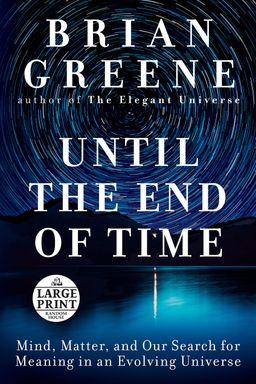
How did matter become mind? In Until the End of Time, Brian Greene charts an integrative journey from the big bang to human meaning, showing that the forces and laws that shaped the early universe also make life, thought, art, and belief possible. He invites you to view everything—from galaxies to grief—through the same physical lens that governs stars and atoms, yet with an emotional awareness of what that means for our transient existence.
Across disciplines—physics, cosmology, chemistry, biology, neuroscience, and aesthetics—Greene constructs a unified story of emergence. The book begins with the entropic arrow of time and builds through cosmic evolution to human consciousness, choice, and creativity. It explores how physical law generates increasing complexity before entropy ultimately levels it away, how life and thought represent temporary islands of order sustained by energy flows, and how humanity creates symbolic legacies that defy our material limits.
From Order to Entropy—and Back Again
The core thread is entropy, the tendency of systems to move from order to disorder. Yet instead of doom, entropy becomes a creative principle. Steam engines, stars, and cells all sustain local order by exporting disorder elsewhere—a dynamic Greene calls the entropic two-step. Life itself, he reminds you, is a heat engine that feeds on low-entropy energy from food or sunlight, using it to build complex structures while radiating waste. You are a thermodynamic process that organizes energy into pattern and purpose.
This framework reframes decay, aging, and death: they are not failures but natural expressions of the same physical dance that allows structure to appear at all. Every heartbeat and thought is an entropic negotiation—an act of local defiance funded by the wider universe’s drift toward equilibrium.
Cosmic Evolution and Life’s Ascent
The book next scales out to cosmology, tracing how quantum jitters in the infant universe gave rise to every star and atom today. Inflation stretched those microscopic fluctuations, seeding clusters where gravity sculpted galaxies and stars. Within stars, fusion forged the heavier elements—carbon, oxygen, iron—that later became the chemistry of life. The periodic table, Greene shows, is a cosmic artifact of thermodynamic and quantum processes.
From there the narrative cascades into biology, where energy gradients and molecular information combine. Schrödinger’s question—“What is Life?”—becomes concrete: DNA encodes information; metabolism manages energy; and both are expressions of physical law. Greene links Prigogine’s nonequilibrium thermodynamics and Jeremy England’s notion of dissipative adaptation to show how complex structures, including self-replicating molecules, can naturally form in driven systems. Life, then, is entropy’s creative reversal, a pattern designed to dissipate energy more efficiently.
Mind, Meaning, and Freedom
Emerging from biological evolution are consciousness and free will—phenomena that physics alone cannot yet fully demystify. Greene carefully distinguishes the mechanistic basis of brain processes from the subjective feeling of awareness: Chalmers’s “hard problem” remains unsolved. Still, theories like integrated information (Tononi) and attention-schema (Graziano) suggest that awareness might arise when information becomes richly interconnected and self-referential. Consciousness, in this telling, is not beyond physics—it is the highest form of physical organization we know.
Equally nuanced is Greene’s take on freedom. Against the romantic wish for supernatural control, he offers compatibilism: you are free not because your choices defy physics, but because your structure allows flexible, intelligent responses within it. Freedom is not magic; it is organized complexity engaged in self‑reflection.
Culture, Story, and the Quest for Meaning
Once collective minds emerge, language and story become humanity’s next evolutionary leap. Greene evokes the origins of speech (via FOXP2 and social bonding hypotheses) and explains why narrative became our cognitive flight simulator. Through storytelling, you and your ancestors rehearsed danger, empathy, and cooperation long before living them. Stories evolve into myths, religions, and arts—the cultural technologies by which we test identity, morality, and mortality.
Religion, he notes, anchors meaning through cognitively intuitive agents and communal ritual (Boyer, Wilson, Becker). Art and music, meanwhile, are explained as evolutionary hybrids: sexual signals (Darwin, Miller), social glue (Dissanayake), cognitive training grounds, and aesthetic rewards (Pinker’s “cheesecake” thesis). Their significance lies in how they help finite minds handle infinity—by turning emotion into pattern and chaos into beauty.
The Arc Toward the End
Beyond personal finitude stretches cosmic fate. Our star will swell into a red giant, the galaxies will dim, black holes will evaporate, and entropy will win—but not soon. Greene’s tour through late-time physics (Dyson’s infinite thought experiment, Boltzmann brains, dark energy’s big rip) underscores both the fragility and bravery of thinking itself. Even the capacity to contemplate our own end is, paradoxically, a triumph of entropy‑defying order.
The book’s central message is not despair but perspective: to see yourself as part of the universe’s unfolding story. You are matter become aware, energy momentarily configured to look inward. The atoms that will one day scatter from your body come from stars and will return to them. Meaning, then, isn’t written in eternity—it’s composed in the moments when awareness, art, and love briefly stand against the cosmic tide.