
Idea 1
Reclaiming Focus and Meaning in the Age of Email
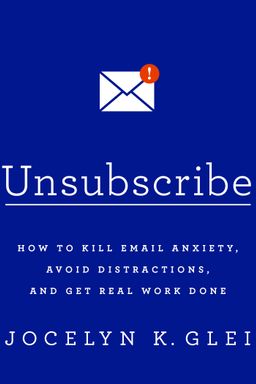
How often do you open your inbox first thing in the morning, intending to get organized, only to spend your day reacting to messages instead of doing meaningful work? In Unsubscribe, Jocelyn K. Glei argues that email has become one of the greatest thieves of creative energy and attention in the modern workplace. We aren’t simply drowning in messages; we’re caught in psychological traps that make us feel productive while quietly undermining our purpose. Glei contends that to reclaim focus, we must stop treating email as our taskmaster and instead reshape our relationship with it into that of a tool—a means for supporting our most important work rather than dictating it.
This book is not just about managing your inbox—it’s about managing your mind. Glei explores the neuroscience, behavioral patterns, and cultural pressures that have made email addictive, stressful, and guilt-inducing. Drawing on research from psychologists like Daniel Goleman and behavioral economists such as Dan Ariely, she shows why every ping creates false urgency and compulsion. It’s the combination of variable rewards, the illusion of progress, and the rule of reciprocity that turns email into an emotional roller coaster—making it both irresistible and exhausting.
The Emotional Mechanics of Digital Distraction
At its heart, Glei’s argument is psychological. When she compares our inbox-checking habits to rats pressing levers for random food pellets, she’s describing a neurological loop built on uncertainty and anticipation. Some emails bring joy—a new opportunity, a note from a friend—but most bring demands or disappointments. Because we can’t predict which type will arrive, we keep checking compulsively, hoping for that next reward. This behavior mirrors the classic Skinner Box experiments that demonstrated the power of variable reinforcement.
You might think you’re being proactive by chasing inbox zero—a momentary sense of control—but, as Glei explains, email progress is deceptive. It’s the “progress paradox”: the satisfying illusion of completing small tasks that don’t move the bigger needle. Your unread count goes down, dopamine spikes, and yet the emails flood back in minutes. The meaningful work—your long-term project, your manuscript, your design—stays untouched amid this false productivity. (In similar fashion, Cal Newport in Deep Work argues that modern tools give a shallow sense of accomplishment while eroding the capacity for deep focus.)
The Social Complexity of Every Message
Glei also dissects email’s emotional volatility—why misunderstandings balloon and simple requests spiral into guilt or defensiveness. Because email strips away tone, facial expressions, and real-time feedback, it amplifies negativity. Daniel Goleman calls this the “negativity bias”: a natural tendency to interpret neutral messages as critical or cold. When you send a cheerful message, the recipient might read it as neutral; when you send a neutral one, they may feel slighted. It’s not that we’re oversensitive—it’s that the medium itself distorts emotion. Understanding this bias is the first step toward writing emails that cultivate empathy and minimize unnecessary tension.
This deficit of social cues also explains why email creates guilt. The simple act of receiving a message triggers what sociologists call the rule of reciprocity—the ingrained urge to respond to any outreach, even from strangers. In the physical world, it’s limited by effort: we can’t handwrite 600 letters a week. But online, the effort disappears, and the expectation inflates. We feel morally obligated to answer everyone, even when doing so derails our priorities. Email thus weaponizes our kindness and our need to be liked, turning us into digital martyrs who mistake responsiveness for contribution.
Refocusing on “Meaningful Work”
The remedy, Glei insists, is not a new software trick but a shift in mindset. To say “no” to email, you must first say “yes” to something else: the projects and goals that matter most. She introduces the concept of “meaningful work”—tasks that build your skills, advance your mission, or complete long-term creative projects. By defining clear, measurable goals, you give your attention a north star that helps weigh every incoming message against what truly deserves your time. Once you anchor your priorities, you can process your inbox strategically: respond to what aligns, decline what doesn’t, and let go of the guilt about what remains unanswered.
The book is organized as a practical toolkit divided into four parts—Psychology, Strategy, Style, and Superpowers. You first learn how email manipulates your brain and emotions; then you learn systems for managing your inbox deliberately. Next, Glei coaches you through mastering communication style—writing messages that are clear, kind, and persuasive. Finally, she extends the discussion beyond email itself, showing how the same principles apply to all digital distractions—texts, social media, Slack, and beyond. Email becomes a metaphor for modern life: mastering it is mastering your attention.
Ultimately, Unsubscribe is both a manual and a manifesto. It reminds you that your creative potential depends on deliberate focus, not constant connection. It encourages kindness, clarity, and boundaries in a world that confuses accessibility with productivity. And it argues that the battle for sanity in the digital age begins not with quitting email entirely, but with re-teaching yourself how to use it consciously—and, when needed, how to walk away from it altogether.