
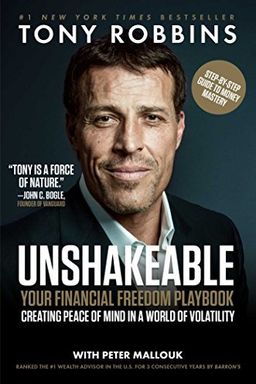
Unshakeable cover

Unshakeable

by Tony Robbins

Unshakeable is your essential guide to mastering the financial markets with confidence. Discover actionable principles and strategies to make smart investments, harness the power of compound interest, and secure your financial future. Tony Robbins offers insights to transform financial fear into financial freedom, empowering you to thrive in any economic climate.

Becoming Unshakeable: Mastering Wealth and Inner Peace

What would it feel like to wake up each morning knowing you’ll never have to worry about money again—regardless of what the markets are doing, no matter how chaotic the global economy becomes? In Unshakeable, Tony Robbins contends that such peace of mind isn’t a fantasy reserved for the rich or the lucky. It’s the product of knowledge, discipline, and mastering a clear set of psychological and financial principles that enable anyone to create both financial independence and emotional freedom.

Robbins argues that true wealth transcends money—it’s about confidence, certainty, and living without fear. The world may always be uncertain, but your foundation doesn’t have to be. Drawing from interviews with over fifty financial titans—like Ray Dalio, Warren Buffett, John Bogle, and Paul Tudor Jones—Robbins distills their wisdom into a practical playbook. He reveals how the best investors thrive even during market crashes, how to protect yourself from Wall Street’s hidden traps, and how to build a mindset that remains calm when everyone else is panicking.

From Financial Chaos to Freedom

Robbins opens with the turmoil of 2008, when markets collapsed and fear paralyzed millions. Even seasoned investors lost their nerve, showing how few truly understood the rules of money or the psychology of markets. “The world is uncertain,” Robbins reminds us, “but uncertainty is where the greatest opportunities live.” His premise: if you know the historical patterns of markets, keep fees low, diversify wisely, and stay invested, you can turn volatility into a weapon for compounding wealth instead of a source of panic.

This perspective redefines what it means to be financially unshakeable: it’s not about predicting the future—it’s about preparing intelligently for it. Robbins shows you how to base your financial life on patterns that have held steady for over a century rather than reacting emotionally to today’s headlines. (He often compares this mindset to the wisdom of great generals in Sun Tzu’s Art of War: victory goes to those who anticipate, not those who react.)

The Rule Book of Wealth

Robbins divides the book into three major sections. The first, “The Rule Book,” exposes how the financial industry often preys on investor ignorance. He dismantles myths about actively managed funds, explains how hidden fees erode two-thirds of lifetime returns, and highlights Wall Street’s incentives that prioritize their profits—not yours. He introduces the revolutionary power of low-cost index funds, compounding interest, and realistic savings strategies—tools that can make an ordinary investor’s portfolio outperform most professionals.

The Playbook for Investing

In the second section, “The Unshakeable Playbook,” Robbins partners with Peter Mallouk—named America’s Top Independent Financial Advisor by Barron’s—to show how to build a resilient portfolio. Together they boil down decades of investment science into the Core Four Principles: don’t lose, seek asymmetric risk/reward, minimize taxes, and diversify across assets, markets, and time.

Mallouk reinforces these concepts with real world examples, recalling how his clients thrived during the 2008 crash by rebuying stocks when they were cheap. They illustrate how market cycles, like seasons, are inevitable—winters (recessions) always give way to spring (recovery). Understanding these seasons frees you from fear and lets you take advantage of downturns instead of suffering from them.

The Psychology of Wealth

But wealth is more than math—it’s mindset. The third section, “The Psychology of Wealth,” argues that 80% of success in investing is psychology and only 20% is mechanics. Robbins guides readers through the emotional traps—fear, greed, impatience, overconfidence—that sabotage most investors. He introduces behavioral finance ideas like confirmation bias, recency bias, and loss aversion, explaining how our survival instincts misfire in the modern financial world. Using stories of billionaires who master emotion, Robbins outlines practical systems for staying calm, rebalancing wisely, and holding your course through market turbulence.

True Wealth: The Beautiful State

Finally, Robbins extends his philosophy beyond money. In the closing chapters, he insists that real wealth lies in living in what he calls a beautiful state—a mindset of gratitude, growth, and contribution. Citing figures like the Dalai Lama and Winston Churchill, he argues that material success without inner peace is the ultimate failure. Using vivid metaphors—from $86 million abstract paintings to stories of Robin Williams’s tragic life—he contrasts achievement with fulfillment and explains that abundance is a decision, not just a bank balance. Every reader, he says, must learn to “master the mind, not be mastered by it.”

Throughout Unshakeable, Robbins blends timeless financial wisdom with personal empowerment. By understanding market patterns, eliminating hidden costs, finding trustworthy advice, and cultivating an unshakeable mindset, you can build a life that’s not only financially free but emotionally fearless. Whether the market soars or plunges tomorrow, you’ll have something far greater than money—you’ll have certainty, peace, and purpose.


Freedom Through Financial Literacy

At its heart, Robbins’ message begins with knowledge. He argues that money anxiety stems from ignorance—and that financial literacy is the modern form of empowerment. In his workshops and writings, Robbins recounts watching friends, clients, and even celebrities lose fortunes because they didn’t understand how investment fees, taxes, and market cycles work. In contrast, people who take time to learn simple investing principles—like compounding, index investing, and diversification—can achieve independence far faster than those chasing high returns.

The Power of Compounding

Robbins retells the classic story of Joe and Bob—two young men investing $300 a month at 10% annual return. Joe starts at 19 and stops at 27, while Bob starts late at 27 and keeps going for nearly four decades. Though Joe invests far less money, he retires richer, proving that time—not timing—is the ultimate multiplier. Robbins compares this to planting seeds in fertile spring soil: wealth grows slower at first but multiplies geometrically with time. The earlier you start, the more the exponential magic of compound interest works for you.

From Consumer to Owner

Financial freedom, says Robbins, comes when you stop being just a consumer and start becoming an owner. “Pay yourself first,” he insists—set up automatic systems that route a percentage of your income into investments before you even see it. This turns saving into a habit rather than a decision. He cites behavioral economist Richard Thaler’s concept of “Save More Tomorrow,” where individuals commit to increase their savings every time they get a raise. Whether you start at 3% or 15% of your income, the key is consistency.

Recognizing Market Seasons

Robbins emphasizes our human gift for pattern recognition. Understanding that corrections and recoveries are cyclical—like seasons—enables investors to act logically when markets fall. Corrections (10% drops) occur roughly once a year on average, and bear markets (20% drops) every three to five years. Knowing this transforms fear into expectation. Instead of panicking, you can view downturns as annual sales on world-class assets. Robbins compares this to farmers who plant crops wisely—they don’t fear winter because they’ve prepared during the harvest.

By combining knowledge with emotional resilience, Robbins concludes, anyone can graduate from financial victim to financial master. Literacy is power, but action is freedom.


The Seven Facts That Free You from Fear

In one of the book’s most empowering chapters, Robbins presents what he calls his seven “Freedom Facts.” These data-driven realities dismantle the myths that keep most investors anxious and reactive. They teach you to expect market volatility, embrace downturns, and realize that staying invested is the surest way to long-term success.

Fact 1–3: Expect the Storm

First, corrections happen annually, lasting an average of only 54 days. Second, fewer than 20% of corrections turn into full bear markets. And third, no one—not forecasters, economists, or Wall Street pundits—can consistently predict when those downturns arrive. Robbins humorously cites dozens of failed predictions by prominent analysts like Nouriel Roubini, illustrating that even “Dr. Doom” gets it wrong most of the time. “Prediction is very difficult,” Nobel physicist Niels Bohr once quipped, “especially about the future.” Robbins uses this to reassure you that you don’t need prophetic timing to succeed—you just need discipline.

Fact 4–6: Bear Markets Become Bull Markets

From 1980 to 2015, the S&P 500 saw intra-year drops averaging 14%, yet ended positive in 75% of those years. Every bear market in U.S. history—every single one—has eventually turned into a higher bull market. Robbins highlights moments like March 2009, when the S&P rebounded 69.5% within a year of bottoming. Quoting Templeton’s famous line, “The best opportunities come in times of maximum pessimism,” Robbins teaches you to view fear as your ally. When everyone else is running from the fire, the brave investor steps in and buys the future at a discount.

Fact 7: The Real Danger Is Sitting Out

Perhaps most striking is Robbins’ final fact: the greatest cost isn’t losing money in a correction—it’s missing out on the market entirely. JPMorgan data shows that missing the 10 best trading days over a 20-year period cuts average returns nearly in half. Missing 30 of the best days wipes out your returns completely. And since those best days often come within two weeks of the worst days, people who panic and sell lose twice: once when they sell, again when they miss the rebound. Courage, Robbins insists, is always rewarded.

Together, these seven facts create what he calls investor freedom: the calm conviction that every winter is temporary and every panic contains its own spring.


Beware the Wolves of Wall Street

Robbins devotes a sharp section of Unshakeable to exposing how much of the financial industry works against ordinary investors. Behind polished titles like “wealth manager” or “financial consultant” often hide brokers whose incentives align not with your success, but with their commissions.

The Hidden Fee Machine

Many people wrongly believe they pay no fees. In truth, the average actively managed mutual fund costs around 2–4% annually, factoring in hidden charges like transaction fees, cash drag, marketing expenses, and taxes. Jack Bogle reminded Robbins that over 50 years, these costs can drain two-thirds of your gains. Paying Wall Street’s toll takers is like buying a $4 latte for $249—it demolishes compounding.

Actively Managed Folly

Robbins cites a sobering record: 96% of actively managed funds fail to beat the market over 15 years. Yet fund companies market these funds using short bursts of good performance—what Bogle calls “reversion to the mean.” Morningstar’s five-star funds, often touted as top picks, rarely sustain their rank after a decade. The financial press fuels this illusion by celebrating whoever got lucky lately, while quietly burying the funds that failed.

Freedom via Indexing

For most investors, Robbins argues, low-cost index funds are the ultimate liberation. They’re transparent, diversified, tax-efficient, and charge as little as 0.05% in fees. Following pioneers like Bogle, Swensen, and Buffett, he urges you to stop chasing hot managers and start owning the market itself. Over decades, this approach not only beats nearly all professionals but also frees you from financial anxiety. “It’s not about time in the market,” he writes, “it’s about time and cost in your favor.”


How to Find (and Avoid) Financial Advisors

In a world flooded with self-proclaimed financial “experts,” Robbins teaches readers how to separate fiduciaries—those legally bound to act in your best interest—from brokers and salespeople posing as advisors. He notes that 90% of U.S. financial advisors are actually brokers rewarded for selling products, not for helping clients achieve goals.

Understanding the Fiduciary Difference

A fiduciary must, by law, put your interests first. A broker, by contrast, only needs to meet a “suitability” standard—meaning their recommendation doesn’t have to be the best one, just an acceptable one. Robbins compares it to the difference between a doctor who must prescribe the right medicine versus one paid by pharmaceutical companies to push certain drugs. Unsurprisingly, the latter often profits more while the patient suffers.

The Problem of Dual Registration

Many so-called independent advisors hide behind dual registration, switching hats between fiduciary and broker roles. One minute they’re promising impartial advice; the next, they’re selling high-commission products. Robbins recalls his own frustration discovering that an advisor he trusted was profiting this way—legally. To protect yourself, he offers seven simple questions to vet any advisor—starting with “Are you a registered investment advisor?” and “Do you or your firm receive third-party compensation?”

By understanding incentives, Robbins says, you not only safeguard your portfolio but reclaim control over your financial life. In short: don’t let the barber decide when you need a haircut.


The Core Four Principles of Investing

When Robbins distills his interviews with the world’s best investors, four universal investment principles emerge—the “Core Four.” Together, they form the backbone of every stable portfolio, whether you’re building wealth or preserving it for generations.

1. Don’t Lose

Warren Buffett’s two rules—“Never lose money” and “Never forget rule number one”—capture the mindset of elite investors like Ray Dalio and Paul Tudor Jones. Avoiding large losses is critical because recovering from a 50% decline requires a 100% gain. The greats design portfolios that “stay okay even when we’re wrong,” often through diversification, hedging, and asymmetric risk.

2. Asymmetric Risk/Reward

Success lies in risking little to gain much. Jones seeks trades with a five-to-one ratio—risking $1 for the chance to make $5. Similarly, Richard Branson’s Virgin Airlines launch included a clause allowing him to return leased planes if it failed. Limited downside, unlimited upside. Robbins calls these “nirvana opportunities,” achievable even for average investors through buying undervalued assets during market panics.

3. Tax Efficiency

Taxes routinely eat 30–50% of returns, yet many investors ignore them. Robbins cites David Swensen’s tax-maximized strategies—holding for over a year to get lower capital gains rates and using tax-advantaged accounts like 401(k)s, Roth IRAs, and PPLI (“the rich man’s Roth”). He also praises Master Limited Partnerships (MLPs), which can deliver 8–10% income while keeping 80% tax-free.

4. Diversification

Finally, successful investors never bet everything on one horse. Diversify across asset classes (stocks, bonds, real estate, commodities), within each, globally across markets, and across time through steady investing. Dalio calls diversification “the Holy Grail of investing,” because 15 uncorrelated bets can reduce risk by 80% without lowering returns. Robbins concludes: it’s not about being right—it’s about structuring your portfolio so you can’t be wrong for long.


Slaying the Bear: How to Profit from Market Crashes

Perhaps the book’s most counterintuitive wisdom is this: bear markets are your greatest wealth-building opportunities. Robbins and Peter Mallouk insist that instead of fearing crashes, you should prepare for them strategically—because every major market decline in history has been followed by even greater growth.

Preparation, Not Prediction

Mallouk uses the 2008–2009 crisis as his case study. While panic consumed Wall Street, his firm rebalanced portfolios, selling appreciated bonds and buying stocks at historic discounts. Within a year, the market rebounded over 60%. Their clients, who stayed invested, multiplied their wealth. The strategy: maintain enough safe assets (about seven years of income) so you never have to sell in panic; then rebalance periodically to buy low and sell high automatically.

Customized Asset Allocation

Reject cookie-cutter portfolios. Instead, base your allocation on your needs—retirement goals, debt, lifestyle—not on age or risk tolerance alone. Mallouk urges investors to accept that risk equals reward, but that prudent diversification across stocks, bonds, and alternative assets (like REITs or MLPs) smooths volatility. It’s about designing a ship strong enough to withstand any storm.

Rebalancing and Emotional Fortitude

The hardest part of slaying the bear isn’t mathematical—it’s emotional. During chaos, you’ll want to flee, but patience wins. Mallouk encourages strict rebalancing rules: when markets tank, buy; when euphoria reigns, trim profits. Your discomfort becomes your opportunity. Or as Buffett quips, “Be greedy when others are fearful.” Over time, fearlessness in winter ensures prosperity in every spring.


Silencing the Enemy Within

After arming readers with financial strategy, Robbins turns to psychology—the battlefield of every investor’s mind. The single biggest risk to wealth, he warns, isn’t the market—it’s you. Behavioral biases like fear, greed, or overconfidence sabotage even the smartest portfolios. He reveals six cognitive traps and the systems top investors use to avoid them.

Understanding Emotional Biases

Our brains evolved for survival, not investing. The same circuits that detect predators now react to falling stock prices. This “fight or flight” response drives investors to sell low and buy high. Robbins references behavioral finance pioneers Daniel Kahneman and Amos Tversky, noting that losses trigger twice as much pain as gains give pleasure—a phenomenon called loss aversion. To conquer it, you must install rules—automatic systems that check emotions with logic, much like a pilot’s checklist prevents midair mistakes.

Six Mental Pitfalls

  • Confirmation bias: We seek information that supports our beliefs and ignore contradictions. Solution: intentionally solicit opposing views.
  • Recency bias: Assuming recent trends will continue; euphoria at highs, despair at lows.
  • Overconfidence: Thinking we’re better than average investors, leading to unnecessary risk.
  • Greed and speculation: Chasing home runs rather than steady base hits.
  • Home bias: Refusing global diversification out of comfort with the familiar.
  • Negativity bias: Letting memories of losses overshadow facts of recovery.

Robbins prescribes preparation and gratitude as antidotes. By expecting volatility, automating saving, and focusing on progress, you transform fear into faith.


Real Wealth: Living in a Beautiful State

The final chapter of Unshakeable expands from financial mastery to emotional fulfillment. Robbins insists that money alone doesn’t create happiness—it only magnifies who you already are. Real wealth, he writes, is the ability to live free from suffering and full of gratitude, regardless of circumstance.

From Achievement to Fulfillment

Financial freedom without emotional peace is empty. Robbins describes two arts of living: the science of achievement (how to get what you want) and the art of fulfillment (how to enjoy it). He uses Robin Williams’ tragic story to illustrate how even massive success cannot substitute for emotional wellbeing. Fulfillment, he says, comes from two needs: constant growth and meaningful contribution.

Mastering the Mind

Robbins introduces the concept of the beautiful state—living in joy, love, and appreciation instead of stress or fear. He identifies three triggers of suffering: focusing on loss, less, or never. Whenever these thoughts appear, he applies his “90-second rule”: breathe, notice the thought, and replace it with gratitude before fear multiplies. Over time, this rewires your emotional habits toward peace.

The Power of Gratitude and Giving

Gratitude is the fastest path to happiness. In a guided meditation, Robbins urges readers to feel their heartbeat, remember moments they’re thankful for, and focus on giving. He quotes Templeton: “Wealth begins with appreciation.” The chapter closes with his mission to feed a billion people through Feeding America—showing that the highest purpose of abundance is service. Real wealth, Robbins concludes, is living in a beautiful state and using your blessings to bless others.

Dig Deeper

Get personalized prompts to apply these lessons to your life and deepen your understanding.

Go Deeper

Get the Full Experience

Download Insight Books for AI-powered reflections, quizzes, and more.