
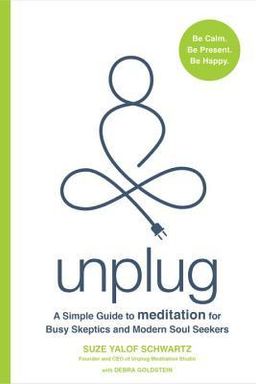
Unplug cover

Unplug

by Suze Yalof Schwartz

Unplug is a practical guide to meditation, revealing how this ancient practice can fit seamlessly into modern life. With just ten minutes a day, learn to enhance your mental clarity, reduce stress, and boost happiness. Discover diverse techniques and establish lasting habits for a calmer, healthier life.

Unplug and Reconnect: The Transformative Power of Meditation

When was the last time you truly paused—no notifications buzzing, no mind racing, no endless to-do list fighting for your attention? In Unplug: A Simple Guide to Meditation for Busy Skeptics, Suze Yalof Schwartz invites readers to rediscover what it feels like to be in the present moment. Drawing on her journey from high-stress Vogue editor to founder of Los Angeles’s first drop-in meditation studio, Schwartz argues that our happiness, success, and fulfillment lie not in doing more but in unplugging—learning to pause the noise, breathe, and focus inward.

Meditation, she asserts, isn’t mystical, religious, or complicated. It’s a simple, scientifically supported practice that anyone can learn. Through it, you train your brain to stop reacting automatically to stress and instead respond with calm and intention. Schwartz’s message is refreshingly direct: you don’t need incense, a guru, or hours of free time. You just need a few quiet minutes and the willingness to sit still and breathe.

The Case for Unplugging

In today’s 24/7 culture, stress has become a badge of honor. Schwartz knows this firsthand. For decades, she thrived on deadlines, glamour, and high-stakes fashion chaos. But when she hit a wall of anxiety and exhaustion, her psychotherapist mother-in-law introduced her to a three-minute breath exercise that changed her life. That small moment of calm inspired her radical career shift—from styling makeovers for red carpets to creating Unplug Meditation, a modern, no-woo-woo space where anyone could learn to meditate without pretension.

Her premise is simple but profound: our brains are overwhelmed by 50,000 thoughts a day. Meditation reclaims your attention and puts you back in charge of your reactions. It’s not about suppressing thoughts; it’s about noticing them and calmly letting them go. This space—what Schwartz calls the "gap"—is the key to peace, clarity, and real happiness.

Making Meditation Modern and Accessible

Schwartz debunks the old stereotypes of monks on mountaintops. Her approach is secular, science-backed, and designed for modern life. Guided by teachers like Davidji, Olivia Rosewood, and Natalie Bell, she delivers meditation in digestible, five-minute doses. You can meditate at a coffee line, in traffic, or between meetings. You can even use tools like sound baths, breath work, or crystals—if you want to, not because you must.

She draws on research from Harvard neuroscientist Sara Lazar showing that meditation increases gray matter in areas linked to memory, emotional control, and empathy. Studies from UCLA and Johns Hopkins confirm that it reduces anxiety, strengthens immunity, and boosts happiness. Schwartz’s point is clear: this is not self-indulgent escapism; it’s neuroplastic self-improvement.

From Overdrive to Presence

At its heart, Unplug champions the radical idea that doing less can help you accomplish more. Meditation creates what Schwartz calls the “aha gap”—a stillness in which creativity and clarity rise to the surface. It reconnects you with intuition, renews compassion in your relationships, and helps you make decisions aligned with what really matters. As meditation teacher Kristen Luman notes, “Meditators trust their gut more because they can actually hear it.”

Throughout the book, Schwartz builds a toolkit of short, accessible meditations—each designed to fit seamlessly into everyday life. These range from the one-minute “Unplug Meditation” to the “Espresso Meditation” for instant calm, the “Traffic Meditation” for road rage, and “Feel the Love Meditation” for compassion. Her practical tone makes mindfulness less about transcending real life and more about transforming how you experience it.

Why It Matters

Schwartz’s mission is to democratize calm. In her view, meditation isn’t just personal self-care—it’s a public service. A calmer you means a kinder, more resilient society. She argues that every person who learns to pause before reacting breaks a cycle of stress that ripples outward to families, workplaces, and communities. The success stories in the book—from corporate executives to kids learning to breathe through tantrums—prove her point.

In the end, Unplug isn’t about escaping the world; it’s about reentering it fully awake. Schwartz’s voice is funny, candid, and deeply relatable. Her journey from chaos to clarity embodies what she teaches: that the most powerful makeover you can give yourself doesn’t come from fashion but from presence. As she puts it, “Almost everything will work again if you unplug it for a few minutes, including you.”


What Meditation Really Is (and Isn’t)

Meditation, Schwartz insists, is not about chanting, emptying your brain, or turning into a monk. It’s a systematic method for training your attention and rewiring your brain to respond consciously rather than reactively. In her popular Simple Formula for Straight-Up Meditation, she breaks it down into six easy steps: focus, let go, drift, notice, refocus, repeat. That’s it. The entire practice revolves around redirecting your attention—what neuroscientists call strengthening the prefrontal cortex while calming the amygdala (the brain’s fear center).

The “Monkey Mind” Problem

Most people’s minds are like tabs on a browser—constantly switching between memories, worries, lists, and random musings. Schwartz calls this “Google Brain.” Meditation teaches you to stop hopping from thought to thought and instead notice each one without judgment, then return to the present moment. Over time, you realize you are *not* your thoughts—you are their observer. As Eckhart Tolle says, “The moment you realize you are not present, you become present.”

The Power of the Gap

When you focus—say, on your breath or a mantra—and then naturally let that focus go, a tiny space opens before the next thought arises. Schwartz calls this “the gap,” a fleeting moment of pure awareness and peace. You can’t force it, but you can train your brain to slip into it more often. She likens it to lying by the ocean with nothing to do except breathe—total presence, total calm. Even a millisecond of that gap begins to transform your daily life.

Redefining Success

Westerners often approach meditation like a task—something to be mastered. Schwartz, ever the recovering perfectionist, reframes it. You can’t “win” meditation. As teacher Davidji puts it, “Even in a shallow dive, you get wet.” Every session, even the restless ones, helps rewire your brain for calm and clarity. The only bad meditation is the one you don’t do.

Over time, what happens on the cushion spills into daily life. That pause between inhale and exhale becomes a psychological pause in which you can choose your reaction rather than being ruled by it. Whether you’re in a traffic jam or a tense meeting, you’ll find yourself unplugging from chaos and plugging back into awareness.


Science, Benefits, and Brain Magic

Schwartz goes beyond personal anecdotes to ground her case in science. The evidence is staggering: meditation doesn’t just make you feel better—it changes your brain and body in measurable ways. Neuroscientist Sara Lazar’s MRI scans reveal that consistent meditators have thicker frontal cortices (where memory and decision-making live) and smaller amygdalas (where fear and anxiety dwell). In other words, meditating literally makes you smarter and calmer.

Mental and Emotional Health

Studies from Yale, Harvard, and Johns Hopkins show that regular meditation reduces anxiety, depression, and mind-wandering—effects comparable to antidepressants, but without side effects. Practicing daily lowers cortisol (the stress hormone) and boosts dopamine and endorphins (the feel-good chemicals). Schwartz’s student Courtney, a TV reporter healing from heartbreak and divorce, describes how meditating three times a week shifted her from sadness to gratitude and joy within a month.

Physical Health and Longevity

Beyond the brain, meditation promotes heart health and slows aging. Dr. Tamara Horwich of UCLA states that stress is one of the biggest risk factors for heart disease, and meditation directly reduces it. Meanwhile, Nobel Prize–winning researcher Elizabeth Blackburn found that meditating just twelve minutes a day can increase telomerase activity—the enzyme that preserves cellular youth—by 43 percent. You can literally meditate your way to longer, healthier life.

Performance, Focus, and Success

Meditation enhances clarity and focus, allowing professionals—from hedge fund managers to athletes like Kobe Bryant—to operate at peak performance. As Natalie Bell and Lena George explain, it strengthens the brain’s “CEO,” the prefrontal cortex, letting you act from reason instead of reactivity. Schwartz points to studies showing multitasking reduces efficiency by up to 40%, while meditation restores singular focus. Even giant corporations—Google, Apple, and Aetna—now integrate mindfulness training to improve productivity and engagement.

The data, the stories, and the transformations all point to one truth: meditation isn’t a spiritual luxury. It’s a biological upgrade. Or, as Schwartz puts it: “A meditation a day keeps the doctor away.”


Presence, Happiness, and Inner Glow

Meditation isn’t just brain training—it’s happiness training. Schwartz argues that the deepest joy comes not from achievements or possessions, but from presence. Even luxurious vacations lose their glow after two weeks, but daily meditation creates lasting change because it rewires the brain’s “happiness set point.” You stop searching for joy outside and begin generating it from within.

The Science of Happiness

Research from Yale and Harvard confirms that wandering minds are unhappy minds. Meditation stops this constant mental time travel, anchoring you in the now, where contentment exists. It also activates the left prefrontal cortex—the brain’s “happy zone.” As meditation teacher Amy Budden says, “Meditation can trump environment and genes to hardwire happiness.”

Confidence, Beauty, and Charisma

In one of the book’s most engaging sections, Schwartz reveals meditation’s “side effect” of natural beauty. Relaxation smooths worry lines, restores posture, and gives a genuine glow. Lauren Eckstrom quips, “Meditation gives you the kind of glow that makes people stop and say, ‘I want what she has.’” Presence is magnetic. Harvard psychologist Ellen Langer’s studies show that being truly attentive makes you more charismatic and attractive—proof that inner calm radiates outward.

After weeks of practice, Schwartz saw her students emerge visibly lighter, calmer, and happier. Their smiles came easier, their voices softened, and their relationships improved. The joy wasn’t from escaping reality; it came from returning to it fully awake. As she writes, “Meditation doesn’t make you different. It makes you more yourself.”


Relationships, Empathy, and Emotional Intelligence

When you get calmer, your relationships follow. Schwartz emphasizes this truth repeatedly: meditation improves every connection—to partners, children, colleagues, and even strangers. Neuroscientist Sara Lazar’s research shows that meditation thickens the temporoparietal junction, the part of the brain linked to empathy and perspective-taking. As empathy increases, compassion naturally follows.

From Reaction to Response

Schwartz illustrates this with stories of parents, partners, and professionals who shift from snapping to pausing. One mother, for example, used to “morph into Momzilla” on school mornings, yelling to get her kids out the door. After meditating, she began pausing to breathe with them before leaving. The result? Happier mornings, fewer tears, and a family who now teases her lovingly: “Mom, did you meditate today?”

Children and Emotional Regulation

Schwartz extends this practice to parenting. With teacher Laurie Cousins, she demonstrates how even small meditations can teach kids self-regulation—breathing through tantrums, using “meditation jars,” and doing playful exercises like the “smell the roses, blow the candle” technique. As kids learn to observe their emotions rather than be ruled by them, they develop tools for resilience that last a lifetime.

Ultimately, mindfulness reshapes how we treat one another. Stress breeds miscommunication; presence breeds connection. Meditation melts judgment, builds curiosity, and turns everyday interactions into opportunities for compassion. In Schwartz’s view, it’s not just self-care—it’s relationship repair.


Meditation Anywhere, Anytime

One of the central demystifying messages of Unplug is that meditation can happen anywhere. You don’t need a mountain retreat or a perfect cushion. Schwartz shares stories of people meditating in parking lots, coffee lines, and offices. Her students learn to build “mini moments” of awareness into daily routines—an empowering form of portable peace.

Everyday Meditations

Practicality drives Schwartz’s teaching. She includes dozens of specific exercises:

  • The Espresso Meditation for instant calm through breath cycles
  • The Traffic Meditation to turn road rage into mindfulness
  • The Starbucks Meditation for mindful waiting and gratitude
  • The Unplug Meditation for a sixty-second reset—U.N.P.L.U.G. (Unplug, Notice, Pick, Let, Understand, Get on with your day)

The idea? You integrate meditation into life rather than escape from it. Waiting at a red light or brushing your teeth becomes an opportunity to return to presence.

Creative Meditations

Schwartz also includes accessible sensory practices—guided imagery, aromatherapy, sound baths, walking meditation, even crystal and chakra balancing. Some sound exotic, but her tone stays grounded: “If crystals feel good, use them. If they don’t, skip them.” The goal isn’t ritual; it’s awareness. Whether you gaze at a candle, hold a stone, or watch your breath, the practice is the same: focus, drift, return.

By demystifying meditation into moments you can practice anytime, anywhere, Schwartz takes mindfulness from the mat to the marketplace. Your life becomes the meditation hall.


Finding Purpose Through Stillness

What if the clarity you’ve been searching for is waiting in silence? Schwartz shows that meditation doesn’t just relax you—it awakens you. Underneath the noise lies intuition, creativity, and purpose. As teacher Lena George explains, when the nervous system shifts from fight-or-flight to calm awareness, the brain literally broadens its perceptual field. You don’t just feel better; you see more possibilities.

Listening to Your Inner Guidance

Meditation connects you with what Schwartz calls the “still, small voice.” The insight may whisper like intuition or arrive like revelation. She recounts stories of people who quit jobs, left unhealthy relationships, or pursued passions they’d long ignored—choices born not of impulse but of deep clarity. Actor Johnny O’Callaghan, for example, followed a gut feeling on a trip to Africa and ultimately adopted a son he instantly knew was his.

Reclaiming Authentic Fulfillment

In a consumer culture obsessed with more, meditation leads you toward less—but more of what matters. Schwartz, a former fashion editor surrounded by luxury, discovered through meditation that joy comes from essence, not excess. You learn to ask, “What truly fulfils me?” and to release what doesn’t. Former addicts and impulse buyers in her classes describe how mindfulness freed them from destructive loops by letting them pause before acting.

Meditation becomes both compass and fuel. It doesn’t give you a new life; it lets you clearly see the one you were meant to live. As Mark Twain said (and Schwartz quotes), “The two most important days in your life are the day you are born and the day you find out why.”


Keeping the Habit and Deepening the Practice

Meditation works only if you practice it. Schwartz offers practical wisdom for keeping it consistent. The trick? Make it easy, make it regular, and make it yours. Meditate first thing in the morning when the brain is most receptive, she suggests—it sets the tone for your entire day. Even five minutes counts, as long as you do it daily.

Creating Your Ritual

Rituals signal the brain that it’s time to shift states. Schwartz recommends lighting a candle, using essential oils, or doing a quick “locker visualization” where you mentally stow away your to-do list. These rituals reduce resistance. Her humor keeps it light: “The best time to meditate is when your Chinese food delivery is not imminent.”

Patience, Persistence, and Play

Most beginners quit because they expect bliss right away. Schwartz reframes patience as part of the discipline. “You don’t vote on whether to brush your teeth,” she recalls her teacher saying, “you just do it.” Some days will feel noisy, others peaceful—both count. Remember Davidji’s analogy: meditation is like turning on a light; you don’t fight darkness, you just switch focus.

Going Deeper

Once established, you can extend sessions gradually. The “Unplug 28-Day Challenge” builds from one to twenty minutes a day. Each week deepens stillness and strengthens neural pathways for calm. The “advanced” technique, Schwartz jokes, isn’t mystical—it’s simply doing more of the basics. Consistency turns meditation from practice to lifestyle.

Eventually, every part of life becomes a meditation. You eat slower, speak kinder, and respond wiser. As Schwartz concludes, “Almost everything will work again if you unplug it for a few minutes, including you.”

Dig Deeper

Get personalized prompts to apply these lessons to your life and deepen your understanding.

Go Deeper

Get the Full Experience

Download Insight Books for AI-powered reflections, quizzes, and more.