
Idea 1
Letting Go of Past Success to Unlock Your Future
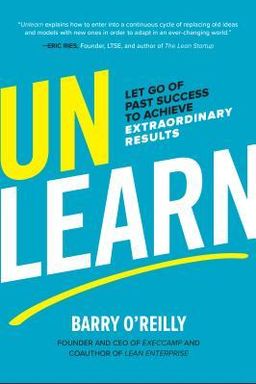
When was the last time you realized that what once made you successful might now be holding you back? In Unlearn: Let Go of Past Success to Achieve Extraordinary Results, Barry O’Reilly challenges you to confront the habits, mindsets, and methods that were once useful but have turned into anchors. His central claim: in an age of disruption, the biggest barrier to growth isn’t the inability to learn more—but the unwillingness to unlearn what no longer works.
O’Reilly contends that today’s leaders—from tech CEOs to teachers—are stuck in the paradox of success. The very approaches that once propelled them forward—rigid processes, proven playbooks, and predictable thinking—now limit innovation. Unlearning is the antidote: the deliberate process of questioning, reframing, and letting go of outdated mental models so you can relearn and break through to extraordinary results. In doing so, he builds a system called the Cycle of Unlearning, which consists of three perpetual stages: unlearn, relearn, and breakthrough.
The Core of Unlearning
O’Reilly opens with a powerful example—Serena Williams’ slump after years as the world’s number-one tennis player. Despite training harder, she began losing. Her trusted routines had become limitations. When she hired an unconventional coach, Patrick Mouratoglou, she took the biggest risk of her career—abandoning proven strategies to discover new ones. This act of courage and adaptability exemplifies what O’Reilly calls the paradox of success: the more successful you are, the harder it is to change. Serena’s story sets the tone for the book—not as a lesson in talent, but in mental flexibility.
Why We Resist Change
Humans crave certainty. Success breeds comfort, and comfort breeds rigidity. O’Reilly points out that organizations and individuals alike often fail to acknowledge when their environment has changed. They cling to “what worked before.” This resistance isn’t ignorance—it’s a psychological trap rooted in ego, fear of uncertainty, and reward systems that favor short-term results. He draws from leaders at NASA, Disney, Capital One, and T-Mobile to reveal how even world-class organizations can be blinded by their own achievements until change becomes a necessity.
The Cycle of Unlearning
The solution lies in building a new habit loop: Unlearn outdated assumptions, Relearn new information or behaviors through experimentation, and use those insights to achieve a Breakthrough—then repeat. This framework isn’t a one-time fix; it’s a continual system for adaptation. Unlearning begins with identifying limiting beliefs, relearning requires deliberate practice and experimentation, and breakthroughs emerge when reflection transforms mindset. It’s the organizational version of personal growth combined with agile innovation. Leaders who intentionally apply the cycle—rather than waiting for crises—can stay ahead of disruption, not just survive it.
Why It Matters
O’Reilly argues that the speed of change today demands adaptability as a core competency. In business terms, adaptability beats efficiency. Companies like Amazon and Google thrive not because they know more than competitors, but because they learn, unlearn, and relearn faster—powered by experimentation and safe-to-fail systems that treat mistakes as sources of information rather than weakness. In a broader sense, he reminds you that unlearning isn’t limited to companies; it’s a mindset applicable to improving any part of life—from leadership and creativity to stress and performance.
Across twelve chapters, O’Reilly expands this principle from personal transformation to corporate innovation, drawing vivid examples from Serena Williams, NASA’s learning culture after the Challenger disaster, Disney’s billion‑dollar MagicBand experiment, and even the UK’s National Health Service rebuilding massive IT failures. Each story shows that true innovation often starts with the uncomfortable act of letting go. Unlearning is courage in action—a skill that, once mastered, lets you drop the safety of past success and embrace the uncertain path toward something far greater.