
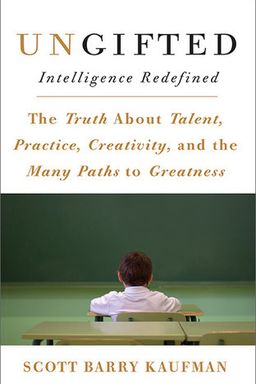
Ungifted Intelligence Redefined cover

Ungifted Intelligence Redefined

by Scott Barry Kaufman

Ungifted: Intelligence Redefined challenges conventional views on intelligence, emphasizing a holistic approach that values creativity, practice, and growth mindset. Scott Barry Kaufman reveals the limitations of IQ testing and advocates for a personalized educational system that nurtures each child''s unique potential.

The Dynamic Nature of Human Intelligence

Scott Barry Kaufman’s central argument is that human intelligence is not a fixed quantity bound by genes or defined by test scores. Instead, it is a dynamic system—a lifelong interplay of biology, environment, motivation, and experience. The book challenges conventional notions that label individuals as “smart,” “gifted,” or “learning disabled,” proposing instead that potential unfolds through engagement, opportunity, and personalized development. Kaufman draws from neuroscience, developmental psychology, and his own childhood story to remind you that ability grows from interaction, not isolation.

Genes and the environment: the dance of development

From the beginning, Kaufman reframes “nature versus nurture” as “nature and nurture in constant conversation.” Twin and adoption studies (Bouchard Jr., Turkheimer) show genetics predict variations in intelligence, but not the destiny of any person. Genes operate as potential activators, responding to environmental stimuli. A child’s environment can amplify tiny advantages—a phenomenon Bronfenbrenner and Ceci called the “multiplier effect.” For instance, a small early language benefit can snowball through enriched interaction, books, and supportive adults, while deprivation constrains expression of genetic potential.

This balance explains why adopted children raised in stimulating, high-SES homes often gain 12–18 IQ points compared to their early-life peers. Kaufman calls these cascades “developmental trajectories,” reminding you that potential is malleable, especially early in life.

Labels, testing, and the human story

Kaufman’s personal experience with special education underscores how simplistic labels can distort understanding. Historically, intelligence testing began with Alfred Binet’s compassionate aim to identify children needing help. But later adaptations—like Terman’s Stanford-Binet—turned scores into social hierarchies. Kaufman traces how misuse, from eugenic immigration screening to rigid school sorting, narrowed opportunity instead of enabling growth. Modern CHC theory (Cattell-Horn-Carroll) and “intelligent testing” practices seek to fix this, urging professionals to interpret patterns, not numbers, and see scores as estimates with confidence intervals rather than verdicts.

Reimagining development and talent

Across giftedness, learning disabilities, autism, and creativity, Kaufman integrates research into a broader human story: one mind may express potential through music, another through spatial reasoning or deep focus on special interests. He revisits the giftedness debate—from Terman’s IQ gatekeeping to Renzulli, Gardner, and Sternberg’s multifaceted frameworks—and argues that “giftedness” is the interaction of passion, ability, and context. Similarly, modern approaches to learning disabilities (like RTI and COG-PSW) embody this perspective: look at response, strengths, and social context, not just score discrepancies.

Autistic cognition, often framed as deficit, shows the same principle. When special interests align with learning, motivation skyrockets—Winter-Messiers found improved speech and social responsiveness during discussions of special interests. Kaufman calls this “strength-based intelligence”: every mind has domains where processing style becomes advantage.

Beyond IQ: understanding engagement and passion

The core mechanism of growth is engagement. Dopamine research distinguishes “wanting” (pursuit) from “liking” (reward), showing why curiosity and goal pursuit matter more than innate pleasure. When contexts satisfy autonomy, competence, and relatedness (Deci & Ryan’s self‑determination theory), learning becomes self-sustaining. Harmonious passion—integrated into life—produces balanced achievement, while obsessive passion breeds burnout. Kaufman’s cello story with his grandfather illustrates how supportive passion creates long-term excellence.

Growth mindset and self‑regulation

Mindset transforms effort into improvement. Building on Carol Dweck’s research, Kaufman shows how students with growth beliefs persist through difficulty, while fixed beliefs feed avoidance. Early interventions that teach self‑regulation, such as Tools of the Mind or Project Bright IDEA, improve academic and emotional outcomes. Combined with reduced stereotype threat and high expectations (Rosenthal’s Pygmalion effect), these methods reshape developmental pathways—confirming that “change the context, and you change the child.”

Practice, expertise, and brain plasticity

Expertise arises where sustained practice meets cognitive strategy. Ericsson’s deliberate practice shows elite performance depends on focused, feedback-rich effort over thousands of hours. Spearman’s g, the prefrontal-parietal network, and neuroscience converge to explain why working memory and attentional control correlate with reasoning, yet practice can reshape networks themselves (musicians, jugglers, LSAT trainees). The lesson: both talent and training matter, and each modifies the other through experience-dependent plasticity.

Creativity and the wandering mind

Creativity connects multiple systems—executive control, default-mode, and emotional processing. Kaufman draws on Singer, Kounios, Beeman, and Limb’s findings to show how daydreaming and flow emerge as functional states for innovation. The default network enables self-reflection and idea incubation, while flow integrates spontaneous generation and focused control. These processes prove that adaptive mind wandering, often dismissed in schools, is actually crucial for planning and imaginative synthesis.

Toward Personal Intelligence

Kaufman’s ultimate synthesis—the Theory of Personal Intelligence—defines intelligence as the dynamic integration of engagement and ability in pursuit of personal goals. Every person’s mind combines deliberate and spontaneous processes to solve problems meaningful to them. This view values identity, purpose, and lifelong growth over test-based prediction. Practical models like The Future Project and the Posse Foundation demonstrate institutional ways to cultivate talent through passion and mentorship, not cutoff scores.

In sum, the book’s main theme urges you to see intelligence as a lifelong process of transformation—a symphony composed by genes, context, motivation, creativity, and choice. When you design learning or leadership with that truth in mind, you foster not just smarter individuals, but fuller human beings.


Genes, Context, and Human Potential

Genes and environment interact dynamically to shape who you become. Kaufman explains that genetics set parameters—sensitivities and tendencies—not scripts. Studies like Turkheimer’s twin work show that socioeconomic context governs how much genetic variance is expressed. In low-SES homes, environmental constraints mute genetic influence; in enriched settings, talents flourish. Your genes guide where you seek experiences (Experience-Producing Drives), and those choices reinforce your strengths.

The multiplier and sensitivity effects

Small early advantages grow through positive feedback loops—the Matthew effect. Children exposed to richer language and supportive interaction accumulate vocabulary and confidence that compound over time. Boyce and Ellis describe “orchids” and “dandelions”: sensitive children magnify environmental effects more dramatically than resilient ones. This reinforces Kaufman’s message—potential is least genetic when conditions are hardest, and most genetic when opportunities abound.

Key insight

Genes are instruments for extracting environmental information, not blueprints. Their interaction with context determines what kind of intelligence you will exhibit.

The implication is profound: nurture changes nature. Early, well-targeted support can unleash capacities that biology only seeds. This gives parents, teachers, and policymakers genuine power to shape trajectories rather than merely measure outcomes.


Rethinking Tests and Labels

Intelligence and learning labels often tell more about systems than students. Kaufman traces how IQ’s history evolved from Binet’s helpful tool to Terman’s rigid hierarchy. Tests became gatekeepers for gifted programs and exclusion criteria for special education. Yet scores contain errors, cultural bias, and context dependency. A child’s performance varies with motivation, familiarity, and examiner expertise; many scorers commit elementary mistakes. Modern CHC theory supports nuanced interpretation through profiles of cognitive strengths and weaknesses.

From discrepancy to dynamic identification

Learning-disability identification historically used IQ–achievement gaps, a flawed substitute for psychological processes. Kaufman highlights how Response to Intervention (RTI) and Cognitive Pattern of Strengths and Weaknesses (COG-PSW) moved beyond static discrepancies. RTI observes how students respond to evidence-based teaching; COG‑PSW combines CHC assessments to tailor interventions. Together, they demonstrate assessment as response-driven and personalized.

Labels, opportunity, and neurodiversity

Kaufman aligns with the neurodiversity movement: dyslexia and ADHD can hide creative and entrepreneurial talents. Studies show dyslexic individuals excelling in holistic perception and pattern recognition—skills invaluable beyond school metrics. He argues for multi-method assessment that values coping skills, motivation, and unique strengths, rejecting labels that narrow self-concept. His own transition from special education to academic success proves how context and support redefine potential.

Key message

Tests must serve people, not define them. Assessment should reveal how a person learns—not merely quantify how much they know.


Passion, Mindset, and Self‑Regulation

Motivation and mindset dictate whether ability is activated. Kaufman merges neuroscientific and psychological evidence to show that passion transforms effort into mastery. Dopamine fuels goal pursuit (“wanting”), not merely pleasure, and harmonious passion aligns with well-being, while obsessive passion harms it. Deliberate practice succeeds only when sustained by intrinsic motivation—joyful learning rather than fear-driven perfectionism.

Growth mindset and expectations

Believing intelligence grows encourages risk-taking and persistence. Teachers’ expectations, as shown in Rosenthal’s Pygmalion effect, can literally elevate student performance. Fixing ability as immutable activates stereotype threats—Steele and Aronson demonstrated that subtle reminders of racial stereotypes lower test scores. Reframing anxiety as helpful arousal or expressive writing before exams (Ramirez & Beilock) restores working memory and performance.

Building self‑regulation early

Self-control predicts success beyond IQ. Programs like Tools of the Mind and PATHS teach inhibition and emotional control, leading to long-term gains in graduation, health, and even crime reduction (Moffitt’s cohort studies). Kaufman insists that intervention timing matters: the earlier you teach regulation, the longer cognitive benefits compound. Effective development merges emotional, social, and cognitive scaffolding under one roof.

Practical takeaway

Create contexts that nurture enjoyment, growth feedback, and self‑control—these psychological processes are the real multipliers of intelligence.


Practice, Expertise, and the Brain

To bridge talent and skill, Kaufman unites Ericsson’s deliberate practice theory with Spearman’s concept of g and neuroscience’s prefrontal-parietal network. Expertise emerges from structured, feedback-rich practice targeting weaknesses. Ericsson’s research on digit-span and violin performers proves strategy—not raw talent—drives improvement. Techniques like chunking and the method of loci expand cognitive capacity by making information meaningful, effectively increasing working memory’s functional load.

g and brain networks

Spearman’s g manifests as a set of correlated abilities supported by the lateral prefrontal–parietal network. Imaging studies (Jung & Haier, Duncan) reveal efficient activation among high‑g individuals during reasoning tasks. Kaufman explains that fluid reasoning depends on both general capacity and learned strategies—plasticity allows you to train parts of the network over time. Practice literally reshapes brains: juggling, music, and reasoning training studies corroborate long-term gray-matter changes.

Limits and integrative training

Short-term “brain training” often fails because transfer is narrow. Hambrick and Silvia Bunge’s research shows gains occur mainly for those whose working memory is the bottleneck. True transfer arises when training includes strategy instruction, emotional regulation, and context. Kaufman positions expertise as the joint product of ability, motivation, and social support. You don’t just repeat tasks—you redesign thinking to handle complexity.

Essential idea

Expertise evolves through deliberate practice guided by meaningful goals, adaptive strategies, and continuous feedback. Your brain changes as your actions do.


Creativity, Openness, and Flow

Kaufman explores creativity as an oscillation between control and spontaneity. Daydreaming and default-mode activation enable internal exploration, while executive networks refine and evaluate ideas. Singer’s studies of daydreaming and Immordino-Yang’s compassion research show how imaginative wandering fosters empathy and planning. During moments of flow, both systems align, allowing effortless concentration and expressive performance—as captured in Limb’s jazz improvisation studies.

The neural balance and personality trade-offs

Using DeYoung’s model, Kaufman distinguishes Intellect (analytic curiosity) from Openness (experiential exploration). Creativity thrives when Openness’s associative thinking meets Intellect’s control. Reduced latent inhibition—allowing more stimuli into awareness—predicts artistic creativity but also vulnerability to disorganized thought. Dopamine pathways mirror this tension: striatal activity supports imagination, while frontal circuits supply order.

Managing the creative paradox

The same openness that inspires ideas requires regulation to shape them productively. Kaufman argues you can cultivate both through environments that alternate unstructured exploration and deliberate evaluation. Creative work benefits from breaks that enable incubation and controlled revisiting afterward. When you learn to toggle between play and discipline, your mind becomes capable of genuine innovation rather than random novelty.

Creative insight

Balanced minds—open enough to explore, structured enough to refine—produce enduring creativity and mental resilience.


Personal Intelligence and Human Flourishing

In concluding, Kaufman presents his Theory of Personal Intelligence—the idea that intelligence is the synergy of ability and engagement applied toward personally meaningful goals. It’s not about ranking minds but cultivating authentic fulfillment. The theory emphasizes identity, motivation, and long-term growth. You act intelligently when you pursue your purpose with adaptive strategies, curiosity, and creative flexibility.

Education and social design

Kaufman highlights schools and initiatives translating this idea into practice: The Future Project (turning passions into school-wide projects), Beau Lotto’s experiential science learning, and the Posse Foundation’s dynamic admissions methods. These models assess motivation and collaborative ability alongside cognitive metrics. They cultivate environments where uncertainty and exploration are safe, allowing each student to discover their unique path to expertise.

A broader definition of success

Personal intelligence reframes success as a journey of learning, adaptation, and meaning-making. It includes deliberate reasoning, intuitive insight, emotional understanding, and creative play. The ultimate message: intelligence is a verb, not a label. The most “intelligent” life is one lived with curiosity, compassion, and sustained engagement in growth.

Final reflection

When you treat intelligence as personal and evolving, the question shifts from “How smart are you?” to “How will you use your mind to enrich your world?”

Dig Deeper

Get personalized prompts to apply these lessons to your life and deepen your understanding.

Go Deeper

Get the Full Experience

Download Insight Books for AI-powered reflections, quizzes, and more.