
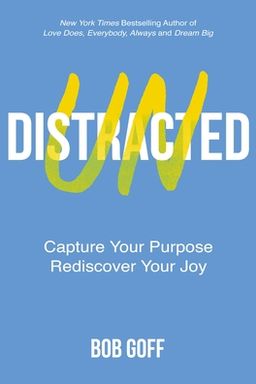
Undistracted cover

Undistracted

by Bob Goff

Undistracted by Bob Goff is a powerful guide to overcoming the distractions that prevent us from living our best lives. Through engaging stories and practical advice, Goff shows readers how to focus on what truly matters, rediscover their joy, and embrace a life filled with purpose and love.

The Undistracted Life: Finding Joy, Purpose, and Focus

Have you ever found yourself pulled in dozens of directions at once—trying to juggle work, family, faith, and expectations, only to end the day exhausted but unfulfilled? In Undistracted: Capture Your Purpose, Rediscover Your Joy, Bob Goff challenges that modern malaise of busyness and fragmentation. He argues that life’s richness and purpose are not found through doing more things but through living with deliberate focus—a life undistracted by fear, comparison, and noise.

Goff contends that distraction is one of the most subtle yet powerful forces sabotaging our joy. He writes, “Distraction is what leads us into minefields,” warning that many of us wander into dangerous emotional, spiritual, and relational territory because we mistake busyness for purpose. By learning to identify what pulls us away from meaning—and rediscovering the courage, curiosity, and love that guide us home—we can live lives that are not just successful but truly holy and fulfilling.

A Modern Epidemic of Distraction

In the opening chapters, Goff compares distraction to wandering into a minefield: we think we are near the boundary of danger but are really in its center. His stories—from accidentally standing on a rattlesnake while filming on a water tower to tossing rocks into what he thought was a safe minefield on the Iraq-Iran border—serve as vivid metaphors for how easily we lose focus amid the chaos of modern life.

He explains that distractions steal not only our time but also our identity. When we act like the people others want us to be, we lose sight of who God says we are. For Goff, distraction becomes a spiritual enemy that “injures us with a thousand paper cuts,” keeping us from expressing our gifts. The antidote, he says, is not hyper-efficiency or rigid discipline but deep love and focus on lasting things: faith, family, and calling.

The Invitation to Purpose and Joy

Goff’s premise is simple but transformational: purpose drives undistracted living, and joy is its natural outcome. “Find your purpose,” he writes, “and you will experience more joy.” Put differently, the fix for distraction isn’t withdrawal but captivation—an engaging, passionate focus on what truly matters. He invites readers to trade endless noise for clarity, encouraging them to make room for joy by releasing false expectations and reclaiming their God-given creativity.

“The way to beat distraction is to become captivated by something much bigger and much better—such as purpose and joy.”

He reminds us that God’s invitation is not conditional. We don’t need permission or more information—we need examples and proximity to focused people who live with joyful clarity so that some of their intentionality can “rub off.”

Faith as Focus: The Undistracted Vision

Faith anchors Goff’s idea of focus. He writes that living undistracted requires spiritual blinders—not to narrow our worldview, but to block the false urgencies that compete with eternal priorities. Just as racehorses wear blinders to stay focused on the finish line, we must learn to fix our gaze on what will last forever: our faith, our family, and our purpose. Everything else, he insists, is “temporary and transitory.” When our attention is directed toward the eternal, joy flows naturally, even amid difficulty.

The book’s many stories—from prison cells at San Quentin to heart procedures, from flying planes through darkness to rescuing dreams lost to disappointment—illustrate that living undistracted is less about perfection and more about presence. It’s not avoiding trouble but choosing courage, authenticity, and grace when distraction tempts us to withdraw or to chase the wrong things.

Rediscovering Joy and Purpose

Ultimately, Goff’s larger argument is that joy and purpose are already embedded in our lives—we’ve simply forgotten to notice them. Living undistracted means making the daily decision to rediscover what matters: the small acts of kindness, the unselfish availability, the courage to be authentic, and the humility to love people exhaustively. As he puts it, “You are someone who has permission to live with an unreasonable, unthinkable, totally absurd amount of focus, purpose, joy, and fulfillment.”

Throughout the chapters, the reader follows Goff through near-death experiences, hilarious misadventures, and remarkable encounters that illuminate how undistracted living transforms ordinary days into divine purpose. Every story ends with actions that are as practical as they are inspirational—such as taking daily notes, reconnecting with one’s “song,” or simply finding one’s way back to a focused, joy-filled rhythm.

Why This Message Matters

Goff’s undistracted philosophy matters deeply in an age overloaded by information and performance. It's a reminder—echoing thinkers like Richard Rohr and Henri Nouwen—that the antidote to chaos isn’t withdrawal but awakened, joyful participation in what God is already doing. His personable storytelling invites you not only to reflect but to act. Whether climbing a water tower with balloons, teaching prisoners about freedom, or sending a space capsule into the Ugandan sky, Goff’s life testifies that joy is not found in avoiding distraction but in confronting it with faith and purpose. The journey he offers is not a set of rules but a rumor of possibility: that the world becomes clear when you live with undistracted love.


The Destruction of Distraction

Bob Goff begins with the concept that distraction destroys purpose by scattering our attention. Through humorous and vivid stories, he reveals how easily we drift from intention and faith—mistaking busyness for meaning. In Kurdistan, Goff realizes that being in what seemed like a safe area was actually a minefield, illustrating how mental, relational, or spiritual distraction can trap us in danger we don’t even perceive.

Recognizing Our Minefields

We all carry invisible minefields—comparison, insecurity, financial pressure, or fear of failure. They force us to live reactively, rather than intentionally. Goff invites readers to write down every distraction in a day, from drifting thoughts to small diversions (“I chased the neighbor’s dog. I ate three Pop-Tarts.”), to reveal how much time we lose to noise. This gentle exercise echoes mindfulness practices found in works like Cal Newport’s Deep Work or James Clear’s Atomic Habits: awareness precedes change.

The Rattlesnake at Our Feet

One of Goff’s most striking metaphors describes standing on a tower so focused on climbing that he failed to notice a rattlesnake at his feet. The story illustrates how our obsession with future goals blinds us to where we actually stand. “Sometimes,” he warns, “we’re so busy looking up and forward that we forget to look down.” Spiritual distraction, he argues, poisons our capacity for presence.

Darkness and the Thousand Cuts

Goff identifies distraction not just as a human flaw but as a spiritual weapon: darkness doesn’t aim to destroy us outright but to paralyze us through countless diversions. He writes that evil prefers “a thousand paper cuts” to a single blow, because each little distraction drains energy from purpose. His goal for readers is to create “rumble strips”—small reminders to stay in their lane and keep returning to purpose and joy.

Blinders and Examples

To live undistracted, we need “blinders” like racehorses in the Kentucky Derby—tools to block peripheral noise and focus on eternal goals. We also need examples of purposeful living more than information. Goff insists we become undistracted by proximity to people who embody focus, so faith can become contagious. The destruction of distraction is countered not by isolation but connection.

In a world drowning in data and instant opinions, Goff’s invitation is simple but radical: stop arguing about facts, start rediscovering truth through story and love. Becoming undistracted doesn’t mean ignoring the world; it means tuning into what lasts—your family, your faith, and your calling. Only then, he says, can we “find our song again.”


The Keyhole of Eternity

When Goff experiences heart trouble, his doctor informs him that his pulse races at 220 beats per minute—a rhythm that could kill him. The only cure: stop his heart and shock it back to life. That medical reset becomes a metaphor for spiritual renewal. Like his heart, many of us need to stop the frantic motion and restart with purpose.

The Courage to Restart

Would you risk everything to start life anew? Goff compares rebirth in Jesus to a defibrillation that resets our heartbeat to a rhythm of grace. Change, he says, is invasive but necessary. “Decide in advance,” he writes, “that you’ll do whatever it takes to get your heart right—even if it kills all previous versions of you.” Through this lens, faith isn’t a passive belief system but an active reset—a movement from distraction to divine alignment.

Different Hearts, One Purpose

Everyone’s heart beats differently, and that’s how we’re meant to live. Our task isn’t synchrony but harmony—diverse rhythms united by purpose. “Our hearts were meant to beat together, not the same,” Goff writes, urging readers to drop comparison and embrace uniqueness. Faith grows when we stop mimicking others and become fully ourselves.

Childlike Faith and Trust

Jesus said we must become like children to enter heaven. Goff learns this lesson while trusting a doctor to literally stop his heart. “What amount of additional information do you need before you’ll trust God to fix your heart?” he asks, highlighting how true faith demands both innocence and courage. He awakens with a new rhythm—and a deeper understanding that surrender is salvation’s starting point.

Capturing Ideas and Reflection

In his post-restart clarity, Goff develops a new practice: note-taking as spiritual reflection. Like Marcus Aurelius or Benjamin Franklin, he turns self-examination into growth. Writing things down helps us notice God’s fingerprints in life’s chaos. His stories of George Lucas scribbling “R2D2” and Paul calling lives “letters from God” remind us that even mundane notes can become sacred insight if stewarded well.

Looking through the “keyhole of eternity,” Goff encourages readers to pair wisdom with childlike faith—like a jellyfish that reverts to youth to grow wise again. Life is fleeting, he warns, but legacy lasts when your heart beats for love, reflection, and divine availability.


Breaking Free by Coming Home

In one of the book’s most poignant chapters, Goff examines the prison of insecurity—both literal and emotional. His visits to San Quentin transform his view of what it means to be free. True freedom, he realizes, doesn’t come from unlocking external doors but from returning home to authenticity.

Freedom Inside the Walls

Teaching classes to prisoners, Goff discovers that vulnerability liberates. When one inmate admits guilt after 18 years of denial, “he was the freest man I had ever met.” In honesty, Goff sees spiritual jailbreak. Like the prisoners, we self-incarcerate through pride, bitterness, and fear—but when we tell the truth, we walk free.

The Illusion of Security

A terrifying experience of being locked in a jail meeting room without electricity teaches Goff that “a room designed for maximum security can become a place of total insecurity.” Our fortresses of career, perfectionism, or control may look safe but bind us in anxiety. Security built on appearances gives way to loneliness. Coming home means dismantling that illusion and finding rest in vulnerability.

Reconnecting with Your Shadow

Borrowing imagery from Peter Pan, Goff describes our separation from our “shadowself.” We chase it around, detached and frantic, pretending we’re fine. Healing comes when, like Peter, we allow a trusted friend to “sew us back together.” Safe community is the thread that reunites our divided selves. “People who live with purpose are willing to be sewn back together,” Goff writes.

Rejecting Cynicism

Later, Goff turns his attention to cynics—the modern snipers who shoot down optimism. Cynicism, he says, is merely “insecurity wearing arrogance.” It breeds distraction and drains purpose. He urges readers to take the “bus” instead of accepting rides from cynical people, favoring virtue seekers over fault finders.

Ultimately, “coming home” means returning to who you truly are—an accepted, imperfect, deeply loved person. Freedom begins not at the prison gate but at the moment you stop pretending and start living beloved and undistracted by fear.


The Happiness of Pursuit

Goff teaches that happiness is a decision, not a result. Through stories about flying airplanes and juggling thousands of decisions a day, he shows how distraction hijacks joy—and proposes practical ways to reclaim it. Like pilots who perform “GUMPS checks,” we must continually evaluate whether our emotional and spiritual systems are prepared for flight.

Choosing Happiness on Purpose

Modern adults make more than 35,000 decisions daily, but children make far fewer—and are significantly happier. Childlike joy, Goff observes, comes from simplicity and presence. He urges us to “decide to be happy” rather than waiting for circumstances to permit it. Happiness isn’t found after success; it’s cultivated through attention to what lasts.

Trading Proximity for Presence

Distraction tricks us into substituting proximity for presence. We live near our families without really being with them. Whether through screens, career ambitions, or busyness disguised as productivity, we forget to see each other fully. Goff prescribes rituals of reconnection: playing catch, lighting fires, smelling the smoke of old stories—all as ways to reawaken human closeness.

Reclaiming Time and Perspective

Goff uses a countdown clock set to his estimated lifespan to remind himself how short life is. Rather than morbid, it brings vitality—encouraging presence over scrolling, sunsets over social media. With humor and poignancy, he tells readers: “Trade reality shows for actual reality.” Happiness isn’t deferred; it’s available now if we stop chasing future joy and start living current contentment.

True happiness, Goff concludes, turns into kindness—the outward expression of inner joy. “Jerks are quickly forgotten,” he says, “but one act of kindness can be remembered forever.” Being fully present creates ripple effects of empathy and purpose. The pursuit of happiness, when undistracted, always leads home to love.


Finish Your Work

In the final chapter, Goff brings everything full circle through the metaphor of an unfinished guitar. He started building it in college and abandoned it halfway. Forty-two years later, finding it in the attic reminds him—and us—that half-finished dreams represent distraction’s greatest casualty. Finishing our work, he says, honors God.

The Courage to Complete

Goff revisits his project with patience, realizing the delay wasn’t failure but opportunity for rediscovery. Partnering with a craftsman named Jed, he learns the joy of completion not through speed but perseverance. Quoting Jesus—“I have brought glory by finishing the work You gave me”—Goff calls every reader to identify one unfinished task or relationship and see it through.

Guarding Your Focus

A story about a sniper near the San Diego airport epitomizes distraction’s danger: “It only took one shooter to shut down an entire airport,” he writes. Likewise, one unchecked fear or regret can halt our life’s progress. The solution? Declare like Nehemiah rebuilding Jerusalem’s walls: “I’m doing important work, and I can’t come down.” Purpose demands protection from every “Oh no” valley of doubt.

Living Undistracted Until the End

Finishing your work doesn’t mean perfection; it means persistence. It’s the act of doing what God placed before you with joy, until the job is done. Whether writing, forgiving, rebuilding, or loving, completion is the ultimate undistracted act. “Lists are for rookies,” Goff concludes, “action is for the undistracted.”

He closes with grace: not all unfinished things are failures—some are reminders that we’re still being built. But the invitation stands: pick up the guitar, finish the fretboard, and play your song before life’s curtain falls.

Dig Deeper

Get personalized prompts to apply these lessons to your life and deepen your understanding.

Go Deeper

Get the Full Experience

Download Insight Books for AI-powered reflections, quizzes, and more.