
Idea 1
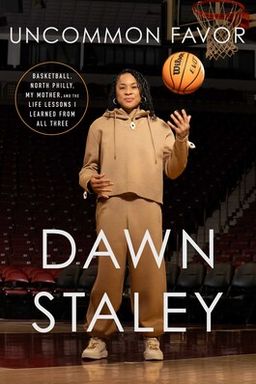
Uncommon Favor: Grit, Faith, and Service
How do you turn a hard start into a life that lifts others? In Uncommon Favor, Dawn Staley argues that long-term excellence is built at the intersection of disciplined courage, people-first leadership, and service-driven ambition, all sustained by faith you practice in the dark as much as the light. Staley contends that you don’t wait for perfect conditions—you build habits, shoulder hard things you’d rather avoid, and then hand the ladder back down so others can climb.
In this guide, you’ll discover how early discipline—hammered in by a mother who smashed unwashed dishes to the floor to make a point—became the steel in Staley’s spine. You’ll then learn how “hope as a ladder” works in real life—from a Dartmouth camp flyer that felt like destiny to a neighborhood legend, Hank Gathers, who opened the court (and the boys’ minds) so she could earn her place among the “first ten.” Finally, you’ll see how setbacks—UVA culture shock, a one-point Final Four loss, being cut from the 1992 Olympic team, post-Olympic depression, and a painful equal-pay fight—shaped a philosophy that prizes people over process, habits over hype, and service over spotlight. Along the way, we’ll examine the grind of USA Basketball’s 1995–96 “Breakfast Club,” the birth of the WNBA, South Carolina’s program turnaround and fanbase (“G-Hive”), and Staley’s public stands on equity and belonging.
What This Book Argues
Staley’s core argument is simple and bracing: greatness isn’t an accident of talent; it’s a daily choice to practice discipline, absorb loss without losing heart, and keep the main thing the main thing—people. She insists that excellence compounds only when you build boring, repeatable habits (think: milk-crate bank shots until you can’t see the rim, or defense-first drills for freshmen Bambi-on-ice) and when you center relationships over rigid playbooks. It’s a point John Wooden made about character and habits; Staley drives it home with modern proof from cramped project courtyards to Olympic podiums.
“The disciplined person can do anything… Hope is a ladder… People over process.”
The Big Ideas You’ll Meet
- Discipline turns potential into destiny: a South Philly kid named “Dirt” for choosing the court over the bath becomes a three-time Olympic gold medalist and Hall of Fame coach.
- Hope isn’t a feeling; it’s a climb—and you’re obligated to lower the rungs for the next person (see: pieces of the 2017 championship net mailed to every Black woman D-I head coach, Carolyn Peck’s “net” lineage, and Staley’s INNERSOLE and after-school programs).
- It’s not where you start, it’s where you finish: from UVA’s “conform” meeting with a dean to a rubber-band snap that fixed turnovers, to losing in 1992 by a single point—and then shepherding an underdog South Carolina squad to an undefeated 2024 title.
- You have to do what you don’t want to do to get what you want: the House Party line that kept her in Spain when she wanted to fly home, and the Tara VanDerveer regimen that broke the team down to build an unstoppable 1996 gold standard.
- People over process: the USC reboot that stalled until recruiting centered one question—“Do you love basketball?”—and a fan culture (“G-Hive”) that packed an arena and unified a city.
Why It Matters Now
Women’s sports are surging in audience and cultural power (witness 18.9 million for the 2024 title game), but they’re still negotiating for equal value and respect. Staley models how to win the games and the arguments: she documents the months-long, walk-away-ready equal-pay negotiation that ended with parity; the lawsuit that shut down a smear; and the postgame mic moments that challenged coded language about Black women’s teams. The relevance stretches beyond sports into any domain where you must lead across differences, fight for fair value, and keep your soul intact.
How to Read This Summary
Each section unpacks a lesson—with stories of Estelle Staley’s household justice, Hank Gathers’s neighborhood grace, Debbie Ryan’s patience, Tara VanDerveer’s “Breakfast Club,” John Chaney’s flowers (“You done good!”), and the night Staley lost the 1992 Final Four by one point—and what it looks like in your career, your team, your family. Expect comparisons to Angela Duckworth’s Grit (for stamina), Carol Dweck’s Mindset (for learning from losses), and James Clear’s Atomic Habits (for systems that scale). Expect hard things (pericarditis while coaching a title run) and soft things (a Havanese named Champ who taught compassion). And expect faith—expressed not as platitude but as pressure-tested operating system: “God has a funny way… When you’re at your worst, He’s at His best.”
If you lead, want to lead, or simply want your life to add up to more than your achievements, Uncommon Favor shows you how disciplined love—of the work and the people—makes you both tougher and kinder. And how to turn your wins into ladders other people climb.