
Idea 1
Uncomfortable Conversations That Heal
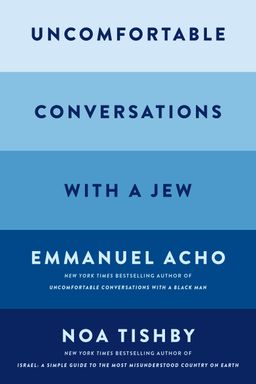
When a friend you love is hurting—and another friend is angry at you for standing with them—how do you stay human, honest, and whole? In Uncomfortable Conversations With a Jew, Emmanuel Acho (a Black Christian TV host) and Noa Tishby (an Israeli Jewish advocate) argue that the way out of our most explosive cultural fights is through: through rigorous curiosity, through plain language about antisemitism and Israel, through stories, and through a willingness to hold tension without dehumanizing each other. They contend that ignorance, lazy labels, and meme-level slogans have outpaced history—and that you can relearn how to see people before positions and complexity before clicks.
The book is a seat-at-the-table conversation that keeps boomeranging to one core claim: antisemitism is a shape-shifting conspiracy mindset that survives by changing costumes—religious, racial, political—and today much of it wears the wardrobe of anti-Zionism. Yet, they insist, you can critique Israeli policies (as Noa herself often does) and even oppose specific wars without veering into anti-Jewish hatred. The line, they show, is bright when you learn how to find it—and porous when you don’t.
What You'll Learn (And Why It Matters)
You’ll first discover what "being a Jew" actually means—and why the word Jew isn’t a slur to reclaim or a synonym for a religion. Judaism, they explain, is an ethno-religion and a peoplehood: a portable civilization that includes belief, story, land, culture, and law. That matters because many of the fiercest modern claims (e.g., “Jews are white colonizers”) short-circuit once you really grasp Jewish diversity, origins, and belonging. You’ll also see why Noa lights Shabbat candles as a secular Jew and why Emmanuel asks, without flinching, “Is it fair to say Jews are white?”
Next, you’ll walk through stereotypes—money, media, power—and learn how a medieval workaround about moneylending plus Shakespeare’s Shylock became today’s “globalist octopus” memes. You’ll look at Hollywood’s real backstory (Jews built studios after other doors were closed to them) and sit inside Emmanuel’s lived tension: every major gatekeeper in his career has been Jewish, which made him feel both protected and pressured when he wanted to interview a Palestinian advocate. Noa’s answer reframes “power” vs “positions of power,” and the two of them model what it looks like to talk through a moment that almost blew up their book (spoiler: it did, briefly).
A Layer Cake: Antisemitism Then and Now
You’ll also trace what they call the antisemitism layer cake—from “Christ-killers,” to “plague poisoners,” to “race polluters,” to “Zionists are racists.” The ingredients don’t change much, just the icing. That’s why October 7—and more revealingly, October 8—becomes a hinge in the book. On October 7, Hamas massacred more Jews in a single day than at any time since the Holocaust. On October 8, before Israel had responded, celebratory marches and campus mobs mocked hostages and papered over rape and murder as “resistance.” To Noa, that instant justification was the mask slipping. To Emmanuel, it was the moment he realized how little shared context most people had—and how quickly they reached for slogans.
From there, you’ll study Zionism without slogans: simply, the Jewish right to self-determination in their ancestral homeland (Zion is an ancient name for Jerusalem). You’ll race through two millennia of exiles and returns, Ottoman and British maps, the UN Partition plan, the wars of 1948, 1967, and 1973, and the paired refugee catastrophes—Palestinians who fled or were expelled in 1948 and ~850,000 Jews expelled from Arab lands after. You’ll also examine BDS (Boycott, Divestment, Sanctions), its progressive packaging, and its leaders’ stated goal of ending Israel, not reforming it (compare to Natan Sharansky’s “3D test” for antisemitism: Demonization, Double standards, Delegitimization).
Why This Conversation Is Different
Two things make the book feel different. First, the authors don’t hide their missteps. Emmanuel shares the exact moment his choice to host a Palestinian guest wounded Noa just days after October 7; Noa admits her own anger and why she briefly walked away. Second, the book is crowded with “how to” tools, not just “what to think” claims: how to spot myths that begin with a truth-kernel; how to separate policy critique from people erasure; how to check on your Jewish friends when the news breaks; how to use Shabbat dinners, not social posts, to grow empathy; and how to be a Mensch (Acho’s favorite definition of allyship is simple: find a need and fill it).
Guiding Claim
“People are not always their government, and a government is not always its people.” If you hold that sentence while you read (and while you post), you’ll disagree more honestly and dehumanize less quickly.
Ultimately, this book argues you don’t have to choose between compassion for Palestinians and compassion for Jews; between justice and truth; between your values and your friends. But you do have to learn some history, reject seductive simplifications, and ask better questions—out loud, with someone you might lose. If you crave a playbook for that, this is it.