
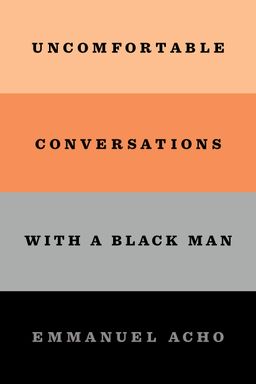
Uncomfortable Conversations with a Black Man cover

Uncomfortable Conversations with a Black Man

by Emmanuel Acho

Uncomfortable Conversations with a Black Man by Emmanuel Acho is a crucial guide to understanding race in America. Through candid dialogue, it explores historical and systemic roots of racism, offering insights for genuine conversations and societal change. This book empowers readers to confront uncomfortable truths, fostering empathy and actionable steps towards equality.

Facing America’s Oldest Conversation: Courage, Race, and Change

What happens when we stop whispering about race and start talking about it—openly, honestly, and yes, uncomfortably? In Uncomfortable Conversations with a Black Man, former NFL linebacker turned educator Emmanuel Acho invites readers, especially white Americans, to sit down at the table and talk about what so often goes unsaid. He argues that America’s greatest pandemic isn’t merely COVID-19 but racism—a 400-year-old virus infecting every system, community, and heart. Through direct, compassionate dialogue, Acho aims to help people recognize that talking about race doesn’t make you racist, but staying silent allows racism to continue unchecked.

Acho’s book expands his viral video series of the same name into a candid, story-rich roadmap for understanding the lived experience of Black Americans. He draws from history, sociology, personal anecdotes, and pop culture to explore questions many white readers are afraid to ask—from “What’s the difference between Black and African American?” to “Why can’t I say the N-word?” to “How can I be an ally instead of a bystander?”

A Table for Truth

In his introduction, Acho sets the tone with the metaphor of a dinner table. Everyone is invited—especially those who might feel awkward or unsure where to sit. He promises that his goal isn’t accusation but healing through understanding. As a first-generation Nigerian American who grew up navigating both white and Black spaces, Acho speaks as a cultural translator. “For all of you who lack an honest Black friend in your life,” he writes, “consider me that friend.” His dual fluency in both worlds makes him especially equipped to unpack the myths, stereotypes, and invisible forces that divide Americans along racial lines.

Getting Comfortable with Discomfort

Acho insists that progress requires pain. “Everything great is birthed through discomfort,” he writes, reminding readers that real growth—be it childbirth, muscle-building, or social change—hurts. Each chapter begins with a real question from a viewer or reader, reflecting the genuine confusion many non-Black Americans feel when confronting their own biases. He answers without jargon or judgment, choosing empathy over accusation. His role isn’t to shame but to guide—to replace guilt with responsibility and defensiveness with understanding.

(In this sense, his work echoes Ibram X. Kendi’s idea from How to Be an Antiracist: that the opposite of racism isn’t neutrality but action. You can’t simply be “not racist”—you must actively oppose racist systems and assumptions.)

Structure and Journey

The book is divided into three main sections—“You and Me,” “Us and Them,” and “We”—mirroring the arc of empathy from self-awareness to collective responsibility. The first part explores personal bias, terminology, and identity. Acho explains white privilege and implicit bias using stories from sports, education, and everyday interactions. He then addresses how language and history shape perception, guiding readers through loaded terms like “Black,” “African American,” and the “N-word.”

The second part expands to systemic barriers—housing, education, justice, and government. Here, Acho confronts myths of “reverse racism” and “black-on-black crime,” tracing roots of inequality from slavery to redlining to mass incarceration. Through stories like Crystal Mason’s prosecution for a mistaken vote and the historical echoes of the Tulsa Massacre, he shows how racism operates not just through individuals but through laws, institutions, and habits.

The final part—“We”—focuses on reconciliation, interracial relationships, activism, and allyship. He invites readers to imagine a country as harmonious as a piano played with both black and white keys. This vision requires humility, dialogue, and persistence. “Ending racism is not a finish line we cross,” he writes. “It’s a road we travel.”

Why This Book Matters Now

Acho’s message landed at a fraught moment, following the 2020 killing of George Floyd and a global outcry against racial injustice. But instead of speaking to politicians or activists, he speaks to ordinary people—coworkers, parents, neighbors—who want to do better but don’t know how. His conversational approach makes space for both feelings and facts, pairing anecdotes with history lessons, like how the 1967 Loving v. Virginia case legalized interracial marriage or how the Thirteenth Amendment’s loophole birthed mass incarceration. Each “Talk It, Walk It” section at the end of a chapter offers practical next steps: learn, act, listen, and keep showing up.

At its core, Uncomfortable Conversations with a Black Man is not a lecture but an invitation. It asks readers to lean in rather than back away—to understand that allyship is built through action, that love across racial lines requires awareness, and that silence sustains inequality. By turning awkward curiosity into honest conversation, Acho models how learning together might just be America’s truest path toward healing.


Seeing Ourselves Clearly: Identity and Language

How do you name something as vast as an identity? Acho begins with this deceptively simple question: what do we call people of African descent in America—Black, African American, or something else? The answer reveals centuries of erasure, reclamation, and pride. Language, he reminds us, is never just semantics; it’s power. To name oneself is to define one’s humanity, and for Black Americans, this right has been repeatedly stolen and reclaimed.

From “Colored” to “Black”

Tracing a linguistic arc from “Colored” to “Negro” to “Black” and “African American,” Acho explores how each era’s term reflected the social climate of the time. “Colored” dominated during segregation, its presence immortalized in the NAACP’s name. “Negro,” promoted by W.E.B. Du Bois, once symbolized intellectual dignity, but by the late civil rights era, younger activists rejected it as a relic of white control. The 1960s slogan “Black is Beautiful” signaled a turning point—the unapologetic embrace of Blackness as pride, not shame.

African American: Heritage and Hyphen

When Jesse Jackson popularized “African American” in 1988, he aimed to connect Black Americans to a cultural and ancestral homeland, much like “Italian Americans” or “Irish Americans.” Yet, as Acho points out, many found the hyphen a new divider, implying separation from full Americanness. As a Nigerian American himself, Acho respects the label but doesn’t personally identify with it—his lineage comes from a specific country, not the whole continent. To him, “Black” is both simpler and more inclusive, an “open umbrella” that covers the African diaspora, whether in the U.S., the Caribbean, or Brazil.

Why Asking Matters

Acho encourages readers to do something profoundly simple yet transformative: ask. Just as a teacher asks students how they prefer to be called, you should ask people of color how they self-identify. It’s not an imposition—it’s respect. The discomfort in asking is part of unlearning indifference. Words shape worlds, and using the right ones signals that you see the person in front of you, not a stereotype.

(This theme parallels Raoul Peck’s I Am Not Your Negro, which adapts James Baldwin’s unfinished writings to show how language can both define and dehumanize.) When you name someone correctly, you acknowledge both their individuality and their shared history. It’s not just linguistic accuracy—it’s an act of love, the first step in restoring dignity through dialogue.


What Lies Beneath: Implicit Bias

Why does someone cross the street when they see a Black man? Why does a résumé with a name like “DeShawn” get fewer callbacks than “David”? Acho argues that this is not overt hatred but implicit bias—the unconscious stereotypes we’ve inhaled since birth. Everyone has them, he says; the real choice is whether we confront or conceal them.

Hidden Prejudices Everywhere

A striking example comes from a 2016 Harvard–Stanford study showing that identical résumés with white-sounding names were twice as likely to earn interviews as those with Black-sounding names. Even companies proclaiming “diversity values” showed the same bias. Similar patterns appear in healthcare—Black mothers die during childbirth three to four times more often than white mothers, partly due to false perceptions that they feel less pain.

Acho likens these patterns to “DENIAL”—an acronym for “Don’t Even kNow I Am Lying.” Many white Americans, he argues, deny bias because they equate it with moral failure. But unconscious prejudice doesn’t make you evil—it makes you human. What matters is developing self-awareness, catching the hidden assumptions before they cause harm. (This aligns with psychologist Daniel Kahneman’s work on “System 1 thinking” in Thinking, Fast and Slow, which shows how mental shortcuts can produce bias.)

How to Unlearn Bias

Acho’s advice is practical: diversify your life. Sit beside someone different on the subway. Join mixed spaces. Take Harvard’s Implicit Association Test. And reject the deceptively flattering claim of being “color-blind.” When someone says, “I don’t see color,” they erase the real history attached to color—and the inequality that persists because of it. “We must see color,” Acho writes, “because we must see injustice.”

Implicit bias can’t be cured overnight, but it can be managed with humility. The goal isn’t guilt—it’s curiosity. As long as bias hides in the dark, it dictates our actions; but once exposed to the light of reflection, it loses its power.


The Invisible Backpack: Understanding White Privilege

Have you ever walked into a room and instantly felt you belonged? That unexamined comfort, Emmanuel Acho argues, is white privilege—the invisible advantage that protects some and burdens others. It’s not wealth or guilt; it’s how society, by default, bends to whiteness. As Peggy McIntosh wrote decades ago, white privilege is like “an invisible knapsack” of special maps, passes, and tools you didn’t know you carried. Acho updates this metaphor with the realism of someone who’s lived without it.

Seeing the Head Start

Acho illustrates privilege through a sports analogy: imagine a race where one runner was held back for the first two hundred meters, while the other received a head start. Simply telling the lagging runner, “You’re free to go now,” doesn’t make the race fair. White privilege, he writes, is not about individual behavior but structural inheritance—centuries of advantages built into education, law, housing, and public trust.

Everyday Examples

It’s seeing your skin tone on a Band-Aid, your history in textbooks, your heroes in movies, or your accent labeled “neutral.” It’s not fearing police violence, not having your résumé dismissed, not worrying someone will clutch their purse near you. These seemingly small experiences compound into a reality where “white” equals “normal.” Meanwhile, Black Americans are constantly reminded that they’re exceptions in spaces not designed for them.

To make the point visceral, Acho recounts how, in 1955, a young Black boy named Emmett Till was lynched after a white woman falsely accused him of harassment—a lie she admitted decades later. While her life moved on, his ended, illustrating how white privilege operates even in death: one person’s voice outweighs another’s life.

What Acceptance Looks Like

Accepting privilege isn’t self-blame—it’s self-awareness. Acho quotes Pastor Carl Lentz: “Even if I’m wrong about white privilege, I’ll have lived a life looking out for others.” To deny privilege, Acho says, is to deny empathy. The goal isn’t to abandon identity but to use advantage to lift others up. (This echoes Brené Brown’s insight that empathy begins when we acknowledge another’s pain, not explain it away.)

In the end, recognizing white privilege isn’t an attack on whiteness—it’s an invitation to fairness. Acho’s message is clear: you didn’t start the race, but you can decide how you run now.


Systems That Stack the Deck: Structural Racism

What if the game was fixed long before you sat down to play? Acho calls systemic racism “the house that always wins”—a set of structures that quietly perpetuate inequality regardless of intent. From housing policy to schools to criminal justice, these systems ensure that advantage reproduces itself, while disadvantage compounds.

Redlining and the Wealth Gap

One of his clearest examples is redlining. In the 1930s, federal housing maps literally marked Black neighborhoods in red, warning banks not to lend there. Homeownership, the cornerstone of intergenerational wealth, became a closed door for millions. Today, the average white family’s net worth is nearly ten times that of the average Black family—a legacy of policies, not personal choices.

Education and the Pipeline

Schools mirror their zip codes. Because public education depends heavily on property taxes, underfunded neighborhoods yield underfunded schools. Acho cites the work of journalist Nikole Hannah-Jones, who calls America’s schools “separate and unequal.” The outcome? Academic inequality turns into economic inequality, and under-resourced schools often feed what activists call the “school-to-prison pipeline.”

Criminal Justice and the Thirteenth Amendment

Acho highlights how the Thirteenth Amendment abolished slavery “except as punishment for a crime.” This loophole fueled convict leasing and mass incarceration, turning Black freedom into a new form of bondage. Today, though only 13% of the U.S. population, Black Americans make up over a third of those imprisoned. Just as plantations once fed the economy, prisons now do the same through cheap labor.

Why Systems Matter

When people say, “I never owned slaves,” Acho responds that racism isn’t about guilt—it’s about inheritance. We all live in systems built by those who did. To fix them, we must acknowledge them. (He echoes historian Richard Rothstein’s argument from The Color of Law that segregation wasn’t accidental—it was government policy.)

Systemic racism, Acho teaches, isn’t a shadow conspiracy—it’s the architecture of everyday life. Until all players face the same odds, no game is fair.


From Protest to Progress: Good Trouble

Why do protesters march when the system seems immovable? Acho answers by tracing America’s protest tradition—from the Boston Tea Party to Black Lives Matter—showing that change has always begun with disruption. The title, “Good Trouble,” borrows from Congressman John Lewis, who urged Americans to cause necessary unrest in the name of justice.

Riot or Rebellion?

After George Floyd’s murder, Acho saw how protests were labeled by who attended them: when white mobs destroyed Black communities (e.g., Tulsa 1921, Wilmington 1898), history called them riots. When Black citizens protested injustice, the same word condemned them as criminals. Acho reframes these uprisings as rebellions—pain made visible. “When people are angry,” he writes, “sometimes they don’t know what to do with it.” Violent outbursts, though not excusable, are symptoms of a deeper disorder: generations of ignored suffering.

He connects this to his mother’s grief—how she once threw herself against a wall after losing her sister. Protest, he says, is collective grief seeking outlet. It’s an emotional truth history often erases.

Marching Forward

From the 1963 March on Washington to present-day BLM movements (the largest in U.S. history), the throughline is moral urgency. The same demands from the 1960s—voting rights, equitable education, fair labor—remain unresolved. That persistence, Acho argues, is proof not of decay but of enduring hope. His view mirrors Dr. King’s conviction that “the arc of the moral universe is long, but it bends toward justice,” so long as people keep pulling.

Productive Activism

“Your pen can be your sword,” Acho quotes a friend during the Floyd protests. He suggests multiple forms of “good trouble”: donate to bail funds, advocate for body-camera laws, support community-based safety programs, or peacefully march. Even artists, he notes, fight by creating truth-telling work—just as Public Enemy, James Baldwin, and Keedron Bryant did in their respective mediums.

Change, Acho concludes, isn’t accidental. Every protest, every vote, every uncomfortable conversation adds weight to the moral arc’s bend. Hope doesn’t roll in on “the wheels of inevitability”—it’s pushed by people willing to disturb the peace for justice.


How to Be an Ally, Not a Savior

Good intentions aren’t enough. In his eleventh conversation, Acho teaches that allyship means risking your comfort for someone else’s equality. An ally, he writes, is a member of a privileged group who acts in solidarity with the oppressed—recognizing that liberation benefits everyone. But this support must come without ego or expectation, avoiding what he calls the “white savior complex.”

Learning from History

Acho pays tribute to white allies through history, from abolitionist William Lloyd Garrison to Olympic athlete Peter Norman, who stood with Tommie Smith and John Carlos during their 1968 Black Power salute. Each sacrificed reputation, wealth, or safety for justice. True allies, Acho stresses, expect consequences—social, professional, even physical. “If you say you are an ally,” he tells readers, “you are saying you will risk your white privilege in the name of equality.”

Avoiding the Savior Trap

Movies often center white heroes liberating Black pain—Acho cites The Help and Hidden Figures—but authentic allyship decentralizes whiteness. He references critic Teju Cole’s essay “The White-Savior Industrial Complex,” which warns that good intentions can maintain the very power imbalances they claim to fix. Allies must act with humility, following the leadership of people of color rather than performing virtue for applause. “Don’t seek credit,” Acho warns. “Seek change.”

Show Up, Then Stay

Acho shares a personal story: a white friend who helped conceptualize his first video backed out hours before filming, paralyzed by fear of backlash. “Being an ally means showing up,” he reflects. Good intentions fade fast; commitment endures. Allies must speak up against racist jokes, challenge workplace inequities, and diversify their own networks. True solidarity’s test isn’t enthusiasm—it’s endurance.

(This echoes Layla Saad’s lesson in Me and White Supremacy: being an ally is a lifelong practice, not a badge.) For Acho, every act counts—the petition you sign, the friend you correct, the silence you break. Allyship isn’t about joining the team; it’s about helping everyone win.


From Words to World: Ending Racism Together

Can racism ever end? Acho’s final conversation, “Breaking the Huddle,” tackles that daunting question with both realism and faith. He compares the fight against racism to a football play: huddles are for strategy; change happens when you break and run the play. The reading, the talking, the learning—all of it means little unless it leads to action.

Three Levels of Racism

Acho identifies racism’s “three levels”: individual, systemic, and internalized. The first includes explicit prejudice and stereotyping; the second encompasses laws and institutions that perpetuate inequity; the third involves the self-doubt and self-blame absorbed by people of color living under oppression. Recognizing all three ensures that our response is holistic—not just about changing laws but transforming hearts and narratives.

Uninventing Race

Race itself, he argues, was an invention—a political tool from the 1600s designed to justify slavery and divide laborers. “Racism has always been about power,” he writes, “which means we can learn to unmake it.” Taking inspiration from Nobel laureate Toni Morrison’s reflection that “there is no such thing as race—only the human race,” Acho envisions a society where differences are celebrated but hierarchies dismantled. Color should be seen, not ranked.

Building the Future, One Conversation at a Time

To get there, he says, start small. Have respectful but honest dialogues, especially across lines of race and politics. Listen more than you speak. If you’re white, practice stepping back; if you’re quiet, practice stepping up. Protect your energy for the long haul—ending racism is a lifelong project, not a quick sprint. His personal story of a surprise farewell party of friends of all races becomes his vision for America: a joyful, multicultural room where everyone’s smiling not because color vanished, but because understanding deepened.

Ultimately, Acho’s message is both sobering and hopeful. We may never reach a “post-racial” world, but we can cultivate an anti-racist one—where justice isn’t theoretical, it’s habitual. “Ending racism,” he reminds us, “isn’t crossing a finish line; it’s walking a better road—together.”

Dig Deeper

Get personalized prompts to apply these lessons to your life and deepen your understanding.

Go Deeper

Get the Full Experience

Download Insight Books for AI-powered reflections, quizzes, and more.