
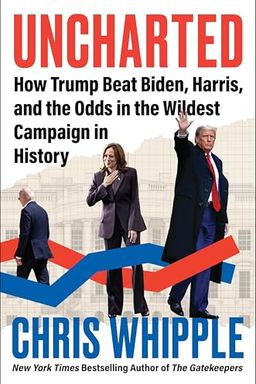
Uncharted cover

Uncharted

by Chris Whipple

The author of “The Gatekeepers” shares anecdotes and insights from the 2024 presidential election.

How Power, Denial, and Timing Decide Elections

What happens when what you see with your own eyes collides with what your team insists is still possible? In Uncharted, Chris Whipple argues that the 2024 race was never just a binary choice between Joe Biden and Donald Trump. It was a high-wire story about power, denial, and timing—how insiders in both parties built and defended their realities until one reality (economic pain, age, and a new media machine) crushed the other. Whipple contends that Biden’s inner circle cocooned an aging incumbent, Trump’s team professionalized just enough to harness populist energy, and Kamala Harris entered too late and too cautiously to claim the mantle of change. The result: a convicted felon mounted the most improbable comeback in modern American politics.

Across hundreds of interviews, Whipple takes you behind the green rooms and motorcades into the rooms where the 2024 narrative was made—and unmade. You’ll meet Ron Klain urging a faltering Biden to skip a weekend photo shoot and rally House progressives; Nancy Pelosi quietly pressing a friend to consider stepping aside; Susie Wiles coaxing discipline from chaos inside Trumpworld; and Kamala Harris’s team running a 107-day sprint that galvanized the base but couldn’t fully separate her from the past four years.

The Stakes: Feelings Beat Facts

Why does this story matter to you? Because Whipple shows that modern campaigns are decided less by white papers and more by feelings—especially the price at the grocery store—and by the media ecosystems that amplify them. Biden’s record (jobs, infrastructure, vaccines) was real, but the feeling of $6 eggs and a $26 fast-food run was more real. As Bill Clinton-era strategist Leon Panetta tells Whipple, leadership is making hard calls before crisis forces your hand; waiting until July to address the age problem made the Democratic pivot harder and the “change” frame harder still. (This echoes political classics like Richard Ben Cramer’s What It Takes, which argued the presidency is won as much in psychology as policy.)

The Players: Bubbles, Bosses, and Operators

Biden’s bubble hardened under Anita Dunn (message gatekeeper), Mike Donilon (alter ego), Steve Ricchetti (Hill whisperer), and Jeff Zients (process czar). Trump’s machine hardened under Susie Wiles (the “Ice Maiden”) and Chris LaCivita (negative-ad maestro), with old rogues—Paul Manafort and Corey Lewandowski—lurking in the wings. George Clooney fired a high-profile flare in The New York Times; Pelosi delivered a friendly but unmistakable nudge on Morning Joe; Obama, pointedly, did not call. Meanwhile, Elon Musk poured money into turnout, Trump launched a new influencer army, and Harris assembled a stealth whip operation that locked down the nomination in 48 hours.

The Arc: From CNN’s Debate to Chicago’s Stage

The book’s core arc is simple but devastating. A week at Camp David exposed Biden’s exhaustion and fixation on foreign validation; the CNN debate made his struggles undeniable; donors, Hill leaders, and even lifelong friends started to move. In July, a would-be assassin’s bullet seemed to give Trump both martyrdom and momentum (“Fight! Fight! Fight!”). Biden, sick with COVID and isolated at Rehoboth Beach, decided to step aside and endorse Harris. Chicago’s Democratic convention felt like catharsis and competence (Spielberg/Katzenberg-grade production; AOC’s fire; Hillary’s redemption speech; Biden’s swan song). But the fall campaign became a knife fight over “change,” cultural wedge issues, and inflation. Harris won the debate on points; Trump won the story on change.

Why It Matters: The New Playbook

Uncharted isn’t just a recounting; it’s a manual for understanding the new playbook. If you lead anything—an organization, a campaign, a team—Whipple warns you about bubbles, delayed decisions, and message–market mismatch. The book argues you must do five things faster than you think: name the hard truth; pick a successor; define change on your terms; meet people where they are (not where your dials say they should be); and master the medium where your persuadables actually live (podcasts, short-form video, creator networks). When you don’t, your opponent will.

Big Idea

In Whipple’s telling, 2024 was decided by “felt reality” + “media machinery” + “timing.” Get any one of those wrong—especially timing—and even strong résumés can’t save you.

If you’ve ever wondered how seasoned operators lose winnable fights, or how a disciplined operation can coexist with Trumpian improvisation, this book delivers vivid answers. It’s political history, leadership case study, and media literacy—rolled into a gripping postmortem of how America chose again, and why the path there looked nothing like the civics book version.


The Biden Bubble Bursts

Whipple’s central portrait is of a presidency insulated by love, loyalty, and fear—then punctured by one bad night. Biden’s team walled him off for years, trading access for message control. The instinct came from scars: the plagiarism collapse of 1988, the pandemic-era basement strategy in 2020, the constant drumbeat about age. Anita Dunn’s posture toward the press—limit exposure, minimize risk—made sense until it didn’t. By 2024, the White House’s motto felt like “no unforced errors,” but the effect was a president seen less and less by allies—and less ready for unscripted combat when it mattered most.

Camp David: The Week Everything Showed

Four days before CNN’s debate, Ron Klain arrived at Camp David and found a president he barely recognized: exhausted, disengaged from domestic issues, and oddly fixated on European leaders’ praise. Mock debates collapsed in minutes. Biden stumbled over his own agenda (“how would I do that?” he asked about childcare he had once championed), brushed off second-term plans (“no more promises”), and clung to infrastructure and jobs as proof he had delivered. Spielberg and Katzenberg coached body language; Dunn and Bob Bauer played moderators. It couldn’t solve fatigue and fog.

The debate’s “We finally beat Medicare” line became a symbol not of stuttering (which Biden’s team rightly contextualizes) but of crossed wires under stress. The optics—ghostly pallor, a whispering voice, and the frozen stare—obliterated years of tightly managed appearances. As Bruce Reed put it, when you’ve learned to overcome a stutter, you must keep moving; Biden hit a mogul and stopped.

Aftermath: Denial Meets Gravity

What happened next reveals the Biden world in miniature. Jill Biden offered reassurance (“You answered every question!”). Loyalists emphasized dial groups that showed voters disliking Trump more than Biden. Klain urged a progressive show of force at the White House; Zients kept to a schedule. Stephanopoulos’s interview landed as “heartbreaking.” Then Nancy Pelosi did what power brokers do: on Morning Joe she praised Biden—while refusing to say he was the nominee. That public ambiguity, followed by a private residence meeting (“We had a long talk about America”), shifted the tectonic plates. Clooney’s op-ed—reportedly pre-cleared in Obama-world—signaled elite donors and Hollywood were out.

Biden bristled at the idea his friends had abandoned him. He felt especially stung by Obama’s silence. Yet at Rehoboth, with COVID as a cruel metaphor, he called Zients: “I’ve decided not to run.” Minutes later he told Harris, then endorsed her in a tweet. In 48 hours, the party that had spent 18 months insisting there was no Plan B executed Plan B.

The Governance Lesson for You

If you lead a team, Whipple’s Biden chapter is a seminar in how bubbles form. You limit exposure to reduce risk; you measure dials not moods; you equate loyalty with silence; you gatekeep access until knives get longer outside your gates. None of this sprung from malice; it came from plausible reasoning and real achievements. But as Panetta notes, good leaders act before crisis forces action. Biden’s late step-down gave Harris 107 days to become the change candidate—against an opponent who’d already claimed the word “change.”

Key Idea

Bubbles are built from love and fear: love of a principal’s legacy; fear of what uncontrolled reality will do. They protect…until they paralyze.

By laying out quotes—the Macron/Scholz fixation; Camp David’s aborted run-throughs; Pelosi’s surgical nudge; Clooney vs. Morning Joe—Whipple doesn’t gloat. He documents how a rational strategy met an irrational moment. If you’ve ever delayed a hard personnel call, or let a schedule substitute for strategy, you’ll recognize the pattern instantly.


Trumpworld: Ruthless, Professional, Still Trump

If Biden’s world looked cautious and scripted, Trump’s looked paradoxical: both more disciplined than 2016 or 2020 and still unmistakably Trump. Whipple’s portraits of Susie Wiles and Chris LaCivita show a campaign that learned from past chaos without losing its edge. Wiles, the unflappable Florida operative who’d been exiled at Ron DeSantis’s request and then rehired by Trump, became the organizing brain. LaCivita, a veteran of the George W. Bush-era Swift Boat ad onslaught, became the message blade. Together they imposed order: staffing the RNC with loyalists; professionalizing polling and ads; coaching candidate discipline—up to a point.

The New Management, Old Instincts

Whipple shows you the tension. On one page LaCivita forecasts a 320-electoral vote landslide to The Atlantic. On another, Trump spends precious minutes at rallies riffing about Hannibal Lecter or genitalia, or suggests Haitian migrants are eating pets in Ohio. The machine wanted “change” vs. “more of the same.” Trump wanted entertainment, grievance, and dominance. Yet the core frame stuck: Are you better off than four years ago? In a country where two-thirds told pollsters “wrong track,” “change” is a tailwind big enough to carry contradictions.

Even as the “grown-ups” managed budgets and buys, the old rogues reappeared. Manafort, fresh off a presidential pardon, consulted on convention themes and under-the-radar strategy; Corey Lewandowski popped back onto the plane, auditing spending and sparring with Wiles/LaCivita. Project 2025—the sweeping right-wing playbook for a second term—was so radioactive Trump disavowed it publicly, while Manafort, less shy, told Whipple it was part of transition planning. The mix felt familiar: ruthlessness wrapped in denial, with plausible deniability on speed dial.

Two Cinematic Moments

Whipple’s eye for theater catches two inflection points. First, Butler, Pennsylvania: the crack of gunfire, Secret Service pile-on, the bandaged ear—and Trump rising, pumping a fist, mouthing “Fight! Fight! Fight!” Instantly, the campaign imported meaning. Evangelicals saw providence; swing voters saw grit; the base saw confirmation that the system tried to erase their champion. Second, Milwaukee’s RNC: choreographed solemnity, Hulk Hogan ripping his shirt, Trump promising unity on Teleprompter before detouring into vendettas. The “new Trump” lasted until his instincts intervened. But the image of survival stuck.

The Machine You Didn’t See

Behind the spectacle was a new distribution network. The campaign built ties with “Very Online” influencers (Nelk Boys, Adin Ross, Theo Von), reached millions of young men where cable can’t, and had a mega-amplifier in Elon Musk, who poured more than $100 million into a turnout PAC and turned X into a de facto campaign hub. Some of that ground operation was sloppy (U-Hauls for canvassers; forged door-knock logs), but it mapped onto a truth: you don’t need to win the most TV viewers if you dominate the feeds your persuadables actually scroll. (Compare to Barack Obama’s 2008 social media edge; Whipple suggests the right now owns the creator economy.)

Key Idea

Trumpworld 2024 proves you can graft professional management onto a populist brand—if you accept that the candidate will still be the candidate.

For you, the lesson is counterintuitive: you don’t have to eradicate chaos to win; you have to bound it. Wiles and LaCivita didn’t teach Trump new tricks; they channeled his old ones into a simple narrative and filled the air with ads and content that reinforced it. In a feelings-first election, that was enough.


Harris’s Hundred‑Day Sprint

Harris enters Whipple’s story as a supporting player and becomes a protagonist overnight. What follows is the most impressive 48-hour consolidation of party power in recent memory—and an uneven 100-day attempt to rebrand a sitting vice president as a change agent. The contradiction ran through everything: she had to be grateful heir and bold reformer; a prosecutor of Trump and a truth-teller about Biden; familiar to Democrats and new to swing voters. Whipple’s access illuminates both the execution and the constraint.

Locking Down the Nomination

When Biden called with his decision, Harris’s inner circle—chief of staff Lorraine Voles, senior adviser Brian Fallon, strategist Sheila Nix—activated a prebuilt “break glass” plan. Stephanie Schriock and allies had already begun a discreet whip count of pledged delegates (and even modeled signatures), intentionally using operatives without direct Harris ties to avoid any whiff of disloyalty. Within hours, Harris had commitments from Whitmer, Newsom, Shapiro, Cooper, Kelly, and the Clintons; Barack Obama endorsed a few days later, signaling “process” even as the outcome was clear. By Tuesday, the math was done.

Chicago: A Show of Competence and Joy

The DNC in Chicago was the campaign at its best. Spielberg/Katzenberg advised pacing and visuals; Stephanie Cutter and James Goldston produced crisp, story-driven segments. AOC delivered righteous populism; Hillary Clinton, relaxed and thunderous, reminded Democrats what “almost” felt like; Biden’s farewell—quoting “American Anthem”—landed with grace. Harris’s acceptance threaded the needle: strong on Israel and commander-in-chief posture, clear on abortion rights and economic goals, with the “We’re not going back!” refrain. Polls ticked up. Money gushed ($81 million in 24 hours; ultimately $1B).

The Inside Game—and the Gap

Inside headquarters, Jen O’Malley Dillon (the Biden 2020 architect) ran field and ops; David Plouffe (Obama’s 2008 mastermind) advised on message; Stephanie Cutter shaped the stagecraft. The arrangement gave Harris horsepower but also a cultural inheritance. O’Malley Dillon’s ground game was the gold standard: hundreds of offices, thousands of staff, tech-driven voter contact that made 2008 look analog. But as one veteran told Whipple, narrative beats infrastructure when voters want something different—and the “opportunity economy” message struggled to dislodge feelings of inflation and fatigue.

Harris’s public moves showed the straddle. She visited the border and promised to revive a bipartisan bill Trump had killed; she put Tim Walz—folksy coach, gun owner, labor ally—on the ticket instead of the sharper but riskier Josh Shapiro (whose hawkish Israel stance risked alienating key constituencies). She dominated the ABC debate on substance but could not fully puncture Trump’s “why haven’t you done it in 3.5 years?” line—because she couldn’t (or wouldn’t) say, plainly, what she would have done differently than Biden.

The Cost of Caution

Whipple recounts a critical moment on The View. Asked, “Would you have done something differently than President Biden?” Harris replied, “There is not a thing that comes to mind.” Within 24 hours, Trump had an ad: images of border chaos, grocery prices, global unrest—then the clip. Harris’s team had workshopped stronger lines (including a clean “my presidency will not be a continuation of Joe Biden’s”), but loyalty—and fear of blowing up the coalition—prevailed. As one aide told Whipple, Biden had personally given Harris permission to separate; emotionally and culturally, that permission was hard to use.

Key Idea

You can nail the convention and the debate and still lose if the story voters hear is continuity, not change—especially in a “wrong track” year.

For you, the leadership lesson is bracing: gratitude is admirable, but identity is non-negotiable. If you inherit a brand at the moment the market wants a different one, you must say clearly what’s new—even if it stings.


Narratives Beat Numbers

Whipple argues that the 2024 information battlefield rewarded simple frames delivered through new pipes. Trumpworld boiled the race down to two words—“Bidenomics” and “change”—and spent relentlessly to hammer them. Harrisworld built the most sophisticated turnout machine in Democratic history and ran a forward-looking case on abortion rights, democracy, and costs. The first strategy aligned with felt reality; the second aligned with policy reality. The felt reality won.

The Ad Wars

Two ads tell the story. First, “Bidenomics”: Harris saying “Bidenomics is working” cut against a montage of price hikes, gas signs, and layoffs. The claim was cherry-picked, but the feeling it summoned was true for many. Second, “They/Them”: an old clip of Harris discussing transgender care access for inmates, cut to imply taxpayer-funded “sex changes” for “murderers,” landing with the tag, “Kamala is for they/them. President Trump is for you.” It was demagoguery by design—and one of the most effective culture-war spots in a generation (LaCivita’s updated Swift Boats). Harris’s team tested replies but mainly pivoted away, fearing an extended culture fight would drown out their economic pitch to suburban women. The ad ran 30,000+ times, especially during football.

The Debate: Points vs. Story

On ABC, Harris fact-checked, framed, and, by most elite accounts, won. Trump, prompted by online agitators, delivered the now-infamous “They’re eating the dogs, they’re eating the cats” riff about Haitian migrants. Fact-checkers swarmed; Springfield city officials denied it. But as Brad Parscale bluntly told Whipple, “He made it funny.” More important, Trump kept returning to “change”: three and a half years in office and “why hasn’t she done it?” Harris’s answers—endorsements from Bush/Romney/McCain alumni; a catalog of what she’d do—scored points but didn’t flip the story. The post-debate bump never arrived.

The Ecosystem Shift

Trump’s team exploited the new media map: creator partnerships, podcast bookings, and micro-influencers that reached low-propensity male voters of every race. Harris explored Joe Rogan—whose Spotify audience dwarfs prime-time cable—but internal resistance and logistics killed it. Meanwhile, Laura Loomer rode along on Trump’s plane (briefly), and Musk turned X into a rally stage. The message–medium fit mattered: if your undecideds live on podcasts and Shorts, you must go to podcasts and Shorts. (Marshall McLuhan would nod knowingly; Obama 2008 did this through Facebook before it was conventional.)

Ground Game vs. Story

O’Malley Dillon’s model assumed a familiar trade: accept being outspent on late TV to invest in turnout infrastructure. In a normal year, that wins close races. In a change year, the story itself mobilizes. Manafort needled that Democrats “turned out the base that was going to vote anyhow,” while Trumpworld targeted the soft periphery through culture and grievance. Early vote numbers in urban cores underperformed; rural surges overperformed. The new math: a tight, highly motivated coalition + viral content often beats a larger, less energized coalition + superior field.

Key Idea

In the attention economy, your narrative must ride the feeds your voters actually use—otherwise your facts will never be heard.

For you, the application is concrete: find where your persuadables live, learn their vernacular, and build creative native to those channels. Don’t tell yourself “we’ll keep it classy on TV” if your audience has already left TV.


Lessons From a Preventable Loss

Whipple’s final chapters are a sobering playbook of what to do next time—and what to avoid if you’re leading in any high-stakes environment. He doesn’t reduce Harris’s defeat to a single error. He shows how multiple near-right choices add up to a wrong outcome when the context (inflation pain, change hunger, media shifts) tilts against you. It’s less “blame X” than “understand the system you’re playing in.”

You Can’t Argue With Groceries

One anecdote says it all: a young voter paying $26 at McDonald’s and suddenly “feeling” inflation. As Whipple writes through a source, “You can’t talk people out of that feeling.” It doesn’t matter that inflation trended down or that U.S. recovery beat most peers. If the price of lunch feels shocking, macro charts are noise. Campaigns must acknowledge pain first, then make a credible “here’s what we’ll do now” offer—ideally with a break from what hasn’t felt good enough.

Change Means Saying What’s New

Harris had permission from Biden to differentiate; she hesitated. The View answer crystallized that tension. The lesson for you: gratitude is admirable, but clarity wins. Voters award promotions to candidates who answer, crisply, “What will be different on Day One?” (Humphrey learned this late in 1968 with a Vietnam break from LBJ; he almost won. Harris never took the equivalent leap.)

Master the New Distribution

Don’t surrender the creator economy to your opponent. If your metrics show men under 35 are movable on podcasts and Shorts, then the principal must show up there—even if it produces static on Twitter for a week. Whipple shows how Trumpworld’s influencer lattice was a turnout machine disguised as entertainment. Democrats will have to build an equivalent—without losing their moral compass.

Professionalize Without Sterilizing

Trump’s team didn’t try to turn him into a unifying elder statesman. They bounded his worst impulses and reinforced the change story. Conversely, Biden’s team over-optimized message control until their candidate’s muscles atrophied for the unscripted moment. The leadership takeaway: systems should serve the principal’s strengths, not substitute for them.

Act Before Crisis Forces You

Pelosi’s gentle-but-firm intervention worked because it was executed with care and timing. But the larger lesson is Panetta’s: leaders must make tough calls early. Had Biden stepped aside months sooner, a primary might have produced a nominee with a deeper, earlier “change” story—perhaps Harris, perhaps another governor. Instead, crisis compressed the timeline and made message pivots harder.

Key Idea

Strategy is context + timing. Even excellent tactics—field offices, flawless conventions, sharp debates—lose if they arrive after the narrative has set.

Whipple closes with a reminder: 2024 didn’t make Trump normal; it made his ecosystem effective. If you lead teams, his story says to audit your bubble, confront reality early, define your difference plainly, and ship your story where your audience actually lives. The rest is commentary—and turnout.

Dig Deeper

Get personalized prompts to apply these lessons to your life and deepen your understanding.

Go Deeper

Get the Full Experience

Download Insight Books for AI-powered reflections, quizzes, and more.