
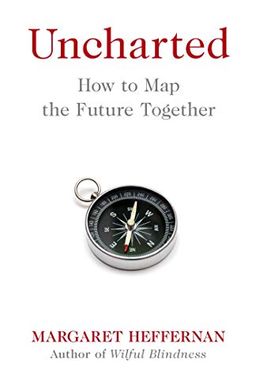
Uncharted cover

Uncharted

by Margaret Heffernan

Uncharted by Margaret Heffernan explores the art of planning for an uncertain future. It challenges the reliability of predictions and emphasizes the importance of innovative thinking and scenario planning. Discover how embracing uncertainty can lead to transformative growth and unexpected opportunities.

Living with Uncertainty

What do you do when the world refuses to fit your plans? Margaret Heffernan argues that the greatest challenge of our age isn’t ignorance—it’s our addiction to prediction. We still seek certainty as though progress means total foresight, but complexity makes that impossible. The world has become nonlinear and entangled: you can’t isolate causes or guarantee results. Heffernan invites you to trade in the illusion of prediction for the practice of preparedness, experimentation, and imagination.

Complicated vs. Complex

In a complicated system—like a car engine or assembly line—every part connects predictably. You can plan repairs and calculate outcomes. But complex systems—like a city, a climate, or a company—shift dynamically because every element adapts. McChrystal’s contrast between the Gulf War (complicated) and the Iraq conflict (complex) shows the difference: one followed a script, the other rewrote itself daily. Apple’s vast supply web offers a modern case—factory strikes or storms can ripple globally. In complexity, you can be brilliant and still blindsided.

Heffernan calls this “the constancy of uncertainty.” Instead of fighting reality, you must accept it. Hannah Arendt noted long ago that uncertainty is irreducible in human life; the modern mistake is pretending otherwise through markets, algorithms, or charisma.

The Addiction to Prediction

Because you crave reassurance, you fuel industries that sell it. Economists from Irving Fisher to Roger Babson built fortunes promising foresight; pundits and tech prophets do the same today. But Heffernan exposes the pattern: simplified models create illusions of control, media reward boldness over accuracy, and institutions monetize confidence. The result is fragile systems guided by theatrics rather than truth. Big data and AI deepen the trap by turning guesses into numbers that look objective but carry baked-in biases (as Cathy O’Neil wrote, “opinions embedded in code”).

You even see an automation paradox: the more you outsource thinking, the less capable you become. Eleanor Maguire’s work with London taxi drivers showed that navigation strengthens the hippocampus, while dependence on GPS weakens it. Convenience erodes competence—and dependency invites manipulation.

From Certainty to Curiosity

Heffernan’s alternative is not despair but disciplined curiosity. You can’t exorcise uncertainty, but you can learn to work with it. That means examining assumptions, running experiments, and imagining multiple futures. Daryl Plummer at Gartner models this shift—treating forecasts as hypotheses to test rather than truths to obey. The message: stop buying certainty; start building capacity.

The Book’s Core Journey

Across its chapters, Uncharted explores how humans, institutions, and artists navigate uncertainty without guarantees. You’ll see why forecasting fails and what to replace it with; how memory and history lend creativity rather than dictate rules; why flukes and mutations drive progress; and how experiments, scenarios, and preparedness create resilience. Later, Heffernan draws lessons from art, cathedral builders, leaders, and even hospice workers to show that uncertainty, embraced humanely, becomes the ground of meaning and action.

Core Insight

You can’t predict the future, but you can design for surprise—cultivating skills, trust, and imagination that let you respond when it arrives.

The book offers a mental shift: from prediction to preparedness, from efficiency to resilience, and from fear of the unknown to curiosity about what’s possible. Uncertainty isn't the enemy—it’s the medium in which freedom, creativity, and humanity operate.


When Forecasts Fail

Forecasting has long promised to tame uncertainty, yet history shows its limits. Heffernan uses early forecasters like Irving Fisher, Roger Babson, and Warren Persons to show how smart people can get trapped by their own models. Fisher’s data systems, Babson’s Newtonian charts, and Persons’s cycles looked rigorous, but all failed before the 1929 crash. Their blindness wasn’t stupidity—it was structural. Models compress reality and reward conviction over doubt.

Three Chronic Weaknesses

Heffernan distills three recurring pathologies. First, models are incomplete—you must omit variables to compute anything, and what’s excluded often proves decisive. Second, ideology shapes design: whether Greenspan’s faith in deregulation or modern econometric assumptions, belief clouds measurement. Third, conflicts of interest distort clarity because forecasting itself becomes an industry that profits from disruption.

Modern Echoes

This same drama repeats: celebrity pundits profit from bold errors; universities and media amplify drama; sensational headlines sell. The 47% automation scare (Oxford Martin study) became gospel despite wide uncertainty. Loud certitude still trumps calibrated humility. Yet precision, Keynes warned, “creates drama”—and drama sells.

A Better Way to Forecast

Philip Tetlock’s Good Judgment Project offers antidotes. It trains ordinary people to make probabilistic forecasts, update often, collaborate widely, and learn from mistakes. Tetlock’s superforecasters aren’t prophets—they’re deliberate learners whose success peaks within months rather than years. Their lesson: treat all forecasts as temporarily useful hypotheses, not permanent truths.

Lesson

The point is not to eliminate prediction but to use it as a probe. Forecasts can guide inquiry—only if you expose their assumptions and never mistake them for guarantees.

Prediction can help only if you know where it breaks. Uncritical faith blinds; humble, adaptive forecasting frees you to adjust when reality changes.


Learning from Memory and History

Memory and history build the scaffolding for imagination—yet both deceive when mistaken for repetition. Heffernan combines neuroscience and history to show why you can’t plan the future as a sequel to the past.

Memory as Foresight

Neuroscientist Eleanor Maguire proved that the brain’s memory system also powers imagination. Taxi drivers who master London’s “Knowledge” grow hippocampal gray matter; amnesiacs who can’t recall the past also fail to visualize the future. Attention thus becomes foresight: if you navigate on autopilot, you erode the material for imagining possibilities.

History as Raw Material, Not Recipe

Analogies seduce by simplicity. France’s Maginot Line, designed from World War I lessons, ignored future mobility; U.S. Cold War leaders invoked Munich to misread new conflicts. Historical echoes rarely repeat but always rhyme imperfectly. Karl Popper warned that expanding knowledge ensures novelty—any deterministic history is false.

Using History Well

Heffernan’s method: draw contrasts, not conclusions. Use several analogies to expose differences. Ask what has changed: context, scale, technology, incentives. Jacob Dunne’s transformation through restorative justice illustrates this: by reinterpreting his own past, he imagined a new identity. Memory and history, when seen as creative materials, emancipate rather than confine.

Key Point

Use history to expand imagination, not to reduce options. The past is guidance, never geometry.

By treating memory and history as dynamic, you train your mind to hold multiple scenarios—an essential skill in a complex world where past analogies often mislead but deeper reflection can generate genuine innovation.


Chance, Science, and Serendipity

Progress, Heffernan argues, stems as much from accidents as from design. Whether in science, genetics, or technology, breakthroughs often depend on flukes, not forecasts. The danger is that efficiency culture strangles the randomness that breeds discovery.

Discovery’s Unruly Nature

Scientific advances oscillate between planning and luck: the Human Genome Project aligned tools deliberately, but penicillin and cosmic microwave radiation were pure serendipity. If you optimize too tightly, you remove slack for surprise. Resilient systems mimic biology: redundancy, variety, and occasional waste sustain vitality.

The Myth of Genetic Destiny

Genetics illustrates probability, not fate. Twin studies show only partial heritability; polygenic scores explain fragments, not futures. Yet companies and pundits—from 23andMe to Robert Plomin—sell destiny wrapped as data, risking discrimination and fatalism. The Pygmalion effect warns how predicted futures can become self-fulfilling.

CRISPR and Moral Complexity

Gene editing revives eugenic temptations: who defines improvement, and who can afford it? Heffernan recalls Francis Galton’s legacy and China’s aborted CRISPR babies to argue for humility. Power over biology demands collective debate, or inequality hardens into DNA. The ethical question echoes automation and surveillance capitalism: when prediction becomes control, freedom erodes.

Core Message

Flukes and mutations are engines of progress. Design systems that welcome accidents, not ones that punish them.

Uncertainty, even risk, proves creative when institutions preserve space for experimentation. The future depends less on perfect control than on preserving unpredictability as the soil where new ideas germinate.


Experimentation and Scenarios

If prediction fails, you can still experiment. Heffernan treats experiments as disciplined ways to learn about systems whose behavior can’t be forecast. Rebecca Hosking’s plastic-bag campaign in Modbury began with a local trial and rippled around the world—proof that small experiments can yield non-linear results.

An Experimental Mindset

Good experiments share traits: clear intention, small scale, measurable observation, and a backbone organization to sustain learning. Examples range from Jos de Blok’s Buurtzorg nursing model to the Wolfe’s Neck Center’s carbon-zero dairy project. Each blends autonomy (for complexity) with structure (for scaling). Experiments prioritize learning over success; each iteration refines understanding.

Scenario Planning as Collective Experiment

When the time horizon stretches too far for testing, scenario planning extends experimental thinking to imagination. Pierre Wack’s Shell scenarios in the 1970s transformed strategy by treating narrative as data—multiple futures analyzed seriously, not ranked by probability. Modern examples—from Slovenia’s Vision 2050 to Mexico Posibles—show how transparent storytelling turns uncertainty into shared ownership.

Scenarios work because they teach people to empathize with alternative worlds. Participants learn flexibility, patience, and the capacity to act without guarantees. Iteration builds capability as much as foresight.

Guideline

Don’t plan one future—practice many. Probe reality through small trials and large stories that expand what you and your community consider possible.

This mindset—combining experimental humility with narrative breadth—anchors Heffernan’s core strategy: replacing futile efforts to forecast with creative architectures of learning and adaptation.


Artistry and Ambiguity

Artists, Heffernan suggests, live out the virtues required for life in uncertainty: attention, patience, and ambiguity. They invent by not knowing. The creative process becomes a model for leadership and citizenship in a complex era.

Attention and Incubation

Artists gather evidence from life. Writers like Ibsen catalogued behavioral minutiae; Katie Paterson listens to telescopes and time. Like Maguire’s taxi drivers, they build cognitive maps through cultural navigation. This takes slowness—Peter Brook’s distant memory of a man outside a prison matured into art decades later. The message: you must notice, then wait.

Living the Questions

Rilke’s advice—“live the questions”—frames how artists tolerate ambiguity. Mike Leigh improvises films without scripts; Tracey Emin revises endlessly; Katie Paterson’s century-spanning “Future Library” resists closure. This patience contrasts with corporate haste and political polarity. Creativity isn’t prediction—it’s the disciplined practice of dwelling with possibility.

Collaboration and Discovery

Art also models co-creation. Norman Ackroyd’s etching process, irreversible and tactile, exemplifies risk. Sebastian Barry’s rewriting mirrors scientific iteration. Toni Morrison’s view of readers as co-conspirators suggests how organizations might engage publics—not as consumers but participants. Ambiguity becomes an invitation.

Creative Ethic

In art as in life, uncertainty isn’t failure—it’s fertile ground. What matters is presence, patience, and the courage to keep making while meaning emerges.

To think like an artist is to live experimentally—observant, iterative, open to contradiction. Those are precisely the attributes that allow individuals and institutions to thrive when prediction fails.


Preparedness and Leadership

In the book’s final movement, Heffernan describes preparedness as active hope—a system designed to move fast and humanely when the unpredictable strikes. It’s leadership built on trust and long horizons rather than on prediction.

Building Systems that Flex

CEPI’s global vaccine work, led by Richard Hatchett, rehearsed for pandemics before they hit: funding multiple “just-in-case” candidates, creating “just-in-time” manufacturing networks, and cultivating local relationships for trust. Similar logic drives Cary Fowler’s Svalbard seed vault and Wales’s Future Generations Act—backcasting from the desired outcome to the required present.

Leadership as Trust Network

Preparedness also depends on relationships. Crises test social capital: Risto Siilasmaa’s turnaround of Nokia worked because he convened plural options; Barings Bank’s endurance flowed from colleagues’ loyalty built over years. Friendship and shared narrative sustain institutions beyond technical plans.

Cathedral Thinking

Heffernan’s metaphor of the cathedral project sums up collective endurance. CERN’s pursuit of physics knowledge, Gaudí’s Sagrada Família, and the Human Genome Project all married a guiding mission with adaptability. Their secret: a big, moral ambition paired with openness to changing tools and generations of contributors. Public legitimacy keeps them alive.

Facing Mortality

Her closing reflections on hospices and late-life creativity tie the theme to mortality itself. Dying well—through dignity, preparation, and generosity—reflects the same virtues. Hospices design rituals for continuity; artists like Beethoven, Matisse, and Glenda Jackson show that final acts can reveal radical new style. Uncertainty and finitude, faced honestly, deepen life’s meaning.

Final Understanding

Preparedness replaces prediction; trust replaces control; legacy replaces certainty. The goal is not to master the unknown but to remain capable within it.

Heffernan ends with hope grounded in realism: since the future cannot be forecast, it must be built—together, experimentally, and with conscience.

Dig Deeper

Get personalized prompts to apply these lessons to your life and deepen your understanding.

Go Deeper

Get the Full Experience

Download Insight Books for AI-powered reflections, quizzes, and more.