
Idea 1
Turning Fear and Doubt into Fuel for Brilliance
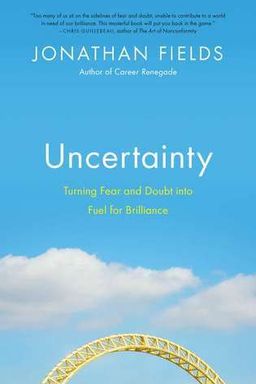
How can you pursue work that matters when fear and uncertainty make you freeze before you start? In Uncertainty, Jonathan Fields tackles the paralyzing tension between creativity and fear. He argues that uncertainty is not a threat—it is the raw material of innovation and genius. The difference between those who create extraordinary things and those who don’t is not talent or luck, but how they engage with the unknown.
Fields contends that every truly original idea begins in the dark. If the outcome were certain, someone would have done it already. Whether you’re a painter, entrepreneur, dancer, or designer, you must step into a fog of incomplete information, risk, judgment, and doubt. These are the “three psychic horsemen” of creation—uncertainty, risk of loss, and exposure to criticism—that most people try to avoid. But Fields shows that these discomforts are not barriers to creativity; they are its breeding ground. Learning to tolerate, and even amplify them, unlocks your ability to create on a higher level.
Why Uncertainty Matters
Creativity begins as a question. You wonder—what if?—and act without knowing if your idea will succeed. Every phase is filled with unknowns, from early experiments to final form. Traditional success models reward predictability, but Fields reminds us that certainty equals replication. Anything fully known has already been done. To innovate, you must endure ambiguity long enough to discover something new. This echoes what psychologists call “tolerance for ambiguity,” a trait tightly linked to creative ability (as also explored by researchers like Franck Zenasni).
The Cost of Avoiding the Unknown
Most people experience uncertainty as pain. Brain imaging shows that ambiguous situations trigger the amygdala—the brain’s fear center—causing anxiety similar to physical threat. When exposed to judgment on top of that, fear multiplies. You may rush to end the discomfort by abandoning the project or clinging to safe, predictable paths. Fields calls this the tragedy of “premature certainty.” It kills originality just shy of the breakthrough. By chasing comfort, creators guarantee mediocrity.
How Fear Alchemists Transform Anxiety into Fuel
In contrast, great creators, whom Fields calls “fear alchemists,” harness uncertainty instead of fleeing it. Randy Komisar jumped out of a “perfectly fine airplane” when he left a secure CEO track to invent the role of “Virtual CEO.” Marie Forleo risked reputation and resources to start audacious mastermind adventures that broke every business norm. Documentary filmmaker Erik Proulx turned job loss into a creative rebirth by making Lemonade—a film about others who reimagined themselves after being fired. All faced colossal risk and public scrutiny, but their willingness to act despite fear birthed innovation and meaning.
Learning the Alchemy
Fields rejects the myth of the “fearless creator.” Most innovators are not immune to anxiety; they simply manage it differently. Through rituals, supportive environments (hives), mindful practices, and reframing techniques, they transform the pain of uncertainty into motivation. These tools—what Fields calls certainty anchors, attentional training, and creative hives—form a scaffold for handling the psychological weight of creation. The goal isn’t to eliminate fear but to cultivate equanimity, a calm awareness that allows creativity to flow even when outcomes are unknown.
Why These Ideas Matter
We live in an era defined by volatility, whether in art, business, or life. Innovation now depends not on perfect plans but on the ability to act while uncertain. Fields’s message converges with ideas from Seth Godin’s Linchpin and Carol Dweck’s Mindset: real success comes from leaning into discomfort. By understanding uncertainty as a creative signal—not a bug, but a feature—you can build art, products, and lives that transcend safety and make a lasting impact. This book is a map for anyone who chooses to dance with doubt and turn it into brilliance.