
Idea 1
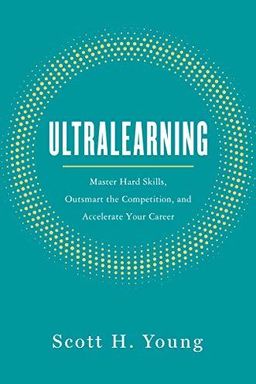
Ultralearning: The Art of Learning Hard Things Fast
What if you could master any skill or subject faster than you ever thought possible—without going back to school? In Ultralearning, Scott Young presents a bold answer: you can, through an approach he calls ultralearning—a self-directed, aggressive strategy for acquiring skills and knowledge both deeply and quickly. With rising costs of education, rapid technological change, and a world that rewards continuous adaptation, Young argues that you must take control of your own learning if you hope to thrive. Traditional schooling, while valuable, is too slow, too expensive, and too structured for an economy where skills expire quickly and self-motivated learners win.
Drawing from his own experiments—like teaching himself MIT’s entire computer science curriculum in one year and learning four languages in twelve months—Young explores how ordinary people can do extraordinary things through intelligent, intense self-education. He illustrates his ideas with stories of others who pushed boundaries: Benny Lewis mastering languages in three months, Roger Craig “hacking” Jeopardy! through data analysis, and Eric Barone teaching himself programming, pixel art, and music to create Stardew Valley. These examples reveal the building blocks of ultralearning: metalearning, focus, directness, practice, feedback, and experimentation.
Why Ultralearning Matters
Young warns that our era of accelerating change demands more from learners. Automation, globalization, and constant technological disruption mean average effort is no longer enough—average is over (a phrase borrowed from economist Tyler Cowen). To stay relevant, you must master difficult, valuable skills faster than your peers. Yet traditional education is both costly and mismatched to modern realities. College can leave you buried in debt without teaching practical abilities. The good news? The same technologies that destabilize old industries—open online courses, free educational materials, and digital communities—also empower anyone worldwide to learn at an elite level on their own schedule.
By investing deliberately in deep learning, Young contends, you gain confidence, adaptability, and leverage. You stop being limited by formal credentials and start demonstrating mastery through performance. Self-motivated ultralearning isn’t just a professional strategy—it’s a path to personal fulfillment. The more you push your boundaries, the more you realize how elastic your potential really is. As James Clear notes in the book’s foreword, ultralearning gave him the framework he used to become a bestselling author of Atomic Habits. The same process, Young argues, can help you reinvent yourself in any domain.
From Theory to Practice
So how does ultralearning actually work? Young distills nine core principles that govern how the brain best acquires challenging new knowledge:
- Metalearning: Before you start learning, map out how to learn. Research methods, tools, and pitfalls in your chosen skill.
- Focus: Cultivate intense concentration and eliminate distractions. It’s not about time spent but energy invested.
- Directness: Learn by doing the real thing, not by abstract or theoretical substitutes.
- Drill: Identify your weakest links and attack them with deliberate practice.
- Retrieval: Test yourself constantly—memory improves more through recall than re-reading.
- Feedback: Seek immediate, honest input and learn to interpret criticism without defensiveness.
- Retention: Use spaced repetition and overlearning to make knowledge stick.
- Intuition: Strive to understand deeply, not just memorize; build mental models like Richard Feynman did in physics.
- Experimentation: Break conventions, test new techniques, and push beyond your comfort zone.
Over the course of the book, Young teaches you how these principles weave together into a flexible, evidence-based framework for mastering almost anything—from languages and engineering to music and design. He grounds every principle in cognitive science while keeping the stories human: students, professionals, and autodidacts using these methods to disrupt their limits. By the end, Ultralearning invites you to design your own self-education project, combining strategy, creativity, and courage to learn whatever matters most to your future.