
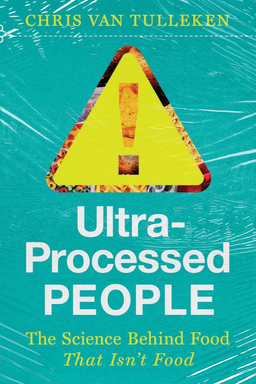
Ultra-Processed People cover

Ultra-Processed People

by Chris van Tulleken

Ultra-Processed People delves into the pervasive influence of ultra-processed foods on our health and society. Through engaging narratives and scientific insights, Chris van Tulleken reveals the hidden costs of these dietary staples and empowers readers to reclaim their well-being with informed choices.

The Food System That Eats Itself

What if much of what you eat isn’t really food, but a profitable simulation of it? Chris van Tulleken’s Ultra‑Processed People argues that ultra‑processed food (UPF) isn’t simply a nutritional category, but the defining symptom of a food system engineered to overconsume, overwhelm biology, and privatise profits while externalising harm. Through evidence, history, and personal experiment, he shows that UPF reshapes your body, brain, and society — and that this shift is every bit as profound as the rise of tobacco or fossil fuels.

What defines UPF — and why the purpose of processing matters

You can recognise UPF by one simple rule: if it’s wrapped in plastic and includes ingredients you wouldn’t find in a home kitchen, it’s probably ultra‑processed. The NOVA framework, created by Brazilian researcher Carlos Monteiro, sorts foods by their degree of transformation. But Monteiro added a crucial twist: intent. Ultra‑processing is not merely mechanical or chemical; it’s purposeful — the deliberate engineering of cheap, convenient, brandable packages designed to displace real food and capture consumer spending.

That purpose clause transforms the conversation. It shifts focus from fat, sugar and salt to the economic logic that shapes what you eat. UPF is designed to be profitable first, edible second. In every supermarket, its dominance reflects the scientific and industrial race to make food addictive, long‑lasting, and scaleable rather than nourishing.

How UPF disrupts biology and appetite control

Human appetite evolved with foods that required chewing, digestion, and multisensory evaluation. Tulleken’s experiments and Kevin Hall’s NIH inpatient trials show that when you feed volunteers diets made of 80% UPF — even matched for calories and nutrients — they eat about 500 calories more per day. Why? UPF is soft, fast, and high‑energy. It bypasses the body’s feedback loops mediated by hormones like leptin, ghrelin, and peptide YY. You eat quickly and your satiety signals arrive too late. Hall’s trial offered proof that the form and texture of food — not its nutrients — determine intake.

UPF hacks the brain’s reward circuitry too. Taste and smell, which evolved to indicate genuine nutrients, are hijacked by artificial flavours that mimic nutrition but deliver none. The result is a persistent wanting disconnected from true nourishment — much like addiction paradigms. You can like a UPF less than you crave it; manufacturers exploit that gap ruthlessly.

Engineering and economics — the hidden machinery

Behind every bright packet lies an industrial ecosystem. Food technologists replace natural fats and proteins with modified starches, RBD oils and emulsifiers; this molecular reconstruction builds texture at minimal cost. Firms like Kraft learned decades ago how to use starch pastes instead of eggs in mayonnaise. Commodity traders (ADM, Bunge, Cargill) and ingredient giants (Kerry Group) refine and sell these fractions worldwide. The result is a global marketplace where taste, texture and shelf life are monetised. Every substitution, every stabiliser increases scalability and decreases biological feedback.

The health evidence and scientific consensus

The case against UPF isn’t ideological; it’s empirical. Hall’s trial supplied experimental proof. Observational studies — including analyses in BMJ and Neurology — show dose‑dependent risk increases for cancer, cardiovascular disease, dementia, depression, and early death. Mechanistic studies offer biological plausibility: emulsifiers that erode gut mucus, altered microbiomes, sweeteners that confuse insulin response. No single component explains everything; the harm emerges from the interaction of thousands of engineered decisions turned into one seamless eating experience.

From personal biology to social structure

The problem isn’t your willpower. Obesity and metabolic disease follow the contours of poverty and industrial logistics, not laziness. Clare Llewellyn’s twin data show how genetic vulnerability interacts with environment: predispositions amplify when diets are dominated by cheap UPF. Meanwhile, marketing — cartoon mascots, advergames, bus vouchers — conditions taste from infancy. The system creates lifelong consumers. When Nestlé sends floating supermarkets up the Amazon, or when McDonald’s dominates food swamps in Britain, it’s not responding to demand; it’s manufacturing it.

The bigger picture: power, regulation, and resistance

UPF isn’t just a health issue — it’s a political economy. As long as stock markets reward volume, ultra‑processing will persist. Regulatory failures like the US GRAS loophole allow companies to self‑declare additives safe; industry‑funded science dilutes public understanding. Environmental costs — deforestation, antibiotics, plastics — are ignored in pricing. Solutions require cultural, political, and personal rewiring: transparent labelling, bans on child marketing, procurement of real food, and citizens who see food choices as civic choices.

Core message

Ultra‑processed food is a mirror of the modern economy: efficient, profitable, seductive — and biologically incompatible. Understanding how it works is the first step toward escaping its grip.

In the chapters that follow, Tulleken’s argument unfolds from molecule to marketplace: how UPF is made, how it manipulates the mind, how it damages the environment and democracy, and what both governments and individuals can do to reclaim control over what counts as food.


The Chemistry of Convenience

You probably don’t pause to consider the molecular tricks inside a tub of supermarket ice cream or a slice of packaged bread. Yet those tricks define the industrial revolution of food. Ultra‑processing replaces real ingredients with modified substitutes that replicate their sensory roles — fats, proteins, carbohydrates — at a fraction of the cost.

Rebuilding food from fragments

Where traditional cooking starts with whole foods, UPF manufacturing begins with commodity fractions: starches, protein isolates, refined oils. Engineers reconstruct texture using maltodextrins and gums; Paul Hart explains how Kraft replaced eggs with starch paste in mayonnaise to duplicate creaminess. Palm and soybean oils are processed through RBD (refined, bleached, deodorised) steps until interchangeable. This technological interchangeability makes products stable, cheap and identical worldwide.

Softness, meltability and rapid consumption

Through extrusion, puffing and emulsification, UPF becomes easy to chew and fast‑eating. Stabilisers like guar and xanthan gum hold water, prevent ice crystals and produce creamy mouthfeel — the reason Lyra’s ice cream never melted in the park anecdote. These same properties accelerate eating speed and disable the natural resistance of chewing that triggers satiety. UPF, in effect, is pre‑chewed.

Engineering flavour and reward

Flavourists use aroma compounds and enhancers to construct a sensory signal that mimics nutrition. Barry Smith’s research shows that your brain merges smell, touch and taste into a flavour ‘barcode’. Manufacturers design fixed olfactory signatures — such as the sweet‑acid‑cold combo in Coca‑Cola — that teach craving through repetition. These signals hijack dopamine pathways so you want the product even when you don’t particularly like it.

Additives and the microbiome connection

Emulsifiers like polysorbate‑80, DATEM and carboxymethylcellulose degrade the intestinal mucus layer and change gut microbial populations, as shown in mouse studies in Nature. Maltodextrin promotes pathogenic slime films; trehalose may foster virulent Clostridium difficile strains. These ingredients are not inert — they interact with living microbes that regulate immunity and metabolism.

The economic logic behind the recipe

Every modified ingredient is a cost‑saving innovation. Industrial fats allow swapping based on price; gums prolong shelf life; flavourings reduce waste. Global firms profit because UPF can travel months through supply chains without spoiling. It’s convenience by chemical design. But that convenience, Tulleken argues, carries costs your body quietly pays — hormonal confusion, microbial disruption and runaway appetite.


Feeding Patterns and Health Evidence

When food scientists translate NOVA’s idea into tests, the results are shockingly consistent. Ultra‑processed diets don’t just correlate with disease; they cause measurable biological changes. Kevin Hall’s randomized inpatient trial remains pivotal: two matched diets, identical in calories and nutrients, produced starkly different outcomes. The UPF group ate faster, consumed 500 additional kcal daily, and gained weight within two weeks. That single experiment turned a hypothesis into evidence.

Observational and mechanistic reinforcement

Following Hall’s work, large cohort studies broadened the picture. In France, participants with 10% higher UPF intake had elevated cancer risk; in the US, data linked it to cardiovascular death. In China, to dementia. The pattern is dose‑dependent: the more UPF you eat, the higher the risk. Laboratory findings explain why — emulsifiers disturb the gut barrier, sweeteners distort microbial metabolism, and textures promote rapid ingestion. MRI studies at University College London show altered connectivity between reward and homeostatic brain areas after sustained UPF consumption.

Criticism and industry interference

Defenders of UPF often claim the NOVA scale is crude or confounded by socioeconomic status. Yet many rebuttals come from industry‑funded authors. Coca‑Cola’s Global Energy Balance Network is a classic example — shifting blame to inactivity instead of diet. Similar strategies appear in cereal and dairy lobbying, where reformulated products are presented as ‘improved.’ The book’s analysis of conflicts of interest reveals that funding reproducibly biases outcomes, echoing the patterns previously seen in tobacco and pharmaceuticals.

Interpreting the convergence

The strength of the claim lies in convergence: controlled trials, epidemiology, mechanistic biology all point the same way. Each method has limitations, yet together they form a coherent narrative of harm. The conclusion isn’t that UPF is a poison in the conventional sense — it’s that it alters feedback systems and environments at scale so disease becomes statistically inevitable. That’s the shift public health now confronts.


Biology and the Myth of Willpower

Tulleken reframes weight from a moral problem into a biological and social one. Your body evolved sophisticated mechanisms to regulate intake; UPF sabotages them. Understanding this helps you see why ‘eat less, move more’ advice fails in a system designed to overwhelm your natural defences.

Hormonal and neural signals

Leptin, ghrelin, GLP‑1 and peptide YY act as your internal calibration system. Whole foods trigger balanced responses — slow glucose rise, steady satiety. UPF’s energy density and softness accelerate consumption and distort hormonal timing. Hall’s metaphor of the broken thermostat captures this neatly: the environment resets your internal temperature so your regulatory ‘stop’ signals fail to activate until it’s too late.

Reward circuits and addictive parallels

Neurologically, the hedonic drive to eat overlaps with addiction pathways for drugs and gambling. UPF delivers immediate dopamine spikes without sustained satisfaction. The brain learns to chase cues — packaging, smells, jingles — even in the absence of hunger. This is deliberate design, not accident. Barry Smith’s flavour barcode research explains how consistency across exposures builds craving and brand loyalty.

Activity and genes misunderstood

Comparative anthropology from Herman Pontzer’s Hadza studies shows daily energy expenditure is surprisingly constant regardless of activity. Exercise reallocates calories rather than eliminates them. Meanwhile, genetic vulnerability manifests more strongly in food‑insecure environments. Clare Llewellyn’s twin analyses confirm that heritability of BMI is environment‑dependent — UPF makes predisposition potent.

Key takeaway

Obesity is not a failure of discipline; it’s a predictable outcome of an engineered environment. To fix it, society — not individuals — must change the food landscape.


Additives, Loopholes and the Invisible Risks

The book reveals a striking legal blind spot: most chemicals in food never undergo independent safety testing. Under US GRAS rules, companies can self‑declare substances safe. Corn Oil ONE’s withdrawn submission, littered with errors, and FEMA’s self‑approval of flavour compounds illustrate how additives enter the market unchecked. The burden of proof falls on citizens and academics long after exposure.

The hidden scale

Since 2000, roughly 766 new chemicals entered US foods; fewer than 20 underwent full FDA review. Industry panels, often composed of internal experts, determine safety without publishing data. Tulleken’s analysis of Tom Neltner’s estimates underscores that nearly 1,000 substances may be circulating under entirely private GRAS determinations.

Flavour industry self‑regulation

FEMA’s expert panel approved over 2,600 flavorings as GRAS; when independent toxicology found liver cancer in mice exposed to isoeugenol, the panel dismissed it as dose‑irrelevant. This episode exemplifies commercial conflict: economic incentives shape scientific judgment. (Comparable frameworks exist in cosmetics, where ‘fragrance’ labels hide hundreds of untested molecules.)

Implications for you

This system builds structural ignorance into the food market. You cannot know what long‑term mixtures of low‑dose chemicals do to human biology. The EU, though imperfect, offers transparency; the US model outsources oversight. If precaution mattered, reform would mandate open databases and periodic review. For now, choosing products with short ingredient lists remains the most practical safeguard.


Money, Marketing and Global Spread

Ultra‑processing thrives because it aligns perfectly with modern capitalism. Each link in the chain — from soybean grower to retailer to investor — earns more when more is sold. This feedback makes unhealthy supply not a bug but a feature.

Value extraction across layers

Commodity farmers capture only a quarter of consumer spending. Ingredient firms convert crops into profitable isolates; processors like Froneri scale production; retailers market convenience; investors demand perpetual growth. Emmanuel Faber’s downfall at Danone demonstrates that even socially minded CEOs are punished for prioritizing ethics over yield. In this Darwinian market, moral innovation collapses under shareholder pressure.

Global marketing and cultural displacement

In Brazil, Nestlé’s floating supermarket Terra Grande brought branded UPF deep into the Amazon. Cheap shelf‑stable sweets displaced local staples and correlated with surges in childhood obesity. Similar transitions unfold in Ghana with fast‑food chains. The narrative repeats: corporations create culture, not just respond to it.

Environmental and ethical costs

Behind each product lie hidden externalities — deforestation for soy and palm, antibiotic resistance from intensive farming, plastic pollution from millions of single‑use packs. These costs rarely appear in price tags. Fixing this requires economic re‑design: taxes on promotions, bans on child advertising, procurement favouring whole foods, and international producer‑responsibility rules.

System insight

UPF is not an anomaly; it’s capitalism’s perfect food — cheap, scalable, addictive and endlessly promotable. Changing it means changing the incentives themselves.


Fixing Food: Policy and Personal Action

Tulleken ends with pragmatic hope. Escaping UPF’s grip requires structural regulation and personal awareness, not moral purity. The precedent is global infant‑formula policy: when marketing kills, rules must shield the vulnerable.

Policy lessons from history

The WHO’s Code after Jelliffe’s formula scandal proved that restricting advertising can save lives. Chile’s 2016 labeling laws — black octagon warnings and school bans — show modern equivalents work. Purchases fell and children learned to resist marketing. Similar models could address UPF.

Removing industry from rule‑making

Independent regulation depends on keeping corporate money out of expert panels. The British Nutrition Foundation’s corporate membership and similar bodies blur lines between research and lobbying. Nutrition policy shaped by industry will always protect volume sales first.

Acting as an individual citizen

Start small but aware: compare ingredient lists, cook simple whole meals, and test your responses by temporarily increasing UPF intake as Tulleken did. Many find immediate differences — higher hunger, mood swings, digestive shifts. Voting and advocacy matter too: support transparency, marketing limits and fair food access.

Closing insight

Individual change helps, but collective change sustains. Food is political: once society values real nourishment over profit, the system will follow.

Dig Deeper

Get personalized prompts to apply these lessons to your life and deepen your understanding.

Go Deeper

Get the Full Experience

Download Insight Books for AI-powered reflections, quizzes, and more.