
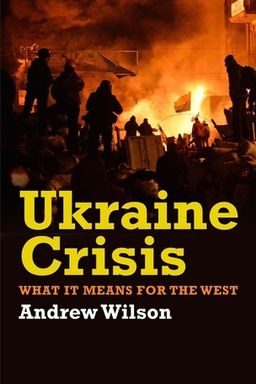
Ukraine Crisis cover

Ukraine Crisis

by Andrew Wilson

Ukraine Crisis by Andrew Wilson takes a deep dive into the political upheaval in Ukraine, from the Maidan uprising to the annexation of Crimea. This compelling narrative examines the broader implications for Russia, the European Union, and the global political landscape, offering a critical analysis of Eastern Europe''s turbulent dynamics.

The Long Construction of Ukrainian Identity

To understand modern Ukraine, you need to see the nation as the outcome of a thousand-year debate about origins, territory, and belonging. The book traces how shifting empires, faiths, and ideas formed a layered identity—one that has repeatedly reimagined itself from Kievan Rus through the Cossack revolts, imperial domination, modern nationalism, Soviet trauma, and post‑1991 independence. Ukraine’s story is not linear; it is a succession of reinventions shaped by competing myths and concrete struggles for sovereignty.

From shared Rus to contested origin

You start with medieval Rus, a common political and cultural space stretching from Kiev to Novgorod. Its legacy became the pivot for modern disputes: Russian historians claim it as the cradle of their nation; Ukrainians assert it as a proto‑Ukrainian state. The evidence supports both unity and diversity—church rites, trade along the Dnieper, and shared architecture coexisted with regional political divergence. That tension (shared roots versus later fragmentation) reappears in every modern phase of the identity debate.

Myths and antiquities as national scaffolding

Modern Ukrainians built mythic continuity through Scythians, Trypillians, and Aryans, using archaeology and scripture as political tools. Lev Sylenko and Yurii Kanyhin crafted ‘Aryanist’ genealogies, while others invoked biblical ancestry linking Ukraine to Japheth and Magog. These stories mattered less for historical truth than for symbolic power: they gave Ukraine a deep civilizational pedigree and moral claim to European belonging. (Note: such myth‑making parallels Ceauşescu’s Dacian myth in Romania and nineteenth‑century European ethnogenesis fantasies.)

Borderlands, faith, and political evolution

Between Poland, Lithuania, and Muscovy, a Ruthenian identity developed through Orthodox, Uniate, and Catholic interplay. Petro Mohyla’s Orthodox revival made religion a vessel for culture. The later Cossack revolts under Bohdan Khmelnytskyi merged social rebellion with spiritual defense of Orthodoxy, yielding the Hetmanate—an embryonic state. Mazepa’s fall in 1709 ended autonomy but left enduring symbols of liberty. These narratives of defiance and faith became templates for later nationalism.

Empire, Galicia, and the nineteenth‑century awakening

Under the Romanovs, national institutions vanished, replaced by Russification. In Galicia, Austrian tolerance and education created an opposite model—a crucible of enlightenment where Hrushevskyi reimagined Rus as ‘Ukraine‑Rus’. The western experience introduced the idea of civic nationhood through cooperatives and schooling. The contrast between imperial coercion and Habsburg pluralism explains why nationalism later emerged stronger in the west and more ambivalent in the east.

Wars, revolutions, and failed states

World War I shattered empires and offered fleeting chances for independence—the UNR, Hetmanate, and ZUNR—all constrained by foreign armies and internal divisions. The interwar years then split politics and culture: militant nationalism under Dontsov and the OUN confronted avant‑garde modernists like Khvylovyi, Kulish, and Kurbas, who sought a European cultural orientation. Stalinist repression destroyed both camps, killing the intelligentsia and uprooting peasantry through famine and collectivisation.

Modern Soviet legacy and independence

Post‑war Ukraine lived between compliance and quiet cultural survival. Dissidents like Stus and Dziuba revived conscience politics; Rukh harnessed the glasnost era’s openings and joined pragmatic elites to secure 1991 independence peacefully. Yet patrimonial habits persisted. The 1990s brought economic collapse, oligarchic capture, and ambiguous institution‑building, producing a hybrid post‑Soviet state with democratic forms but weak enforcement.

Geopolitics and the struggle for orientation

Stepan Rudnytskyi’s river‑axis theory and Yurii Lypa’s Black Sea Doctrine redefined Ukraine as a south‑facing maritime power rather than a northern satellite. Russian narratives—Gumilev’s ethnogenesis and Dugin’s Eurasianism—rejected this autonomy, imagining a ‘Great Space’ that absorbs Ukraine. These contending maps made the country a hinge between Europe and Eurasia, explaining the persistent tug‑of‑war from empire to present conflict.

From Orange to Maidan: civic awakenings

The Orange Revolution showed how civic mobilization could challenge oligarchic manipulation but faltered in implementation. Yanukovych’s presidency revived extraction politics and corruption; his rejection of the EU deal in 2013 provoked Euromaidan, repression, and collapse. Russia’s annexation of Crimea and hybrid war in Donbas transformed civic nationalism into state defense: Ukrainian patriotism became bilingual, inclusive, and defined by resistance as much as aspiration.

The new Ukraine amid war

After 2014, war acted as paradoxical catalyst—fusing civic and cultural unity but stressing institutions. Under Poroshenko, the state pursued reform amid economic crisis and IMF rescue. Volunteer networks and civil society filled gaps, while oligarchs and corruption proved persistent. The book’s larger argument comes full circle: Ukrainian identity survives not because of purity of origin but because of adaptive resilience. Each imperial rupture, from Rus to Romanov to Soviet to hybrid war, forced Ukrainians to reinvent the meaning of nationhood under pressure—and that, more than any myth of descent, defines the country’s continuing story.


Origins and Historical Memory

Ukraine’s identity struggle begins with how people remember Rus. You see the debate over whether Rus was one people or a precursor to several modern nations. The chronicles, from The Lay of Ihor’s Host to the Ruska Pravda, paint a mosaic of shared culture, yet political centers diverged northward and southward. This dual heritage underlies modern tension between claims of common origin and unique descent.

Common roots and divergent paths

Trade routes, Christian liturgy, and architecture framed Rus as a cohesive high culture. But after the twelfth century, Novgorod’s republicanism and Vladimir’s princely hierarchy bred separate templates. The sack of Kiev in 1169 symbolized moral and political fracture. Later theorists like Hrushevskyi treated these splits as proof of distinct ethnic evolution. You, as a reader, learn that unity and divergence coexist—a reminder that origins are interpretive, not deterministic.

Myth, archaeology, and national narrative

Scythian treasures and Trypillian pottery became nationalist emblems, translating material evidence into ancestral myth. Mainstream scholarship resists such continuity, but politics values the symbolism. Ancient motifs—Tridents as solar emblems, Scythian ploughmen as civilized warriors—crafted historical legitimacy. Myth functions politically: it ties land and antiquity together, projecting ethical guardianship over Europe’s frontier.

Insight

Why origins matter

Identity needs a myth of beginning, but those myths are pliable instruments. In Ukraine’s case, they serve as lenses for contemporary sovereignty debates, not fixed proof of ethnicity.

You therefore read Rus less as birthplace of nations than as a shared cultural galaxy. Modern Ukrainian and Russian narratives extract selective constellations, each claiming the same light. Understanding that pattern helps you see why history functions as a battleground for legitimacy today.


Empire and Cultural Survival

As empires absorbed Ukrainian lands, identity survived through faith, language, and education. The Polish–Lithuanian Commonwealth brought Polonisation; Ruthenian elites balanced Orthodoxy against Uniatism. Lithuania’s use of Ruthenian chancery kept administrative continuity. When Russia expanded south, Russification curtailed this autonomy, removing the institutional core that Scotland preserved within Britain—a telling contrast of union versus absorption.

Church as cultural refuge

Orthodox and Greek Catholic institutions anchored identity. Petro Mohyla’s reforms meshed religious renewal with civic learning. Later, under Habsburgs, the Greek Catholic Church became a social engine for nationalism. Education networks like Prosvita turned piety into literacy, a transition crucial for modern political awakening.

Galician Piedmont and scholarly revival

Galicia’s autonomy bred scholarship: Mykhailo Hrushevskyi’s historical synthesis made Ukrainian history academically coherent. He framed Ukraine–Rus as a continuous nation distinct from Russia’s imperial story. Cultural societies and local cooperatives built civil capacity, creating the foundations for the twentieth‑century nationalist movements.

Every empire left institutional fossils—laws, clerics, chanceries—through which Ukrainians later reconstructed statehood. The lesson: survival through culture can offset absence of formal sovereignty, but it makes independence harder to operationalize later.


Cossack Revolt and National Awakening

You enter the seventeenth century when the Cossacks transformed rebellion into proto‑nationhood. Khmelnytskyi’s uprising in 1648 fused Orthodox defense and peasant grievance. The Hetmanate’s institutions—councils, military service, taxation—sketched early statehood, even if fragile. Mazepa’s attempt to break from Moscow ended autonomy but secured symbolic immortality: the image of freedom opposed to empire.

Political and cultural afterlives

Cossack liberty became mythic currency. Artists and poets revived it—Shevchenko’s verse and Repin’s paintings gave heroic form. The legacy coexisted with critique: some saw anarchic adventurism, others democratic proto‑republicanism. The dual reading reflects Ukraine’s political ambivalence even later—valorizing freedom but craving stable rule.

Connection to later revolutions

The Cossack experience forecast the patterns seen in 1917 and 2004: alliances of peasants, clergy, and intellectuals revolting against distant elites. These rebellions rarely stabilized into durable institutions but reshaped cultural imagination. (Note: Khmelnytskyi’s pact with Muscovy illustrates early geopolitics of dependence retold endlessly in later debates.)

In short, the Cossacks are a metaphor of Ukraine itself—chaotic, resilient, and inherently ungovernable when crushed by empire, yet repeatedly reborn as emblem of sovereignty.


Modernism and Soviet Trauma

The interwar and Soviet decades reveal two opposing energies: creative explosion and systematic destruction. After the revolutionary chaos, Ukrainian modernists sought to redefine culture in urban and avant‑garde forms. Mykola Khvylovyi’s slogan “Away from Moscow!” captured the ambition to Europeanize intellect. Les Kurbas, Kulish, and Boichuk built theatre and art equal to European peers. Simultaneously, radical nationalism (Dontsov, OUN/UPA) turned violence into ideology, mapping extremes of self‑definition.

The modernist vision

Artists claimed modernity as national mission—Khvylovyi invoked Goethe, Boichuk invoked Italian masters—to prove Ukraine could lead, not follow. The Autocephalous Church pursued religious modernization. For a moment, the 1920s embodied a cosmopolitan Ukrainian dream.

Stalinist repression and famine

That dream imploded. Korenizatsiia’s tolerance ended; purges executed or demoralized the elite. The Holodomor killed millions, erased the rural base, and shattered continuity. Dovzhenko’s films and Malevich’s paintings captured the horror aesthetically. The regime replaced thinkers with compliant vydvizhentsy. Ukraine’s cultural muscle atrophied, its memory silenced for decades.

This trauma explains both post‑war conformity and the later moral fervor of the dissidents. National revival always carried echoes of loss; cultural renaissance was memory‑work as much as invention.


Dissidence, Independence and Aftermath

By the 1960s–1990s, Ukrainian identity re‑emerged through conscience and negotiation. Dissidents like Stus and Lukianenko used law and poetry against Russification. Rukh translated moral protest into mass movement. The 1991 independence combined idealism and pragmatism—a peaceful transition via a ‘Grand Bargain’ that preserved old elites but secured sovereignty.

Post‑independence dilemmas

The new state inherited bilingualism, regional disparity, and weak institutions. Economic collapse and oligarchic capture followed, producing hybrid democracy. Religious pluralism multiplied identities instead of uniting them: rival Orthodox patriarchates and a resilient Greek Catholic Church turned faith into another domain of competition.

From revolution to reform fatigue

Orange Revolution (2004) achieved civic awakening but stopped short of systemic justice. Oligarchic politics and energy corruption, visible in RosUkrEnergo, proved structural. Yanukovych’s presidency displayed textbook state capture—judicial control, privatization scandals, predatory networks. His downfall reopened Ukraine’s struggle for democratic renewal.

The take‑home idea: independence is sustained less by elite declarations than by civic persistence. Ukraine’s repeated protest cycles testify to social stamina, even when institutional change lags behind moral expectation.


War and Reinvention After 2014

The Euromaidan and subsequent war mark Ukraine’s latest refounding. Yanukovych’s rejection of the EU deal sparked nationwide protest. When repression became lethal, state legitimacy collapsed and Russia seized Crimea. Hybrid war followed in Donbas, underscoring how geopolitical imagination turns into armed contest. Ukraine’s response—mobilization, volunteerism, and reform—defines the new civic phase of nation-building.

Hybrid war and territorial defense

Unlike the 2004 protests, 2014 blended revolution with military response. Russian planners exploited ambiguities: unidentified soldiers, manipulated referendums, proxy governance. The conflict destroyed infrastructure and displaced millions. Yet it also forged unity beyond language or region; Russian‑speaking patriots stood alongside Ukrainophones, reframing identity as civic loyalty rather than ethnic exclusivity.

Political and economic reboot

Poroshenko’s 2014–2015 administration sought stabilization through IMF programs and European alignment. GDP collapse forced austerity, while volunteers maintained defense supply chains. Civil society matured dramatically, compensating for state frailty. The war revealed both limits and potential: institutions under stress can still produce moral consolidation.

Core insight

Conflict accelerated democratization by necessity. Ukrainian civic patriotism now rests on participation and sacrifice more than lineage—a transformation from historical to experiential nationhood.

Ukraine thus continues the grand pattern visible since Rus: pressured by external power, revitalized by internal will. War reshaped citizenship, proving again that adversity is the crucible from which Ukrainian statehood renews itself.

Dig Deeper

Get personalized prompts to apply these lessons to your life and deepen your understanding.

Go Deeper

Get the Full Experience

Download Insight Books for AI-powered reflections, quizzes, and more.