
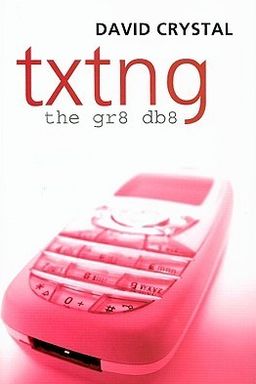
Txtng cover

Txtng

by David Crystal

David Crystal''s ''Txtng: The gr8 db8'' celebrates the ingenuity and artistry of texting as a modern communication form. Dispelling myths of linguistic decay, it reveals texting''s creative potential and historical lineage, offering a thoughtful exploration of this digital vernacular.

The Linguistic Truth About Texting

When was the last time you sent a text and wondered whether those abbreviations—LOL, BRB, or OMG—were ruining the language? In Txtng: The Gr8 Db8, linguist David Crystal invites you to pause and reconsider that fear. Instead of seeing texting as a linguistic apocalypse, Crystal argues it’s actually a celebration of creativity, brevity, and adaptation. He dismantles myths about texting being a threat to literacy and shows it’s simply part of the constant evolution of how humans communicate.

Crystal’s central contention is simple yet radical: texting is not a new language, nor is it destroying English. What we call “textspeak” is the latest manifestation of centuries-old linguistic practices—abbreviation, playfulness, and elasticity. He demonstrates that texting follows logical linguistic principles, many drawn from spoken language and older forms of shorthand, rather than signaling ignorance or decline. More profoundly, texting reveals how adaptable written communication can be when new technologies arise.

From Panic to Perspective

Crystal begins by confronting the moral panic that surrounded texting’s rise. Media outlets described texts as “bleak shorthand” or “a digital virus” destroying literacy. Famous commentators like John Humphrys wrote apocalyptic headlines declaring that texters were linguistic “vandals.” Yet Crystal contextualizes these anxieties within history: every major communication technology—from printing to email—sparked similar fears. When the telegraph and the telephone appeared, people worried they would ruin letter writing and conversation. But language survived, evolving gracefully each time.

Drawing from empirical studies across nations (Norway, Britain, China, and Japan), Crystal shows how few texts actually use heavy abbreviation—often less than 10% of words per message. Most texters mix standard spelling and punctuation with occasional shorthand to save time, reflect informality, or play with tone. Against sensational claims that texting breeds illiteracy, Crystal reveals through research on children and teens that texting often enhances literacy awareness and vocabulary because it encourages language play. It takes linguistic intuition to invent acronyms, spot patterns, and appreciate context—skills that reinforce reading and writing competence rather than erode it.

Texting as Evolution, Not Revolution

Crystal places texting within a long linguistic lineage. Shorthand dates back centuries—think of “IOU” (1618), “ETA,” and “AWOL.” Poets and novelists have historically embraced abbreviations as wordplay, not vandalism. He reminds readers that even William Camden described rebuses in 1605, and that literary figures like Lewis Carroll and Evelyn Waugh toyed with initials and symbolic writing long before SMS existed. In essence, texters were continuing a tradition of playful abbreviation, now carried through a digital medium adored for speed and accessibility.

Far from fragmenting language, texting brings new forms of creativity. Crystal discusses SMS poetry contests in the UK and Tasmania, where writers used 160 characters to craft moving verses. Poets such as Hetty Hughes and Julia Bird blended standard English with clever textisms—emoticons, @-symbols, and rebus-like wordplay—to convey emotion and rhythm within strict constraints. This artistic experimentation echoes haikus and other concise poetic forms. Thus, texting, according to Crystal, isn’t linguistic decay—it’s linguistic art.

Universal Patterns in Play

Throughout the book, Crystal broadens the scope to global texting patterns. Every language adapts SMS conventions to its alphabet and culture. Finnish texters invented “multi-character poems”; Chinese developed numeric codes like “7456” meaning “You annoy me”; French uses “k7” for cassette (“set” = seven); Japanese players write “39” for “thank you” (san-kyu). These are not new linguistic systems but creative applications of phonetics and symbols shared among cultures. English, as a global lingua franca, often provides structural influence, yet each language invents unique shorthand tailored to its own sound system.

Crystal’s argument builds toward a fascinating social insight: texting has changed expectations of availability and immediacy. Studies from Japan’s Mizuko Ito and Daisuke Okabe show teens feel guilty when they can’t reply instantly. Texting has created a culture of “continuous accessibility,” reshaping etiquette and personal boundaries. We’re more connected—sometimes hyper-connected—but also more expressive and inventive than ever before. Texting, for Crystal, is both a linguistic evolution and a sociocultural experiment in brevity, intimacy, and creativity.

Why It Matters to You

Understanding texting’s linguistic logic changes how you view modern communication. It’s not a threat but an opportunity: an experiment in new literacy. Just as poetry compresses emotion into few words, texting compresses relationships, humor, and meaning into tiny screens. You, the reader, become part of an unfolding linguistic revolution—one that rewards ingenuity and challenges assumptions about correctness. As Crystal concludes, language changes because humans love playing with it. “Txtng,” he writes, “is the latest manifestation of linguistic creativity.” If you’ve ever felt guilty for texting in shorthand, this book reassures you: what you’re actually doing is participating in one of humanity’s oldest and most joyful habits—making language your own.


Myths of Linguistic Decline

David Crystal opens with a sharp critique of the sensational headlines that turned texting into a cultural villain. Reports screamed that texters were killing English or writing ‘penmanship for illiterates.’ Yet Crystal patiently exposes these claims as myths rooted in misunderstanding. He gathers evidence from teachers, psychologists, and global studies to show that texting neither erodes literacy nor corrupts grammar.

The Media’s Moral Panic

Crystal recounts how outlets like The Guardian and the Daily Mail derided young texters as lazy or language-deficient. John Humphrys, a famed broadcaster, went so far as comparing them to Genghis Khan destroying civilization. These emotional outbursts, Crystal argues, stem from a deeper anxiety toward change—the same fear that printing presses or telephones once provoked.

He then draws parallels to historical panics: Joseph Addison criticized abbreviations in 1711, and scholars warned printing would corrupt minds. Every technological leap triggers an instinctive defense of tradition, which Crystal calls “linguistic protectionism.” The reality, however, shows language adapting—and thriving—with new forms of expression.

Debunking the Literacy Scare

Crystal offers empirical rebuttals. Studies in Norway, America, and Britain reveal that less than 10% of text content uses abbreviations. Most texters are perfectly literate—they simply mix formal and playful conventions. Teachers report few exam papers featuring textisms, and when abbreviations appear, they're isolated slips born from haste, not ignorance. Teenagers themselves reject the myth: as one 15-year-old told Crystal, “You’d have to be pretty stupid not to see the difference.”

In fact, research by Beverly Plester and Clare Wood showed that children who use texting creatively score higher in vocabulary and spelling tests. To abbreviate effectively, you must understand phonetics, standard spelling conventions, and audience awareness—skills that reinforce literacy. Texting education, Crystal argues, could teach linguistic appropriateness just as analyzing poetry teaches metaphor.

Texting as Social Literacy

Crystal reframes texting as a social form of writing rather than a degradation of it. It’s multimodal, interactive, and context-driven—skills vital for modern communication. Learning when to abbreviate, when to write formally, or how to balance tone mirrors classical rhetoric’s lessons on audience adaptation. Instead of banning texting from classrooms, he suggests embracing it as a gateway to studying linguistic variation. The “fuss,” then, is not about language dying—it’s about society learning to live with its evolution.


The Linguistics of Texting

Crystal’s linguistic anatomy of texting reveals that what looks chaotic on the screen is actually highly systematic. He breaks down texting into six categories of distinctive features—abbreviations, initialisms, omitted letters, nonstandard spellings, shortenings, pictograms, and logograms—and argues none of them are new.

Rebuses and Logograms

A rebus replaces words with pictures or symbols. Crystal links modern examples like “c u l8r” to medieval carvings, Latin inscriptions, and children’s puzzles. Leonardo da Vinci drew rebuses; Lewis Carroll wrote letter riddles; heraldic emblems used symbolic scripts. The ancient impulse to compress language visually resurfaces on phone screens, proving that texting continues an old art of concise expression.

Initialisms and Shorthand

When you type LOL or BRB, you’re using a modern extension of classical acronym formation. Crystal traces this lineage from Latin abbreviations like NB (‘nota bene’) to twentieth-century terms such as AWOL and ASAP. English speakers have always abbreviated for speed or style. In texting, this practice simply moved from letters to screens.

Nonstandard Yet Understandable

Nonstandard spellings—like “luv” or “wot”—offend purists but have long literary pedigrees. Dickens, Twain, and Zephaniah used them to show dialects and speech rhythms. Crystal reminds us that these spellings existed a century before texting and don’t reflect illiteracy but creativity and realism. Even dropping vowels stems from information theory: consonants carry most meaning, so “ths sntnc hsnt gt ny vwls” remains readable.

Individual and Cultural Adaptation

Texters adapt their style to situation and audience. Parents avoid slang when texting children; friends imitate each other to build rapport. This subtle “accommodation” mirrors speech adjustment in real conversations. Texting, therefore, reproduces normal linguistic dynamics—style-shifting, creativity, and contextual awareness—within 160 characters.


Texting as Play and Creativity

Why do people invent abbreviations like IMHOAY (‘in my humble opinion at you’) or ROTFLMAOWTIME (‘rolling on the floor laughing my ass off with tears in my eyes’)? Crystal says the answer lies in human playfulness. Texting isn’t just functional—it’s a linguistic playground.

Texting Competitions and Poetry

Crystal highlights early SMS poetry contests such as The Guardian’s award (2001–2002) and global events like Tasmania’s poetry competition. Winners used brevity as artistry, crafting emotional worlds in under 160 characters. Hetty Hughes’s poem about university life and Julia Bird’s witty chemistry love poem combined rhyme and textisms seamlessly. Judged by poets like Peter Sansom and U.A. Fanthorpe, these works proved texting capable of literary tenderness and imagination.

Ludic Language Culture

Crystal connects texting to a universal love of play (“ludic” language). From crosswords to rhymes, humans delight in stretching rules. He invokes Ernest Wright’s novel Gadsby, written entirely without ‘e’, as a historical parallel: extreme linguistic constraint breeds creativity. Similarly, SMS poets turn limitations—tiny screens and strict character counts—into aesthetic virtues.

Digital Literature and Evolution

Texting eventually inspired new genres like SMS novels (Yoshi in Japan, Hannu Luntiala in Finland) and even prayers or anthems rewritten in text style. These experiments, Crystal argues, show that texting can achieve poetic resonance and narrative structure. The ludic impulse makes texting a modern folk art form—one that transforms everyday communication into micro-literature.


The Social Life of Texting

Texting has quietly transformed social relationships. Crystal provides vivid examples—from teens in Japan and the Philippines to parents in the UK—showing that texting builds intimacy, coordination, and identity. It’s not just a linguistic shift; it’s a sociological one.

Connection and Coordination

Text messages organize modern life. They help coordinate meet-ups, convey greetings, and manage daily tasks. Crystal notes that in Guadeloupe, mobiles are nicknamed ‘the where-are-you? phone,’ emphasizing their role in locating family and friends. Texting is both private and ubiquitous—it bypasses voice disruptions in noisy bars or planes yet maintains closeness.

Emotion, Etiquette, and Accessibility

Texting allows emotional expression without face-to-face risk. Teenagers worldwide use it to flirt, confess, or soften rejections. Parents send reminders like PRMTXT campaign’s “Have fun 2night. Stay safe.” Organizations use texts to deliver weather alerts or Amber Alerts, and in emergencies, texts often reach recipients faster than calls.

But texting also creates new etiquettes. Delayed replies may signal problems; ignoring messages breaks unspoken social rules. Studies by Mizuko Ito show Japanese youths see failure to reply promptly as violating friendship norms, reflecting a new culture of hyper-accessibility.

Empowerment and Inclusion

Crystal underscores texting’s empowering role—it allows the deaf to communicate easily and helps shy youth find their voice. Texting helps introverted students express themselves, forming what sociologist Kate Fox calls a “digital village square.” Far from isolating us, texting expands our social networks and gives new forms of community—a reassuring counterpoint to fears of fragmentation.


Who Texts and How

Crystal’s sociolinguistic data reveals surprising patterns of texting across ages and genders. While teens pioneered SMS culture, adults and seniors soon joined. The global spread transcended demographics, proving that texting reflects universal human needs rather than youth rebellion.

Age and Gender

Research by Richard Ling in Norway showed that over 85% of young adults text daily, but women send longer, more complex messages and use more emotional content. Men’s texts tend to be factual and brief. As Crystal notes, these distinctions mirror conversational gender differences identified by sociolinguists like Deborah Tannen.

Older generations—initially skeptical—found value in texting’s discretion and convenience. For many parents and professionals, texts became tools for quick coordination. Even grandparents participate, as seen in Eileen Bridge’s SMS poem that won literary praise.

Cultural and Economic Factors

Cost dramatically influenced adoption. In the Philippines, text once cost a single peso, making it accessible to millions (the country was dubbed “Generation Txt”). In China, users preferred SMS to voice calls due to affordability. In the U.S., technical incompatibility delayed uptake until phones and networks standardized around 2002. Once rates fell, usage exploded.

Texting as Identity

Crystal describes youth texting as badge-like—a way to signal belonging. Slang, emoticons, and abbreviation styles define peer identity as much as fashion or music. He quotes a 23-year-old surprised to see people texting during a funeral—a reminder that social adaptation to new norms can clash with older expectations. Still, texting ultimately humanizes communication, balancing practicality and expression across generations.


Global Texting and Multilingual Innovation

Crystal’s chapter on multilingual texting opens a window into how different scripts adapt to SMS constraints. The Roman alphabet dominates, but every culture finds ingenious ways to bend technology to its linguistic structure.

Adapting Scripts and Symbols

Chinese texters use numeric rebuses like 7456 (‘You annoy me’) and complex blends like ‘8807701314520’ meaning ‘hug hug you, kiss kiss you forever.’ Japanese users write “39” (san-kyu) for “thank you” and combine syllables and numbers into playful codes. Finnish texters treat brevity as art, French shorten “sept” to “set,” and Italian use “x” for “per.” The Czech and Portuguese omit diacritics (accent marks) for speed and clarity. Each adaptation reflects phonetic logic, not chaos.

English as Global Influence

English dominates texting worldwide, contributing global acronyms like LOL and BRB. Even non-English texters sprinkle their messages with these symbols for coolness or clarity. Yet code-mixing—combining native and English words—creates hybrid expressions, a phenomenon Crystal calls “macaronic language” (as seen in phrases blending German and English or Welsh and English).

Cultural Variation and Universality

Despite structural differences, Crystal observes a universal pattern: texters value brevity, fun, and intelligibility. Whether Latin script or logograms, texting triggers creativity across phonetic systems. Each language maintains identity while participating in a global digital dialect. Texting, therefore, is the first truly worldwide linguistic phenomenon shaped entirely by non-professionals—teenagers and everyday users, building an international language laboratory in their pockets.


Texting and the Future of Communication

Crystal closes by addressing the deeper implications of texting for how we think, write, and live. Will texting alter thought patterns or attention spans? He separates evidence from speculation, showing that while texting changes habits, it doesn’t diminish intelligence—it demands new forms of literacy.

Cognitive and Social Effects

Texting’s brevity can shorten written grammar, as users favor elliptical sentences (“Going out later?”). Yet this conversational conciseness mirrors speech efficiency, not decline. Studies like Veenal Raval’s found texters wrote briefer descriptions but not poorer ones—they adapted communication to medium constraints. Meanwhile, excessive texting may cause physiological issues (thumb strain) or social stress (constant messages disrupting sleep), but these are behavioral, not linguistic, concerns.

Educational Integration

Instead of banning phones, Crystal suggests using texting as a teaching tool. Comparing text abbreviations to formal English builds awareness of tone, style, and audience—core literacy competencies. In Australia, when schools introduced “SMS translation units,” critics cried scandal, but Crystal defends them as perfect exercises in linguistic contrast. Learning when “u” is appropriate and when “you” is required reflects mastery of register, not confusion.

Language in Evolution

Crystal ends optimistically: texting proves language is alive. Just as the printing press, telephone, and internet expanded expression, SMS adds new rhythm and tone to our communication. He imagines future forms merging instant messaging, voice, and gesture, but concludes that texting will remain a vital part of linguistic creativity. Language evolves because humans refuse to stop playing. In every “gr8,” “thx,” or “c u,” we glimpse evolution in progress.

Dig Deeper

Get personalized prompts to apply these lessons to your life and deepen your understanding.

Go Deeper

Get the Full Experience

Download Insight Books for AI-powered reflections, quizzes, and more.