
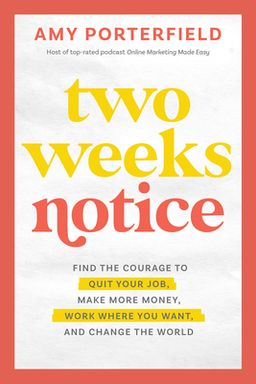
Two Weeks Notice cover

Two Weeks Notice

by Amy Porterfield

Two Weeks Notice is a powerful guide for aspiring entrepreneurs. Amy Porterfield shares her journey from corporate life to successful online business owner, providing practical steps to achieve financial freedom, creative fulfillment, and the lifestyle of your dreams.

Finding the Courage to Quit and Create Freedom

Have you ever felt a deep, nagging sense that you were made for more—but couldn’t quite imagine what “more” looked like? In Two Weeks Notice: Find the Courage to Quit Your Job, Make More Money, Work Where You Want and Change the World, Amy Porterfield argues that professional fulfillment, freedom, and financial independence are not privileges reserved for a select few—they are attainable for anyone willing to take the leap and become their own boss. She contends that modern work culture, with its glass ceilings, burnout, and conformity, traps individuals—especially women—into chasing someone else’s dream. The antidote, Porterfield insists, is entrepreneurship on your own terms.

Through her signature mix of practical strategy and vulnerability, Porterfield invites readers to “unboss” themselves—to transition from employee to entrepreneur. Yet this shift isn’t just about careers; it’s about reclaiming agency over your life. Her premise rests on what she calls the three pillars of freedom: financial freedom, lifestyle freedom, and creative freedom. These are the very ideals that inspired her own transformation—from a corporate marketer at Tony Robbins’s organization to the founder of an eight-figure online business.

The Moment of Awakening

Porterfield describes her turning point vividly. Sitting in a boardroom surrounded by male entrepreneurs, she heard one word echo repeatedly: freedom. These men described working where they wanted, how they wanted, and making money while doing what they loved. That meeting awakened something within her—a realization that she was following a script written by others. This moment of “unbossing” began with a painful awareness: she wasn’t free. Over the ensuing years, she pieced together the blueprint for freedom that this book now shares.

The Problem—and Why It’s Personal

Porterfield’s research highlights the systemic barriers that keep women stuck. Despite making up nearly half the global workforce, women hold only 6 percent of CEO positions and earn 82 cents for every dollar men make (and less for women of color). These aren’t just statistics; they’re evidence of a recurring reality—one that fosters self-doubt, undervaluation, and exhaustion. By blending data with candid storytelling, Porterfield speaks directly to women who feel trapped between gratitude for stability and frustration at unfulfilled potential.

From Fear to Clarity: The Blueprint

The book lays out a step-by-step roadmap for turning the daydream of “someday” into today’s actionable journey. Porterfield covers practical milestones—from deciding on an exit date, designing a runway plan, and selecting a business idea to building an email list, making content, and earning revenue through coaching, services, or digital courses. But she insists that mindset drives everything. Without tackling self-doubt and fear of failure, strategy alone is meaningless. “Courage,” she writes, “is what gets you moving. Confidence is what keeps you going.” That thread of mindset mastery runs through every chapter.

Making it Relatable: From Corporate to Calling

Porterfield’s own missteps make her lessons accessible. She recounts hiding under her desk to learn from another entrepreneur, handing out ill-designed metallic business cards that looked like condom wrappers, and crying through failures that eventually taught resilience. The humor and humility humanize her success. Unlike lofty business manuals that focus on abstract strategy, Two Weeks Notice is grounded in personal trial—and triumph.

Why This Matters Now

In an era defined by instability, layoffs, and burnout, more people are reimagining work itself. Porterfield’s book serves as both how-to guide and comfort manual for anyone feeling the pull to leave the cubicle. Drawing influence from Marie Forleo’s Everything Is Figureoutable and Mel Robbins’s The 5 Second Rule, Porterfield positions courage as the new currency of success. Entrepreneurship, she argues, isn’t just about income—it’s about impact: creating a life imbued with meaning, flexibility, and contribution.

The Promise of Freedom

Ultimately, Two Weeks Notice promises transformation. It invites readers to own their time and rewrite the story of work. If you’ve ever felt undervalued, anxious to change, or secretly certain you’re “meant for more,” Porterfield’s message is clear: you can design a business—and a life—by your own design. Her voice, equal parts coach and confidante, walks beside you through fear, logistics, and self-belief until you can whisper your own “I quit”—not just to your job, but to self-doubt itself.


Decision Time: Building the Courage to Leave

At the heart of Porterfield’s journey lies an act of courage: deciding it’s time to leave. The first major obstacle isn’t logistics—it’s permission. Chapter one of Two Weeks Notice unveils the emotional pivot from fear toward freedom through relatable stories of women on the brink of change.

The ‘Nudge from the Universe’

For Porterfield, the moment came after being told by a superior, “You are not a marketer.” Though meant in frustration, she internalized it as “You’ll never make it on your own.” Instead of retreating, she framed the insult as a cosmic nudge, doubling down on her exit plan. Similarly, her students experienced their own awakenings: Janine set an exit date after a canceled project negated months of sacrifice; Anne founded a business after losing her corporate job. Each story reaffirms a truth—discomfort catalyzes transformation.

Choosing “Why” Over Worry

Porterfield emphasizes that behind every leap is a personal why. For her, it was as simple—and selfish—as “I never want anyone to tell me what to do again.” Your why doesn’t need to sound noble or world-changing. It simply needs to be honest enough to keep you anchored when fear floods in. She encourages readers to write down what they’re sick of, what they crave, and what freedom means to them. Identifying your why transforms wishful thinking into commitment.

“Saying yes doesn’t mean you won’t have doubts,” Porterfield reminds. “It means you believe in yourself just a little bit more than you don’t.”

Addressing Common Fears

From fear of financial insecurity to imposter syndrome, Porterfield normalizes the mental chaos that accompanies major change. Rather than dismissing these fears, she reframes them. For example, fear of failure isn’t proof you’re unready—it’s evidence you care. She lists common concerns (“What if I fail? What if people judge me? What if the bills don’t get paid?”) and provides grounded responses. The remedy? Prepare a “runway”—a practical cushion before your leap (akin to Sheryl Sandberg’s idea of “leaning in” while planning smart exits).

Security vs. Freedom

Security feels comfortable, but Porterfield argues it’s the great illusion. “Better the devil you know than the devil you don’t,” she jokes, then counters: “The devil you know is still the devil.” True freedom requires discomfort. She likens risk to necessary turbulence while flying to somewhere better. As she discovered at Tony Robbins’s company, real growth never happens from safety—it thrives on uncertainty. Porterfield insists that “freedom comes with risks—but it’s worth every ounce of fear.”

The Dirty Dancing Analogy

One of the most charming metaphors in this chapter comes from pop culture. Porterfield likens herself to Johnny in Dirty Dancing—the one who pulls “Baby” out of the corner. She envisions herself standing beside readers who are still tentatively clutching safety, inviting them to the spotlight. The metaphor highlights that courage isn’t solitary—it’s contagious. Once you stand up and declare your decision, momentum makes the rest inevitable. Deciding you’re ready may not erase fear, but it sets your destiny in motion.


Unbossing: Planning Your Leap and Navigating People

Leaving a job doesn’t mean burning bridges—it means executing a clear, empowering exit plan. Porterfield’s second major concept, Unbossing, captures both heart and logistics: choosing your date, building your runway, communicating with loved ones, and formally giving notice. This process transforms abstract desire into concrete momentum.

Choose a Date and Make It Real

Porterfield’s mantra is simple: “It’s not real until it’s scheduled.” She recalls writing her quit date—June 19, 2009—on a sticky note and placing it on her mirror. Each morning it reminded her she was building toward freedom. She argues that the act of scheduling signals commitment not only to yourself but to the universe. Opportunities begin to align once a date exists. Setting an exit date kills indecision, the silent dream killer.

Building Your Runway

Porterfield defines a “runway” as the practical groundwork you lay before quitting. Steps include defining your business idea, setting financial expectations, crafting early content, and creating a workspace at home. Importantly, she advises against distractions such as designing business cards or elaborate websites too soon—these are pleasant forms of procrastination. Focus on substance, not surface.

Navigating Relationships

Few parts of leaving are more emotional than telling others. Porterfield offers scripts for having honest conversations with spouses, friends, and even skeptics. Her advice is strategic: tell only those who will support your vision at first. Naysayers, she says, “don’t get to know yet.” This approach protects fragile dreams from premature judgment. She also redefines support—your partner’s approval is nice, but unnecessary. You are accountable to your freedom, not others’ fears.

Giving Notice with Grace

When the moment arrives, quit professionally. Plan your conversations, give reasonable notice (two to four weeks), avoid oversharing, and leave gracefully. Porterfield herself called Tony Robbins directly to resign—a terrifying act she completed with shaking hands. “You’ll never be completely ready,” she writes. “You just have to get it done anyway.” Her practical wisdom mirrors Brené Brown’s philosophy: vulnerability and courage often coexist in messy imperfection.

Your Runway Checklist

  • Declare your exit date and post it visibly.
  • Draft a simple financial plan and temporary income path.
  • Define your starter business idea.
  • Create basic content that introduces your future brand.
  • Designate a home workspace, no matter how humble.
  • Tell three supportive people who will hold you accountable.

With clarity, compassion, and structure, “unbossing” becomes less reckless and more like a rite of passage—a deliberate reclaiming of your time, voice, and power.


Getting Down to Business: Systems That Sustain Success

Once you’ve left, the hardest part begins—showing up every day without a boss hovering over you. In Getting Down to Business, Porterfield reveals the daily disciplines that separate flourishing entrepreneurs from frustrated freelancers. This chapter is about creating boundaries, protecting time, and finding accountability.

Non-Negotiables: Guardrails for Freedom

Boundaries, Porterfield explains, are the backbone of self-leadership. Without them, freedom curdles into burnout. She recommends writing “non-negotiables”—personal rules aligned with your values. For instance, she refuses to schedule afternoon meetings because her priority is her marriage (“Hobie is my priority”). Other examples include quitting work at 5 P.M. and avoiding mindless scrolling. These commitments form the foundation of sustainable success.

Tiger Time: Fiercely Protecting Focus

Every entrepreneur battles distraction. Porterfield’s antidote is Tiger Time—a ritual where you fiercely guard blocks of focused work, particularly for creative tasks. For her, Tiger Time meant dedicating mornings exclusively to content creation. She cites Shonda Rhimes’s quote: “Dreams don’t come true just because you dream them. It’s hard work that creates change.” Tiger Time operationalizes that idea.

Creating a Workspace That Works

Working from home sounds heavenly until you find yourself juggling laundry and deadlines simultaneously. Porterfield teaches readers to create environments of focus—doors that close, phones that silence, atmospheres that inspire. Whether it’s a corner desk or co-working space, physical separation creates psychological strength.

Accountability Partners

Motivation fades; accountability sustains. Porterfield encourages forming partnerships with peers who check in weekly or quarterly. She credits her own success to mastermind groups and daily text check-ins with fellow entrepreneurs. In her words, “Don’t wait for support to find you—go find it.” Her husband’s advice rings through this message: “Let me believe in you until you’re ready to believe in yourself.” This chapter marks the transition from dreamer to disciplined doer—where structure becomes the real secret to freedom.


Dial In Your 'You' Factor: Discovering Your Business Idea

Once the logistics are in place, what exactly will your business be? Porterfield introduces the concept of the “You Factor”—that unique mix of skills, experience, and enthusiasm that sets your business apart. The key isn’t originality; it’s authenticity. As Mark Twain famously said (and Porterfield quotes), “There is no such thing as a new idea.”

Finding Your Sweet Spot

Porterfield distills idea generation into four intersecting categories, forming what she calls “the sweet spot test”: your 10% edge (what you know a bit better than others), your audience’s struggles, your potential for profit, and what lights you up. If all four overlap, you’ve found your sweet spot. For example, one student’s 10% edge in YouTube monetization became a six-figure course teaching others how to earn ad revenue with minimal subscribers.

No Idea Is Too Simple

Porterfield cautions against perfection paralysis—the myth that your idea must be grand or save the world. From potty-training programs to tap-dance training, she shares dozens of examples proving that viable ideas often emerge from everyday expertise. What matters most is alignment. When your business feels like you, resilience follows.

Authenticity Beats Comparison

Her advice to new entrepreneurs facing crowded markets is simple: wear blinders like Seabiscuit. Focus on your lane; comparison corrodes creativity. She urges readers to believe in abundance—there’s room for everyone. Courage, not confidence, fuels originality. As Mel Robbins suggests, “Confidence is built through acts of everyday courage.” Porterfield echoes this: courage creates momentum; confidence arrives as proof.

Making the Leap from Idea to Action

After identifying your sweet spot, Porterfield guides readers through brainstorming, validation calls, and framing early offers. Her technique, the “Post-It Party,” transforms scattered ideas into tangible frameworks. The key is movement over mastery. Don’t wait until confident—start courageous. This chapter’s message is liberating: your business doesn’t need to be revolutionary; it just needs to be you.


You Ain’t for Everyone, Boo: Defining Your Audience

In one of the book’s most practical sections, Porterfield describes the importance of identifying your ideal customer, affectionately dubbed the Ideal Customer Avatar. “You ain’t for everyone, boo,” came her friend Jasmine Star’s advice after critics attacked a social media post. Porterfield took it as an epiphany: to scale impact, you must narrow focus.

Zooming In, Not Out

Trying to please everyone leads to diluted messages. Porterfield uses real case studies, like Millie, an ESL teacher whose resources failed to gain traction until she focused solely on middle school educators. The result? A 10,000% growth in her email list and 80% open rates. Specificity creates resonance; broadness breeds invisibility.

Bringing the Avatar to Life

The Ideal Customer Avatar isn’t an abstract persona but a vivid story. Porterfield even shares her own: “Dana,” a 39-year-old nurse and single mom yearning for entrepreneurial freedom. She includes demographic details, emotional struggles, and desires. Writing Dana’s story helped her team tailor every word of marketing to a single heartbeat—a practice similar to Donald Miller’s “StoryBrand” framework.

Inclusivity Within Specificity

Porterfield warns against allowing specificity to become exclusionary. A business can intentionally serve a core audience while remaining inclusive in language, imagery, and access. She applauds brands like Thinx, which evolved from “for women with periods” to “for people with periods.” This shift models conscious entrepreneurship rooted in compassion.

Validating with Real Conversations

To confirm your avatar’s needs, Porterfield recommends validation calls—short interviews to hear potential clients’ real struggles. These conversations yield priceless market language and empathy. Perfect is unnecessary; connection is everything. As Brooke Castillo advises, “B-minus work can change lives; unpublished perfection helps no one.” Porterfield’s approach helps you find your “who” and serve them wholeheartedly.


Content Is Queen: Building Trust Through Generosity

Porterfield’s mantra is legendary among her students: Content is queen. She argues that consistent, high-value content is the cornerstone of trust and credibility. Whether delivered through blogs, podcasts, or videos, free content builds relationships long before sales close. Her own eight-figure business was built on this principle.

Pick a Platform

You don’t need to be everywhere. Choose one channel—blog, podcast, or video—and master it. Porterfield’s own pivot to weekly podcasting tripled her profits. She cites data showing audiences connect profoundly with consistent voices they trust. Frequency breeds familiarity, and familiarity breeds loyalty. Consistency over complexity is her golden rule.

Serve Before You Sell

Rather than hoarding your best ideas for paid products, give generously. “If she gives away this much for free,” Porterfield jokes about audience psychology, “imagine her paid stuff!” Free content introduces transformation; paid content completes it. Her distinction echoes Seth Godin’s belief that “generosity is marketing.”

Batch Creation and Repurposing

To avoid overwhelm, Porterfield teaches “batching”—creating content in focused blocks. For example, she records a month of podcasts in one day. Later, she repurposes transcripts as blog posts, quotes, and social clips. This simple system maximizes impact while minimizing fatigue. It’s time management in action.

From Consistency to Community

Ultimately, the queen’s crown is trust. Weekly content keeps you top of mind, establishes expertise, and creates emotional connection. Porterfield reminds readers that content is conversation, not performance: “You’re not creating to impress—you’re creating to connect.” Mastering this mindset turns casual followers into raving fans and lifelong customers.

Dig Deeper

Get personalized prompts to apply these lessons to your life and deepen your understanding.

Go Deeper

Get the Full Experience

Download Insight Books for AI-powered reflections, quizzes, and more.