
Idea 1
Leading from Being: Transforming Business Through Ancient Wisdom
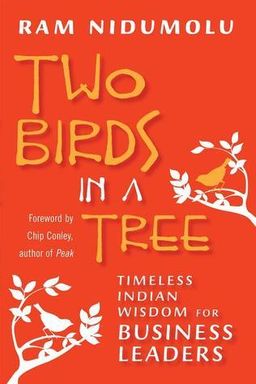
What if leadership had less to do with acquiring power or profit—and more to do with awakening your deepest sense of humanity and connection to life itself? In Two Birds in a Tree: Timeless Indian Wisdom for Business Leaders, Ram Nidumolu challenges the traditional understanding of leadership rooted in relentless doing and possessing. He argues that true transformation—in life and in business—comes when leaders reorient themselves from the narrow lens of the ego to the spacious awareness of Being. This shift, he claims, is the essence of what he calls "Being-centered leadership."
At the heart of his argument is a metaphor from the ancient Indian Upanishads: two birds living on the same tree. One—the lower bird—is restless, anxious, and forever pecking at the fruits around it, alternating between sweet and bitter tastes. The other—the higher bird—is serene and watchful, observing from above, radiant in golden stillness. These two birds represent the dual nature within every leader: the striving ego and the serene self. The journey of leadership, Nidumolu proposes, is to help the lower bird rise toward the higher one by reconnecting business, and oneself, to the larger contexts of nature, humanity, and integrity.
Why Business Needs a New Consciousness
According to Nidumolu, global business as we know it stands at a crossroads. While industrial enterprise has historically improved material living standards, its unchecked drive for short-term growth has degraded ecosystems, widened inequality, and eroded trust in institutions. He reminds the reader of alarming statistics: humanity has entered the Anthropocene era, with species extinction accelerating and climate disruption threatening civilization. Yet most leaders continue operating in what he calls a “closed model of capitalism,” asking only how to outperform competitors within narrow boundaries of profit or market share.
What’s missing, he suggests, is the rediscovery of Being—the timeless essence that all life shares. This concept, central to Indian philosophy and echoed by thinkers like Heidegger and Maslow in the West, transcends religion. It’s the awareness of life’s interconnected fabric, the realization that the same consciousness underlies our self, others, nature, and the world. Without acknowledging this deeper reality, business remains fragmented, functional—but soulless.
From Analysis to Inspiration
Nidumolu writes not as a mystic removed from corporate life but as someone steeped in business analysis. A former professor and sustainability consultant for Fortune 500 firms, he confesses that data-driven prescriptions have failed to move hearts. Statistics create awareness but rarely inspire transformation. Stories, however, penetrate emotions and ignite genuine change. This is why he turns repeatedly to allegories—like the two birds—to illustrate the leadership journey as a movement from human doing to human being.
“Real change does not happen through reason-driven analysis,” Nidumolu notes, “but through emotion-driven stories that awaken something deeper.”
For leaders trapped in burnout or disillusionment, this message resonates personally. The author invites you to see leadership not as managing outputs but as cultivating awareness—where decisions arise from alignment with purpose and empathy rather than fear or greed. He reminds us that leadership is not only about external results but also about inner evolution: transforming the mind-set, identity, and beliefs that drive business actions.
The Path of Being-Centered Leadership
The book unfolds through ancient wisdom and modern case studies, from Anita Roddick of The Body Shop to Indra Nooyi at PepsiCo, Ray Anderson at Interface, and Azim Premji at Wipro. Across these stories, Nidumolu traces the qualities of Being-centered leaders: they operate with humility, courage, and long-term vision; they align business success with stewardship of people and planet; and they view leadership as service.
He structures this universal journey in his REAL road map—four stages guiding every leader’s evolution toward Being:
- Recognize the higher reality: awaken to the timeless context beyond profits—the web of humanity and nature.
- Experience this recognition through deep reflection and direct encounters that shape consciousness.
- Anchor in this awareness so it guides decisions and resists the storms of competition or fear.
- Lead by example by embodying authenticity, inclusion, stewardship, and wisdom.
Throughout, Nidumolu bridges philosophy and practicality. He cites research—like Harvard’s study of sustainable companies outperforming others—to show that Being-centered businesses are not only more ethical but also more profitable over time. This isn't spirituality as retreat; it's spirituality as competitive advantage through inner clarity and connectedness.
Why These Ideas Matter Today
In an era marked by political polarization, environmental collapse, and soulless work cultures, Two Birds in a Tree offers a humanistic antidote. It reframes capitalism as a system that can heal rather than harm. Nidumolu’s call is not anti-profit but pro-purpose: to integrate growth with goodness, results with responsibility. Much like E.F. Schumacher’s Small Is Beautiful or John Mackey’s Conscious Capitalism, this book invites you to reconsider what success means—to serve rather than dominate, to harmonize rather than exploit.
When you lead from Being, you operate from a deeper source. You measure success through long-term well-being, sustained delight across stakeholders, and alignment with what Nidumolu calls “the higher bird” within you. Ultimately, his question is both practical and existential: Will business remain an anxious pecking bird destroying its own tree—or can leaders rise to the view from above where fear dissolves into compassion and enterprise becomes a force for renewal?
The answer, he suggests, lies within you. Every decision, every connection, every act of awareness can help you rise toward that higher perch—to see the world whole, to lead with wisdom, and to rediscover that business, at its best, is a spiritual practice of Being in action.