
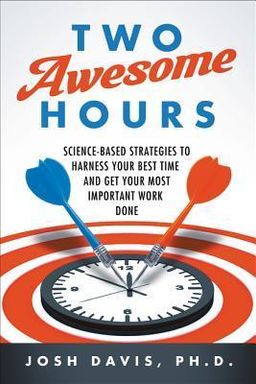
Two Awesome Hours cover

Two Awesome Hours

by Josh Davis

In ''Two Awesome Hours,'' Josh Davis unveils science-based strategies to reclaim productivity in a distraction-filled world. Learn to harness mental energy, optimize your work environment, and embrace strategic distractions for effective work, all within 120 minutes.

Working With Your Biology for True Productivity

Have you ever had a day when you worked non-stop—answering emails, slogging through meetings, checking off tasks—yet finished feeling drained and strangely unaccomplished? In Two Awesome Hours, Josh Davis, Ph.D., offers a revolutionary perspective on productivity: it’s not about doing more, but about creating the conditions for peak effectiveness. He argues that our obsession with efficiency—the idea that we can squeeze value from every minute—is misguided because we’re treating ourselves like machines. Humans aren’t built for continuous output; we’re biological systems that fluctuate with mental energy, emotion, and environment. Instead of trying to fill every hour, Davis contends we can accomplish far more by setting up two hours each day for our minds to operate in top form.

Davis draws from neuroscience, psychology, and real-world examples to explain why working against our biology backfires—and how working with it can transform our results. He shows that laser focus, creativity, and intelligent decision-making arise when specific conditions align: when we understand our decision points, manage mental energy wisely, stop fighting distractions, leverage the link between mind and body, and shape our workspace to help our brains function optimally. These five deceptively simple strategies form the backbone of the book, but each one rests on science about how your brain processes fatigue, emotion, attention, and environmental cues.

The Efficiency Trap

Early in the book, Davis explores why traditional approaches to time management fail. From Benjamin Franklin to modern executives, we’ve celebrated relentless busyness as the mark of success. Yet Franklin’s true genius wasn’t constant work—he took long lunches, socialized, mused, and invented between projects. The secret wasn’t his efficiency; it was his ability to create mental conditions for breakthroughs. Davis calls our pursuit of nonstop productivity the “efficiency trap.” Staying on task longer or cramming more hours only depletes the biological systems we depend on for performance. The very effort to be always efficient undermines the creativity, focus, and strategic thinking that make work meaningful.

Instead, Davis proposes optimizing for effectiveness. The brain, like a muscle, delivers bursts of strength and clarity when treated right. Trying to keep it running full-speed all day is futile. But if you intentionally craft periods—say, two hours—of high mental readiness, you can accomplish what normally takes an entire day. Those two hours are when you tackle the decisions, problems, and creative leaps that truly move your work forward. The rest of the day, Davis explains, is fine for lower-stakes tasks: answering email, signing paperwork, scheduling travel, or routine collaboration. When you stop demanding constant high performance and instead build around these “awesome hours,” the paradox is that you end up producing more of what matters.

The Science Behind the Approach

What makes the “two awesome hours” approach convincing is that it’s grounded in how attention, energy, and emotion actually work. Davis introduces concepts like “embodied cognition”—the idea that our bodies and minds are inseparable. Your posture, movement, breathing, and even lighting influence mental control. Feeling sluggish isn’t just laziness; it’s biology. Similarly, he explains that attention isn't a spotlight that can stay locked forever—it’s a scanning system built to refresh. So when you lose focus, you’re not failing; your brain is doing its job.

Throughout the book, Davis pairs scientific clarity with relatable stories. A tired CFO named Samantha, for example, can’t get work done in her noisy open office until she learns to reshape her environment—clearing clutter, adjusting lighting, and scheduling quiet time. A marketing director named Tom risks tanking a big presentation because he spent the morning draining his mental energy on small decisions. And Amanda, a freelance designer, learns that letting her mind wander (rather than fighting distraction) sparks creativity. Each story becomes a mirror for the reader: we see our own daily routines and realize how often our biology sabotages our intentions.

Why This Matters Today

We live in a culture that glorifies endurance—being always online, always responsive, always busy. Davis’s book reminds you that professional mastery isn’t about constant activity but strategic renewal. The modern workplace taxes the brain with nonstop switching, emotional regulation, and physical stillness. By creating conditions for true attentional focus and energy, you can produce elite performance without burnout. The lessons of Two Awesome Hours aren’t just about work; they touch every part of life. Managing energy instead of time helps you reclaim mental clarity for creativity, decision-making, and relationships. It gives back the freedom Franklin enjoyed—the space for invention and inspiration amid achievement.

Across the next key ideas, you’ll explore each strategy in depth: how to recognize decision points, manage mental energy, stop fighting distractions, use the body to sharpen the mind, and make your workspace support your thinking. Davis’s message is empowering and practical: you don’t need an overhaul of your schedule—just two hours when everything works together perfectly. Those hours, properly designed, are enough to change the trajectory of your day, your work, and even your life.


Recognize Your Decision Points

Davis begins his first strategy with a simple insight that feels radical once you notice it: every day contains a few fleeting moments when you can choose your next task consciously. He calls these “decision points”—the small windows between activities when your mind pauses, becomes self-aware, and can redirect your attention. Missing these moments keeps you trapped in automatic mode, jumping reflexively from email to message to meeting without considering what truly matters. Recognizing decision points is about reclaiming agency over your attention.

Why We Run on Autopilot

Most of your day, Davis explains, unfolds through “neural routines.” You start checking email, and your brain enters an automatic loop—one reply triggers the next. Like a computer program, you run the habit until something interrupts it. This automaticity saves energy, but it also blinds you to better choices. A consultant named Doug illustrates this perfectly: he tries to finish one important email before meeting his CEO, but gets lost in smaller messages until the clock forces him to run late and unprepared. What Doug needed wasn’t more discipline—it was awareness of the decision point that appeared when his morning task ended.

How Decision Points Work

From a neuroscience standpoint, decision points arise when competing mental routines trigger conflict. Your brain’s anterior cingulate cortex acts like an alarm, waking you from the trance of routine to ask, “What should I do next?” That self-awareness feels uncomfortable—like guilt, indecision, or anxiety—which is why most people rush through it. But those few seconds are precious. Pausing during them lets you connect with your deeper priorities instead of reacting to urgency. Davis compares this to creating “psychological distance.” When you pull back for even sixty seconds, you start seeing the big picture instead of the shiny problem in front of you.

“Hurrying through moments of choice might save five minutes; choosing wrongly can waste hours.”

This line captures Davis’s point elegantly. You trade small feelings of efficiency for large losses of meaning and output.

Making Decision Points Intentional

Davis suggests savoring these moments rather than avoiding them. When a task ends—when you hang up a call or close a document—acknowledge to yourself: “This is a decision point.” Move slightly, drink some water, breathe deeply. That brief reset distances you from the momentum of the previous routine and opens space for conscious choice. He also encourages “planned decision points”—preparing in advance for likely interruptions. If you know that colleagues will often pop in “for a quick question,” decide ahead of time how you’ll use those interruptions to reevaluate what’s worth doing next instead of reacting. Psychologists call this tactic an “implementation intention”: planning what to do if a specific cue appears.

Practical Example

Imagine your phone buzzes during focused work. Instead of opening the message immediately, you pause, take a breath, and ask, “Is this right for me right now?” That two-second question may save you from an hour of low-value distraction. Even scheduling small rituals—like closing your laptop between projects or walking around your desk—can act as reminders that you’re entering a new decision point. The key is embracing the discomfort of the pause; it’s the sign that consciousness has returned.

(Note: This idea mirrors the mindfulness principle popularized by Jon Kabat-Zinn and echoed by Cal Newport in Deep Work—that intentional awareness between tasks restores focus. Davis’s innovation is that you only need a few such moments each day to transform your productivity.)


Manage Your Mental Energy

Mental energy is your fuel for focus and decision-making, and Davis insists that it’s finite. Every choice, inhibition, and emotional reaction drains the brain’s “executive functions.” Strategy 2 shows how to allocate this fuel wisely—using insight from neuroscience about mental fatigue and emotional regulation—to ensure your high-demand tasks coincide with high-energy moments.

Mental Fatigue and Decision Depletion

Davis illustrates fatigue through Tom, a marketing director preparing a pitch. Instead of brainstorming first, Tom answers his inbox for ninety minutes, making dozens of small social decisions. By the time he finally turns to his creative ideas, his brain’s decision-making capacity is spent. Research supports this effect: making choices—even trivial ones—temporarily depletes self-control and persistence. Like muscles, neural circuits tire from effort. The remedy? Sequence your day to protect high-energy times for creative or analytical challenges, and push low-stakes decisions (like scheduling or emails) to later.

The Power of Emotion

Energy isn’t only drained by cognitive load; it’s shaped by emotion. Fascinatingly, Davis shows that negative feelings such as anger, sadness, and anxiety aren’t always bad. Anger can drive assertive, risk-taking action when fear holds you back; sadness promotes cautious, fair decision-making; and anxiety heightens alertness before high-stakes performance. Even Beyoncé admits she performs better when nervous, because anxiety primes focus. The lesson is not to suppress emotion but to use it strategically. Feel angry? Channel it toward courage. Feeling cheerful? Use it for creativity.

“The right mental energy for the right task matters more than constant motivation.”

You don’t need to be positive all day—you just need to align tasks with your emotional state.

Techniques for Managing the Tank

Davis gives practical methods for avoiding or restoring mental depletion: breathe slowly for physiological calm, laugh to regain positivity, or nap briefly (ten minutes is ideal—longer breaks may cause grogginess). He suggests scheduling creative work early, before hundreds of micro-decisions consume your willpower. Break news or emotionally charged media habits before big tasks, since they trigger self-control expenditure. He also introduces “strategic incompetence”—the bold decision to deliberately let some less important obligations slide. Saying no to peripheral tasks preserves the capacity for what truly matters.

Ultimately, managing mental energy reframes productivity as emotional and biological management rather than scheduling. It’s not about having enough hours; it’s about arranging your mental terrain so your best thinking happens when you choose.


Stop Fighting Distractions

If mental energy is your fuel, attention is your steering wheel. In Strategy 3, Davis dismantles the myth of sustained focus. Your brain is not built like a floodlight that can be locked in place—it’s a restless radar scanning for change. Fighting distractions with willpower fails because you’re battling biology. Instead, learn to direct and even embrace your wandering mind.

The Evolution of Attention

Our ancestors survived by noticing novelty: sudden sounds, movement, danger. That same evolutionary mechanism now responds to buzzing phones and flashing notifications. The brain habituates quickly—after a few minutes of reading a report, it’s programmed to look for new stimuli. So when we chastise ourselves for losing focus, we’re misunderstanding function. Neuroscience shows that trying to suppress thoughts (“Don’t think about a polar bear!”) only reinforces them by activating the neural networks associated with the forbidden idea. Attention fights are unwinnable.

Removing Predictable Distractions

Since willpower doesn’t help, Davis advises environmental control: turn off email notifications, silence phones, use noise-cancelling headphones, and close your door or reserve quiet rooms. He calls this avoiding “booby traps”—devices and setups that constantly trigger your attention system. Even meditation practice helps endurance; seasoned meditators outperform others in sustained attention tests. But external control only goes so far.

The Paradox: Let Your Mind Wander

Mind wandering isn’t failure—it’s essential. Studies from UC Santa Barbara reveal that breaks of easy cognitive tasks lead to creative insight. When your mind drifts, it subconsciously recombines ideas and solves problems. Participants who daydreamed performed better on repeated creativity tasks than those who stayed focused or did nothing. Wandering also aids planning; when thoughts drift, they often return to future goals. Davis likens this to a stagehand rebuilding your set while a sideshow plays—when you come back, the main stage is ready with new brilliance.

“Focus is not the absence of distraction—it’s the skill of returning.”

Letting your thoughts drift calmly and then re-centering attention creates resilience, not weakness.

Mindful Attention

Borrowing from mindfulness, Davis recommends noticing distractions without judgment. When your mind wanders, observe it like a surfer watching waves—accept most waves and wait for the right one to ride. After a few minutes, your brain naturally resets and you’ll feel ready to dive back in. This practical self-compassion differentiates meaningful daydreaming from procrastination. If you stop seeing distraction as moral failure, you’ll find yourself calmer, clearer, and paradoxically more focused.

The result: better creativity, less frustration, and sustainable attention. The best scholars, artists, and thinkers—from Einstein to modern designers—have used structured daydreaming as fuel for insight. Davis makes that technique scientifically mainstream.


Leverage Your Mind–Body Connection

In Strategy 4, Davis tackles how physical actions directly influence mental states—a concept known as the mind–body connection. You don’t just think with your brain; you think with your whole physiology. The way you move, breathe, eat, and hydrate all affect clarity, confidence, and emotional control. By tweaking these factors, you can transform sluggish afternoons into periods of peak cognition.

Movement Creates Clarity

Exercise, Davis explains, works like pressing a mental reset button. Even ten to forty minutes of moderate movement increases self-control and executive function. He cites studies where exercising before decision-heavy tests improved performance and emotional calm. Walking or light jogging sharpens attention, helps inhibit unhelpful reactions, and boosts focus for hours. Nelson Mandela’s habit of running in place during imprisonment showed how movement sustains thinking. The lesson: physical energy replenishes mental energy immediately, not just in the long term.

Food and Drink as Cognitive Tools

Nutrition also alters cognition within hours. High-carb meals can briefly improve attention but crash later; protein boosts memory; healthy fats sustain brain performance. Low glycemic foods—like fruits, vegetables, and lean proteins—stabilize blood sugar for balanced moods and better focus. Water is equally vital: even mild dehydration reduces attention and increases irritability. Davis advises smaller, more frequent meals and regular hydration. Caffeine, if used smartly, can heighten alertness—but oversized doses provoke anxiety. Pairing caffeine with protein or fat (coffee with cream, yogurt drinks) maintains positive effects longer.

“Your emotions often reflect your chemistry more than your character.”

Manipulating physical inputs—exercise, food, hydration—lets you shape emotional readiness for performance.

Practical Strategies

To apply this idea, Davis suggests simple rules: exercise before cognitively demanding work or stressful meetings; eat light, nutrient-balanced meals; hydrate every couple of hours; and stick to moderate, not heroic, caffeine intake. Even adopting “power poses”—expansive physical stances—can trigger hormonal changes that boost leadership confidence. His approach resonates with research by Amy Cuddy (Presence) and others linking posture to psychology.

The takeaway: your body is not peripheral to your productivity—it’s the engine. Treating the body as a thinking partner brings immediate and measurable improvements to performance. You can literally move your way into better ideas.


Make Your Workspace Work for You

The final strategy draws everything together: your environment shapes how your brain performs. Light, noise, clutter, and movement patterns affect concentration, creativity, and confidence. Davis combines scientific research on environmental psychology with practical hacks to transform ordinary workspaces into cognitive performance zones.

Noise and Focus

The most damaging distraction, Davis notes, is “intermittent speech”—snippets of conversation you can partially understand. It’s more disruptive than continuous noise or music because your brain tries to decode meaning from fragments. Meta-analyses show productivity drops significantly under such conditions. His solution: seek quiet whenever focus matters. Use noise-cancelling headphones, earplugs, or secluded rooms for deep work. Silence is better than white noise, though moderate ambient noise can support creativity—similar to the café buzz many people enjoy.

Lighting and Creativity

Light affects circadian rhythms and cognition. Bright, blue-enriched light—similar to daylight—raises alertness and self-control, while dim lighting encourages creative freedom by reducing perceived constraints. Davis encourages dynamic lighting: bright for analysis, soft for ideation. Even proximity to windows can improve vitality. This insight echoes studies in architecture and health psychology showing how physical space influences thought.

Clutter, Movement, and Restoration

A messy desk might symbolize creativity for some, but clutter usually hijacks attention by competing for mental space. Davis advises clearing your workspace before high-focus periods. Arrange tools to encourage expansive movement—reaching across your desk, stretching, standing, walking. Such postures raise testosterone and lower cortisol, increasing risk tolerance and leadership presence. Finally, he recommends personalizing with restorative elements like plants, artwork, or nature imagery. These subtle cues help replenish mental energy.

“Your environment is either priming you for focus or sabotaging it.”

Every detail of noise, light, posture, and clutter becomes a biological signal for the brain’s performance mode.

Applying Environmental Awareness

The example of Samantha, the overwhelmed CFO, illustrates this transformation. By reserving quiet rooms, clearing papers, and adding family photos and serene imagery, she balanced focus with calm. Davis closes by reminding readers that workspace design interlocks with every other strategy—it affects decision points, mental energy, attention, and even the feasibility of exercise breaks. By aligning surroundings with psychological needs, you create an environment that helps you have your two awesome hours every day.

Ultimately, making your workspace work for you isn’t decoration—it’s science in service of your best thinking.

Dig Deeper

Get personalized prompts to apply these lessons to your life and deepen your understanding.

Go Deeper

Get the Full Experience

Download Insight Books for AI-powered reflections, quizzes, and more.