
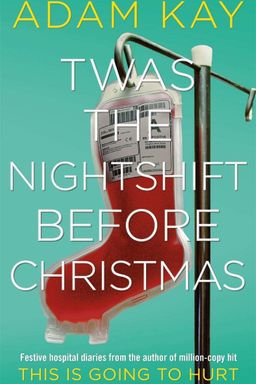
Twas The Nightshift Before Christmas cover

Twas The Nightshift Before Christmas

by Adam Kay

Twas The Nightshift Before Christmas by Adam Kay provides a hilarious yet poignant look at the extraordinary dedication of NHS staff during the festive season. Filled with bizarre tales and emotional insights, it honors the healthcare heroes who save lives while sacrificing their own holiday cheer.

Medicine, Christmas, and the Human Cost of Care

Have you ever wondered what happens behind hospital walls while the rest of the world is celebrating Christmas? In Twas the Nightshift Before Christmas, Adam Kay, former junior doctor and author of the bestselling This is Going to Hurt, invites you into the emotionally charged, chaotic, and surprisingly darkly funny world of festive medicine. Through his trademark diaries, Kay reveals not only the absurdity and exhaustion of working in the National Health Service (NHS) over the holidays but also the extraordinary resilience, humor, and heartbreak that define life on the medical front line.

At its heart, the book argues that working in medicine—especially during peak times like Christmas—is far from the public’s sanitized, heroic imagination. Instead, it is a profession of paradoxes: laughter amidst tragedy, compassion under duress, and festive cheer shadowed by mortality. Kay contends that society’s ritualized celebration of Christmas, with its promise of rest, excess, and family togetherness, throws the sacrifices of healthcare workers into sharp relief. For them, the season of goodwill is just another stretch of demanding shifts and sometimes absurd crises, albeit with tinsel in the corridors and pagers that don’t care about turkey dinners.

The Festive Battlefield of the NHS

Kay’s premise is built on firsthand experience: out of seven Christmases as a doctor, he worked six. His reflections on this cycle of sacrifice are searingly honest. From labor wards filled with mothers naming their babies Holly and Casper, to urology emergencies involving tinsel, gaffer tape, and misplaced DIY ambitions, the clinical becomes comically bizarre. Yet for every laugh, there’s a headline of quiet despair — patients dying on Christmas Day with Jingle Bells accidentally playing from a doctor’s tie, or lonely elderly people brought to hospital by relatives seeking a ‘granny dump’ before the festivities. The juxtaposition of dark humor and real human suffering creates an emotional chiaroscuro that defines Kay’s Christmas diary entries.

He shows that hospitals do not pause for sentiment or symbolism. Illness never observes holidays, and medicine’s duty of care extends through snowstorms and family dinners alike. With biting wit and empathy, Kay contrasts public narratives—of joy, rest, and family unity—with the hidden struggle of overworked NHS staff performing quiet acts of heroism. The result is a tragicomic portrait, anchored in absurd real-life cases that often seem more Dickensian than modern.

Faith, Humor, and Survival

Religion flickers in the background as an ironic motif: a Jewish doctor working Christmas after Christmas because everyone assumes he won’t mind. Kay leans into this role both comically and poignantly. His ‘Jewish enough’ identity—Jewish tree, no synagogue, selective diet of belief—becomes a metaphor for how doctors often negotiate personal cost through humor and compartmentalization. Festive shifts demand both emotional detachment and resilience; humor becomes not just survival but solidarity. When a consultant arrives at work in an inappropriate reindeer jumper mid-orgy pattern, or an obstetrician sews up a mother while brass bands massacre carols in the foyer, humor sustains pride and sanity.

Yet the humor never erases the heartbreak. Through small, crystalline moments—like discussing death with a frightened ninety-one-year-old or witnessing the ethical complexities of a life-saving termination—Kay exposes the emotional weight doctors quietly bear. His anecdotes mix laughter with lump-in-throat poignancy. And unlike the comforting sentimentality of holiday films, these are stories where ‘Merry Christmas’ might be whispered in an ICU or labouring mother’s room rather than around a tree.

Medicine as Mirror of Morality

Christmas becomes a cultural lens. For the general public, it highlights excess, family drama, and enforced joy. For doctors, it amplifies systemic injustice and moral fatigue. The NHS is depicted not as an institution but as a fragile ecosystem balancing compassion against burnout. Kay’s essays repeatedly return to one idea: these workers give up the very things the holiday stands for—connection, rest, presence—to preserve those things for others. In that sense, their labor embodies the spirit of Christmas more authentically than any carol could.

The book also argues for gratitude. In his ‘Alternative Christmas Message,’ Kay calls for a cultural ritual to recognize the half-million NHS staff who silently work while everyone else feasts. Whether through donating blood, sending thank-you cards, or simply refraining from sticking vegetables in orifices, he insists appreciation needs to be habitual, not seasonal. His plea is both comic and profound—a reminder that social health depends on visible thanks as much as invisible labor.

Why This Story Matters

More than a sequel to his first book, Twas the Nightshift Before Christmas distills the experience of care into one symbolic week of the year. It’s a meditation on work, exhaustion, and meaning. It reminds readers that vocation isn’t a romantic ideal but a costly commitment that demands humor, humanity, and, sometimes, heartbreak. By moonlighting as both comedian and confessor, Kay achieves something rare: turning the clinical into the universal. You don’t need to wear scrubs to recognize the weight of duty or the ache of being absent from life’s celebrations. In showing us what it costs to keep others alive and well, Kay expands what it means to care—not just during Christmas, but in every season of survival.


The Christmas Shift: Chaos, Comedy, and Compassion

Adam Kay begins his diaries with “Christmas is just another day for the NHS,” capturing how the festive myth of rest abruptly ends at ward doors. His first Christmas shift in 2004, a urology posting, foreshadows the absurd blend of tragedy and farce that runs through the book. It’s a space where patients roast their own limbs, insert tinsel where the sun doesn’t shine, and lonely families abandon relatives so they can party without guilt. Yet, amid these indignities, doctors like Kay keep doing the work—bleary-eyed, underpaid, and running on adrenaline disguised as goodwill.

The Festive Ward

Kay’s Christmas wards are grotesque and human all at once. Decorations droop, lights flicker, and staff move from resuscitations to labor rooms where babies named Holly or Caspar enter the world. His “patients” become Dickensian caricatures rendered with affection: the man dressed as a turkey who nearly desiccated himself in tin foil, or the octogenarian who wore a three-piece suit to emergency surgery “in case he needed mouth-to-mouth.” These snapshots show how life refuses to abide by the calendar—and how the medical profession carries on regardless.

Handling Death, Delivering Life

Christmas magnifies both birth and death. In one memorable scene, Kay delivers devastating news to a family as his novelty Rudolph tie bursts into tinny “Jingle Bells.” The absurdity becomes an accidental mercy—grief softened by ridiculousness. Later, on labor ward, joy and crisis collide: a mother nearly bleeds out from a ruptured ear artery, saved only by teamwork spanning specialties. Kay’s depiction of medicine’s range—from idiocy to heroics—feels cinematic because it is rooted in truth. He emphasizes the emotional skill required to move instantly between tragedy and laughter without collapsing under the weight of either.

The Price of Professional Compassion

Doctors, he notes, often measure reward in “a warm glow,” a kind of moral currency that can’t pay rent but keeps them functional. Over Christmas, that glow brightens even as it burns—partners left behind, sleep abandoned, families neglected. Only brief miracles punctuate the fatigue: a fellow doctor covers his bleep for an afternoon so Kay can see The Incredibles at the cinema. These small, humane exchanges replace the formal festivities society associates with goodwill. In Kay’s hands, they become salvation itself.

“The Force is strongest when working over Christmas,” Kay writes. Compassion becomes both a job description and a coping mechanism—a fragile superpower in a broken system.

By exposing the messy humanity under the NHS’s polished image, Kay helps readers see doctors not as saints or bureaucrats but as human beings navigating chaos with dark humor and weary grace.


When Humor Holds a Scalpel

Kay’s comedy isn’t decoration—it’s anesthesia. He wields humor as both blade and balm, dissecting the absurdities of hospital life while shielding himself from its emotional wounds. From crafting condom wreaths with nurses to unwrapping patients’ unfortunate uses of candy canes and peanut butter, his jokes expose two truths at once: medicine can be horrifying, and laughter is its most humane defense. Much like M*A*S*H or Samuel Shem’s The House of God, his humor isn’t cruelty—it’s catharsis.

Laughing Through Trauma

Kay’s tone oscillates between biting one-liners and quiet heartbreak. When faced with patients using Mars bar wrappers as condoms or inserting Christmas lights for pleasure, he doesn’t merely mock; he marvels at the creative intersection of biology and desperation. Humor becomes an ethical release valve for frontline workers who must see both the ridiculous and the tragic without collapsing under either. When he quips that “maybe there’s an easier way to deliver bad news,” he’s really addressing his own exhaustion—the need to find laughter in sorrow.

Absurdity as Armor

Across chapters, absurd encounters—like a man mummified in gaffer tape or patients allergic to their own peanut-lubricant experiments—highlight how chaos isn’t confined to the operating theater. For medical staff, humor replaces the armor they can’t afford to wear. It’s not that they take suffering lightly, but that laughter creates a thin, life-saving membrane between compassion and collapse. (Compare to Viktor Frankl’s Man’s Search for Meaning, where finding levity amid hardship becomes a form of spiritual defiance.)

The Cost of Suppressed Sincerity

Yet, when humor fails, the toll surfaces. After performing a traumatic surgical termination on a young woman to save her life, he describes feeling “haunted by what doctors aren’t told before they specialize.” His stoicism cracks; his jokes falter. The contrast between jokes about “vaginaphylaxis” and moments of raw remorse exposes how laughter conceals grief. By the book’s end, the reader realizes comedy doesn’t erase trauma—it merely grants the courage to keep going.

Through every punchline, Kay honors the paradox of the healer’s psyche: empathy sustained through irony, horror transcended by humor. It’s why his voice resonates with both medics and readers who will never step into an operating room.


Ethics, Empathy, and the Breaking Point

Between the jokes, Twas the Nightshift Before Christmas is a study in moral fatigue. Kay’s diaries chart how clinical detachment—essential in a profession marinated in crisis—gradually corrodes empathy. His 2008 and 2009 entries show the toll of continuous exposure to death, dysfunction, and ethical minefields. The stories aren’t framed as moral lessons but lived questions: How honest should you be with a dying patient? Should professional confidence override your emotional truth?

Facing Mortality Up Close

No passage cuts deeper than when a ninety-one-year-old patient quietly asks, “Am I dying?” Kay hesitates, lies, and spends the night hating himself for it. He recognizes too late that withholding truth was a failure of courage, not compassion. This admission marks a turning point in his self-awareness: beneath the bravado, the exhaustion has muted his integrity. The diary becomes less about obstetrics and more about emotional reckoning.

Systemic Dysfunction and Moral Injury

Kay’s critique of the NHS bureaucracy is pointed but never cynical. Bureaucratic absurdities—a twelve-hour shift legally defined as work whether you do thirteen or eleven hours—echo the moral injury common in public-service professions. Compassionate care becomes a privilege wrestled from financial restrictions and poor management. He describes being denied compassionate leave after a colleague’s bereavement and seeing empathy outsourced from policy to individuals. In such an environment, decency is no longer an institutional value—it’s personal rebellion.

He likens health secretaries to villains from Harry Potter—each new one “the worst since the last.” Behind the satire lies heartbreak: a system where overworked doctors oscillate between guilt and guiltlessness, trapped in loops of Rota Gods and patient emergencies.

Beyond Professional Armor

The deeper message is that medicine demands not superhuman stoicism but humility. When a seasoned consultant admits that breech deliveries still scare him after thirty years, Kay glimpses a model of honest vulnerability—the antidote to burnout. It’s not invincibility but honesty that keeps doctors human. Recognition replaces repression. And in a world obsessed with miracles, admitting fallibility becomes its own kind of grace.


Love, Loneliness, and the Life Left Behind

Running parallel to medical chaos is the private wreckage of relationships and identity. Medicine, Kay reveals, consumes more than hours—it devours intimacy. Partners wait at home, friends drift away, and Christmas becomes a symbol of absence. He jokes that charity work and rotas achieve the same end: either way, you’re missing dinner. But behind the wit, there’s a chronic ache for normalcy. His partner H eventually disappears from his life—a casualty of professional overcommitment.

The Doctor at the Doorstep of Isolation

Kay illustrates how the 80-hour work weeks create existential vertigo: returning home to an empty flat on Christmas night, microwaving stolen toast, pocketing the crumpled joke from a hospital cracker. He calls the ward his “work family,” but unlike real families, these bonds vanish when contracts change. Constant relocation between hospitals—each year a new postcode—turns belonging into a myth. His diaries read like dispatches from a witness protection program of the emotionally displaced.

Small Acts of Connection

Despite the loneliness, the narrative glows with micro-gestures of human connection: colleagues covering shifts, patients gifting thanks, midwives decorating wards with glove-balloons and speculum “reindeer.” These moments are Kay’s antidote to alienation. They remind both him and the reader that medicine, despite its institutional failures, is powered by individual kindness. Every laugh shared over tea in the mess is a rebellion against detachment.

When he finally admits missing the hospitals even after leaving medicine, it’s revealing. The job broke him, but it also gave him purpose. His longing isn’t masochism—it’s a recognition that hospitals, for all their pain, made him feel alive and useful. In that paradox lies the true emotional architecture of the book: love and loss coexisting like patient and doctor, each depending on the other for meaning.


A Call for Gratitude and Humanization

Kay’s closing chapters shift from memoir to manifesto. In his ‘Alternative Christmas Message,’ he proposes replacing royal platitudes with real acknowledgment for those who keep society breathing. Unlike ceremonial speeches, his gratitude isn’t performative—it’s practical. He urges readers to channel their goodwill into tangible acts: donate blood, join organ registers, send a thank-you note. The humor remains—‘and for one day a year, stop sticking vegetables into unexpected orifices’—but beneath it lies a universal moral plea.

Kay insists that appreciation is not a seasonal luxury but a civic duty. The joke underscoring this is that most of us will meet the NHS only twice—once when we’re born, once when we die—yet we expect it to function flawlessly between those bookends. Christmas becomes a ritual test of gratitude: do we remember those who forfeit their own celebrations so ours can continue uninterrupted?

Redefining Heroism

In an era saturated with performative praise for “heroes,” Kay reclaims the concept quietly. Heroism, he suggests, isn’t about grandeur but persistence—the nurse driving a patient home on her way off shift, the doctor returning for one more emergency, or the consultant carving turkey in the staffroom. The NHS, like Christmas itself, thrives not on miracles but on unglamorous endurance.

Medicine as the True Spirit of Christmas

In a final twist, Kay confesses that despite everything, part of him misses working Christmas shifts. The adrenaline, camaraderie, and meaning outweighed the exhaustion. Through that bittersweet admission, he reframes service itself as a form of belonging—proof that purpose can coexist with sacrifice. The doctors he once mocked for selflessness become avatars of humility he now holds dear.

By closing with both laughter and longing, Kay transforms a diary of grotesque anecdotes into a quiet celebration of compassion. His message lingers long after the punchlines fade: that humanity’s best self may not be found around a dining table, but in the fluorescent corridors where someone, somewhere, still answers the bleep.

Dig Deeper

Get personalized prompts to apply these lessons to your life and deepen your understanding.

Go Deeper

Get the Full Experience

Download Insight Books for AI-powered reflections, quizzes, and more.