
Idea 1
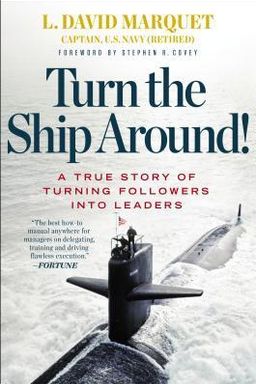
Turning Followers into Leaders: The Heart of 'Turn the Ship Around!'
Have you ever felt stuck in a job where your creativity and initiative seemed to vanish—where you were told to follow instructions rather than think? In Turn the Ship Around!, U.S. Navy Captain David Marquet tackles that universal frustration head-on. He argues that traditional leadership models—built on the idea that there are leaders who command and followers who obey—are disastrously outdated. Marquet contends that in today's world of complex problems and cognitive work, organizations must replace the leader-follower model with a leader-leader structure, where everyone takes responsibility, thinks independently, and acts like a leader.
Through the gripping story of his command of the nuclear-powered submarine USS Santa Fe, Marquet shows how he transformed the Navy’s worst-performing crew into one of its best. His approach wasn’t about charisma or hero worship—it was about systems, language, trust, and constant learning. Turn the Ship Around! isn’t just a military memoir; it’s a master class in reprogramming how we think about leadership, teamwork, and organizational control. As Stephen Covey (author of The 7 Habits of Highly Effective People) writes in the foreword, Marquet exemplifies the rare leader who empowers others to lead themselves.
The Problem: Leader-Follower Structures
Marquet begins with an honest confession: he was trained to be the perfect product of a hierarchical system. The Navy, like many corporations, operated under the assumption that the captain should make decisions and others should execute them. Leadership was defined as the ability to control thought, plan, and action. On the USS Will Rogers, his previous command, Marquet tried to implement empowerment programs within this leader-follower structure—and failed miserably. The crew waited for orders, operated mechanically, and avoided initiative. He realized that “empowering followers” only reinforces their dependence. True empowerment means removing the distinction between leader and follower altogether.
This insight gave rise to his central argument: leadership isn’t about controlling people—it’s about releasing their potential. As humans, we are naturally active problem-solvers; bureaucracy and command cultures have trained that instinct out of us. Marquet asks a daring question: What if everyone on board, regardless of rank, took responsibility for thinking and decision-making?
The Experiment: USS Santa Fe
When Marquet assumed command of the Santa Fe in 1999, it was not only the worst-performing submarine—it was also a crew trapped in complacency. Sailors described their jobs with chilling resignation: “Whatever they tell me to do.” The ship had abysmal morale, high turnover, and an infamous reputation. In six months, the crew was scheduled for deployment. With no time to fire or replace anyone, Marquet resolved that the only thing he could change was how people acted and interacted. His audacious goal: transform followers into leaders.
Instead of issuing orders, Marquet began distributing control. Using mechanisms like “Chiefs in Charge,” he made middle managers—chief petty officers—responsible for their teams’ leave, training, and scheduling rather than passing tasks up the chain. Every sailor began to own outcomes. This shift from privilege to accountability laid the foundation for the leader-leader model: push authority down to where information lives instead of dragging information up to where authority resides.
Leader-Leader Philosophy in Practice
Marquet’s transformation wasn’t theoretical—it was messy, hard, and human. He introduced specific, actionable mechanisms that forced intellectual engagement at every level. For example, he replaced “briefs” with “certifications,” so each team member had to actively prove competence rather than passively listen. Officers learned to say “I intend to…” when announcing actions—a language shift that compelled clarity of thought and gave ownership back to the crew. These simple linguistic changes created enormous cultural ripples.
Over time, the crew grew technically and emotionally competent. The Santa Fe achieved operational excellence, went from worst to first in fleet performance, and reenlisted twelve times more sailors than the previous year. More importantly, after Marquet left, the ship continued to thrive—proof that he had embedded leadership, not dependency, into its DNA.
Why This Matters to You
You may not command a submarine, but you probably lead—or are led—in complex systems that suffer from the same ailments: passive compliance, wasted intelligence, and fear of mistakes. As Marquet explains, the modern workplace resembles the bridge of a submarine—a tightly bound, high-stakes environment where withholding ideas can sink the ship. Whether you’re guiding a company, a classroom, or a team project, the same principle applies: stop trying to inspire followers; start releasing leaders.
Across the book, you’ll explore three pillars that support this transformation: Control (distributing decision-making), Competence (building mastery so people can act responsibly), and Clarity (ensuring everyone understands the organization’s purpose). Each pillar comes alive through vivid stories—from fire drills gone wrong to a sailor daring to tell the captain, “No, sir, you’re wrong.” These mechanisms—like “Take Deliberate Action,” “Don’t Brief, Certify,” and “Encourage a Questioning Attitude”—show how even established hierarchies can evolve into collaborative ecosystems.
Leadership Redefined
As Marquet summarizes, leadership is no longer about being right at the top—it’s about creating an environment where everyone can make decisions, take initiative, and continuously learn. The crew of the Santa Fe didn’t just follow him—they became him.
In the end, Turn the Ship Around! argues for a fundamental rethinking of authority itself. It invites you to ask a radical question about your own workplace: What would happen if everyone were trusted to lead? Marquet’s answer is inspiring and practical—your people would no longer wait for orders; they’d take command of their destinies.