
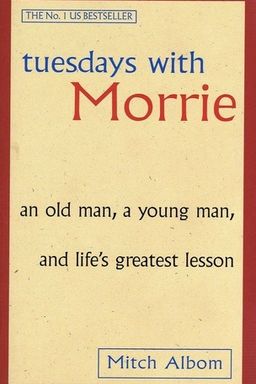
Tuesdays with Morrie cover

Tuesdays with Morrie

by Mitch Albom

Tuesdays with Morrie by Mitch Albom explores life’s greatest lessons through the profound conversations between Albom and his dying professor, Morrie. This touching narrative delves into themes of love, connection, and the true essence of a meaningful life, offering readers a poignant reflection on what truly matters.

Learning How to Live by Learning How to Die

What if the best lessons about living came not from success or achievement, but from the experience of dying? In Tuesdays with Morrie, Mitch Albom invites you into a series of powerful conversations between himself, a busy sports journalist chasing ambition, and his beloved college professor, Morrie Schwartz, who is slowly dying from ALS. Through these weekly meetings—always on a Tuesday—Morrie offers a final course unlike any taught in the classroom. The subject is life, and the teacher is a man racing against death.

Albom contends that modern culture distorts our understanding of meaning. We pursue wealth, status, and success but seldom stop to ask whether these pursuits bring real happiness. Morrie’s impending death strips away these illusions, revealing what truly matters: love, connection, forgiveness, and purpose. The book challenges you to confront mortality—not with fear but with humility—because, as Morrie repeats throughout their sessions, “Once you learn how to die, you learn how to live.”

The Reconnection Between Teacher and Student

Mitch Albom’s story begins as a tale of lost connection. After graduating from Brandeis, he promises to stay in touch with Morrie but drifts into career obsession, becoming successful yet emotionally empty. Sixteen years later, he sees Morrie on television being interviewed by Ted Koppel—his old professor now confined to a wheelchair, openly discussing death. This unexpected encounter rekindles their relationship, and Mitch begins visiting Morrie every Tuesday. Their meetings quickly evolve into a course on the meaning of life: no grades, no lectures, just conversations about grief, fear, family, and love. You are invited to become the third participant in those conversations, learning alongside Mitch each week.

The Heart of Morrie’s Philosophy

Morrie’s wisdom centers on rejecting societal illusions. He challenges what he calls the “brainwashing” of modern culture—the relentless messages that tell you to chase possessions and success, even though none of these will sustain you when your body fails. For Morrie, love and compassion are the only rational acts. He believes that our best existence is lived through relationships, community, and honest engagement with suffering. As his body deteriorates, Morrie decides his task is not merely to die, but to turn dying into living—to teach others how to face death without losing their spirit.

Throughout their conversations, Morrie redefines strength: not as physical resilience but emotional presence. When he needs help eating or moving, he accepts assistance with gratitude rather than shame, framing dependency as a return to childlike trust. He sees beauty even in the agony of disease because it allows him to focus on what endures—the love between people and the lessons of compassion that outlast the body. His “curriculum” includes topics like death, family, emotions, aging, money, marriage, and forgiveness, all threaded together by one message: “Love each other or perish.”

Facing Death as a Mirror to Life

Morrie’s approach feels like spiritual realism. He borrows from Buddhism, Christianity, and Judaism, creating what he calls a “religious mutt” philosophy. He suggests imagining a small bird on your shoulder that asks daily, “Is today the day I die?” This isn’t morbidity—it’s an invitation to live consciously. Knowing that death can arrive anytime helps you value your mornings, your relationships, and even simple acts of kindness. The professor teaches that accepting death doesn’t mean resigning from life; it means being more alive while you can. His essence echoes the Stoic tradition (Seneca and Marcus Aurelius), yet it’s softened by humor, dance, and warmth.

The Emotional Transformation of Mitch Albom

Through these Tuesdays, Albom transforms from a man defined by deadlines into one defined by consciousness. He learns to detach from emotions without denying them—a Buddhist lesson Morrie emphasizes. Detachment doesn’t mean indifference but understanding feelings so deeply that you can release them. This changes how Mitch approaches his own life and ultimately his strained relationship with his brother. Morrie’s presence becomes a moral compass—a reminder that success without tenderness is hollow. By graduation day, Albom’s final “thesis” isn’t academic but emotional: love is the only force strong enough to outlive death.

Why Morrie’s Lessons Matter Today

In a culture still obsessed with achievement, Tuesdays with Morrie remains a quiet revolution. It proposes that meaning doesn’t come from speed or status but from connection and reflection. You may not have a teacher like Morrie, but his insights remind you to slow down, hug those you care about, forgive before it’s too late, and measure wealth not by possessions but by the love you give and receive. Morrie’s classroom was his living room; his textbook was experience; his test was courage. Through Albom’s storytelling, you realize that death’s certainty can become the greatest teacher of life. The lessons endure beyond the grave because, as Morrie teaches, “Death ends a life, not a relationship.”


Acceptance and the Art of Dying Well

Throughout Morrie’s decline, he chooses acceptance over fear. His philosophy isn’t to fight death but to learn from it, turning the process into his final research project. Rather than retreat into bitterness or self-pity, he uses ALS to examine the emotions most people spend their lives avoiding. Morrie teaches that real peace comes from understanding impermanence—the Buddhist awareness that everything changes. To live fully, you must face your mortality directly.

Facing Death Consciously

Morrie describes his illness as a candle that melts his body away. First he loses control over his legs, then his arms, and finally his breathing. Yet each loss becomes an opportunity to grow inwardly. He sees dying not as failure but as a natural phase. Like many spiritual traditions (Hinduism’s reincarnation or Stoic resignation), Morrie believes this process strips life down to its essentials, forcing him to see beauty in ordinary things—the hibiscus flower outside his window, the sound of laughter, or the simple act of human touch.

Detachment Without Denial

When Mitch asks how to handle fear, Morrie introduces the idea of detachment. He argues that you must let emotions penetrate you fully before releasing them. Suppressing grief or sadness only prolongs pain. Instead, you say, “This is fear. This is sadness,” and then step outside of it. It’s a mental practice that allows serenity even in suffering. When Morrie nearly chokes to death, he tells Mitch that if he dies, he hopes to do so peacefully—not resisting but accepting what is happening with awareness.

Transforming Fear Into Teaching

Morrie transforms each symptom into a lesson. When he needs help urinating, he sees it as practice for humility. When someone wipes his brow, he considers it an exercise in gratitude. His acceptance doesn’t glorify pain—it humanizes it. He encourages others to talk about dying openly, rejecting society’s taboo on death (“People act like it’s contagious”). This courage aligns with Viktor Frankl’s view in Man’s Search for Meaning: even in suffering, one can find meaning by choosing one’s attitude.

Through these choices, Morrie demonstrates that dying well means living deliberately until the end. His final lesson—“Don’t let go too soon, but don’t hang on too long”—captures the balance between courage and surrender. If you can learn to accept death without bitterness, Morrie insists, you can finally live the life you were meant to live.


Love and the Human Connection

For Morrie, love is not a sentimental emotion but the foundation of existence. From his childhood losses—his mother’s death, his father’s emotional absence—to his later life surrounded by students and friends, Morrie’s enduring belief is that human connection is what gives life meaning. His famous motto, “Love each other or perish,” comes from poet W.H. Auden, but Morrie embodies it daily. He believes that without affection and attention, people grow sick long before disease touches their body.

The Circle of Giving and Receiving

Even as his muscles fail, Morrie insists on being present for others. He continues counseling friends and comforting visitors who arrive weeping. When Mitch offers food, Morrie delights—not because he can eat it, but because he feels the love behind the gesture. He teaches that giving and receiving affection are inseparable acts. You cannot give deeply unless you also allow love in. This mirrors the psychological insight of Carl Rogers, who argued that empathy is reciprocal—it nourishes both giver and receiver.

Family as Spiritual Security

During their fifth Tuesday, Morrie declares that family is the only foundation strong enough to combat life’s fear. He tells Mitch that without family, people are birds with broken wings. Money can buy comfort, but not belonging. He cherishes his wife Charlotte and his sons Rob and Jon, saying their love forms his spiritual security: the assurance that someone is always watching over him. He encourages Mitch, who is childless, to recognize that raising children is not a burden but a profound form of giving meaning.

Love as the Antidote to Fear

As death closes in, Morrie’s view of love expands. He tells Mitch that genuine love endures beyond physical loss: “Death ends a life, not a relationship.” Whether family, friends, or former students, the love we create persists. Morrie’s memorial scene confirms this—letters flow from strangers moved by his teachings. Love, he argues, makes each person immortal in the hearts of others. In this way, Morrie turns dying into proof that love never dies.


The Trap of Culture and the Freedom to Choose Meaning

Modern culture, according to Morrie, imprisons people with false values. We are taught that being successful, rich, and busy equals worthiness. Yet these pursuits leave individuals isolated and unfulfilled. Morrie’s illness exposes the emptiness of these ideals. He develops his own culture—one built on compassion, authenticity, and close relationships. You can do the same, he insists, without rejecting society completely but by choosing what truly feeds your soul.

Rejecting the Cultural Script

At the peak of his career, Mitch lives in the fast lane—working multiple media jobs, investing in stocks, and measuring his days by deadlines. His disconnection mirrors our collective obsession with productivity. When Morrie contrasts this with his slower life filled with conversation and music, Mitch begins to question his own definition of success. The ALS diagnosis turns Morrie into a mirror reflecting what matters most when time becomes finite.

Creating a Personal Subculture

Morrie advises everyone to build a “little subculture” rooted in kindness rather than competition. This means rejecting the parts of culture that make you feel inferior or validated only by possessions. He uses himself as an example—hosting lively discussions even as his body deteriorates, surrounding himself with empathy rather than pity. Like Thoreau withdrawing to Walden Pond, Morrie shows that creating your own community can free you from cultural lies without isolating you from others.

Living by Choice, Not Default

Once you realize the world’s noise doesn’t dictate your worth, you can begin to live intentionally. Morrie’s advice echoes existentialists such as Viktor Frankl and Jean-Paul Sartre: meaning isn’t found—it’s created by your choices. He challenges you to make room for reflection, generosity, and trust. “Invest in the human family,” he says. When you do, ambition transforms into empathy, and your life stops being a race for more and becomes a practice of enough.


Aging, Dependency, and the Beauty of Vulnerability

Morrie dismantles society’s fear of aging. Instead of viewing dependency as humiliation, he calls it a return to innocence. When others dress him or lift him, he feels what every child feels in a mother’s arms—complete love without judgment. “We all yearn to go back to those days when we were completely cared for,” he explains. Aging isn’t losing; it’s returning to emotional truths that youth often ignores.

Dependency as Connection

When Morrie becomes too weak to wipe himself, he reframes this dependence as intimacy. He tells Mitch that society teaches shame about relying on others, but the truth is that interdependence is natural. It reminds you that life’s bookends—babyhood and old age—both require love to survive. Accepting help teaches humility and gratitude, not defeat. This perspective stands against Western ideals of rugged individualism, offering a more compassionate model of humanity.

Aging as Growth, Not Decay

Morrie insists “aging is not just decay—it’s growth.” Every year brings wisdom if you’re paying attention. Envying youth reflects a life without meaning. People who have learned and loved fully don’t wish to go backward. He encourages embracing age as accumulation—of insight, of empathy, of deeper appreciation. He sees himself as every age he’s ever been, not separate from his past selves. This mindset helps him find joy at seventy-eight while dying.

In accepting vulnerability, Morrie reveals that dignity doesn’t come from independence but from presence. Whether child or elder, your worth lies in your capacity to connect. Aging gracefully means letting go of control while holding onto compassion—a paradox that Morrie lived beautifully every day.


Forgiveness and the Freedom to Let Go

Late in his decline, Morrie turns to forgiveness—both of others and himself. He tells Mitch, “Forgive yourself before you die. Then forgive others.” This simple instruction carries decades of wisdom. Through the story of his estranged friend Norman, who sculpted his bust but died before Morrie could reconcile with him, Morrie exposes how pride and resentment trap people in grief. Forgiveness, he says, is liberation from the weight of unfinished business.

Forgiving Others

Morrie regrets rejecting Norman’s attempts to reconnect after a misunderstanding. That regret turns into pain once Norman dies. Morrie realizes that refusing forgiveness only multiplies suffering. He urges Mitch—and you—to forgive not because others deserve it but because you deserve peace. Holding anger, he warns, is like holding hot coals—it burns you before anyone else. His lesson mirrors teachings from The Art of Happiness by the Dalai Lama: compassion relieves personal pain more than vengeance ever could.

Forgiving Yourself

Equally vital is self-forgiveness. Morrie admits he once obsessed over not writing enough or achieving enough acclaim. Facing death reveals how pointless self-criticism can be. Forgiving yourself means accepting imperfection, knowing you’ve done your best within your limits. This releases energy for love and gratitude instead of regret. He tells Mitch to make peace with who he is and focus on who he’s still able to be, even now.

In embracing forgiveness, Morrie models emotional freedom. He proves that reconciliation—whether internal or external—is the final step toward peace. By forgiving, you lighten death’s burden and ensure that when the final moment comes, your heart isn’t weighed down by resentment but lifted by compassion.


The Legacy of a Perfect Day

Morrie’s vision of a perfect day crystallizes all his teachings. When Mitch asks what he’d do if healthy for twenty-four hours, Morrie answers simply: eat breakfast, swim, talk with friends, walk in a garden, share pasta for dinner, and dance. No luxury, no fame—just connection and presence. This modest vision reveals the heart of his philosophy: meaning lies in ordinary joy fully appreciated.

Finding Beauty in Everyday Moments

After months confined to a chair, Morrie dreams of reconnecting with simple sensations—the warmth of tea, the breeze on his face, the laughter around a table. These desires remind you that perfection is not in achieving more but in noticing more. When life slows down, what’s left are the tiny experiences that wealth or ambition often eclipse. In this way, Morrie’s imagined day becomes a spiritual practice of presence.

Death Ends a Life, Not a Relationship

As the final sessions close, Morrie teaches Mitch that relationships transcend death. “Talk to me,” he says, “and I’ll listen.” When Morrie dies, Mitch feels that their conversation continues—proof that love outlives the body. This echoes themes in The Five People You Meet in Heaven, where Albom later explores eternal connection. Morrie’s approach encourages you to see death not as erasure but transformation—the persistence of influence and affection.

Living as If It’s Your Perfect Day

Ultimately, Morrie’s perfect day is a blueprint for living meaningfully now. Dance, talk, love, and rest; don’t wait until illness forces gratitude. When you cherish small joys daily, you’re already living your perfect day. Morrie’s death becomes his graduation—a final lesson that life’s true perfection isn’t in avoiding the end but in embracing everything that comes before it.

Dig Deeper

Get personalized prompts to apply these lessons to your life and deepen your understanding.

Go Deeper

Get the Full Experience

Download Insight Books for AI-powered reflections, quizzes, and more.