
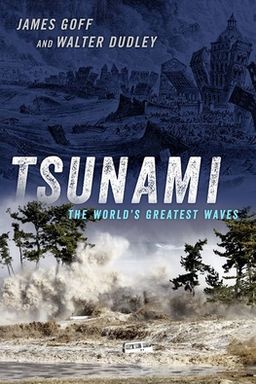
Tsunami cover

Tsunami

by James Goff and Walter Dudley

Tsunami takes readers on a gripping exploration of history''s most significant tsunamis. Through a blend of scientific analysis, ancient legends, and survivor tales, authors James Goff and Walter Dudley reveal crucial lessons for ensuring a safer future.

Reading the Ocean’s Memory

When you study tsunamis, you are really learning to read the ocean’s memory—its record of sudden displacements, collapses, and surges that unite geology, technology, and human experience. Across centuries of catastrophe, this book shows that tsunamis are not a single phenomenon but a family of events, shaped by faults, volcanoes, landslides, impacts, and even man-made failures. The author’s central claim is that understanding tsunamis means combining two kinds of knowledge: the instrumental (data, sensors, models) and the human (stories, traditions, behaviors). Neither works alone.

Technology and the detection chain

The first part of this book takes you through the evolution of tsunami warning systems—from tide gauges and seismographs to the Deep-ocean Assessment and Reporting of Tsunamis (DART) buoys. You see how this chain of instruments and people grew out of experiments in the mid-twentieth century and now girds the globe. Yet even with satellites and international coordination, technical limits remain: local tsunamis often strike within minutes, leaving you no time for official alerts. The message is clear: technology can buy hours, but instinct saves seconds.

Multiple origins of disaster

You learn that tsunamis emerge from many triggers: subduction earthquakes like the 1960 Chile event, submarine landslides like the Storegga Slide, or volcanic collapses such as Krakatau and Santorini. The book broadens your imagination—meteor impacts (Eltanin, 2.6 million years ago) and dam failures (Vajont, 1963) can also raise enormous waves. By mapping these causes, the author shows that tsunami science is interdisciplinary, spanning tectonics, volcanology, fluid dynamics, and history.

Human voices and survivor lessons

No instrument records behavior; survivors do. Their stories—from Marsue McGinnis at Laupahoehoe to Howard Ulrich in Lituya Bay—illustrate what action means when seconds count. These personal accounts teach you embodied knowledge: the next wave may be larger, the ocean retreat warns of imminent arrival, and hesitation kills. Similarly, oral traditions like the Acehnese 'smong' in Simeulue Island or Gohei’s rice-sheaf fire in Japan carry memory through generations, saving lives when science and bureaucracy lag behind.

Culture, words, and history

The word 'tsunami' itself mirrors this meeting of worlds. Once confined to Japan, it entered global language after the 1946 Aleutian event. Through linguistic clarity, communities learned to separate 'tidal waves'—a misleading term—from real displacement waves. Local languages and myths embed empirical clues: Māori stories of taniwha warn of unstable coasts; Japanese terms distinguish types of water rise. In this way, the language of hazard becomes part of its solution.

The broader frame

Ultimately the book argues that tsunami knowledge lives in layers—scientific, cultural, and emotional. By listening to oral traditions, reading physical deposits, and advancing real-time technology, you build an integrated view of oceanic risk. The linkage of ancient events (Santorini, Storegga, Kuwae) with modern ones (1960 Chile, 2004 Indian Ocean) forms a continuous thread: the sea remembers, and humans can learn to anticipate its voice.

Core message

To live safely near water, you must combine rapid recognition of physical signs—ground shaking, sea withdrawal, strange sounds—with respect for stories and technology that transmit hard-earned wisdom. Tsunami science begins with sensors but ends with people.

Reading the ocean’s memory means seeing the continuum between myth and measurement. This book’s journey—from ancient deposits to DART buoys—challenges you to think not just about waves, but about how knowledge itself travels across generations and disciplines.


Triggers of the Unthinkable

You may think tsunamis are exclusively earthquake-driven, yet they originate from a spectrum of violent changes in Earth’s surface and water. This section reveals how geological instability multiplies tsunami possibilities—from subduction zones to volcanic islands, collapsing slopes, and even human-made explosions.

Seismic origins

Subduction-zone earthquakes are the classic generators. The 1960 Chile earthquake (magnitude 9.5) displayed how seafloor uplift across over 600 miles of fault created trans-Pacific devastation. Yet some 'tsunami earthquakes' rupture slowly (like Aleutian 1946) and yield disproportionately large waves compared to their magnitude—all because they displace vast volumes of seabed gently but deeply.

Landslides and confined basins

Submarine and coastal slides can dwarf seismic impacts locally. Lituya Bay’s 1958 event, releasing about 40 million cubic yards of rock into a small fjord, reached a record run-up of 1,720 ft. Its physics resemble a confined explosion: geometry funnels energy upward. Other landslides, like Alaska’s Taan Fjord (2015), repeat similar dynamics as retreating glaciers destabilize slopes.

Volcanoes as water displacers

Eruptions combine multiple tsunami-generating mechanisms—caldera collapse, pyroclastic flow entry, or flank failure. Santorini (~1600 BC) probably drowned Minoan ports, Krakatau (1883) erased towns around Sunda Strait through explosions and collapses, and Mount Pelée (1902) illustrated small tsunamis from lahars and flow surges. Volcanic tsunamis remind you that hazard prediction must include both seismic and magmatic monitoring.

Impact and artificial sources

Meteor impacts like Eltanin (~2.6 Ma) show that ocean collisions can vaporize vast water volumes and generate kilometers-high transient waves. Man-made failures echo the same physics: the 1919 Boston Molasses flood and the 1963 Vajont reservoir disaster show industrial negligence can unleash tsunami-like floods, dense and deadly in city streets and valleys.

Insight

Every trigger—seismic, volcanic, landslide, impact, or mechanical—shares a core ingredient: water displacement. Recognizing physical precursors (ground shaking, retreating sea, collapsing slopes) is your first defense.

Expanding your mental model beyond earthquakes prepares you for realism: tsunamis are diverse, locally amplified, and can stem from either natural instability or human error.


Seeing the Invisible: Warning Systems

Behind global preparedness lies a network of sensors and decision chains that turn invisible pressure changes into lifesaving alerts. You see this technological evolution from harborside tide gauges to deep-ocean DART buoys and worldwide communication centers.

Early observation networks

The first coordinated system, the US Seismic Sea Wave Warning System (1948), linked seismographs in Alaska, Arizona, and Hawaii to tide stations across the Pacific. Those gauges could confirm whether a quake had generated a wave—but they also misled when harbors muted or exaggerated signals. False alarms taught humility to early forecasters.

The DART revolution

In 1995, NOAA’s PMEL laboratory launched DART prototypes off Oregon. These bottom pressure recorders detect subtle pressure shifts as tsunamis pass overhead, transmit to surface buoys, and relay data by satellite. Integrated by 2004 into global networks, they transformed warnings—separating real ocean-crossing waves from harmless ripples, sparing communities needless panic.

Limits and responsibility

Technology helps only where geography and time allow. For remote sources like Chile 1960, you have hours; for nearshore landslides or volcanoes, minutes or none. The 2004 Indian Ocean tragedy proved how missing infrastructure cost lives, while Aceh’s survivors on Simeulue Island survived through oral memory (“smong”). True safety lies in combining technical and cultural systems.

Key idea

Sensors can recognize motion, but only people can respond. When you feel strong coastal shaking, your instinctive evacuation replaces all machinery.

This technical lineage, from Finch’s nineteenth-century tide rules to DART satellites, illustrates science’s progress and humility: accuracy increases, but reaction time still depends on human readiness.


Human Memory and Oral Science

Long before seismographs, communities remembered the sea’s violence in stories, songs, and rituals. This section shows how oral traditions serve as environmental records and warning systems, sometimes more dependable than instruments.

Traditional signals

Gohei’s torch story in Japan’s 1854 Ansei Nankai tsunami—burning rice sheaves to guide villagers uphill—epitomizes embodied memory. In New Zealand, Māori tales of taniwha and 'coming of the sands' correspond to genuine tsunami deposits between 1470–1510. These oral maps guided later geology, turning legend into stratigraphic direction.

Deep-time evidence

Archaeology contributes similar voices. The 6,000-year-old Aitape Skull (Papua New Guinea) rests in tsunami layers, showing how human settlement repeatedly adapted to coastal catastrophe. Oral and archaeological sequences together stretch the real disaster record far beyond written archives.

Societies reshaped

The Polynesian 'long pause' around 1450 after the Kuwae eruption and associated Tonga-trench events illustrates how environment rewires migration and culture. Interrupted voyaging was not mysterious—it reflected destroyed fleets and coastlines. Like Doggerland’s submersion after the Storegga wave, oral survivals mark turning points in human geography.

Lesson

Treat every myth of flooded lands or sea monsters as a testable hypothesis. Oral knowledge carries environmental precision—and may be your best guide when instruments fail.

By merging narrative and sediment, you see how science can draw from centuries of storytelling to reconstruct cycles of catastrophe and resilience. Listening itself becomes a method of prediction.


Extreme Physics and Confined Waters

Extreme run-ups reveal how local geometry magnifies water’s force. Lituya Bay (1958) stands as the textbook of confined-basin physics, while freshwater events remind you that deadly waves are not limited to saltwater coasts.

Lituya Bay and amplification

A rockslide into the narrow T-shaped fjord created an upward surge exceeding skyscraper height. The confined topography focused momentum, stripping forest and launching waves at nearly 130 mph. Eyewitnesses like Howard Ulrich survived by pure chance. Researchers use these scars to model landslide-tsunami mechanics—proof of nature’s nonlinear scale.

Freshwater parallels

Lake and reservoir tsunamis follow similar rules. Lake Tahoe’s prehistoric slide (100 m wave), Switzerland’s Tauredunum (563), and Italy’s Vajont (1963) demonstrate kinetic energy unleashed in minutes. Fjord slides like Alaska’s 2015 Taan event remind engineers that glacier retreat and slope loading can trigger near-instant disasters.

Why confined basins matter

Urban planning often assumes coastal run-up of tens of feet, but local geometry can multiply it dozens of times. If you live near steep-sided lakes or fjords, understanding shape and sediment stability matters more than distance from the coast.

Takeaway

Confined water bodies are amplifiers: small triggers cause giant effects. Always assess topography before evaluating risk—it can turn a minor slide into a megatsunami.

These cases expand your concept of scale and remind you that hazard depends not only on source energy but on where that energy is trapped.


Modern Catastrophes and Global Learning

Modern tsunamis—Chile 1960 and the 2004 Indian Ocean—illustrate the transition from scientific curiosity to global responsibility. Together they show how wave propagation, cultural response, and international systems evolve across decades.

1960 Chile: patterns across oceans

Chile’s 9.5 quake created the farthest-reaching tsunami ever recorded. Its travel across the Pacific taught physicists how resonance, bathymetric focusing, and crest compression shape destruction zones. It devastated Hilo (Hawaii) and struck Japan hours later. Mapuche oral cycles of 'serpent battles' mirrored scientific recurrence—myth describing periodic plate motion.

2004 Indian Ocean and the failure of warning

Without an Indian Ocean system, 2004 exposed millions—resulting in 230,000 deaths. But localized memory proved powerful: Simeulue’s 'smong' saved almost everyone, and a child educated in England saved her Phuket resort. Post-disaster rebuilding, such as Vilifushi’s elevation by the Red Cross, showcased adaptive resilience. Yet buoy system maintenance still falters—proof that institutional learning is fragile.

From tragedy to integration

Each event pushed warning technology and education forward. Chile 1960 shaped nuclear plant design bases; 2004 created global cooperation networks. Science improved, but memory—human and cultural—remains the most reliable alarm.

Lesson

Global systems depend on local wisdom. Sustainable safety arises when international data sharing meets community-level awareness.

Modern catastrophes reveal the hybrid nature of preparedness: technical sensors, storytelling, education, and equitable recovery work together to make seas survivable.


Hidden Depths and Planetary Risk

The ocean floor hides evidence of ancient impacts and slides whose consequences still echo through Earth's climate and biology. The Eltanin impact, the Storegga slide, and the drowning of Doggerland show how deep geological forces intersect human history and planetary systems.

Eltanin and extinction

A 2.6-million-year-old asteroid smashed the Southern Ocean, vaporizing water and generating enormous pressure waves. Its energy rivaled hundreds of millions of atomic bombs, producing marine overpressure deadly to whales and fish, and perhaps contributing to megafaunal extinctions. Although no crater remains, chemical anomalies prove the event, reminding you that deep-ocean impacts conceal immense planetary consequences.

Storegga and Doggerland

The Storegga Slide (~8,150 years ago) along Norway’s margin liquefied 800 cubic miles of sediments, sending waves across the North Sea. Doggerland—once a populated bridge between Britain and Europe—vanished beneath rising seas and tsunami surge, a 'Mesolithic Brexit' that forced maritime adaptation. The event’s sedimentary scars and tools left behind document sudden loss and ingenious resilience.

Modern parallels

Today, methane hydrates and offshore development echo old triggers. The Ormen Lange gas field sits in the Storegga scar, engineered with awareness of slide recurrence risk. The lesson: geological memory must inform modern exploitation and settlement decisions.

Big Picture

Earth’s deep record reveals tsunami hazards on every timescale—from seconds to millennia. Treat ancient deposits not as lore but as templates for future dynamics.

By understanding hidden depths, you see tsunamis as both local human tragedies and planetary-scale processes that shape coastlines, cultures, and climates across time.

Dig Deeper

Get personalized prompts to apply these lessons to your life and deepen your understanding.

Go Deeper

Get the Full Experience

Download Insight Books for AI-powered reflections, quizzes, and more.