
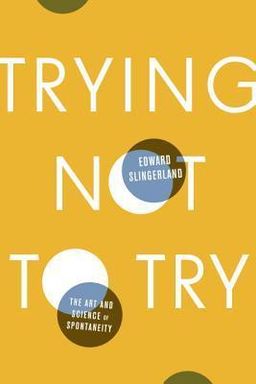
Trying Not to Try cover

Trying Not to Try

by Edward Slingerland

Trying Not to Try unveils the wisdom of ancient Chinese philosophies, guiding you to live a stress-free life by embracing spontaneity. Discover how to achieve harmony between mind and body through the effortless power of wu-wei, and unlock your natural charisma and influence with de. Transform your life with these timeless teachings.

Trying Not to Try: The Paradox of Wu‑Wei

How can you be effortlessly effective when effort itself blocks the way? In Trying Not to Try, Edward Slingerland explores this ancient and universal paradox: the more you try to relax, the tenser you become; the harder you strive to be genuine or moral, the more contrived you look. Early Chinese thinkers called the desired state wu‑wei—literally “no doing,” but really meaning spontaneous, unselfconscious mastery. They paired it with de, the magnetic social radiance that flows from genuine, effortless virtue. The book asks: how do you cultivate authenticity and skill when conscious effort undermines both?

The structure of the paradox

Wu‑wei is the feeling of flow—like Butcher Ding’s cleaver gliding through an ox without resistance or a jazz musician losing self-awareness and letting 'the music play them.' Yet wu‑wei cannot be commanded by the conscious mind. The moment you think 'now I’ll be spontaneous,' cognitive control activates and destroys fluidity. Ancient Chinese philosophers and modern neuroscientists converge on the same truth: deliberate effort recruits slow, rule-based circuits that inhibit embodied performance.

Two minds, one struggle

Your brain has dual systems. The fast, emotional, and embodied “hot” mind handles automatic skill and social cues, while the slow, language-bound “cold” mind plans and monitors. Wu‑wei happens when the hot system leads and the cold mind quiets down. Studies of jazz improvisation (Charles Limb and Allen Braun) show decreased activity in the lateral prefrontal cortex during flow, suggesting 'transient hypofrontality'—a physiological state of relaxed vigilance. But you only reach it through repeated training; the paradox demands structured preparation followed by surrender.

Cultural and philosophical responses

Early Chinese thinkers offered four competing strategies to manage the paradox. Confucius emphasized carving and polishing: use ritual and social practices to engrave virtue until it becomes second nature. Laozi proposed the opposite—let go of striving, return to simplicity, and allow naturalness to reemerge. Mencius described moral cultivation as farming sprouts of goodness: nurture innate empathy gently, without force. Zhuangzi pursued radical surrender—emptying the self and laughing at the futility of control. These paths blend into one pragmatic insight: try hard early, but then stop trying and trust the body.

Social and ethical stakes

Wu‑wei is not just personal bliss; it is the foundation of social trust. When action flows effortlessly from sincere motives, others sense authenticity—this is de. De is visible charisma: a ruler who governs by de leads without coercion, a friend with de earns trust without convincing. People instinctively detect spontaneity through tone, facial microexpressions, and timing. If virtue could be perfectly faked, cooperation would collapse. Thus the paradox of wu‑wei doubles as a safeguard for sincerity in social life.

Modern relevance

Slingerland ties ancient wisdom to cognitive science and daily struggle. Overthinking spoils performance and relationships alike; scripted authenticity—from dating guides to political image management—feels hollow. The solution is not one secret technique but a balanced ecosystem: train habits until automatic, then design contexts that allow relaxation and trust. Modern rituals—sports routines, meditation, music, synchronized activities—perform the same function Confucian rites did. You don’t solve the paradox once and for all; you learn to manage it gracefully.

Core insight

If you have to force yourself to be spontaneous, you’ll fail. But if you discipline yourself and your environment so that spontaneity arises naturally, you can act effortlessly—and that authenticity is both individually freeing and socially essential.

In short, Trying Not to Try shows you that wu‑wei is not magic but practice—a lived balance between training and trust, cold preparation and hot action, deliberate cultivation and genuine ease. Mastering that balance is the secret art of being human.


The Two Minds Within You

According to Slingerland, the paradox of wu‑wei begins inside your brain. You behave as if you’re one self, but you actually operate with two minds: a quick, embodied system that knows how to act, and a slower, deliberate one that knows how to plan. Understanding this division—modern dual‑process theory—unlocks why genuine spontaneity feels like ‘something else is doing it.’

Hot and Cold Cognition

The hot system (System 1) is intuitive, emotional, and non‑verbal. It handles walking, throwing, playing music, speaking in rhythm. The cold system (System 2) is reflective and linguistic—it can debate ethics or solve calculus but often jams performance. Athletes who start “thinking about their swing” lose their flow because slow monitoring interrupts fast execution. This fits ancient language: Confucius’s warning against 'over‑thinking rituals' matches today’s 'choking under pressure' research.

Neural Mechanics of Wu‑Wei

Two regions matter most: the anterior cingulate cortex (ACC) detects conflict, while the lateral prefrontal cortex (LPFC) exerts control. During flow or improvisation, LPFC activity drops while ACC stays alert—your conscious overseer relaxes but doesn’t go offline. The basal ganglia store learned routines, enabling 'automaticity': once a pattern is ingrained, your cold mind can safely step aside. Dietrich’s concept of transient hypofrontality—brief quieting of prefrontal oversight—explains the runner’s high or musical absorption that ancient texts described as 'fasting of the mind.'

Training and Letting Go

You can’t jump to wu‑wei directly. First you use the cold mind to train precise habits; then you let the hot mind run them. Driving, typing, moral reflexes—each starts self‑conscious but ends fluent. The same applies to virtue: practice compassion deliberately (as Mencius advised) until empathy fires automatically. When performance demands spontaneity, quiet control through meditation or rhythmic ritual can down‑regulate frontal interference and let spontaneity return.

Insight

Wu‑wei brains are trained brains. The secret is alternation: intense rehearsal under conscious control, followed by relaxation that lets embodied systems take over. Without both, you either freeze or flail.

Slingerland’s fusion of neuroscience and philosophy turns wu‑wei into a practical psychology of skill—learn deeply, then forget deliberately.


Confucian Ritual and the Art of Training

Confucius offers the most structured path into wu‑wei. He admits you’re not born spontaneous. You must cultivate ease through disciplined ritual—dance, music, etiquette, and social performance that slowly “carve” the self into harmony. Edward Slingerland calls this cultural training for spontaneity: use deliberate social practice to rewire your instincts so that virtue becomes effortless.

Ritual as Embodied Priming

Rituals regulate body and emotion together. Bowing, seating order, tone, and movement repeatedly prime feelings of respect and empathy. This works like psychological priming: exposure shapes automatic response. Ancient communal performances—music, synchronized dance—built shared identity and emotional resonance. Modern neuroscience agrees: coordinated movement triggers oxytocin release and strengthens prosocial trust.

Training Values into the Body

Confucius’s phrase “carving and polishing” means gradually embedding abstract principles in muscle memory. Ritual schools rehearse proper gestures until they feel natural. Over time, propriety becomes feeling rather than rule. The result is moral spontaneity—acting with graceful ease because the body itself now prefers right action. This Confucian solution tackles the paradox head‑on: deliberate effort first, effortless virtue later.

Authenticity and Its Dangers

But the system can produce counterfeit virtue. The “village poseur” mimics manners without sincere commitment. Ritual without heart breeds hypocrisy—a theme echoed by Laozi. True wu‑wei needs inner resonance: emotional alignment and genuine intention. Otherwise external polish becomes moral theatre, not de.

Takeaway

Train through repetition and community; use ritual to prime emotions; but keep alert to sincerity. Real grace is embodied virtue, not memorized choreography.

The Confucian method provides the practical scaffold for wu‑wei—an engineered route to authenticity through structure, habit, and heartfelt participation.


Laozi and the Wisdom of Letting Go

Against Confucian discipline, Laozi counsels unlearning. You achieve wu‑wei not by carving but by ceasing to carve. The Laozi warns that striving for virtue distorts natural goodness—trying makes you fake. The cure is simplicity and withdrawal: reduce desire, let go of control, and restore the ‘uncarved block’ of the mind.

Undoing Effort

Modern psychology supports Laozi’s paradoxical claim: deliberate relaxation often fails because attention itself creates tension (Wegner’s ironic effect). Laozi’s advice—“take away until nothing is left”—anticipates paradoxical intention therapy: stop forcing sleep, stop chasing flow, and it arrives on its own. In cognitive terms, Laozi promotes downregulation of frontal control, the neural correlate of letting go.

Social and Political Flexibility

Laozi also offers a soft‑power strategy. Leaders who yield attract loyalty; rivers rule by lying low. This principle appears in martial arts and diplomacy—feigned weakness generates control. Yet Laozi warns: once wu‑wei becomes instrumental, the spell breaks. You must genuinely desire not to dominate for humility to radiate as de.

Limits and Balance

Slingerland notes Laozi’s romantic difficulty: total simplicity ignores progress and technology that improve life. The uncarved block fits small communities better than complex states. Still, the Laozi path tempers over‑civilized striving, reminding you that subtraction—not addition—can foster peace.

Insight

Sometimes effort is the disease. Laozi teaches that spontaneous balance appears when you stop fixing yourself. In modern terms: relax control, quiet narratives, and let embodied intelligence recalibrate.

The Laozi’s way reminds you that wu‑wei is not only built by discipline—it can also bloom through letting go, emptiness, and trust in natural process.


Mencius and the Growth of Moral Sprouts

Mencius bridges Confucius’s rigor and Laozi’s relaxation with a farming metaphor: you already have seeds of goodness—compassion, respect, integrity—and must cultivate them gently. Pulling sprouts kills them; ignoring them leaves them wild. This moderate path turns moral virtue into organic growth rather than forced reform.

Innate Seeds of Goodness

His “child at the well” scenario proves that empathy arises instantly, before thought. These moral emotions are embodied reflexes, not learned calculations. Neuroscience backs him: mirror‑neurons and somatic markers guide decisions faster than deliberate reasoning (Damasio). Wu‑wei thus becomes moral fluency—automatic rightness built from nurtured compassion.

Cultivation Without Coercion

Mencius tells King Xuan to extend his spontaneous pity for an ox to his people: recognize genuine feeling, then amplify it deliberately but gently. This methodology—reflection, story, and imaginative extension—uses warm cognition to enlarge empathy. It is profoundly psychological: human betterment depends on noticing inner sprouts and letting them grow through practice, not ideological push.

Lesson

Mencius teaches you to garden virtue, not assemble it. You nurture emotional roots until right action flowers naturally—sincere, effortless, wu‑wei morality.

His approach gives modern psychology a moral ecology: self‑improvement that relies on gentle awareness and guided empathy instead of rigid control or total passivity.


De: The Social Power of Authenticity

Wu‑wei becomes visible as de, the charisma of effortless virtue. De is what makes people trust you—it radiates from relaxed sincerity, not performance. In early China, rulers with de led without punishment; today, leaders with authenticity inspire loyalty without manipulation.

Why De Works

De is an honest signal. Because spontaneous behavior is hard to fake, observers detect genuineness through subtle nonverbal cues—microexpressions, posture, timing. Ekman’s studies of Duchenne smiles and thin‑slicing research confirm that people unconsciously spot insincerity. Thus genuine wu‑wei produces reliable trust signals vital for cooperation.

Cultural Costly Signals

Societies create hard‑to‑fake markers—ritual mastery, accent, tattoo, or costly practice—so sincerity becomes visible. Robert Frank’s economic models show that cooperative systems rely on emotions that make cheating costly. Ancient rituals served the same evolutionary purpose: external proofs of inner authenticity.

When Authenticity Fails

Modern image management—PR campaigns or political branding—often fail because de cannot be simulated. Only embodied consistency convinces. Confucius’s warning to be ‘vigilant while alone’ highlights that your private comportment shapes public trust.

Key Truth

De emerges spontaneously when inner values and outward acts align. You can’t advertise sincerity; you must live it.

Understanding de explains why wu‑wei matters beyond the self—it stabilizes trust networks, politics, and culture through embodied authenticity.


Signals, Cooperation, and Civilization

Slingerland expands the paradox into anthropology: civilizations depend on managing sincerity at scale. In small groups you know everyone personally; in large societies you rely on signals that make genuine commitment visible. Wu‑wei, expressed as de, is the moral technology that makes cooperation possible.

From Oracle Bones to Modern Economics

Archaeological evidence shows this insight anciently. Shang rulers gained legitimacy through authentic self‑sacrifice—acts credible only if sincere. The Guodian bamboo texts analyze how political leaders must internalize virtue since feigned loyalty collapses trust. Modern economists like Robert Frank echo it: long‑term cooperation depends on emotions that look irrational but prove reliability.

Costly and Honest Signals

Evolution favors signals too expensive to fake—peacock tails, gazelle stotting. Human rituals operate similarly: years of specialized training or accent reveal genuine participation. Religious rites, tattooing, or ceremonial oaths serve to verify sincerity. These cultural technologies make wu‑wei scalable, converting private virtue into public trust.

Insight

Civilization survives by designing practices that transform conscious values into embodied habits—ritual, education, and art are humanity’s long‑term solutions to the paradox of sincerity.

Thus wu‑wei is not a mystical luxury but a structural feature of social order—the invisible mathematics of trust that holds cultures together.


Practical Paths to Spontaneity

Slingerland ends with concrete ways to cultivate wu‑wei today. There is no shortcut, but multiple routes work together: structured routine, meditative release, emotional cultivation, and environmental design.

Ritual and Habit

Start with repetition. Rituals, music, daily gratitude, or practice sessions install values and skills into muscle memory. Like Confucius’s rites, your environment trains emotional response. Design spaces—art, rhythm, community—that cue your desired state.

Meditation and Letting Go

Add moments of release. Meditation lowers frontal control; paradoxical intention (Frankl) turns effort upside down. If you can’t relax, try intending to stay tense—it often triggers relaxation. Laozi’s wisdom and modern psychology meet here.

Empathy Training and Moral Sprouts

Use story and reflection to strengthen compassion. Reading, volunteering, and perspective‑taking exercises expand Mencian sprouts of empathy. These bodily emotions anchor genuine moral spontaneity.

Avoiding Pitfalls

Two dangers persist: overthinking (monitoring destroys flow) and performative authenticity (pretending sincerity erodes trust). Avoid them by combining training with honest motive—do not seek wu‑wei as prestige.

Pragmatic Guidance

Build bodily foundations through habit; periodically step away to let go; cultivate genuine care. Wu‑wei arises from alignment between effort and surrender.

The message: practice seriously, but hold it lightly. In your daily life, design rhythm and rest so that natural ease can appear.


Embodied Ethics for Modern Life

In closing, Slingerland extends wu‑wei from personal psychology to public culture. Modern society prizes rational control and policy but neglects embodied wisdom. The book argues that laws and incentives can’t replace moral training embedded in the body.

Embodiment Over Abstraction

True ethical reliability arises from practiced habits—what the Confucians called ritual and music. Education should teach how to act gracefully, not just what rules exist. Business and politics need genuine practices rather than slogans; wisdom must feel natural to work.

Failures of Performance

Fake authenticity—the branding of virtue—collapses quickly. Corporate “soft power” campaigns or public relations mimic de but lack embodied sincerity. People trust consistent, long-term behavior, not cosmetic posture.

Building Embodied Culture

For individuals, this means practicing arts, sports, mindfulness—any skill that teaches coordination between body and mind. For communities, it means institutions that cultivate character: shared rituals, education in empathy, and spaces for genuine collaboration.

Final Insight

When society honors embodied practice, wu‑wei becomes common sense. The paradox dissolves into habit, and sincerity fuels civilization.

Slingerland’s closing vision is simple yet radical: integrate body, emotion, and community so that trust and virtue no longer require effort—they live naturally within us.

Dig Deeper

Get personalized prompts to apply these lessons to your life and deepen your understanding.

Go Deeper

Get the Full Experience

Download Insight Books for AI-powered reflections, quizzes, and more.