
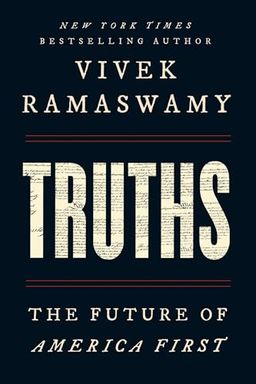
Truths cover

Truths

by Vivek Ramaswamy

The entrepreneur and former Republican presidential candidate shares his opinions on a variety of issues.

Ten Truths to Re-anchor American Life

What do you use to decide what’s true when the loudest voices reward outrage over honesty? In Truths, Vivek Ramaswamy argues that America doesn’t have a policy problem as much as a truth problem: we’ve lost a shared set of first principles that once grounded public life. He contends the path back isn’t new slogans or technocratic tinkering, but a return to bedrock truths—moral, scientific, constitutional, and civic—stated plainly and defended boldly, even when they violate today’s orthodoxies.

Ramaswamy lays out ten contentious claims that, he says, were once obvious and can be again: God is real; the climate-change agenda (not the climate itself) is a hoax; an open border is not a border; there are two genders; the administrative state is unconstitutional; the nuclear family is the greatest form of governance; reverse racism is racism; nationalism isn’t a bad word; facts are not conspiracies; and the U.S. Constitution is the strongest guarantor of freedom in history. Across chapters, he binds these together with one through line: reclaiming truth requires courage, conversation, and the demolition of systems—bureaucratic and cultural—that profit from confusion.

Why these truths, and why now?

Ramaswamy frames his project as a sequel to the nationalist shift that defined the Trump-era right—arguing that “America First” must mature from instincts into ideas. He describes two emerging conservative futures: National Patronage (use government muscle to protect workers through tariffs and industrial subsidies) and National Liberty (rebuild strategic independence by dismantling the administrative state and deepening trade with allies, all while fortifying borders, culture, and constitutional limits). His sympathies land with National Liberty, but his priority is clarifying what the movement stands for beyond negations of the left.

These chapters are not white papers. They’re kitchen-table arguments with references: Galileo’s heliocentrism to explain today’s heterodoxies; Steven Koonin’s Unsettled and Alex Epstein’s Fossil Future to challenge climate dogma; the Cass Review in the UK to scrutinize “gender-affirming care”; West Virginia v. EPA, Loper Bright, and SEC v. Jarkesy to show the Supreme Court chipping away at the fourth branch; and Founders like Washington, Adams, Jefferson, and later Tocqueville to remind us that constitutional liberty presumes character and community—starting in the home.

What you’ll learn in this summary

First, you’ll see how “God is real” isn’t a church-state power grab but a claim about the source of moral law and social cohesion—and why even famous atheists (Richard Dawkins, Ayaan Hirsi Ali) now defend Christianity’s cultural inheritance. Then you’ll examine how the climate-change agenda (not physics) works as a political economy: an unfalsifiable narrative that funnels power to bureaucrats and to China, often hurting the poor and energy-insecure the most.

Next, we’ll turn to sovereignty. “An open border is not a border” forces a basic arithmetic of compassion, rules, and incentives: asylum is for persecution, not poverty, and systems must match that reality. “There are two genders” pushes back on institutionalized compelled speech and medicalization of teen distress, arguing for compassion without denial of biological fact.

We’ll also explore governance: how the administrative state inverts separation of powers by letting agencies write, enforce, and adjudicate their own rules; why the nuclear family is the most local, humane, and effective form of social order; and how race essentialism (e.g., post-affirmative action workarounds) undermines equal protection while producing the very resentments it claims to cure.

Finally, we’ll look at nationhood and dissent. Civic nationalism binds diverse people with shared ideals—free speech, religious liberty, self-governance—so Ramaswamy proposes a national civics threshold (pass the same civics test as naturalized citizens) to align rights with responsibilities. And he argues that “facts are not conspiracies”: uncomfortable truths from the lab-leak hypothesis to Saudi roles in 9/11 were first smeared as kooky, then later conceded—proof that you must defend the marketplace of ideas if you want truth to surface when it counts.

Guiding Premise

“Truth isn’t relative. It isn’t dispensable. It’s the only thing that matters in the end.”

Why this matters to you

If you feel whiplashed by rules that change mid-sentence, this book hands you first-principle anchors—claims you can test in conversation, live by as a parent or neighbor, and evaluate as a citizen. It’s also a lens for sorting political noise: is a proposal expanding self-governance and truth-seeking, or deepening dependency on bureaucracies that evade accountability? Ramaswamy wants you debating—on purpose—so that persuasion can replace performance, and so that a civic “we” can be rebuilt from the bottom up.


Ten Truths to Re-anchor American Life

What do you use to decide what’s true when the loudest voices reward outrage over honesty? In Truths, Vivek Ramaswamy argues that America doesn’t have a policy problem as much as a truth problem: we’ve lost a shared set of first principles that once grounded public life. He contends the path back isn’t new slogans or technocratic tinkering, but a return to bedrock truths—moral, scientific, constitutional, and civic—stated plainly and defended boldly, even when they violate today’s orthodoxies.

Ramaswamy lays out ten contentious claims that, he says, were once obvious and can be again: God is real; the climate-change agenda (not the climate itself) is a hoax; an open border is not a border; there are two genders; the administrative state is unconstitutional; the nuclear family is the greatest form of governance; reverse racism is racism; nationalism isn’t a bad word; facts are not conspiracies; and the U.S. Constitution is the strongest guarantor of freedom in history. Across chapters, he binds these together with one through line: reclaiming truth requires courage, conversation, and the demolition of systems—bureaucratic and cultural—that profit from confusion.

Why these truths, and why now?

Ramaswamy frames his project as a sequel to the nationalist shift that defined the Trump-era right—arguing that “America First” must mature from instincts into ideas. He describes two emerging conservative futures: National Patronage (use government muscle to protect workers through tariffs and industrial subsidies) and National Liberty (rebuild strategic independence by dismantling the administrative state and deepening trade with allies, all while fortifying borders, culture, and constitutional limits). His sympathies land with National Liberty, but his priority is clarifying what the movement stands for beyond negations of the left.

These chapters are not white papers. They’re kitchen-table arguments with references: Galileo’s heliocentrism to explain today’s heterodoxies; Steven Koonin’s Unsettled and Alex Epstein’s Fossil Future to challenge climate dogma; the Cass Review in the UK to scrutinize “gender-affirming care”; West Virginia v. EPA, Loper Bright, and SEC v. Jarkesy to show the Supreme Court chipping away at the fourth branch; and Founders like Washington, Adams, Jefferson, and later Tocqueville to remind us that constitutional liberty presumes character and community—starting in the home.

What you’ll learn in this summary

First, you’ll see how “God is real” isn’t a church-state power grab but a claim about the source of moral law and social cohesion—and why even famous atheists (Richard Dawkins, Ayaan Hirsi Ali) now defend Christianity’s cultural inheritance. Then you’ll examine how the climate-change agenda (not physics) works as a political economy: an unfalsifiable narrative that funnels power to bureaucrats and to China, often hurting the poor and energy-insecure the most.

Next, we’ll turn to sovereignty. “An open border is not a border” forces a basic arithmetic of compassion, rules, and incentives: asylum is for persecution, not poverty, and systems must match that reality. “There are two genders” pushes back on institutionalized compelled speech and medicalization of teen distress, arguing for compassion without denial of biological fact.

We’ll also explore governance: how the administrative state inverts separation of powers by letting agencies write, enforce, and adjudicate their own rules; why the nuclear family is the most local, humane, and effective form of social order; and how race essentialism (e.g., post-affirmative action workarounds) undermines equal protection while producing the very resentments it claims to cure.

Finally, we’ll look at nationhood and dissent. Civic nationalism binds diverse people with shared ideals—free speech, religious liberty, self-governance—so Ramaswamy proposes a national civics threshold (pass the same civics test as naturalized citizens) to align rights with responsibilities. And he argues that “facts are not conspiracies”: uncomfortable truths from the lab-leak hypothesis to Saudi roles in 9/11 were first smeared as kooky, then later conceded—proof that you must defend the marketplace of ideas if you want truth to surface when it counts.

Guiding Premise

“Truth isn’t relative. It isn’t dispensable. It’s the only thing that matters in the end.”

Why this matters to you

If you feel whiplashed by rules that change mid-sentence, this book hands you first-principle anchors—claims you can test in conversation, live by as a parent or neighbor, and evaluate as a citizen. It’s also a lens for sorting political noise: is a proposal expanding self-governance and truth-seeking, or deepening dependency on bureaucracies that evade accountability? Ramaswamy wants you debating—on purpose—so that persuasion can replace performance, and so that a civic “we” can be rebuilt from the bottom up.


Ten Truths to Re-anchor American Life

What do you use to decide what’s true when the loudest voices reward outrage over honesty? In Truths, Vivek Ramaswamy argues that America doesn’t have a policy problem as much as a truth problem: we’ve lost a shared set of first principles that once grounded public life. He contends the path back isn’t new slogans or technocratic tinkering, but a return to bedrock truths—moral, scientific, constitutional, and civic—stated plainly and defended boldly, even when they violate today’s orthodoxies.

Ramaswamy lays out ten contentious claims that, he says, were once obvious and can be again: God is real; the climate-change agenda (not the climate itself) is a hoax; an open border is not a border; there are two genders; the administrative state is unconstitutional; the nuclear family is the greatest form of governance; reverse racism is racism; nationalism isn’t a bad word; facts are not conspiracies; and the U.S. Constitution is the strongest guarantor of freedom in history. Across chapters, he binds these together with one through line: reclaiming truth requires courage, conversation, and the demolition of systems—bureaucratic and cultural—that profit from confusion.

Why these truths, and why now?

Ramaswamy frames his project as a sequel to the nationalist shift that defined the Trump-era right—arguing that “America First” must mature from instincts into ideas. He describes two emerging conservative futures: National Patronage (use government muscle to protect workers through tariffs and industrial subsidies) and National Liberty (rebuild strategic independence by dismantling the administrative state and deepening trade with allies, all while fortifying borders, culture, and constitutional limits). His sympathies land with National Liberty, but his priority is clarifying what the movement stands for beyond negations of the left.

These chapters are not white papers. They’re kitchen-table arguments with references: Galileo’s heliocentrism to explain today’s heterodoxies; Steven Koonin’s Unsettled and Alex Epstein’s Fossil Future to challenge climate dogma; the Cass Review in the UK to scrutinize “gender-affirming care”; West Virginia v. EPA, Loper Bright, and SEC v. Jarkesy to show the Supreme Court chipping away at the fourth branch; and Founders like Washington, Adams, Jefferson, and later Tocqueville to remind us that constitutional liberty presumes character and community—starting in the home.

What you’ll learn in this summary

First, you’ll see how “God is real” isn’t a church-state power grab but a claim about the source of moral law and social cohesion—and why even famous atheists (Richard Dawkins, Ayaan Hirsi Ali) now defend Christianity’s cultural inheritance. Then you’ll examine how the climate-change agenda (not physics) works as a political economy: an unfalsifiable narrative that funnels power to bureaucrats and to China, often hurting the poor and energy-insecure the most.

Next, we’ll turn to sovereignty. “An open border is not a border” forces a basic arithmetic of compassion, rules, and incentives: asylum is for persecution, not poverty, and systems must match that reality. “There are two genders” pushes back on institutionalized compelled speech and medicalization of teen distress, arguing for compassion without denial of biological fact.

We’ll also explore governance: how the administrative state inverts separation of powers by letting agencies write, enforce, and adjudicate their own rules; why the nuclear family is the most local, humane, and effective form of social order; and how race essentialism (e.g., post-affirmative action workarounds) undermines equal protection while producing the very resentments it claims to cure.

Finally, we’ll look at nationhood and dissent. Civic nationalism binds diverse people with shared ideals—free speech, religious liberty, self-governance—so Ramaswamy proposes a national civics threshold (pass the same civics test as naturalized citizens) to align rights with responsibilities. And he argues that “facts are not conspiracies”: uncomfortable truths from the lab-leak hypothesis to Saudi roles in 9/11 were first smeared as kooky, then later conceded—proof that you must defend the marketplace of ideas if you want truth to surface when it counts.

Guiding Premise

“Truth isn’t relative. It isn’t dispensable. It’s the only thing that matters in the end.”

Why this matters to you

If you feel whiplashed by rules that change mid-sentence, this book hands you first-principle anchors—claims you can test in conversation, live by as a parent or neighbor, and evaluate as a citizen. It’s also a lens for sorting political noise: is a proposal expanding self-governance and truth-seeking, or deepening dependency on bureaucracies that evade accountability? Ramaswamy wants you debating—on purpose—so that persuasion can replace performance, and so that a civic “we” can be rebuilt from the bottom up.


Why "God Is Real" Still Matters

Ramaswamy opens with a lightning rod: “God is real.” He doesn’t wield it as a theocratic cudgel, but as a statement about truth, conscience, and why the American experiment requires a moral source bigger than the state. Raised in the Hindu Vedanta tradition, he argues—alongside Kant and C. S. Lewis—that our moral law within points beyond neurons to a lawgiver. Even if you’re secular, he says, society collapses when it loses a shared reverence for transcendent truth.

Science describes; it doesn’t explain “Why?”

The book sketches big-bang cosmology (noting Georges Lemaître, a Catholic priest, first proposed it), tensions between relativity and quantum mechanics, and string theory’s troubles (via Columbia’s Peter Woit). The punchline isn’t “science proves God,” but that science alone can’t answer the ultimate “Why?” questions. He cites atheist Lawrence Krauss’s The Edge of Knowledge to show how many ultimate questions remain open. As Alex O’Connor (another atheist) says: confusing description with explanation is a category error.

From there, he raises the fine-tuning puzzle (drawing on Paul Davies and Patrick Glynn): if slight changes in the strong force or water’s properties would have precluded life, why is the cosmos “set” just so? He notes Aristotle’s “unmoved mover” and Jefferson’s deism to argue: you can critique particular theologies without denying a Creator.

Morality points to a moral source

Ramaswamy leans on Immanuel Kant’s pairing—“the starry heavens above and the moral law within”—and on C. S. Lewis’s argument that calling a line “crooked” presumes a standard of “straight.” He invokes infant and primate studies (e.g., eight-month-olds glaring at aggressor blocks; capuchins rejecting unfair cucumber-grape distributions) to argue that fairness is innate, not merely socially programmed. William Lane Craig’s condensed logic—if objective moral values exist, God exists—appears as a clean syllogism.

He also offers Alvin Plantinga’s “Evolutionary Argument Against Naturalism”: if evolution optimizes for survival, not truth, we lack warrant to trust truth-apt cognition without a grounding outside pure material processes. And when Darwinian accounts of love can’t explain self-sacrificial commitments (e.g., husbands and wives who would die for each other), he insists that love signals a transcendence materialism can’t fully capture.

Faith, not force—and why nations need it

He’s explicit: government must not establish religion. But he warns against today’s elite hostility toward faith, which morphed from “freedom of religion” into a practical “freedom from religion” in public life. He quotes Washington, Adams, Jefferson, and Tocqueville to show the Founders saw religion as essential to the habits that sustain self-government. Without a transcendent reference point, he argues, the state fills the vacuum (as in revolutionary France, Soviet communism, Maoism)—or a new “woke” religion does.

Even staunch atheist Richard Dawkins recently called himself a “cultural Christian,” and writer Ayaan Hirsi Ali embraced Christianity for civilizational reasons: it built institutions—science, rule of law, universities—that defend human dignity (note the contrast with soft nihilism on today’s campuses). Ramaswamy’s pastoral application is simple: many young Americans are depressed and aimless; giving them a language of vocation—“You are loved and made for a purpose”—is the antidote to ennui.

Founders’ Logic

“Can the liberties of a nation be thought secure when we have removed their only firm basis… that these liberties are a gift of God?” —Thomas Jefferson

What this means for you

You don’t have to share Ramaswamy’s theology to see his civic point: a people that believes rights come from government will accept whatever new rights the state creates—and whatever old ones it rescinds. But a people that believes rights come from a Creator has grounds to limit state power. In your home, that’s permission to talk about first things—truth, goodness, love—without apology. In your community, it’s a call to defend tolerance of religious expression, not mere privatization of faith.


Why "God Is Real" Still Matters

Ramaswamy opens with a lightning rod: “God is real.” He doesn’t wield it as a theocratic cudgel, but as a statement about truth, conscience, and why the American experiment requires a moral source bigger than the state. Raised in the Hindu Vedanta tradition, he argues—alongside Kant and C. S. Lewis—that our moral law within points beyond neurons to a lawgiver. Even if you’re secular, he says, society collapses when it loses a shared reverence for transcendent truth.

Science describes; it doesn’t explain “Why?”

The book sketches big-bang cosmology (noting Georges Lemaître, a Catholic priest, first proposed it), tensions between relativity and quantum mechanics, and string theory’s troubles (via Columbia’s Peter Woit). The punchline isn’t “science proves God,” but that science alone can’t answer the ultimate “Why?” questions. He cites atheist Lawrence Krauss’s The Edge of Knowledge to show how many ultimate questions remain open. As Alex O’Connor (another atheist) says: confusing description with explanation is a category error.

From there, he raises the fine-tuning puzzle (drawing on Paul Davies and Patrick Glynn): if slight changes in the strong force or water’s properties would have precluded life, why is the cosmos “set” just so? He notes Aristotle’s “unmoved mover” and Jefferson’s deism to argue: you can critique particular theologies without denying a Creator.

Morality points to a moral source

Ramaswamy leans on Immanuel Kant’s pairing—“the starry heavens above and the moral law within”—and on C. S. Lewis’s argument that calling a line “crooked” presumes a standard of “straight.” He invokes infant and primate studies (e.g., eight-month-olds glaring at aggressor blocks; capuchins rejecting unfair cucumber-grape distributions) to argue that fairness is innate, not merely socially programmed. William Lane Craig’s condensed logic—if objective moral values exist, God exists—appears as a clean syllogism.

He also offers Alvin Plantinga’s “Evolutionary Argument Against Naturalism”: if evolution optimizes for survival, not truth, we lack warrant to trust truth-apt cognition without a grounding outside pure material processes. And when Darwinian accounts of love can’t explain self-sacrificial commitments (e.g., husbands and wives who would die for each other), he insists that love signals a transcendence materialism can’t fully capture.

Faith, not force—and why nations need it

He’s explicit: government must not establish religion. But he warns against today’s elite hostility toward faith, which morphed from “freedom of religion” into a practical “freedom from religion” in public life. He quotes Washington, Adams, Jefferson, and Tocqueville to show the Founders saw religion as essential to the habits that sustain self-government. Without a transcendent reference point, he argues, the state fills the vacuum (as in revolutionary France, Soviet communism, Maoism)—or a new “woke” religion does.

Even staunch atheist Richard Dawkins recently called himself a “cultural Christian,” and writer Ayaan Hirsi Ali embraced Christianity for civilizational reasons: it built institutions—science, rule of law, universities—that defend human dignity (note the contrast with soft nihilism on today’s campuses). Ramaswamy’s pastoral application is simple: many young Americans are depressed and aimless; giving them a language of vocation—“You are loved and made for a purpose”—is the antidote to ennui.

Founders’ Logic

“Can the liberties of a nation be thought secure when we have removed their only firm basis… that these liberties are a gift of God?” —Thomas Jefferson

What this means for you

You don’t have to share Ramaswamy’s theology to see his civic point: a people that believes rights come from government will accept whatever new rights the state creates—and whatever old ones it rescinds. But a people that believes rights come from a Creator has grounds to limit state power. In your home, that’s permission to talk about first things—truth, goodness, love—without apology. In your community, it’s a call to defend tolerance of religious expression, not mere privatization of faith.


Why "God Is Real" Still Matters

Ramaswamy opens with a lightning rod: “God is real.” He doesn’t wield it as a theocratic cudgel, but as a statement about truth, conscience, and why the American experiment requires a moral source bigger than the state. Raised in the Hindu Vedanta tradition, he argues—alongside Kant and C. S. Lewis—that our moral law within points beyond neurons to a lawgiver. Even if you’re secular, he says, society collapses when it loses a shared reverence for transcendent truth.

Science describes; it doesn’t explain “Why?”

The book sketches big-bang cosmology (noting Georges Lemaître, a Catholic priest, first proposed it), tensions between relativity and quantum mechanics, and string theory’s troubles (via Columbia’s Peter Woit). The punchline isn’t “science proves God,” but that science alone can’t answer the ultimate “Why?” questions. He cites atheist Lawrence Krauss’s The Edge of Knowledge to show how many ultimate questions remain open. As Alex O’Connor (another atheist) says: confusing description with explanation is a category error.

From there, he raises the fine-tuning puzzle (drawing on Paul Davies and Patrick Glynn): if slight changes in the strong force or water’s properties would have precluded life, why is the cosmos “set” just so? He notes Aristotle’s “unmoved mover” and Jefferson’s deism to argue: you can critique particular theologies without denying a Creator.

Morality points to a moral source

Ramaswamy leans on Immanuel Kant’s pairing—“the starry heavens above and the moral law within”—and on C. S. Lewis’s argument that calling a line “crooked” presumes a standard of “straight.” He invokes infant and primate studies (e.g., eight-month-olds glaring at aggressor blocks; capuchins rejecting unfair cucumber-grape distributions) to argue that fairness is innate, not merely socially programmed. William Lane Craig’s condensed logic—if objective moral values exist, God exists—appears as a clean syllogism.

He also offers Alvin Plantinga’s “Evolutionary Argument Against Naturalism”: if evolution optimizes for survival, not truth, we lack warrant to trust truth-apt cognition without a grounding outside pure material processes. And when Darwinian accounts of love can’t explain self-sacrificial commitments (e.g., husbands and wives who would die for each other), he insists that love signals a transcendence materialism can’t fully capture.

Faith, not force—and why nations need it

He’s explicit: government must not establish religion. But he warns against today’s elite hostility toward faith, which morphed from “freedom of religion” into a practical “freedom from religion” in public life. He quotes Washington, Adams, Jefferson, and Tocqueville to show the Founders saw religion as essential to the habits that sustain self-government. Without a transcendent reference point, he argues, the state fills the vacuum (as in revolutionary France, Soviet communism, Maoism)—or a new “woke” religion does.

Even staunch atheist Richard Dawkins recently called himself a “cultural Christian,” and writer Ayaan Hirsi Ali embraced Christianity for civilizational reasons: it built institutions—science, rule of law, universities—that defend human dignity (note the contrast with soft nihilism on today’s campuses). Ramaswamy’s pastoral application is simple: many young Americans are depressed and aimless; giving them a language of vocation—“You are loved and made for a purpose”—is the antidote to ennui.

Founders’ Logic

“Can the liberties of a nation be thought secure when we have removed their only firm basis… that these liberties are a gift of God?” —Thomas Jefferson

What this means for you

You don’t have to share Ramaswamy’s theology to see his civic point: a people that believes rights come from government will accept whatever new rights the state creates—and whatever old ones it rescinds. But a people that believes rights come from a Creator has grounds to limit state power. In your home, that’s permission to talk about first things—truth, goodness, love—without apology. In your community, it’s a call to defend tolerance of religious expression, not mere privatization of faith.


The Climate Agenda vs. Climate Reality

Ramaswamy separates climate science from the climate agenda, arguing the latter is a political program that thrives on unfalsifiable claims, centralizes power, and too often enriches China at America’s expense. His refrain: ask four separate questions—Are surface temperatures rising? Is it primarily man-made? Is warming net harmful? Does the proposed cure cost more human flourishing than the disease?—because activists habitually fuse them into a single, freighted plea.

Is the planet warming—and what are we measuring?

He concedes a modest warming trend over the last half-century, but spotlights how measurements can be distorted by urban heat islands and local land-use changes. He draws on physicist Steven Koonin’s Unsettled to show how newspaper heat maps confuse readers by plotting localized “blobs” of warming driven by urbanization as if they were global greenhouse effects. The terminology pivot from “global warming” to “climate change,” he argues, insulated the narrative from disconfirmation: now any change proves the thesis.

He urges humility on causality. CO₂ is ~0.04% of the atmosphere; other greenhouse gases like H₂O vary far more. Historically, CO₂ has been higher even during glaciations. He notes Antarctic sea ice expanded for decades after satellite tracking began (NASA) and warns against monocausal blame in a system with multiple forcings. His point: uncertainty is not denial; it’s what honest climate science should acknowledge.

Could warming net-help more than harm?

Here Ramaswamy cites Bjorn Lomborg: eight times more people die from cold than heat each year. He also notes climate-disaster deaths collapsed by ~98% over a century—precisely as fossil-fuel use soared—thanks to resilient infrastructure, reliable energy, and technology (a point Alex Epstein develops extensively in Fossil Future). Greening trends, amplified by CO₂ fertilization, complicate doom narratives; and Earth’s feedback systems (e.g., plant carbon sinks) self-adjust more than activists admit.

Most crucially, he argues the poor pay first for elite climate experiments. He tells of a Gambian hospital where intermittent electricity turned routine neonatal care into a tragic lottery. For billions, fossil energy is the line between life and death; pushing them to skip straight to intermittents without baseload is moral preening masquerading as compassion.

When “green” policy deepens red dependencies

He describes how U.S. ESG pressure hobbles domestic producers (e.g., BlackRock voting for Scope 3 emissions caps at Chevron), while Chinese state firms face no comparable shareholder activism. The result: American outputs shrink while China controls battery supply chains, rare earth processing, and solar inputs—growing U.S. dependence. Meanwhile, U.S. agencies backdoor massive climate policy via regulation (SEC climate disclosures; EPA emissions schemes) that Congress never passed.

On the ground, federal subsidies can strong-arm communities. He recounts Iowa CO₂-capture pipelines that require eminent domain against farmers’ objections; he details the 2020 Satartia, Mississippi pipeline rupture that left residents unconscious in their cars, underscoring real-world risk-benefit tradeoffs ignored by activists who would rather bury CO₂ under farms than let it harmlessly dissipate in the air.

Four Separating Questions

1) Is it warming? 2) Is it mostly human-caused? 3) Is warming net harmful? 4) Do proposed cures help more than they harm?

What this means for you

In family debates, refuse bundled claims. Ask which of the four questions you’re actually discussing. At work, scrutinize Scope 3 pledges and supply-chain realities: are you offshoring emissions—and jobs—to China while patting yourself on the back? As a voter, prefer policy that increases reliable energy access (nuclear, gas, next-gen grids) while funding adaptation and hardening infrastructure—ways to save lives now, not just CO₂ decimals in 2100.


The Climate Agenda vs. Climate Reality

Ramaswamy separates climate science from the climate agenda, arguing the latter is a political program that thrives on unfalsifiable claims, centralizes power, and too often enriches China at America’s expense. His refrain: ask four separate questions—Are surface temperatures rising? Is it primarily man-made? Is warming net harmful? Does the proposed cure cost more human flourishing than the disease?—because activists habitually fuse them into a single, freighted plea.

Is the planet warming—and what are we measuring?

He concedes a modest warming trend over the last half-century, but spotlights how measurements can be distorted by urban heat islands and local land-use changes. He draws on physicist Steven Koonin’s Unsettled to show how newspaper heat maps confuse readers by plotting localized “blobs” of warming driven by urbanization as if they were global greenhouse effects. The terminology pivot from “global warming” to “climate change,” he argues, insulated the narrative from disconfirmation: now any change proves the thesis.

He urges humility on causality. CO₂ is ~0.04% of the atmosphere; other greenhouse gases like H₂O vary far more. Historically, CO₂ has been higher even during glaciations. He notes Antarctic sea ice expanded for decades after satellite tracking began (NASA) and warns against monocausal blame in a system with multiple forcings. His point: uncertainty is not denial; it’s what honest climate science should acknowledge.

Could warming net-help more than harm?

Here Ramaswamy cites Bjorn Lomborg: eight times more people die from cold than heat each year. He also notes climate-disaster deaths collapsed by ~98% over a century—precisely as fossil-fuel use soared—thanks to resilient infrastructure, reliable energy, and technology (a point Alex Epstein develops extensively in Fossil Future). Greening trends, amplified by CO₂ fertilization, complicate doom narratives; and Earth’s feedback systems (e.g., plant carbon sinks) self-adjust more than activists admit.

Most crucially, he argues the poor pay first for elite climate experiments. He tells of a Gambian hospital where intermittent electricity turned routine neonatal care into a tragic lottery. For billions, fossil energy is the line between life and death; pushing them to skip straight to intermittents without baseload is moral preening masquerading as compassion.

When “green” policy deepens red dependencies

He describes how U.S. ESG pressure hobbles domestic producers (e.g., BlackRock voting for Scope 3 emissions caps at Chevron), while Chinese state firms face no comparable shareholder activism. The result: American outputs shrink while China controls battery supply chains, rare earth processing, and solar inputs—growing U.S. dependence. Meanwhile, U.S. agencies backdoor massive climate policy via regulation (SEC climate disclosures; EPA emissions schemes) that Congress never passed.

On the ground, federal subsidies can strong-arm communities. He recounts Iowa CO₂-capture pipelines that require eminent domain against farmers’ objections; he details the 2020 Satartia, Mississippi pipeline rupture that left residents unconscious in their cars, underscoring real-world risk-benefit tradeoffs ignored by activists who would rather bury CO₂ under farms than let it harmlessly dissipate in the air.

Four Separating Questions

1) Is it warming? 2) Is it mostly human-caused? 3) Is warming net harmful? 4) Do proposed cures help more than they harm?

What this means for you

In family debates, refuse bundled claims. Ask which of the four questions you’re actually discussing. At work, scrutinize Scope 3 pledges and supply-chain realities: are you offshoring emissions—and jobs—to China while patting yourself on the back? As a voter, prefer policy that increases reliable energy access (nuclear, gas, next-gen grids) while funding adaptation and hardening infrastructure—ways to save lives now, not just CO₂ decimals in 2100.


The Climate Agenda vs. Climate Reality

Ramaswamy separates climate science from the climate agenda, arguing the latter is a political program that thrives on unfalsifiable claims, centralizes power, and too often enriches China at America’s expense. His refrain: ask four separate questions—Are surface temperatures rising? Is it primarily man-made? Is warming net harmful? Does the proposed cure cost more human flourishing than the disease?—because activists habitually fuse them into a single, freighted plea.

Is the planet warming—and what are we measuring?

He concedes a modest warming trend over the last half-century, but spotlights how measurements can be distorted by urban heat islands and local land-use changes. He draws on physicist Steven Koonin’s Unsettled to show how newspaper heat maps confuse readers by plotting localized “blobs” of warming driven by urbanization as if they were global greenhouse effects. The terminology pivot from “global warming” to “climate change,” he argues, insulated the narrative from disconfirmation: now any change proves the thesis.

He urges humility on causality. CO₂ is ~0.04% of the atmosphere; other greenhouse gases like H₂O vary far more. Historically, CO₂ has been higher even during glaciations. He notes Antarctic sea ice expanded for decades after satellite tracking began (NASA) and warns against monocausal blame in a system with multiple forcings. His point: uncertainty is not denial; it’s what honest climate science should acknowledge.

Could warming net-help more than harm?

Here Ramaswamy cites Bjorn Lomborg: eight times more people die from cold than heat each year. He also notes climate-disaster deaths collapsed by ~98% over a century—precisely as fossil-fuel use soared—thanks to resilient infrastructure, reliable energy, and technology (a point Alex Epstein develops extensively in Fossil Future). Greening trends, amplified by CO₂ fertilization, complicate doom narratives; and Earth’s feedback systems (e.g., plant carbon sinks) self-adjust more than activists admit.

Most crucially, he argues the poor pay first for elite climate experiments. He tells of a Gambian hospital where intermittent electricity turned routine neonatal care into a tragic lottery. For billions, fossil energy is the line between life and death; pushing them to skip straight to intermittents without baseload is moral preening masquerading as compassion.

When “green” policy deepens red dependencies

He describes how U.S. ESG pressure hobbles domestic producers (e.g., BlackRock voting for Scope 3 emissions caps at Chevron), while Chinese state firms face no comparable shareholder activism. The result: American outputs shrink while China controls battery supply chains, rare earth processing, and solar inputs—growing U.S. dependence. Meanwhile, U.S. agencies backdoor massive climate policy via regulation (SEC climate disclosures; EPA emissions schemes) that Congress never passed.

On the ground, federal subsidies can strong-arm communities. He recounts Iowa CO₂-capture pipelines that require eminent domain against farmers’ objections; he details the 2020 Satartia, Mississippi pipeline rupture that left residents unconscious in their cars, underscoring real-world risk-benefit tradeoffs ignored by activists who would rather bury CO₂ under farms than let it harmlessly dissipate in the air.

Four Separating Questions

1) Is it warming? 2) Is it mostly human-caused? 3) Is warming net harmful? 4) Do proposed cures help more than they harm?

What this means for you

In family debates, refuse bundled claims. Ask which of the four questions you’re actually discussing. At work, scrutinize Scope 3 pledges and supply-chain realities: are you offshoring emissions—and jobs—to China while patting yourself on the back? As a voter, prefer policy that increases reliable energy access (nuclear, gas, next-gen grids) while funding adaptation and hardening infrastructure—ways to save lives now, not just CO₂ decimals in 2100.


Borders, Asylum, and Choosing Whom to Welcome

“An open border is not a border.” Ramaswamy starts here to restore moral clarity: a nation must choose whom it admits, in what number, and on what terms—or it ceases to be a nation. Gallup data suggest ~700 million people would move to the U.S. if they could; compassion without limits is a math problem, not a policy. The task is to choose with purpose—security first, identity second, prosperity third—as his broader “National Liberty” framework argues.

Asylum is about persecution, not poverty

Under U.S. law, asylum exists for those fleeing persecution for race, religion, nationality, political opinion, or a particular social group—and only when internal relocation isn’t feasible. Ramaswamy recounts abuses: charter tours to Mexico, social-media “travel agencies,” and coached stories that morph upon arrival; cases like a Russian applicant posing as a lesbian, only to admit she lied when pressed by her own lawyer (New York Times). Meanwhile, asylum grant rates vary wildly by judge—from ~4.6% to ~98.5% in the same city—telegraphing a system unmoored from consistent law.

He also exposes perverse incentives: bringing a child expedites release under a 2015 court limit on child detention. DNA tests began revealing non-parent “families” (8.5% to 30% mismatch rates in pilot programs), but testing ended amid accusations it stigmatized “nontraditional families.” Remove tests, and you empower traffickers. Keep catch-and-release, and you multiply crossings. Incentives, not rhetoric, drive flows.

Secure borders, humane process, clear signals

He proposes an Australia-style posture: detain nearly all uninvited entrants pending adjudication (fraud falls when the odds of quick interior release vanish), and require asylum claims in the first safe country reached (currently we apply this only to Canada; expand it southward). He explores the UK’s Rwanda model—process claims abroad and, if approved, offer refuge there—to break smuggling networks and end the “golden ticket” magnetism. He also champions ending birthright citizenship for those not “subject to the jurisdiction” (14th Amendment’s original meaning per Slaughter-House and Elk v. Wilkins), which now fuels “birth tourism” businesses from Beverly Hills to Miami.

Finally, no more eminent-domain bullying for speculative climate projects (like CO₂ pipelines) while basic barriers remain unbuilt. Prioritize resources for physical barriers, sensors, and manpower; end broad catch-and-release; and align local, state, and federal authorities to remove criminal aliens quickly.

Legal immigration by design, not by drift

Ramaswamy’s legal immigration design echoes Canada and Australia: a points-based system that weights skills, demand-based trades, English proficiency, and civics knowledge. Add strategic levers: use visas as tools of foreign policy (limit student visas if China won’t stem fentanyl precursors; penalize countries that won’t take back deportees; tie trade benefits to cooperation). And treat admissions as nation-building: favor applicants likely to assimilate into American civic ideals, not just GDP inputs.

Moral Frame

A government’s obligations run exclusively to its citizens. Charity doesn’t end at home—but sovereignty begins there.

What this means for you

In conversations, separate compassion for migrants from clarity about rules. Ask: Is this policy reducing exploitation and deaths or incentivizing them? Are we conflating asylum (persecution) with economic migration (poverty)? Support reforms that align signals with law (detention pending adjudication), restore the safe-third-country norm, and design a legal path that matches our needs and values. Compassion endures when it’s paired with order.


Borders, Asylum, and Choosing Whom to Welcome

“An open border is not a border.” Ramaswamy starts here to restore moral clarity: a nation must choose whom it admits, in what number, and on what terms—or it ceases to be a nation. Gallup data suggest ~700 million people would move to the U.S. if they could; compassion without limits is a math problem, not a policy. The task is to choose with purpose—security first, identity second, prosperity third—as his broader “National Liberty” framework argues.

Asylum is about persecution, not poverty

Under U.S. law, asylum exists for those fleeing persecution for race, religion, nationality, political opinion, or a particular social group—and only when internal relocation isn’t feasible. Ramaswamy recounts abuses: charter tours to Mexico, social-media “travel agencies,” and coached stories that morph upon arrival; cases like a Russian applicant posing as a lesbian, only to admit she lied when pressed by her own lawyer (New York Times). Meanwhile, asylum grant rates vary wildly by judge—from ~4.6% to ~98.5% in the same city—telegraphing a system unmoored from consistent law.

He also exposes perverse incentives: bringing a child expedites release under a 2015 court limit on child detention. DNA tests began revealing non-parent “families” (8.5% to 30% mismatch rates in pilot programs), but testing ended amid accusations it stigmatized “nontraditional families.” Remove tests, and you empower traffickers. Keep catch-and-release, and you multiply crossings. Incentives, not rhetoric, drive flows.

Secure borders, humane process, clear signals

He proposes an Australia-style posture: detain nearly all uninvited entrants pending adjudication (fraud falls when the odds of quick interior release vanish), and require asylum claims in the first safe country reached (currently we apply this only to Canada; expand it southward). He explores the UK’s Rwanda model—process claims abroad and, if approved, offer refuge there—to break smuggling networks and end the “golden ticket” magnetism. He also champions ending birthright citizenship for those not “subject to the jurisdiction” (14th Amendment’s original meaning per Slaughter-House and Elk v. Wilkins), which now fuels “birth tourism” businesses from Beverly Hills to Miami.

Finally, no more eminent-domain bullying for speculative climate projects (like CO₂ pipelines) while basic barriers remain unbuilt. Prioritize resources for physical barriers, sensors, and manpower; end broad catch-and-release; and align local, state, and federal authorities to remove criminal aliens quickly.

Legal immigration by design, not by drift

Ramaswamy’s legal immigration design echoes Canada and Australia: a points-based system that weights skills, demand-based trades, English proficiency, and civics knowledge. Add strategic levers: use visas as tools of foreign policy (limit student visas if China won’t stem fentanyl precursors; penalize countries that won’t take back deportees; tie trade benefits to cooperation). And treat admissions as nation-building: favor applicants likely to assimilate into American civic ideals, not just GDP inputs.

Moral Frame

A government’s obligations run exclusively to its citizens. Charity doesn’t end at home—but sovereignty begins there.

What this means for you

In conversations, separate compassion for migrants from clarity about rules. Ask: Is this policy reducing exploitation and deaths or incentivizing them? Are we conflating asylum (persecution) with economic migration (poverty)? Support reforms that align signals with law (detention pending adjudication), restore the safe-third-country norm, and design a legal path that matches our needs and values. Compassion endures when it’s paired with order.


Borders, Asylum, and Choosing Whom to Welcome

“An open border is not a border.” Ramaswamy starts here to restore moral clarity: a nation must choose whom it admits, in what number, and on what terms—or it ceases to be a nation. Gallup data suggest ~700 million people would move to the U.S. if they could; compassion without limits is a math problem, not a policy. The task is to choose with purpose—security first, identity second, prosperity third—as his broader “National Liberty” framework argues.

Asylum is about persecution, not poverty

Under U.S. law, asylum exists for those fleeing persecution for race, religion, nationality, political opinion, or a particular social group—and only when internal relocation isn’t feasible. Ramaswamy recounts abuses: charter tours to Mexico, social-media “travel agencies,” and coached stories that morph upon arrival; cases like a Russian applicant posing as a lesbian, only to admit she lied when pressed by her own lawyer (New York Times). Meanwhile, asylum grant rates vary wildly by judge—from ~4.6% to ~98.5% in the same city—telegraphing a system unmoored from consistent law.

He also exposes perverse incentives: bringing a child expedites release under a 2015 court limit on child detention. DNA tests began revealing non-parent “families” (8.5% to 30% mismatch rates in pilot programs), but testing ended amid accusations it stigmatized “nontraditional families.” Remove tests, and you empower traffickers. Keep catch-and-release, and you multiply crossings. Incentives, not rhetoric, drive flows.

Secure borders, humane process, clear signals

He proposes an Australia-style posture: detain nearly all uninvited entrants pending adjudication (fraud falls when the odds of quick interior release vanish), and require asylum claims in the first safe country reached (currently we apply this only to Canada; expand it southward). He explores the UK’s Rwanda model—process claims abroad and, if approved, offer refuge there—to break smuggling networks and end the “golden ticket” magnetism. He also champions ending birthright citizenship for those not “subject to the jurisdiction” (14th Amendment’s original meaning per Slaughter-House and Elk v. Wilkins), which now fuels “birth tourism” businesses from Beverly Hills to Miami.

Finally, no more eminent-domain bullying for speculative climate projects (like CO₂ pipelines) while basic barriers remain unbuilt. Prioritize resources for physical barriers, sensors, and manpower; end broad catch-and-release; and align local, state, and federal authorities to remove criminal aliens quickly.

Legal immigration by design, not by drift

Ramaswamy’s legal immigration design echoes Canada and Australia: a points-based system that weights skills, demand-based trades, English proficiency, and civics knowledge. Add strategic levers: use visas as tools of foreign policy (limit student visas if China won’t stem fentanyl precursors; penalize countries that won’t take back deportees; tie trade benefits to cooperation). And treat admissions as nation-building: favor applicants likely to assimilate into American civic ideals, not just GDP inputs.

Moral Frame

A government’s obligations run exclusively to its citizens. Charity doesn’t end at home—but sovereignty begins there.

What this means for you

In conversations, separate compassion for migrants from clarity about rules. Ask: Is this policy reducing exploitation and deaths or incentivizing them? Are we conflating asylum (persecution) with economic migration (poverty)? Support reforms that align signals with law (detention pending adjudication), restore the safe-third-country norm, and design a legal path that matches our needs and values. Compassion endures when it’s paired with order.


Biology, Compassion, and the Gender Debate

Ramaswamy wades into the fiercest cultural fight with two claims: 1) Sex is binary and biological; 2) Compassion for people with gender dysphoria does not require compelled speech, policy fictions, or irreversible medicalization of children. He argues our institutions have criminalized obvious truths and medicalized teen distress, while punishing open debate—then shows how to hold boundaries and hold out care.

Two sexes; many personalities

He returns to 6th-grade biology: XX is female; XY is male; this maps to reproductive anatomy, not stereotypes. Intersex conditions (e.g., Klinefelter’s XXY; Jacobs XYY) are rare pathologies, not third sexes—just as heterochromia doesn’t negate that human eyes come in discrete colors. He notes a logical contradiction inside today’s “LGBTQIA+” umbrella: many activists claim sexual orientation is immutable (yet lack a discovered “gay gene”), while simultaneously declaring biological sex is fluid despite an entire chromosome set and reproductive function at stake (Douglas Murray makes a similar critique in The Madness of Crowds).

He recounts J. K. Rowling’s torrent of threats for defending sex-based rights (“I wish you nice pipe bomb in mailbox,” one message said). Meanwhile, journalists like Jesse Singal faced smear campaigns for reporting on detransitioners and the shaky evidence behind pediatric transition.

Medicine must follow evidence—and first do no harm

He highlights the UK’s Cass Review, a five-year independent assessment that condemned the poor evidence base for pediatric “gender-affirming care” and urged a psych-first, whole-child model. He shares stories of young women who received puberty blockers, double mastectomies, even hysterectomies as teens—and now regret irreversible choices made amid adolescent turmoil. Affirmation without exploration, he argues, isn’t compassion; it’s capitulation that often spreads peer contagion.

On adults, he emphasizes live-and-let-live rights: free association and freedom from persecution. But drawing hard lines matters in sports (fairness and safety for women competing against biological males), prisons (documented assaults by male-bodied inmates in women’s facilities), and intimate spaces (bathrooms/locker rooms). Safety and truth are public goods; kindness doesn’t require pretending sex is irrelevant.

Speech, science, and the new blasphemy laws

He opposes criminalizing “misgendering,” seeing it as compelled speech incompatible with the First Amendment. On platforms, he criticizes policies that label pronoun disagreement as “harassment” while allowing defamation of dissenters. He also skewers movement incoherence: if being trans is not a medical condition, why should insurers pay for transition surgeries; if it is a medical condition, why prohibit exploratory therapy and evidence review?

A Way Through

Protect speech and biological reality. Protect children from irreversible interventions. Protect adults from persecution. These are compatible.

What this means for you

In your circles, lead with care—listen first—but refuse to give up ground on sex-based rights, women’s safety in sports and prisons, and the need for rigorous, psychosocial-first care for kids. Defend open inquiry (e.g., UK Cass Review) as a model. And don’t outsource your conscience to HR policies: you can respect individuals without endorsing untruths.


Biology, Compassion, and the Gender Debate

Ramaswamy wades into the fiercest cultural fight with two claims: 1) Sex is binary and biological; 2) Compassion for people with gender dysphoria does not require compelled speech, policy fictions, or irreversible medicalization of children. He argues our institutions have criminalized obvious truths and medicalized teen distress, while punishing open debate—then shows how to hold boundaries and hold out care.

Two sexes; many personalities

He returns to 6th-grade biology: XX is female; XY is male; this maps to reproductive anatomy, not stereotypes. Intersex conditions (e.g., Klinefelter’s XXY; Jacobs XYY) are rare pathologies, not third sexes—just as heterochromia doesn’t negate that human eyes come in discrete colors. He notes a logical contradiction inside today’s “LGBTQIA+” umbrella: many activists claim sexual orientation is immutable (yet lack a discovered “gay gene”), while simultaneously declaring biological sex is fluid despite an entire chromosome set and reproductive function at stake (Douglas Murray makes a similar critique in The Madness of Crowds).

He recounts J. K. Rowling’s torrent of threats for defending sex-based rights (“I wish you nice pipe bomb in mailbox,” one message said). Meanwhile, journalists like Jesse Singal faced smear campaigns for reporting on detransitioners and the shaky evidence behind pediatric transition.

Medicine must follow evidence—and first do no harm

He highlights the UK’s Cass Review, a five-year independent assessment that condemned the poor evidence base for pediatric “gender-affirming care” and urged a psych-first, whole-child model. He shares stories of young women who received puberty blockers, double mastectomies, even hysterectomies as teens—and now regret irreversible choices made amid adolescent turmoil. Affirmation without exploration, he argues, isn’t compassion; it’s capitulation that often spreads peer contagion.

On adults, he emphasizes live-and-let-live rights: free association and freedom from persecution. But drawing hard lines matters in sports (fairness and safety for women competing against biological males), prisons (documented assaults by male-bodied inmates in women’s facilities), and intimate spaces (bathrooms/locker rooms). Safety and truth are public goods; kindness doesn’t require pretending sex is irrelevant.

Speech, science, and the new blasphemy laws

He opposes criminalizing “misgendering,” seeing it as compelled speech incompatible with the First Amendment. On platforms, he criticizes policies that label pronoun disagreement as “harassment” while allowing defamation of dissenters. He also skewers movement incoherence: if being trans is not a medical condition, why should insurers pay for transition surgeries; if it is a medical condition, why prohibit exploratory therapy and evidence review?

A Way Through

Protect speech and biological reality. Protect children from irreversible interventions. Protect adults from persecution. These are compatible.

What this means for you

In your circles, lead with care—listen first—but refuse to give up ground on sex-based rights, women’s safety in sports and prisons, and the need for rigorous, psychosocial-first care for kids. Defend open inquiry (e.g., UK Cass Review) as a model. And don’t outsource your conscience to HR policies: you can respect individuals without endorsing untruths.


Biology, Compassion, and the Gender Debate

Ramaswamy wades into the fiercest cultural fight with two claims: 1) Sex is binary and biological; 2) Compassion for people with gender dysphoria does not require compelled speech, policy fictions, or irreversible medicalization of children. He argues our institutions have criminalized obvious truths and medicalized teen distress, while punishing open debate—then shows how to hold boundaries and hold out care.

Two sexes; many personalities

He returns to 6th-grade biology: XX is female; XY is male; this maps to reproductive anatomy, not stereotypes. Intersex conditions (e.g., Klinefelter’s XXY; Jacobs XYY) are rare pathologies, not third sexes—just as heterochromia doesn’t negate that human eyes come in discrete colors. He notes a logical contradiction inside today’s “LGBTQIA+” umbrella: many activists claim sexual orientation is immutable (yet lack a discovered “gay gene”), while simultaneously declaring biological sex is fluid despite an entire chromosome set and reproductive function at stake (Douglas Murray makes a similar critique in The Madness of Crowds).

He recounts J. K. Rowling’s torrent of threats for defending sex-based rights (“I wish you nice pipe bomb in mailbox,” one message said). Meanwhile, journalists like Jesse Singal faced smear campaigns for reporting on detransitioners and the shaky evidence behind pediatric transition.

Medicine must follow evidence—and first do no harm

He highlights the UK’s Cass Review, a five-year independent assessment that condemned the poor evidence base for pediatric “gender-affirming care” and urged a psych-first, whole-child model. He shares stories of young women who received puberty blockers, double mastectomies, even hysterectomies as teens—and now regret irreversible choices made amid adolescent turmoil. Affirmation without exploration, he argues, isn’t compassion; it’s capitulation that often spreads peer contagion.

On adults, he emphasizes live-and-let-live rights: free association and freedom from persecution. But drawing hard lines matters in sports (fairness and safety for women competing against biological males), prisons (documented assaults by male-bodied inmates in women’s facilities), and intimate spaces (bathrooms/locker rooms). Safety and truth are public goods; kindness doesn’t require pretending sex is irrelevant.

Speech, science, and the new blasphemy laws

He opposes criminalizing “misgendering,” seeing it as compelled speech incompatible with the First Amendment. On platforms, he criticizes policies that label pronoun disagreement as “harassment” while allowing defamation of dissenters. He also skewers movement incoherence: if being trans is not a medical condition, why should insurers pay for transition surgeries; if it is a medical condition, why prohibit exploratory therapy and evidence review?

A Way Through

Protect speech and biological reality. Protect children from irreversible interventions. Protect adults from persecution. These are compatible.

What this means for you

In your circles, lead with care—listen first—but refuse to give up ground on sex-based rights, women’s safety in sports and prisons, and the need for rigorous, psychosocial-first care for kids. Defend open inquiry (e.g., UK Cass Review) as a model. And don’t outsource your conscience to HR policies: you can respect individuals without endorsing untruths.


The Fourth Branch: How Bureaucracy Governs You

If you’ve ever felt blindsided by a rule no one voted on, you’ve met the administrative state. Ramaswamy argues that the most consequential edicts in American life aren’t made by Congress but by agencies that write rules, enforce them, and then try their own cases—collapsing separation of powers. He calls it a modern monarchy justified by “expertise,” but increasingly rebuked by the Supreme Court.

Rulemaking without representation

He spotlights the SEC. Congress never passed a criminal statute defining insider trading; yet the SEC built a sprawling regime via rules and enforcement, then resisted legislative clarity to preserve discretionary power. Or consider fines for “off-channel communications”: in practice, that means multibillion-dollar penalties for banks whose employees used personal phones—even when no underlying fraud is alleged. Congress could never pass a law banning workers from texting; the SEC did it by rule.

Worse, the SEC often gags settling parties from criticizing the agency—an affront to the First Amendment’s core purpose of protecting criticism of government. And when you challenge a fine? You’re routed to in-house administrative law judges (ALJs) employed by the agency, where win rates can exceed 90% (one ALJ went 51–0 for the SEC). The same body writes, enforces, and adjudicates: a direct inversion of the Constitution’s design.

Courts are re-drawing the lines

Ramaswamy points to a trio of pivotal decisions. In West Virginia v. EPA (2022), the Court held the EPA couldn’t reshape the energy grid under vague statutory language—the “major questions doctrine” reserves big policy to Congress. In SEC v. Jarkesy (2024), the Court said agencies can’t levy civil penalties without offering jury trials in Article III courts. In Loper Bright v. Raimondo (2024), the Court ended Chevron deference, instructing courts to interpret ambiguous statutes themselves, not reflexively defer to agencies’ expansive views of their own powers.

Meanwhile, the fishing-boat case (Loper Bright) exposed another abuse: the National Marine Fisheries Service tried to force small boats to pay salaries of on-board government monitors—a backdoor tax that made family businesses unviable. Loper curtails this by yanking back judicial deference. These shifts set the stage for a broader rollback—if the executive branch seizes the moment.

A practical dismantling plan

Ramaswamy proposes a “czar” to implement a one-way ratchet: embed constitutional lawyers in agencies to map regs that fail the major-questions test; rescind them by executive order; require future presidents to go through Congress to recreate them. Similarly, use reductions-in-force and civil-service rule changes (authorized by 5 U.S.C. § 3302) to right-size agencies, relocate them outside D.C. (encouraging attrition and reconnecting them to the people they nominally serve), and impose term limits on bureaucrats longer than those on presidents.

Test for Illicit Rulemaking

If Congress would never dare vote for it in daylight, why is an agency doing it by regulation at midnight?

What this means for you

As a citizen, demand your representatives legislate instead of outsourcing to agencies. As a business leader, contest rules that exceed statutory authority—courts are newly open to those challenges. As a voter, reward candidates who commit to the tedious work of unwinding this web: it’s boring until you realize your speech, work, and privacy depend on it.


The Fourth Branch: How Bureaucracy Governs You

If you’ve ever felt blindsided by a rule no one voted on, you’ve met the administrative state. Ramaswamy argues that the most consequential edicts in American life aren’t made by Congress but by agencies that write rules, enforce them, and then try their own cases—collapsing separation of powers. He calls it a modern monarchy justified by “expertise,” but increasingly rebuked by the Supreme Court.

Rulemaking without representation

He spotlights the SEC. Congress never passed a criminal statute defining insider trading; yet the SEC built a sprawling regime via rules and enforcement, then resisted legislative clarity to preserve discretionary power. Or consider fines for “off-channel communications”: in practice, that means multibillion-dollar penalties for banks whose employees used personal phones—even when no underlying fraud is alleged. Congress could never pass a law banning workers from texting; the SEC did it by rule.

Worse, the SEC often gags settling parties from criticizing the agency—an affront to the First Amendment’s core purpose of protecting criticism of government. And when you challenge a fine? You’re routed to in-house administrative law judges (ALJs) employed by the agency, where win rates can exceed 90% (one ALJ went 51–0 for the SEC). The same body writes, enforces, and adjudicates: a direct inversion of the Constitution’s design.

Courts are re-drawing the lines

Ramaswamy points to a trio of pivotal decisions. In West Virginia v. EPA (2022), the Court held the EPA couldn’t reshape the energy grid under vague statutory language—the “major questions doctrine” reserves big policy to Congress. In SEC v. Jarkesy (2024), the Court said agencies can’t levy civil penalties without offering jury trials in Article III courts. In Loper Bright v. Raimondo (2024), the Court ended Chevron deference, instructing courts to interpret ambiguous statutes themselves, not reflexively defer to agencies’ expansive views of their own powers.

Meanwhile, the fishing-boat case (Loper Bright) exposed another abuse: the National Marine Fisheries Service tried to force small boats to pay salaries of on-board government monitors—a backdoor tax that made family businesses unviable. Loper curtails this by yanking back judicial deference. These shifts set the stage for a broader rollback—if the executive branch seizes the moment.

A practical dismantling plan

Ramaswamy proposes a “czar” to implement a one-way ratchet: embed constitutional lawyers in agencies to map regs that fail the major-questions test; rescind them by executive order; require future presidents to go through Congress to recreate them. Similarly, use reductions-in-force and civil-service rule changes (authorized by 5 U.S.C. § 3302) to right-size agencies, relocate them outside D.C. (encouraging attrition and reconnecting them to the people they nominally serve), and impose term limits on bureaucrats longer than those on presidents.

Test for Illicit Rulemaking

If Congress would never dare vote for it in daylight, why is an agency doing it by regulation at midnight?

What this means for you

As a citizen, demand your representatives legislate instead of outsourcing to agencies. As a business leader, contest rules that exceed statutory authority—courts are newly open to those challenges. As a voter, reward candidates who commit to the tedious work of unwinding this web: it’s boring until you realize your speech, work, and privacy depend on it.


The Fourth Branch: How Bureaucracy Governs You

If you’ve ever felt blindsided by a rule no one voted on, you’ve met the administrative state. Ramaswamy argues that the most consequential edicts in American life aren’t made by Congress but by agencies that write rules, enforce them, and then try their own cases—collapsing separation of powers. He calls it a modern monarchy justified by “expertise,” but increasingly rebuked by the Supreme Court.

Rulemaking without representation

He spotlights the SEC. Congress never passed a criminal statute defining insider trading; yet the SEC built a sprawling regime via rules and enforcement, then resisted legislative clarity to preserve discretionary power. Or consider fines for “off-channel communications”: in practice, that means multibillion-dollar penalties for banks whose employees used personal phones—even when no underlying fraud is alleged. Congress could never pass a law banning workers from texting; the SEC did it by rule.

Worse, the SEC often gags settling parties from criticizing the agency—an affront to the First Amendment’s core purpose of protecting criticism of government. And when you challenge a fine? You’re routed to in-house administrative law judges (ALJs) employed by the agency, where win rates can exceed 90% (one ALJ went 51–0 for the SEC). The same body writes, enforces, and adjudicates: a direct inversion of the Constitution’s design.

Courts are re-drawing the lines

Ramaswamy points to a trio of pivotal decisions. In West Virginia v. EPA (2022), the Court held the EPA couldn’t reshape the energy grid under vague statutory language—the “major questions doctrine” reserves big policy to Congress. In SEC v. Jarkesy (2024), the Court said agencies can’t levy civil penalties without offering jury trials in Article III courts. In Loper Bright v. Raimondo (2024), the Court ended Chevron deference, instructing courts to interpret ambiguous statutes themselves, not reflexively defer to agencies’ expansive views of their own powers.

Meanwhile, the fishing-boat case (Loper Bright) exposed another abuse: the National Marine Fisheries Service tried to force small boats to pay salaries of on-board government monitors—a backdoor tax that made family businesses unviable. Loper curtails this by yanking back judicial deference. These shifts set the stage for a broader rollback—if the executive branch seizes the moment.

A practical dismantling plan

Ramaswamy proposes a “czar” to implement a one-way ratchet: embed constitutional lawyers in agencies to map regs that fail the major-questions test; rescind them by executive order; require future presidents to go through Congress to recreate them. Similarly, use reductions-in-force and civil-service rule changes (authorized by 5 U.S.C. § 3302) to right-size agencies, relocate them outside D.C. (encouraging attrition and reconnecting them to the people they nominally serve), and impose term limits on bureaucrats longer than those on presidents.

Test for Illicit Rulemaking

If Congress would never dare vote for it in daylight, why is an agency doing it by regulation at midnight?

What this means for you

As a citizen, demand your representatives legislate instead of outsourcing to agencies. As a business leader, contest rules that exceed statutory authority—courts are newly open to those challenges. As a voter, reward candidates who commit to the tedious work of unwinding this web: it’s boring until you realize your speech, work, and privacy depend on it.


The Family: Society’s First and Best Government

Ramaswamy calls the nuclear family “the greatest form of governance known to mankind.” Not because it’s nostalgic, but because it’s empirically powerful: it shapes character before the state must, cultivates virtue the market can’t buy, and reduces the need for top-down control. He pairs data with cultural critique, urging policy that stops penalizing marriage and starts reinforcing the most local of safety nets.

Talk left, walk right

Cultural elites often praise “family diversity” in public while choosing two-parent stability in private. Brad Wilcox’s research shows college-educated progressives are least likely to moralize about marriage—and most likely to be married themselves. This “preach what you don’t practice” pattern withholds the ladder from kids who need it most, he argues, by refusing to say out loud what the data scream: two-parent homes tend to produce better outcomes.

The numbers are bracing. Kids from fatherless homes are four times likelier to live in poverty, face obesity, teen pregnancy, and drop out; they’re overrepresented among behavioral disorders and incarcerations. One stark stat: a child raised without two married parents is more likely to end up in jail than earn a college degree; in nuclear families, those odds flip. These effects persist even when you control for income (Melissa Kearney, The Two-Parent Privilege).

Culture and policy both matter

Ramaswamy isn’t arguing every two-parent home is rosy or that divorce is never needed. He is saying that norms plus incentives shape choices. The Great Society programs often made Uncle Sam a better “husband” than Dad, unintentionally subsidizing family breakdown (e.g., climbing benefits cliffs when a mother marries). Meanwhile, the military—through culture and policy—creates 1950s-like marriage rates, with no racial disparity, by rewarding spouses (housing allowances, relocation support) and expecting service from families together.

Abroad, Hungary’s profamily reforms—big housing benefits, baby-expecting loans forgiven at third child, tax exemptions for mothers of four—coincided with rising marriages, higher fertility (from 1.23 to ~1.59), and lower abortion and crime. Their exact levers may not map here, but they prove you can move the needle when you want to.

A libertarian case for family

Even if you distrust state activism, family is the best anti-poverty and anti-crime program ever invented. Strong families reduce the need for bureaucracies, which is why Ramaswamy frames profamily policy as a paradoxical use of state power to reduce the state. Step one is easy: stop penalizing marriage; audit benefits with a “do no harm” marriage test. Then, experiment with local incentives (tax policy, childcare deregulation, zoning for multigenerational living) that lower the cost—financial and social—of forming durable households.

Aristotle to the Founders

The family is the first school of virtue; the state depends on the habits the home cultivates.

What this means for you

In your home, treat family formation like the ultimate “success sequence”: finish school, get a job, marry, have kids—in that order—and tell your kids it matters. In your city, push for policies that remove marriage penalties and expand housing options for families. In your workplace, champion schedules and benefits that stabilize—not erode—family life. The less we ask the state to do what families can, the freer we all remain.


The Family: Society’s First and Best Government

Ramaswamy calls the nuclear family “the greatest form of governance known to mankind.” Not because it’s nostalgic, but because it’s empirically powerful: it shapes character before the state must, cultivates virtue the market can’t buy, and reduces the need for top-down control. He pairs data with cultural critique, urging policy that stops penalizing marriage and starts reinforcing the most local of safety nets.

Talk left, walk right

Cultural elites often praise “family diversity” in public while choosing two-parent stability in private. Brad Wilcox’s research shows college-educated progressives are least likely to moralize about marriage—and most likely to be married themselves. This “preach what you don’t practice” pattern withholds the ladder from kids who need it most, he argues, by refusing to say out loud what the data scream: two-parent homes tend to produce better outcomes.

The numbers are bracing. Kids from fatherless homes are four times likelier to live in poverty, face obesity, teen pregnancy, and drop out; they’re overrepresented among behavioral disorders and incarcerations. One stark stat: a child raised without two married parents is more likely to end up in jail than earn a college degree; in nuclear families, those odds flip. These effects persist even when you control for income (Melissa Kearney, The Two-Parent Privilege).

Culture and policy both matter

Ramaswamy isn’t arguing every two-parent home is rosy or that divorce is never needed. He is saying that norms plus incentives shape choices. The Great Society programs often made Uncle Sam a better “husband” than Dad, unintentionally subsidizing family breakdown (e.g., climbing benefits cliffs when a mother marries). Meanwhile, the military—through culture and policy—creates 1950s-like marriage rates, with no racial disparity, by rewarding spouses (housing allowances, relocation support) and expecting service from families together.

Abroad, Hungary’s profamily reforms—big housing benefits, baby-expecting loans forgiven at third child, tax exemptions for mothers of four—coincided with rising marriages, higher fertility (from 1.23 to ~1.59), and lower abortion and crime. Their exact levers may not map here, but they prove you can move the needle when you want to.

A libertarian case for family

Even if you distrust state activism, family is the best anti-poverty and anti-crime program ever invented. Strong families reduce the need for bureaucracies, which is why Ramaswamy frames profamily policy as a paradoxical use of state power to reduce the state. Step one is easy: stop penalizing marriage; audit benefits with a “do no harm” marriage test. Then, experiment with local incentives (tax policy, childcare deregulation, zoning for multigenerational living) that lower the cost—financial and social—of forming durable households.

Aristotle to the Founders

The family is the first school of virtue; the state depends on the habits the home cultivates.

What this means for you

In your home, treat family formation like the ultimate “success sequence”: finish school, get a job, marry, have kids—in that order—and tell your kids it matters. In your city, push for policies that remove marriage penalties and expand housing options for families. In your workplace, champion schedules and benefits that stabilize—not erode—family life. The less we ask the state to do what families can, the freer we all remain.


The Family: Society’s First and Best Government

Ramaswamy calls the nuclear family “the greatest form of governance known to mankind.” Not because it’s nostalgic, but because it’s empirically powerful: it shapes character before the state must, cultivates virtue the market can’t buy, and reduces the need for top-down control. He pairs data with cultural critique, urging policy that stops penalizing marriage and starts reinforcing the most local of safety nets.

Talk left, walk right

Cultural elites often praise “family diversity” in public while choosing two-parent stability in private. Brad Wilcox’s research shows college-educated progressives are least likely to moralize about marriage—and most likely to be married themselves. This “preach what you don’t practice” pattern withholds the ladder from kids who need it most, he argues, by refusing to say out loud what the data scream: two-parent homes tend to produce better outcomes.

The numbers are bracing. Kids from fatherless homes are four times likelier to live in poverty, face obesity, teen pregnancy, and drop out; they’re overrepresented among behavioral disorders and incarcerations. One stark stat: a child raised without two married parents is more likely to end up in jail than earn a college degree; in nuclear families, those odds flip. These effects persist even when you control for income (Melissa Kearney, The Two-Parent Privilege).

Culture and policy both matter

Ramaswamy isn’t arguing every two-parent home is rosy or that divorce is never needed. He is saying that norms plus incentives shape choices. The Great Society programs often made Uncle Sam a better “husband” than Dad, unintentionally subsidizing family breakdown (e.g., climbing benefits cliffs when a mother marries). Meanwhile, the military—through culture and policy—creates 1950s-like marriage rates, with no racial disparity, by rewarding spouses (housing allowances, relocation support) and expecting service from families together.

Abroad, Hungary’s profamily reforms—big housing benefits, baby-expecting loans forgiven at third child, tax exemptions for mothers of four—coincided with rising marriages, higher fertility (from 1.23 to ~1.59), and lower abortion and crime. Their exact levers may not map here, but they prove you can move the needle when you want to.

A libertarian case for family

Even if you distrust state activism, family is the best anti-poverty and anti-crime program ever invented. Strong families reduce the need for bureaucracies, which is why Ramaswamy frames profamily policy as a paradoxical use of state power to reduce the state. Step one is easy: stop penalizing marriage; audit benefits with a “do no harm” marriage test. Then, experiment with local incentives (tax policy, childcare deregulation, zoning for multigenerational living) that lower the cost—financial and social—of forming durable households.

Aristotle to the Founders

The family is the first school of virtue; the state depends on the habits the home cultivates.

What this means for you

In your home, treat family formation like the ultimate “success sequence”: finish school, get a job, marry, have kids—in that order—and tell your kids it matters. In your city, push for policies that remove marriage penalties and expand housing options for families. In your workplace, champion schedules and benefits that stabilize—not erode—family life. The less we ask the state to do what families can, the freer we all remain.


Civic Nationalism, Free Speech, and the Constitution

“Nationalism” isn’t a slur if you mean civic nationalism—a shared loyalty to ideals that bind diverse people: free speech, religious liberty, self-government, equal protection. Ramaswamy contrasts this with ethnonationalism (which ties nationhood to blood or tribe and often degrades into violence). America, like ancient Rome, is a rare civic nation. To keep it that way, he argues we need citizens who both know the ideals and live the duties they entail.

Citizenship is categorical loyalty, not scalar ancestry

Responding to voices like Ann Coulter who favor “at least three generations” before the presidency, he says American-ness isn’t measured on a gradient of lineage. It’s a binary of loyalty. Dual citizenship undercuts that—especially for public officials—because it fractures the exclusive duty citizens and leaders owe to one nation. He proposes requiring disclosure (at minimum) and ending the farcical tolerance of undisclosed dual loyalties in high office.

He also criticizes misaligned priorities: sending $175 billion to Ukraine (including tens of billions in non-defense spending) while U.S. homeland defenses against EMP, hypersonics, and cyber remain under-hardened. Foreign aid and multilateral dues should begin with zero-based budgeting: how, specifically, does this advance U.S. citizens’ interests?

Rebuilding a civic “we”

Ramaswamy proposes a national civics threshold: every high-school senior should pass the same civics test (and take the same oath) we already require of naturalized citizens before gaining the privileges of full citizenship, like voting. This doesn’t strip existing voters; it aligns future voting with minimal knowledge and allegiance. For those objecting on age grounds, he details workarounds (apply to all new registrants; pair with national service pathways) and notes: rights come bundled with responsibilities in every functioning republic.

He then defends the Constitution’s “antimajoritarian” design—the Bill of Rights and structural checks prevent temporary majorities from canceling permanent liberties. Calls for a “living constitution” sound compassionate until you realize they often mean “rule by the fashionable now.” The Founders made amending the document hard on purpose; what they didn’t permit by whim they allowed by supermajority. That’s how you preserve the soil where free inquiry grows.

Free speech makes truth possible

The chapter “Facts Are Not Conspiracies” dovetails here. He shows how claims once derided as kooky—the lab-leak hypothesis; deeper Saudi complicity in 9/11; FBI informant saturation among Jan. 6 groups; the Whitmer-kidnapping entrapment fiasco—later gained official traction or judicial scrutiny. The lesson isn’t “trust every theory.” It’s “don’t foreclose debate.” When platforms, governments, and media collude to label dissent “misinformation,” they often flip months later—after the cultural costs are locked in.

Constitutional Wisdom

Free speech protects all opinions so that truth can emerge in the marketplace of ideas. Stifle that, and you fertilize actual conspiracism.

What this means for you

In your community, revive civic ritual: read the Declaration with your kids; discuss the Bill of Rights; treat knowledge as a duty, not a hobby. In politics, prefer leaders who strengthen homeland defense before foreign largesse and who fortify—not finesse—the Constitution’s constraints. On speech, resist the urge to punish ideas; instead, out-argue them in public. That’s how you keep a civic nation alive.


Civic Nationalism, Free Speech, and the Constitution

“Nationalism” isn’t a slur if you mean civic nationalism—a shared loyalty to ideals that bind diverse people: free speech, religious liberty, self-government, equal protection. Ramaswamy contrasts this with ethnonationalism (which ties nationhood to blood or tribe and often degrades into violence). America, like ancient Rome, is a rare civic nation. To keep it that way, he argues we need citizens who both know the ideals and live the duties they entail.

Citizenship is categorical loyalty, not scalar ancestry

Responding to voices like Ann Coulter who favor “at least three generations” before the presidency, he says American-ness isn’t measured on a gradient of lineage. It’s a binary of loyalty. Dual citizenship undercuts that—especially for public officials—because it fractures the exclusive duty citizens and leaders owe to one nation. He proposes requiring disclosure (at minimum) and ending the farcical tolerance of undisclosed dual loyalties in high office.

He also criticizes misaligned priorities: sending $175 billion to Ukraine (including tens of billions in non-defense spending) while U.S. homeland defenses against EMP, hypersonics, and cyber remain under-hardened. Foreign aid and multilateral dues should begin with zero-based budgeting: how, specifically, does this advance U.S. citizens’ interests?

Rebuilding a civic “we”

Ramaswamy proposes a national civics threshold: every high-school senior should pass the same civics test (and take the same oath) we already require of naturalized citizens before gaining the privileges of full citizenship, like voting. This doesn’t strip existing voters; it aligns future voting with minimal knowledge and allegiance. For those objecting on age grounds, he details workarounds (apply to all new registrants; pair with national service pathways) and notes: rights come bundled with responsibilities in every functioning republic.

He then defends the Constitution’s “antimajoritarian” design—the Bill of Rights and structural checks prevent temporary majorities from canceling permanent liberties. Calls for a “living constitution” sound compassionate until you realize they often mean “rule by the fashionable now.” The Founders made amending the document hard on purpose; what they didn’t permit by whim they allowed by supermajority. That’s how you preserve the soil where free inquiry grows.

Free speech makes truth possible

The chapter “Facts Are Not Conspiracies” dovetails here. He shows how claims once derided as kooky—the lab-leak hypothesis; deeper Saudi complicity in 9/11; FBI informant saturation among Jan. 6 groups; the Whitmer-kidnapping entrapment fiasco—later gained official traction or judicial scrutiny. The lesson isn’t “trust every theory.” It’s “don’t foreclose debate.” When platforms, governments, and media collude to label dissent “misinformation,” they often flip months later—after the cultural costs are locked in.

Constitutional Wisdom

Free speech protects all opinions so that truth can emerge in the marketplace of ideas. Stifle that, and you fertilize actual conspiracism.

What this means for you

In your community, revive civic ritual: read the Declaration with your kids; discuss the Bill of Rights; treat knowledge as a duty, not a hobby. In politics, prefer leaders who strengthen homeland defense before foreign largesse and who fortify—not finesse—the Constitution’s constraints. On speech, resist the urge to punish ideas; instead, out-argue them in public. That’s how you keep a civic nation alive.


Civic Nationalism, Free Speech, and the Constitution

“Nationalism” isn’t a slur if you mean civic nationalism—a shared loyalty to ideals that bind diverse people: free speech, religious liberty, self-government, equal protection. Ramaswamy contrasts this with ethnonationalism (which ties nationhood to blood or tribe and often degrades into violence). America, like ancient Rome, is a rare civic nation. To keep it that way, he argues we need citizens who both know the ideals and live the duties they entail.

Citizenship is categorical loyalty, not scalar ancestry

Responding to voices like Ann Coulter who favor “at least three generations” before the presidency, he says American-ness isn’t measured on a gradient of lineage. It’s a binary of loyalty. Dual citizenship undercuts that—especially for public officials—because it fractures the exclusive duty citizens and leaders owe to one nation. He proposes requiring disclosure (at minimum) and ending the farcical tolerance of undisclosed dual loyalties in high office.

He also criticizes misaligned priorities: sending $175 billion to Ukraine (including tens of billions in non-defense spending) while U.S. homeland defenses against EMP, hypersonics, and cyber remain under-hardened. Foreign aid and multilateral dues should begin with zero-based budgeting: how, specifically, does this advance U.S. citizens’ interests?

Rebuilding a civic “we”

Ramaswamy proposes a national civics threshold: every high-school senior should pass the same civics test (and take the same oath) we already require of naturalized citizens before gaining the privileges of full citizenship, like voting. This doesn’t strip existing voters; it aligns future voting with minimal knowledge and allegiance. For those objecting on age grounds, he details workarounds (apply to all new registrants; pair with national service pathways) and notes: rights come bundled with responsibilities in every functioning republic.

He then defends the Constitution’s “antimajoritarian” design—the Bill of Rights and structural checks prevent temporary majorities from canceling permanent liberties. Calls for a “living constitution” sound compassionate until you realize they often mean “rule by the fashionable now.” The Founders made amending the document hard on purpose; what they didn’t permit by whim they allowed by supermajority. That’s how you preserve the soil where free inquiry grows.

Free speech makes truth possible

The chapter “Facts Are Not Conspiracies” dovetails here. He shows how claims once derided as kooky—the lab-leak hypothesis; deeper Saudi complicity in 9/11; FBI informant saturation among Jan. 6 groups; the Whitmer-kidnapping entrapment fiasco—later gained official traction or judicial scrutiny. The lesson isn’t “trust every theory.” It’s “don’t foreclose debate.” When platforms, governments, and media collude to label dissent “misinformation,” they often flip months later—after the cultural costs are locked in.

Constitutional Wisdom

Free speech protects all opinions so that truth can emerge in the marketplace of ideas. Stifle that, and you fertilize actual conspiracism.

What this means for you

In your community, revive civic ritual: read the Declaration with your kids; discuss the Bill of Rights; treat knowledge as a duty, not a hobby. In politics, prefer leaders who strengthen homeland defense before foreign largesse and who fortify—not finesse—the Constitution’s constraints. On speech, resist the urge to punish ideas; instead, out-argue them in public. That’s how you keep a civic nation alive.

Dig Deeper

Get personalized prompts to apply these lessons to your life and deepen your understanding.

Go Deeper

Get the Full Experience

Download Insight Books for AI-powered reflections, quizzes, and more.