
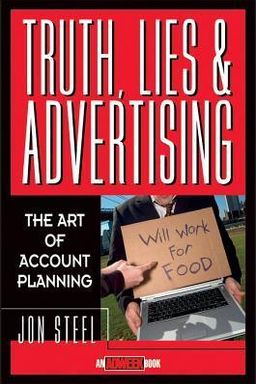
Truth, Lies and Advertising cover

Truth, Lies and Advertising

by Jon Steel

In ''Truth, Lies and Advertising,'' Jon Steel unveils the pivotal role of account planners in creating compelling ads. Through engaging anecdotes, Steel showcases how understanding consumer needs and effective communication drive successful campaigns like the famous ''got milk?'' initiative.

The Art and Truth of Account Planning

When was the last time an advertisement truly spoke to you—not just sold you something, but made you feel seen? In Truth, Lies, and Advertising: The Art of Account Planning, Jon Steel argues that such moments of honest communication are rare because most advertising speaks at people, not with them. Steel contends that revitalizing advertising depends on rebuilding empathy between brand and consumer—a relationship that is fragile, human, and deeply misunderstood.

Steel’s main thesis is that great advertising emerges from truth—specifically, the truth discovered through listening. The discipline that bridges marketers’ objectives and real human insights is account planning. Planning is not just a task or role, but an art of understanding: how to uncover what people genuinely think and feel, and then use that knowledge to inspire creative work that connects and converts. Against the backdrop of an industry obsessed with data and spectacle, Steel calls for an approach that prioritizes human conversation over mechanical measurement.

The Problem with Modern Advertising

Steel begins with an indictment of the advertising world’s ethical reputation: ranked just above car salesmen, ad executives have become symbols of manipulation, not creativity. He jokes that advertisers should thank heaven for the existence of car salesmen—they make the industry look slightly better by comparison. Advertising, he argues, has overreached: it floods our lives with noise, forcing messages rather than earning attention through respect or relevance. In this climate, audiences have evolved “mental deflector shields” that protect them from meaningless messages.

From glossy magazine spreads to forced telemarketing calls, most campaigns rely on sheer repetition rather than resonance. Steel likens this to “throwing a grenade to catch a trout”—a violent, expensive, and lazy way of marketing. And yet companies persist, mistaking presence for persuasion. He points out that while some firms bludgeon customers into awareness, others, such as those behind campaigns like “got milk?”, find smarter ways to build relationships through empathy.

The Emergence of Account Planning

To solve advertising’s human disconnect, Steel traces the evolution of account planning—a discipline originated in Britain during the 1960s by Stanley Pollitt and Stephen King (J. Walter Thompson) and popularized by agencies like Boase Massimi Pollitt (BMP). Pollitt’s insight was simple but transformative: agencies needed an internal ‘consumer conscience.’ Planners were to represent people’s voices in the creative process, ensuring campaigns were grounded in reality rather than opinion or hierarchy. They were professional collaborators—“silent partners” between researchers, creatives, and clients.

Steel recounts how Pollitt fought conventional thinking that separated research and creativity. Instead, research should inspire, not confine, creative ideas. When done well, planners would “peel the onion” of consumer experience—unearthing emotions, contradictions, and motivations that statistical reports could never capture. The planner’s job was not simply to find facts, but to uncover meaning.

Bridging Art and Science

One of Steel’s most provocative arguments involves the battle between art and science within advertising. He contrasts the colorful impulses of ‘creative artists’ with the controlling instincts of ‘scientific marketers.’ The former can drift into arrogance—believing that audiences will love whatever the agency loves. The latter can become obsessed with measurement—treating advertising as a predictable Newtonian machine. Steel’s solution is not to pick sides but to integrate both. Great planners are, as he says, part poet and part physicist. Their craft blends emotional intuition with disciplined inquiry.

“Nothing is so powerful as an insight into human nature,” Steel quotes Bill Bernbach, whose legendary campaigns for Volkswagen and Alka-Seltzer proved that humor and humility could revolutionize an industry dominated by shouting and repetition. Bernbach’s mantra—‘art plus truth equals persuasion’—became the spiritual core of account planning itself.

The Planner as Catalyst

Throughout the book, Steel positions planners not as researchers or administrators but as catalysts for creativity. Their job is to ask the right questions, synthesize layers of information, and translate consumer truths into inspiration for writers and designers. When done right, planning transforms briefs into sparks. It makes data emotional, and research human. For Steel, the creative brief is like a fisherman’s guide—it doesn’t catch the fish but tells the angler where to look.

A Philosophy of Humanity and Simplicity

By the end, Steel’s message moves beyond advertising technique. He proposes a philosophy of communication rooted in humility, empathy, and simplicity. The planner’s responsibility, he reminds us, is to keep everyone “honest”—to ensure campaigns respect the audience’s intelligence rather than insult it. Stories like the famous “got milk?” campaign exemplify this ethos: start with human behavior, not marketing jargon. Create craving, not compliance. And always remember that great advertising doesn’t sell products—it strengthens relationships.

Ultimately, Truth, Lies, and Advertising is an argument for honesty. Steel invites you to see advertising not as manipulation but as dialogue—where truth, when told well, becomes the most persuasive force of all.


Triangulation and Multi‑Perspective Thinking

Steel opens with a metaphor from geography: triangulation. Just as a lost traveler finds their position using three landmarks, effective advertising requires input from three essential perspectives—the client’s business goals, the agency’s creative vision, and the consumer’s lived reality. When these three intersect, the campaign will be on solid ground. When any one dominates, communication falters.

Finding Truth Through Multiple Views

An iconic example Steel uses is a British commercial for The Guardian newspaper. Shot in black and white, it shows a skinhead sprinting down a street. At first glance, he seems violent. But after three perspectives—each revealing more context—the truth emerges: he is saving a man from falling bricks. Steel stresses that advertising must follow the same logic. Singular viewpoints produce stereotypes; multiple perspectives create understanding. To design campaigns that speak authentically, you must join the dots between what the brand wants to say and what people need to hear.

Involving Consumers in Creation

Steel insists that consumers should be active partners, not passive recipients. He likens good advertising to a conversation at a party—you either capture attention through wit and curiosity, or people walk away. Howard Gossage, another pioneer, put it bluntly: “Advertising is not a right, it is a privilege.” Gossage’s interactive campaigns (coupons, quizzes, and humor) invited dialogue decades before “engagement marketing” became a buzzword. The premise remains timeless: respect your audience’s imagination.

Learning from Daily Life

Steel shows how empathy begins with everyday observation. He asks students to recall moments when they persuaded parents for money or asked someone out. The same psychology applies to advertising. If you want someone’s agreement, you must stand in their shoes—understand their hot buttons, fears, and motivations. This practice of mental role‑playing helps uncover truths that transcend data points. Leo Burnett said, “If you can’t turn yourself into a consumer, then you shouldn’t be in the advertising business at all.” Steel’s entire book is a lesson in that transformation.

Triangulation teaches you that empathy is not guesswork—it’s geometry. The more perspectives you include, the closer you get to the truth. That truth, once discovered, becomes the foundation for creativity that feels real, not manufactured.


The British Origins of Planning

To understand account planning’s philosophy, Steel transports the reader to 1960s London—where advertising was dull, formal, and fiercely distrusted. Bill Bernbach’s creative revolution in New York changed that across the Atlantic. Inspired Londoners emerged, including Stanley Pollitt and Stephen King, who fused strategic research with creativity to craft ads people actually enjoyed. Their weapon was account planning, a role designed to infuse consumer insights throughout campaign development.

Stanley Pollitt’s Vision

Pollitt believed agencies needed “a trained researcher beside every account man.” This partner—the planner—would ensure consumer perspectives guided decisions. He called planners the conscience of advertising; they ask uncomfortable questions that others avoid. Pollitt’s structure at Boase Massimi Pollitt became legendary because its advertisements weren’t just clever; they worked. BMP’s combination of creativity and accountability transformed British advertising into a source of national pride.

From Frustration to Philosophy

Steel recounts how Pollitt fought the mechanistic practices dominating agencies—endless data, rigid processes, and Newtonian predictability. He wanted research to ignite imagination, not extinguish it. Instead of judging ads by isolated metrics like recall or persuasion, Pollitt measured success by the depth of connection ads created. Steel likens planners to detectives: they gather clues from data and consumers, then synthesize patterns to uncover hidden motives.

(In later American agencies such as Chiat/Day and Goodby, Silverstein & Partners, this philosophy matured. These creative shops showed that when planners and artists collaborate, magic happens—think Apple’s “1984” or Nike’s “Just Do It.”)

Humility and Curiosity

Steel describes the planner’s personality as both modest and weirdly diverse—sometimes resembling a journalist or psychologist, and occasionally, a professional eccentric. Curiosity is non‑negotiable. The best planners read poetry, study science, and ask dumb questions, because insights often hide in surprise. Their goal is not to control creativity but to fertilize it. As Pollitt wrote, planning means guiding advertising “without stifling creativity.”

By sharing stories from his own mentors—Chris Cowpe, John Webster, and others—Steel turns history into a human portrait. It reminds you that planning began not as an academic exercise but as rebellion: a rebellion against boring advertising and a re‑commitment to honesty, empathy, and play.


Research Done Wrong—and Right

Steel devotes a hefty section to explaining why most advertising research fails. He tells tales of marketers conducting studies for the wrong reasons, asking the wrong questions, and interpreting results to fit their prejudices. Research, in his view, isn't bad—it’s often abused. True understanding requires common sense, not just charts and sample sizes.

The Pitfalls of Poor Research

he recounts absurd examples, from Coca‑Cola’s New Coke fiasco to Soviet factories producing useless giant nails to meet production quotas. These stories illustrate what happens when efficiency triumphs over effectiveness. Methodologies that prioritize comfort and control—rigid questionnaires, sterile focus rooms—only create misleading data. People don’t reveal truths under fluorescent lights and clipboards.

Questions That Matter

Good research, says Steel, begins by asking obvious yet uncomfortable questions: What do people actually care about? What role does this product play in their life? He introduces “creative development research,” in which tests of rough advertising ideas become opportunities for refinement, not mere judgment. In this model, respondents help shape the story rather than act as critics. The goal is iteration, not validation.

The Role of Instinct and Serendipity

Steel encourages you to trust intuition as much as data. The NASA anecdote captures this beautifully: when scientists struggled to invent a zero‑gravity pen, the Soviets simply used pencils. Research must not overcomplicate the simple truth. Likewise, planners must combine rational analysis with lateral interpretation—science with imagination. “Subjectivity over objectivity and simplicity over complexity,” he writes, are the planner’s guiding principles.

Done right, research becomes a creative act of discovery—an excavation of meaning rather than statistics. When done wrong, it justifies mediocrity. Steel’s call to arms is simple: stop mistaking numbers for knowledge.


Crafting the Creative Brief

One of Steel’s most practical chapters, “The Fisherman’s Guide,” turns the creative brief into an art form. A brief, he says, is not paperwork—it’s bait. Its purpose is not to prove how hard you’ve worked but to spark excitement and clarity in creative teams. The best briefs are concise, evocative, and human. They make creatives say, “I want to write that ad.”

Bridging Research and Imagination

Steel compares the brief to a fisherman’s guide: it doesn’t catch fish, but shows where to look and what lure might work. Clients shouldn’t dominate this stage—creatives need room to explore. Nor should briefs be overstuffed with data. “If it’s not relevant to the consumer, it’s not relevant to the brief,” Steel declares. He encourages planners to translate corporate language into real-world human terms (replacing jargon like “positioning statement” with simple descriptions such as “What do we want people to feel?”).

Simplicity Wins

The anecdotes are vivid. An early Sony camcorder brief, overloaded with technical pixel counts, became much clearer when Steel jokingly summarized the camera’s power as “so sharp you could see a bee’s whiskers.” Humor and metaphor, he explains, help bridge complexity. He even admired quarterback Joe Montana’s “simplistic genius”: instead of over‑analyzing plays, Montana completed passes because “it’s always better to complete a pass than not.” Steel argues that planners should write like Montana plays—simple decisions, perfectly executed.

Briefs That Sell the Idea

Great briefs are ads to sell an idea to creatives. They must balance clarity with charm. He shows how Polaroid’s brief—centered on the insight that “the picture is only the beginning”—inspired the famous “See What Develops” campaign. Likewise, Isuzu’s “Grow up, not old” tagline and Sega’s “Welcome to the Next Level” emerged when planners and creatives built ideas together in open conversation, not isolation.

Steel concludes that you don’t have a good brief until you have a good ad. Briefs are living organisms—guides that evolve through dialogue. The best ones make you believe that great advertising isn’t just possible, but inevitable.


Testing Creative Work with Consumers

Steel confronts one of advertising’s biggest anxieties: testing creative ideas. In “Ten Housewives in Des Moines,” he dismantles the notion that focus groups exist to decide what ads should run, arguing instead that they should help make ads better. Research, when used wisely, supports creativity—not suppresses it.

Learning, Not Judging

Steel distinguishes between “testing” and “creative development research.” The aim isn’t to assign a pass/fail grade but to provoke discussion, highlight misunderstandings, and uncover ways to refine the concept. He recalls how Jeff Goodby demanded “someone to say no to me”—a planner acting as internal conscience to prevent runaway arrogance. When feedback reveals flaws, teams fix them; when it reveals consumer confusion, planners clarify.

The Chevys Example

Chevys Mexican Restaurant’s “Fresh TV” campaign nearly died because early focus groups hated its low‑budget prototype. Respondents didn’t understand that the ad had been shot the same day to prove freshness. Steel’s insight saved it: he rewrote one line to say, “For the freshest food, we make the freshest advertising.” That simple clarification turned failure into an award‑winning campaign and boosted sales dramatically. This story shows how planners translate research into creative improvement, not caution.

Negotiating Truth

Steel warns that even brilliant campaigns—Isuzu’s “Mud,” Polaroid’s “Architect,” or Norwegian Cruise Line’s “It’s Different Out Here”—faced rejection in research. Consumers initially misread humor or tone, yet clients trusted intuition. Successful advertising balances data with faith. “Qualitative research is about participation and ideas, not distance and observation,” he writes. The planner’s role is to navigate that tension—to interpret responses creatively and diplomatically.

For you, Steel’s lesson is clear: treat feedback as fuel, not fear. Customers can tell you what feels wrong, but not necessarily how to fix it. That’s your job—to listen deeply, think laterally, and transform criticism into improvement.


The Story Behind 'Got Milk?'

The book’s final act, “Serendipity,” reads like a detective story about creating one of America’s most famous campaigns. When the California Milk Processors hired Goodby, Silverstein & Partners, milk sales were collapsing, and decades of “wholesome family” ads had failed. Steel and his team flipped the script—not promoting milk’s health benefits, but dramatizing the agony of not having milk.

Finding the Real Milk Moment

Research revealed that people rarely drink milk alone; they consume it with foods like cookies, cereal, or peanut butter. So instead of glorifying milk, the team focused on craving. Working with Jeff Manning, the client, and Jeff Goodby, the creative director, Steel designed a deprivation experiment: volunteers were asked to avoid milk for a week. They quickly discovered how frustrating that was—no lattes, ruined cookies, upset moods. “It was a bad end to a bad day,” said one respondent. That emotional truth—milk matters most when it’s missing—became the campaign’s foundation.

From Insight to Icon

Goodby had casually scrawled two words, “got milk?”, for a presentation slide. Steel describes how those shorthand words captured the entire strategy—simple, cheeky, universal. Research validated it. Focus groups loved stories depicting milk deprivation, especially Scott Burns’s quirky “Aaron Burr” script about a man choking on peanut butter during a quiz call. Respondents laughed and felt the pain, proving empathy trumps logic. The campaign launched with TV, outdoor, and store displays that showed tempting food—but never milk.

Results and Legacy

Within months, California’s milk sales rose for the first time in a decade. Nielsen data confirmed higher frequency of consumption, and even households that had abandoned milk returned. When the Dairy Management Institute adopted “got milk?” nationally, volume grew again. More remarkably, the slogan entered popular culture—appearing in parodies, sitcoms, and product tie‑ins (even a Barbie doll). Steel calls it “luck meeting preparation,” but the campaign’s genius lies in its simplicity: dramatize a truth everyone already knows and feels.

As you reflect on this story, Steel leaves you with humility. “Discovery consists of looking at the same thing as everyone else and thinking something different,” he quotes biochemist Albert Szent‑Gyorgyi. In other words, every great idea hides in plain sight—you just have to look with empathy.

Dig Deeper

Get personalized prompts to apply these lessons to your life and deepen your understanding.

Go Deeper

Get the Full Experience

Download Insight Books for AI-powered reflections, quizzes, and more.