
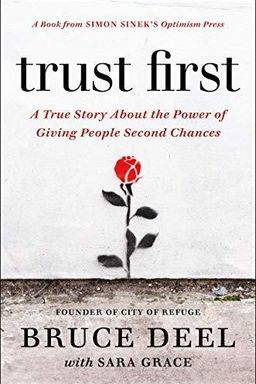
Trust First cover

Trust First

by Bruce Deel with Sara Grace

Trust First chronicles Pastor Bruce Deel’s transformative journey in creating the City of Refuge, showcasing the power of unconditional trust and empathy in uplifting vulnerable communities. This inspiring narrative demonstrates how trust and understanding can ignite profound social change.

Trust as Radical Compassion and Lasting Change

How far would you go to trust someone who has lost everyone’s faith — an addict, a sex-trafficking survivor, or a convict with a gun charge? In Trust First: A True Story About the Power of Giving People Second Chances, Bruce Deel argues that transformation begins not with suspicion or control but with a radical decision to trust first. Deel believes that trust, when given freely rather than earned, awakens a person’s dormant dignity and catalyzes the courage to rebuild. His book chronicles how that conviction built one of America’s most transformative community ministries, City of Refuge, in the heart of Atlanta’s roughest zip codes.

The book weaves stories of people like Gloria, who once pulled a gun at a food line, Ryan, a gang member turned entrepreneur, Vanessa, a drug-addicted mother reborn into family, and Stephanie, a survivor of sex trafficking, who renamed herself Victoria Hope. Deel uses their journeys to illustrate the truth that when people are met with love before judgment, and trust before proof, they change not only their lives but the lives of those around them.

From Crack Pipes to Communion Tables

The story begins with Deel’s humble experiments in compassion — handing out meals in a dangerous Atlanta parking lot. When a frightened, armed woman named Gloria threatened another man, Deel stepped between them with nothing but a gentle touch on her wrist and a whisper: “You don’t really want to do this, do you?” That small moment of peace showed him how trust could defuse violence and create human connection where fear prevailed. This became the cornerstone of his philosophy — that radical trust is not naïve idealism but practical courage.

From those first encounters grew the foundation of City of Refuge — a one-stop shop for people in crisis, combining housing, medical care, job training, trauma recovery, and children’s education. Deel built it not by writing strategies but by refusing to walk away when others did. Each story in the book testifies that transformation is not a miracle; it’s the accumulation of daily trust, unwavering presence, and gentle accountability.

The Moral of Trust in a Distrusting World

Deel’s premise challenges what most of us believe about human nature and safety. He leads by example: he moved his wife and five daughters into a dilapidated church in a crime-ridden neighborhood, ate dinner beside sex workers and addicts, and gave his house keys to gang members. Why? Because people in crisis, he argues, have spent their entire lives distrusted — by families, institutions, and systems that punished poverty rather than nurtured hope. Trust, then, becomes the rare medicine that restores agency and human worth.

“Trust alone is nothing without time.”

This anchoring truth from Deel echoes throughout the book. Trust has to be sustained through relapses, failures, and years of incremental growth. The people Deel helped—like Ryan, who relapsed into crime before founding his own security business—prove that transformation is rarely sudden; it’s cultivated through consistency, love, and time.

Why It Matters Today

Deel’s story goes beyond a nonprofit narrative; it’s a model for relationships, leadership, and community. In workplaces driven by metrics, in politics fueled by fear, and in societies fractured by distrust, Trust First reminds you that compassion is measurable only in the way it changes people. Deel’s “benevolent care” approach echoes ideas from Father Greg Boyle’s Tattoos on the Heart—meeting people where they are, not where we wish they were. It also aligns with Simon Sinek’s philosophy of servant leadership, which inspired the book’s publication through Sinek’s Optimism Press.

In this summary, you’ll explore the key pillars of Deel’s philosophy, from how trust rewires both giver and receiver to how compassion can face violence, addiction, and systemic injustice without faltering. You’ll learn the anatomy of transformation through stories—the building of City of Refuge, the launching of recovery homes for trafficked women, and the redemption arcs of those who learned to trust again. Ultimately, trust becomes not just Deel’s method but his theology: the belief that no one is a lost cause, that love is stronger than fear, and that grace, when applied daily, can resurrect entire communities.


Building the Power of Benevolent Care

Bruce Deel introduces the concept of benevolent care—a radical approach that replaces blame and bureaucracy with unconditional trust. When Deel first began City of Refuge, he didn’t just give out meals; he decided to share life with those society avoided. This philosophy stemmed from a simple belief: every person’s decisions make sense when you understand their pain.

No Judgment, Just Presence

Instead of insisting people “earn” help, Deel offered acceptance first. He lived inside the same broken neighborhoods, moved his family into a decaying church, and opened its doors to homeless mothers and children—even to those with addiction or criminal backgrounds. When others fled after being threatened or robbed, Deel stayed. This persistence modeled a trust that became contagious. People in crisis began healing not because they were fixed, but because someone refused to give up on them.

Deel learned that empathy requires proximity. Living among those he served dismantled his own prejudices. As Rev. Greg Boyle (Tattoos on the Heart) similarly argues, you can’t heal those you avoid. By stepping into other people’s suffering, Deel found that compassion became less an act of charity and more a shared transformation.

Trust Before Proof

Traditional programs often force people to prove they’re “worthy” of help. Deel flipped that logic: trust comes before transformation. For instance, he handed master keys of his shelters to Ryan, a former gang leader with a violent past. Despite betrayal and near-disaster, Deel refused to recant his trust. Over time, Ryan began trusting himself enough to rebuild his life, eventually starting his own company, Watchmen Protective Services, and mentoring ex-offenders. Deel’s takeaway? People rise to meet the trust placed in them.

Learning from Mistakes Without Quitting

Living among the marginalized exposed Deel to danger, including being threatened by a mentally ill man named Michael or arrested while protecting a volatile mother. Yet each crisis taught him that trust must coexist with wisdom. Benevolent care doesn’t mean blind naïveté—it means choosing love even in fear. “Compassion sometimes has an odor,” Deel jokes, referring to cleaning up after crisis situations. But compassion also has resilience—it refuses to withdraw even when hurt.

Through benevolent care, Deel reframed helping from an act of saving to one of solidarity. You don’t fix people—you walk beside them. Transformation, then, is not a transaction; it’s a relationship rooted in enduring presence. In this, Deel echoes Martin Luther King Jr.’s call for a “beloved community”—a society where grace replaces judgment and where love becomes both the mission and the method.


From Charity to Transformation

For Deel, charity was never enough. Food and shelter mattered, but without relationships of trust, they were only temporary bandages. Transformation required proximity, empathy, and a structured environment that turned trust into empowerment. This philosophy birthed City of Refuge’s one-stop shop model—an ecosystem of care that offered everything a person needed to move from crisis to stability.

The Birth of City of Refuge

After moving into a repurposed warehouse in Atlanta’s roughest neighborhood, Deel dreamed of uniting disparate services—housing, healthcare, education, recovery, and employment—under one roof. With help from donors and the city, he built Eden Village, a residential community for homeless women and their children. It became a living embodiment of his guiding ideal: a home where every interaction, from healthcare to meals, was infused with dignity and love.

When Hurricane Katrina struck, City of Refuge opened its doors to refugees, cementing its reputation as a hub of compassion. Later, Deel expanded housing to single women, people with addiction, and victims of abuse. His organization evolved from rescue to restoration—offering not just temporary relief but pathways to employment and independence.

Measuring Success Differently

City of Refuge resisted defining success through data points alone. Deel saw numbers as necessary but insufficient: “Returning dignity to a single life is immeasurable.” True transformation, he realized, emerged when trust and support multiplied—when those once helped returned to help others. By 2018, one-third of the organization’s staff were former residents, living proof that transformed people transform people.

The City of Refuge became more than a shelter—it became a living organism of trust. Like Desmond Tutu’s assertion that “we are made for goodness,” Deel’s community mirrors the belief that dignity breeds dignity. Transformation flourishes not through control but through the steady rhythm of love, structure, and shared purpose.


Stories That Redefine Redemption

Deel’s message gains power through stories, not slogans. Each narrative in Trust First illustrates how trust rewrites the script of failure into one of rebirth. These accounts also reveal that transformation rarely looks clean—it’s often slow, uneven, and deeply human.

Ryan’s Transformation

Ryan Marchman grew up in abuse, gang life, and violence. Deel’s team gave him not just housing but a master key to their property—a symbol of radical trust. When Ryan betrayed that trust, Deel didn’t retract it; he restored it. That act broke the cycle of shame Ryan had known all his life. Years later, Ryan became a business owner, father, and mentor, training other formerly incarcerated men. His story embodies Deel’s belief that trust must outlast betrayal.

Michelle and Stephanie: Healing from Exploitation

Michelle’s trauma as a sex-trafficked woman led Deel to establish safe houses for trafficking survivors. She arrived terrified, asking to erase her identity completely. Helping her change her name was the catalyst for an entire anti-trafficking mission. Likewise, Stephanie (who later renamed herself Victoria Hope) entered broken by years of sexual slavery in a cult. Through patience, therapy, and unconditional love, she slowly learned to trust again—culminating in a moment when she declared, “I believe there is a God now, and He cares about me.”

Each of these stories reinforces the core thesis: rebuilding trust is a spiritual rebirth. Love, when practiced consistently, doesn’t just change circumstances—it reconstructs identity.

Jake’s Final Lesson

Jake, the man who first welcomed Deel to the streets, became the face of both hope and heartbreak. After years of mentoring others, he died alone in the back of a truck. His death plunged Deel into despair—until he realized that Jake’s return “home” to die on campus was an act of trust itself. Even in failure, trust had not been wasted. Transformation’s measure is not perfection but presence.

Through these narratives, Deel insists there are no lost causes. Each person’s story, however tragic, can redeem others. Like Richard Rohr’s observation that “transformed people transform people,” these lives testify that healing is contagious when built on trust.


Fighting Despair with Community

One of the book’s most profound lessons is that trust must be communal. Deel learned early that no single act of kindness could cure systemic despair—it required an ecosystem of believers, volunteers, and former sufferers. The City of Refuge thus evolved from individual compassion to collective transformation.

From Isolation to Empowerment

Communities in crisis are trapped not only by poverty but by distrust. Deel rebuilt this foundation by recruiting residents like Tennie Woods and Vanessa—once addicts or inmates—to lead programs. Volunteers became neighbors, and neighbors became family. This “horizontal leadership” gave credibility that Deel himself, as an outsider, could never achieve. The healed became healers, embodying Martin Luther King Jr.’s vision of shared dignity.

A Culture of Love and Accountability

City of Refuge’s structure combines tenderness with tough love. Deel emphasizes that unconditional love doesn’t dismiss boundaries—it anchors them. Residents sign agreements, attend counseling, and learn self-sufficiency. But discipline is offered gently, like a parent guiding rather than punishing. “Love and acceptance—things Stephanie had never experienced—were her treatment plan,” writes Deel.

Empathy as Infrastructure

By cultivating trust among both staff and residents, Deel transformed empathy into organizational design. City of Refuge became a safe space where failure wasn’t final. The walls radiated hope not through slogans but through daily acts of presence—meals around shared tables, funerals mourned together, birthdays celebrated with laughter. In Deel’s words, “Love is policy here.” For readers, it’s a vivid reminder that empathy, institutionalized, can become one of the most powerful infrastructures for societal healing.


Trust + Time = Transformation

The twin forces that drive Bruce Deel’s entire mission are trust and time. Together, they create the conditions for transformation—slow, imperfect, but lasting. Deel learned this truth from his father, Cecil Deel, whose steady commitment to ministry embodied the essence of finishing well. Transformation, Deel writes, is less an event than a rhythm of endurance fueled by love.

Redefining Success

Modern nonprofits, Deel argues, often confuse impact with measurement. Foundations want numbers—meals served, beds filled—but true success resists accounting. The story of Rufus, once a violent addict, now sober and donating envelopes of cash each week to City of Refuge, captures this idea. In statistical terms, he’s still “dependent.” In human terms, he’s living proof that dignity outlasts addiction.

Time allows trust to take root. It transforms horror into hope and shame into service. Deel reminds readers that transformation cycles can span decades, even lifetimes—but every positive shift, however small, contributes to generational change. The same attitude guides his approach to employees and residents alike: when someone stumbles, they aren’t finished—they’re still becoming.

Finishing Well

Bruce Deel honors his father’s passing as a lesson in perseverance. Cecil never quit his calling, even when unrecognized or poor. His life taught Bruce that consistency is a theology of its own. To “finish well” means to love without condition, to act without demanding outcomes, and to trust even when others withdraw. This ethic sustains Deel when grants fail, when residents relapse, and when tragedy visits his team.

Trust + Time = Transformation

This is not just a formula but a worldview. Trust lights the path; time allows it to take root. Both together yield transformation—not merely in those served but in those who serve.

In the end, Deel’s formula extends beyond City of Refuge. Whether in families, workplaces, or communities, trust breeds growth only through time’s patience. His message to readers is clear: do not measure your compassion by speed or scale. Love is slow, and that’s what makes it divine.


Carrying Trust Into the Next Thing

In the closing chapter, Deel reflects on sustaining hope in a world still scarred by violence and inequity. City of Refuge continues to expand, building affordable housing and mentoring programs, even amidst loss and danger. When a beloved staff member named Beverly Jenkins was murdered, Deel faced the same question that began his journey: can you still trust, even after tragedy?

His answer mirrors his life’s work: yes, through community, consistency, and compassion. Trust, when institutionalized into culture, survives what individual willpower cannot. Deel’s mission now focuses on replication—helping other cities build local versions of City of Refuge—and on teaching ordinary people to become extraordinary neighbors. He insists you don’t need to move into a dangerous neighborhood; you only need to act on the part of love that costs you something.

As he describes family members like his brother Keith or sister April living out everyday compassion—housing displaced friends or caring for the sick—Deel widens the definition of heroism. Radical trust, he suggests, isn’t just for pastors; it’s for anyone willing to replace convenience with commitment. Every small act of faith, every refusal to give up on someone, expands the circle of hope.

In the end, Deel sees his mission not as finished but as ongoing—a journey of “doing good better today than yesterday.” His final vision is both humble and revolutionary: a world where no one is left behind, where compassion is policy, and where trust remains humanity’s deepest act of faith.

Dig Deeper

Get personalized prompts to apply these lessons to your life and deepen your understanding.

Go Deeper

Get the Full Experience

Download Insight Books for AI-powered reflections, quizzes, and more.