
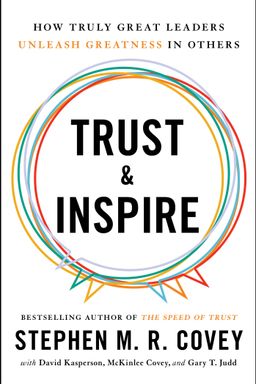
Trust and Inspire cover

Trust and Inspire

by Stephen MR Covey

Trust & Inspire redefines leadership by emphasizing collaboration, trust, and personal growth over traditional control methods. Stephen M.R. Covey presents actionable insights to unlock the potential of modern workforces, offering tools to inspire and engage employees in meaningful and innovative ways.

From Command & Control to Trust & Inspire

The world of leadership has changed, but many leaders are still playing with outdated tools. In Trust & Inspire, Stephen M.R. Covey argues that leaders must move away from the old industrial-era model of Command & Control—which was built on containment, compliance, and supervision—and adopt a new paradigm for today’s creative, distributed, values-driven world: Trust & Inspire. The book’s central claim is simple yet radical: leadership is not management of people but stewardship of potential, and the force that unlocks that potential is trust.

The Collapse of the Old Paradigm

Command & Control worked when work was repetitive and predictable. But today’s world is shaped by five emerging forces: technological disruption, knowledge-based work, hybrid workplaces, multigenerational diversity, and infinite choice for talent and customers. You cannot compel creativity or collaboration with fear and hierarchy. Covey’s metaphor—trying to play tennis with a golf club—captures how misfit the old methods are: they produce activity but not engagement.

The consequences are visible everywhere. Blockbuster’s downfall—as Netflix reshaped entertainment through self-disruption—illustrates how protecting control kills adaptability. Likewise, companies run by overcontrolling founders often stall when they cannot release authority to new generations. What once felt safe now suffocates progress.

Two Imperatives for Modern Leadership

Covey distills modern leadership into two epic imperatives: win in the workplace by attracting and engaging talent through high-trust culture, and win in the marketplace through collaboration and innovation. Containment and compliance undermine both. Without trust, agility vanishes; without inspiration, commitment fades.

Enter the Trust & Inspire Paradigm

Trust & Inspire is not a technique but a worldview. It begins with five core beliefs: (1) everyone has greatness inside; (2) people are whole—body, heart, mind, spirit; (3) life operates from abundance, not scarcity; (4) leadership is stewardship, not entitlement; and (5) influence starts inside-out—the leader goes first. These beliefs replace suspicion and control with empowerment and example.

Leaders like Satya Nadella exemplify the paradigm shift. He rebuilt Microsoft’s culture by modeling humility, empathy, and a growth mindset—restoring innovation and multiplying market value. His leadership did not rely on commands but on modeling trust and inspiring across levels.

The Heart of the Transformation

Covey’s framework revolves around three stewardships: Modeling (who you are), Trusting (how you lead), and Inspiring (why people act). Each stewardship builds from the previous: when you model credibility and humility, people trust your intent; when you extend trust intelligently, people take ownership; when you connect work to meaningful purpose, people bring energy and creativity.

These stewardships apply not only in corporations but in every sphere—parenting, teaching, coaching. The “green and clean” story from Covey’s father shows the spirit of trust and autonomy. A seven-year-old given responsibility for keeping the yard “green and clean” learns accountability, pride, and self-management—lessons more lasting than any command.

Why Many Still Resist

Leaders persist with old scripts because hierarchy feels familiar, efficiency seems faster, and distrust masquerades as prudence. But data and experience reveal the cost: distrust slashes engagement, erodes performance, and triggers turnover. Knowing but not doing, Covey says, means you don’t truly know.

To overcome inertia, leaders must start small—go first, declare intent, clarify expectations, and hold themselves accountable. Culture shifts through one trusted relationship at a time. The book’s many examples—Art Barter’s transformation of Datron from control to service culture, and Cheryl Bachelder’s reversal of Popeyes’ fortunes through servant leadership—prove that Trust & Inspire is both idealistic and intensely practical.

The Payoff

Trust & Inspire multiplies performance by replacing fear with ownership and motivation with inspiration. Covey shows that inspired people are over 50% more productive than merely engaged employees, and 125% more productive than merely satisfied ones. Trust creates speed, inspiration sustains it, and modeling anchors it. When you master these, you fulfill both imperatives: thriving inside your workplace and competing brilliantly in your marketplace.

Core message

You cannot command creativity or compliance into greatness. You must trust for ownership, inspire for commitment, and model for credibility. Leadership today is not about power—it’s about release.

In sum, Trust & Inspire reframes leadership as stewardship: awaken the greatness within others and let go of the illusion that control equals strength. The leaders who learn this shift will build cultures ready for disruption and people ready to give their best.


Modeling Who You Are

Modeling is the first stewardship—the foundation on which the rest of Trust & Inspire stands. Covey argues that you must go first. People follow character and consistency far more than they obey directives. Modeling is about credibility—built through integrity, humility, and competence. You cannot fake trustworthiness; you must earn it daily through your actions.

Credibility = Character + Competence

Covey defines credibility as the union of character (your motives and integrity) and competence (your ability to deliver results). Rely on one without the other and trust falters. Leaders who fail to model both create anxiety or insecurity in teams. Doug Conant’s transformation of Campbell Soup Company started not with new strategy but with personal consistency—declaring his intent transparently and writing over 30,000 thank-you notes to employees, building moral authority beyond his title.

Moral vs. Formal Authority

Titles confer formal authority; behavior earns moral authority. Ken Chenault at American Express, Cheryl Bachelder at Popeyes, and Nadella at Microsoft won voluntary followership because people trusted their authenticity. When you align your public, private, and inner lives, people feel safe to commit.

Virtues to Model

Covey outlines behavioral pairs that embody modeling: humility and courage (admit mistakes yet act boldly), authenticity and vulnerability (show your intent and humanity), and empathy and performance (care while expecting excellence). Cheryl Bachelder practiced these at Popeyes—listening first, serving franchisees, and producing remarkable growth.

Practical reflection

Ask: if your team had to vote, would they reelect you as leader next year? That answer tests your modeling more than any survey.

Modeling shapes the moral authority that enables you to trust and inspire later. When you embody both humility and performance, you communicate: “I believe in us.” That credibility precedes influence and renders control unnecessary.


Trusting as Leadership Practice

Trusting is the second stewardship—it transforms leadership from controlling to empowering. Covey’s formula is simple but profound: Trustworthiness × Trusting = Trust. You cannot create a high-trust culture just by being trustworthy; you must also extend trust. This requires courage and clarity.

Smart Trust: Balancing Risk and Responsibility

Smart Trust blends a high propensity to trust with wise judgment. You start from confidence rather than suspicion, but you assess capability, define guardrails, and plan for course correction. Nordstrom’s famous one-rule handbook—“Use good judgment”—and Netflix’s “freedom and responsibility” ethos both show that trust does not abdicate accountability; it creates self-governance.

Covey distinguishes blind trust from smart trust. The latter uses stewardship agreements to clarify desired results, guidelines, resources, accountability, and consequences. These agreements empower autonomy while preserving responsibility.

Clarify Expectations and Practice Accountability

Two behaviors reinforce trust: define expectations mutually and hold yourself accountable before others. When accountability is mutual—not top-down—teams flourish. Siemens and GM’s trust-based remote work policies show how clear agreements turn flexibility into reliability.

Principle

If you lead by containment, you get compliance. If you lead by trusting smartly, you get commitment.

Trusting demands you go first. When you are the first to extend trust, people rise to meet it. Start small: choose one person, set clear expectations, and back off control. The upward cycle that follows—trust creating performance, performance building trust—renews how leadership feels and functions.


Inspiring Through Purpose and Connection

Inspiration is the third stewardship and the most powerful differentiator. Motivation pushes; inspiration pulls. Covey argues that while extrinsic motivation (carrots and sticks) yields temporary compliance, inspiration taps into intrinsic drive—autonomy, mastery, and purpose (as Daniel Pink has also shown).

Connect People to Their Why

You inspire by connecting people to meaning, not metrics. There are three levels of connection: with self (find your own why), with relationships (show genuine care), and with teams (build belonging). Indra Nooyi’s habit of writing letters to parents of senior executives symbolized deep personal appreciation that inspired loyalty beyond paycheck.

Examples of Inspired Leadership

Satya Nadella’s cultural transformation of Microsoft, Eric Yuan’s trust-centered leadership at Zoom during the pandemic, and Veterans United’s purpose-driven service ethos all show how inspiration multiplies both performance and humanity. Bain’s research confirms the payoff: inspired employees are more than twice as productive as merely satisfied ones.

From Motivation to Inspiration

Covey’s “green and clean” story embodies the shift. A child trusted with responsibility internalizes purpose far deeper than one coerced by reward. In workplaces, inspiration blends autonomy with meaning and produces durable commitment. You start by asking people what matters to them—and linking tasks to that meaning.

Key takeaway

People crave significance as much as success. When you connect everyday work to why it matters, you ignite energy that no incentive program can buy.

Ultimately, inspiration bridges purpose and performance. You don’t need charisma; you need connection and care. When you trust and inspire simultaneously, engagement becomes self-sustaining.


Stewardship Agreements That Empower

To operationalize Trust & Inspire, Covey introduces the tool of stewardship agreements—simple mutual pacts of clarity and accountability. They replace micromanagement with shared understanding. This approach was modeled in Covey’s father’s “green and clean” story, where clarity and trust taught enduring responsibility to a child.

Five Core Elements

  • Desired results: explicit outcomes and timelines.
  • Guidelines: clear boundaries and values (no painting the grass).
  • Resources: support or help available.
  • Accountability: mutual check-ins—walk the yard.
  • Consequences: natural outcomes for success or shortfall.

When these are jointly defined, autonomy becomes safe. Companies like eAssist and story examples of remote teams using agreements demonstrate how results rise without surveillance. This practice turns the leader into a coach—focused on growth as much as goals.

Principle

Clear agreements make freedom trustworthy. Ambiguity breeds control; clarity liberates competence.

Covey encourages starting with one agreement—whether at work, with a family member, or a student. When done right, stewardship agreements turn supervision into collaboration and control into co-ownership of results.


Overcoming Fear and Barriers to Change

Changing from Command & Control to Trust & Inspire is often resisted—not from ignorance but from fear. Covey identifies five common barriers: “This won’t work here,” fear of losing control, inability to let go, arrogance (“I’m the smartest one in the room”), and identity lock-in (“This is who I am”). Every barrier can be rescripted.

Why Change Is Hard

Leaders often don’t see their own limiting scripts—“fish discover the water last.” Others know but don’t act, or cling to habits long past usefulness. Covey likens this persistence to outdated medical bloodletting: wrong paradigm, right intentions.

Practical Countermoves

  • Go first—apologize, declare intent, show vulnerability.
  • Clarify expectations—to prevent confusion and reduce fear.
  • Use smart trust—extend it with prudence, not blind faith.
  • Model humility—listen to learn, not to instruct.

Examples include leaders such as Art Barter, who transformed Datron by replacing control with service, scaling revenue twentyfold, and Dorothy Hogg, who empowered innovation across Air Force units by trusting personnel to lead change. These transitions prove culture shifts are possible.

Major insight

You don’t overturn systems by decree; you start by changing your own scripts and letting results speak for you.

The path forward is incremental. Select one person or one process, apply Trust & Inspire tools for 30 days, and measure changes in engagement and performance. Culture follows behavior—and behavior follows belief.


Trust & Inspire Beyond Work

Covey closes by expanding Trust & Inspire beyond business into life. Leadership is everywhere—parents, teachers, coaches, mentors—anyone who influences another person. The same stewardships apply across roles because human potential does not segment by context.

Parenting

Parenting is about raising capable adults, not compliant children. The “green and clean” yard story illustrates how trust paired with accountability teaches autonomy far earlier than control ever could. Family meetings and shared stewardship for tasks nurture self-governing competence and character.

Teaching

In education, leaders like Muriel Summers (A.B. Combs Elementary) used belief in students’ leadership potential to overhaul culture and results. Teachers who trust students create learning ownership; administrators who trust teachers create creative classrooms. Covey’s daughter McKinlee learned that credibility and connection outperform authority alone.

Coaching

Great coaches balance care and challenge. Bill Walsh, Pete Carroll, and Dabo Swinney push hard but care harder, creating devotion born of trust. A blind climber’s Everest story—the team rallying around shared stewardship after their leader fell sick—dramatically shows how trust and inspiration sustain peak effort in adversity.

Universal truth

Anyone can be a transition figure—the person who sees worth where others don’t and chooses trust over suspicion. Such figures change lives.

Trust & Inspire reframes life leadership as relational stewardship. Whether at home, school, or on the field, your task is the same: see potential, trust generously, and inspire meaningfully. That is how legacies form—not through control, but through release.

Dig Deeper

Get personalized prompts to apply these lessons to your life and deepen your understanding.

Go Deeper

Get the Full Experience

Download Insight Books for AI-powered reflections, quizzes, and more.