
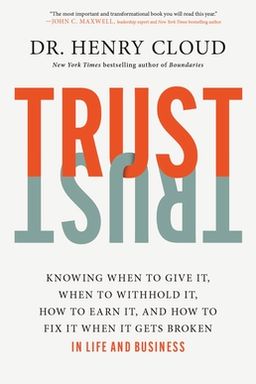
Trust cover

Trust

by Dr Henry Cloud

Trust by Dr. Henry Cloud is an essential guide to understanding and mastering the dynamics of trust in relationships. Through practical insights and powerful anecdotes, it unveils the core elements of trust, providing readers with tools to foster genuine connections and rebuild trust when it''s broken.

The Anatomy of Trust: How Life Runs on Reliability

When was the last time you confidently said to someone, “I trust you”? In his book Trust, Dr. Henry Cloud argues that those three words often define the health of our lives, relationships, and organizations more than anything else. He contends that trust is not merely a feeling—it’s the biological, spiritual, and psychological fuel that makes every human system function. Without trust, love and business alike cannot thrive. With trust, everything flows. Yet, Cloud warns that far too many people think of trust as a vague emotional experience, when it is actually built on tangible, actionable components.

Cloud has spent decades studying how trust works, both in clinical therapy and corporate consulting. He found that while conflicts and betrayals often devastate relationships or leadership teams, people can learn to diagnose and build trust deliberately—as a skill, not just as sentiment. In this deeply researched guide, Cloud introduces a usable model that breaks trust down into five distinct essentials: understanding, motive, ability, character, and track record. Together, these qualities form what he calls the “Trust Paradigm.” When these five are consistently lived out in relationships, teams, and leadership, trust becomes predictable and repairable.

Trust as the Fuel for All of Life

Early in the book, Cloud tells vivid stories showing that every aspect of life hinges on trust—from a CEO and board chair reuniting after a crisis to married couples, employees, and even surgeons on an operating table. He demonstrates through research that societies high in social trust enjoy greater health, longevity, and economic prosperity. Relationships rich in trust lead to faster collaboration and deeper love. By contrast, broken trust brings anxiety, sickness, and stagnation, much like a blocked artery in the body. Trust is to human connection what oxygen is to life—it’s invisible but indispensable.

(Cloud’s assertion echoes management researcher Roderick Kramer’s insight in Harvard Business Review that humans are “naturally predisposed to trust” because it fuels survival—but this instinct can also betray us when we fail to discern who deserves our trust.)

Humans Are Wired to Trust

Cloud moves beyond metaphor to biology. Trust isn’t optional—it’s hardwired. From infancy, trust emerges through attachment, when a baby learns that caregivers meet its needs. Oxytocin, the bonding hormone, floods the system each time that need is met, encoding physiological pathways for future safety. These neural connections train us to expect connection, and later to bond with spouses, friends, and coworkers. When trust fails early, people grow up with deficit models—unable to connect securely, avoidant, anxious, or fearful. The implications for leadership or love are profound: your ability to trust and be trusted depends on how your trust muscle was built (or broken).

He argues that to trust is human. Our brains mirror each other through neurons that replicate emotion; when we feel understood, mirror neurons synchronize, creating empathy. Brain imaging proves that when we perceive another person as safe, stress hormones reduce and cooperation increases. Thus, Cloud concludes, mistrust isn’t merely psychological—it’s neurological malfunction. Healing trust damage means rewiring connections.

The Trust Paradigm: Five Essentials

The book’s heart lies in Cloud’s five-part Trust Paradigm. You can trust someone when:

  • You feel understood—they genuinely grasp what matters to you.
  • Their motive is for your good, not self-interest.
  • They have the ability to deliver what they promise.
  • Their character supports their words—they’re consistent, ethical, emotionally healthy.
  • They have a track record that proves reliability over time.

These five essentials operate in personal relationships, teams, and even nations. If one piece fails, trust breaks. For example, someone may have strong character but lack ability (a moral person who’s incompetent), or ability without empathy (a skilled but self-centered surgeon). The model shows that trust is multidimensional, not binary. This helps you diagnose why trust feels “off” instead of labeling someone as simply untrustworthy.

Repairing Broken Trust

Later, Cloud introduces a structured path for restoring trust after betrayal. He says forgiveness alone doesn’t rebuild trust—only observable change does. Healing begins with acknowledging pain, working through anger and forgiveness, and then verifying that the person has changed across all five essentials. This is not instant reconciliation; trust is rebuilt incrementally, through evidence. Like rehab for the heart, trust restoration requires repeating new, healthy interactions until a pattern forms. In short, scars can heal stronger than the original tissue if handled intentionally.

Learning Discernment and Immunity

Finally, Cloud warns against misplaced trust. Just as the body has an immune system, your relational immune system must detect deceit early. He lists causes of vulnerability—loneliness, guilt, high pain tolerance, fear of boundaries, childhood wounds—and teaches how to develop “trust antibodies” through wisdom and community. Healthy trust means distinguishing forgiveness (releasing past harm) from trust (risking future vulnerability). Without discernment, people repeatedly trust abusers or incompetent partners, confusing compassion with safety.

Ultimately, Trust teaches that life’s fulfillment depends on your ability to build, nurture, and repair trust consciously. Whether leading a company or loving a spouse, your greatest skill isn’t persuasion or performance—it’s becoming a person whose understanding, motives, abilities, character, and track record make others feel safe enough to say, “I trust you.”


Understanding: The First Step Toward Connection

Imagine you’re an FBI negotiator coaxing a bank bomber to release hostages. Dr. Cloud opens his section on understanding with this gripping scenario to prove that trust never starts with persuasion—it starts with empathy. He reminds us that people don’t trust those who argue, convince, or command; they trust those who understand them. Understanding, the first essential of trust, means entering another’s emotional world and communicating, “I get you.”

He cites real negotiator Chris Voss (Never Split the Difference) who says, “Being right isn’t the key to negotiation—it’s having the right mindset.” The right mindset is deep empathy, not logic. Cloud demonstrates through examples—from hostage negotiations to marital fights—that when people feel known, their defensive “lower brain” shuts down and the rational “upper brain” activates. Fear subsides, and safety returns.

The Neuroscience of Being Heard

Our brains mirror emotions. When a mother mirrors her infant’s expressions, oxytocin and mirror neurons synchronize, building trust. Adults respond the same way. Empathy literally rewires the brain’s chemistry toward openness. When someone says, “That must have been hard,” your body calms. Cloud writes that being understood changes physiology as much as psychology—it moves someone from threat to safety. Without understanding, even good advice triggers resistance.

The Power of Mirroring and Listening

To practice understanding, you must mirror—not mimic—another’s reality. That means reflecting feelings (“It sounds like you felt dismissed when he ignored you”), summarizing meaning, and avoiding persuasion until the person feels known. In Cloud’s dramatic boardroom story, the CEO and chairman could only reconcile once one said, “I never knew I made you feel that way.” Listening unlocked miracles that strategy couldn’t.

Carl Rogers, a pioneer of humanistic psychology, proved that “accurate empathy” alone could catalyze healing. Cloud traces this principle across industries: in customer service, medicine, parenting, marketing, and faith communities. Chick-fil-A’s success, for instance, stems from genuine understanding—employees hold umbrellas for moms in the rain. It’s empathy operationalized.

Understanding in Business and Relationships

Understanding applies beyond therapy or hostage crises. In business, companies that understand customers earn loyalty and higher profits. Hotels that anticipate traveler needs or churches that design around unmet community fears (like Rick Warren’s Saddleback Church) embody trust through understanding. In marriage, understanding means you can describe your spouse’s inner world as clearly as your own. Cloud calls this level of attunement “carelessness”—not neglect, but freedom from worry because you feel seen and safe.

The takeaway: you can’t fake understanding. Empathy must be real and followed by actions proving you heard. Understanding fuels all other trust essentials—it’s the doorway through which every meaningful relationship first walks.


Motive: The Heart That Drives Trust

Would you let a surgeon who sees you only as revenue operate on your knee? Dr. Cloud’s account of choosing between three orthopedic surgeons illustrates the second essential of trust: motive. While all were competent, only one cared about him personally. Motive answers the question, “Is this person for me or for themselves?” You can only trust someone whose intention prioritizes your wellbeing—even at cost to themselves.

The first two doctors had skill but self-centered agendas: one rushed him, the other treated him like a teaching prop. The third asked about Cloud’s life, golf, and family. His empathy revealed motivation for human flourishing, not ego. That genuine motive made Cloud fly across the country for surgery—and trust was rewarded with success.

Why Motive Matters

Motive answers “Why?” behind every action. As John Gottman’s “index of betrayal” describes, relationships decay when partners stop looking out for each other’s interests. When people act only for themselves, they ignite distrust and division. Cloud amplifies Gottman’s concept: trust thrives when both partners work for each other's wellbeing—“having their back,” even unseen.

Love as the Ultimate Motive

Cloud connects motive with spiritual law. True trust requires love—the commandment to “love your neighbor as yourself.” Moral codes alone (“do not cheat”) cannot sustain relationships; only compassion and empathy do. Rules restrain impulse; love transforms motive. An addict may know he shouldn’t drink, but learning how his behavior hurts his child changes his motivation. Love moves intent outward.

Motive in Leadership and Business

In organizations, motives that serve higher purposes generate exponential trust. Cloud shares examples of a homebuilder whose subcontractors worked faster because each considered others’ needs, reducing timelines and costs. He also spotlights airline regulators who shared information transparently to improve safety—a move based on trust and shared motive, which reduced fatalities by 80%. When leaders act from “for you” motives rather than power or fear, trust multiplies and results follow.

Ultimately, motive is the invisible engine driving all trustworthy behavior. Whether in marriage, leadership, or surgery, trust rises or falls not on competence alone but on whose good you are seeking. Cloud presses the question every leader and partner must ask daily: “Am I doing this for me—or for us?”


Ability: Competence You Can Count On

You may love someone deeply, but would you trust them to perform brain surgery? The third essential of trust is ability—the capacity to deliver what’s promised. Cloud illustrates this with another leadership story: a capable COO named Bradley promoted to CEO simply because he was trustworthy and likable. Yet the company soon stagnated. Why? He lacked the visionary ability of a CEO. Cloud’s advice to the board: “Where did he get the E?”—exposing that good character is not the same as the right capability.

Competence Completes Character

Ability ensures that good intentions don’t collapse under poor execution. Your doctor may care deeply but must still perform surgery precisely. Your colleague may mean well yet fail to deliver results. Without competence, trust is misplaced. Cloud encourages leaders to vet skills as rigorously as morals. Churches, marriages, and companies falter when someone’s loving heart exceeds their functional ability. Delegating tasks without verifying skill undermines both trust and performance.

Evaluating Suitability

The root of “ability” means “suitable.” Cloud reminds readers that evaluating ability isn’t arrogance—it’s wisdom. You wouldn’t trust him to fix your car, he jokes, nor your finances, because he lacks that ability. Each context requires specific competencies. This truth prevents nepotism and blind loyalty—such as promoting family members or friends simply because of relationship ties rather than fitness. Ability-based trust saves organizations and marriages from unnecessary pain.

Building and Vetting Ability Over Time

Ability can grow. Like Bradley’s hypothetical coaching plan, people can develop new skills if given structure and accountability. Cloud cites the black hole of “yes boards” in nonprofits—filled with loyal friends who lack governing competence. True stewardship demands evaluating skill objectively, not sentimentally. Trust is never one-size-fits-all; someone may be trustworthy in friendship but not finance, marriage but not management.

Ability prevents disappointment disguised as betrayal. Test competencies before entrusting responsibilities. A trustworthy heart is beautiful, but only a capable hand makes it reliable.


Character: Who You Are When Pressure Hits

Character is the fourth pillar of trust and arguably its backbone. Cloud defines it as the set of inner qualities that determine how someone behaves under pressure, not just their moral honesty. A person can be ethical yet emotionally immature, arrogant, or volatile—and therefore untrustworthy. Character asks not “Will you lie?” but “Will you handle stress, temptation, and feedback with integrity?”

In vivid examples, Cloud contrasts surgeons whose rage paralyzes operating rooms with leaders whose empathy multiplies results. He calls these interpersonal qualities “soft skills,” though they yield hard consequences. Without emotional intelligence—self-control, humility, kindness—even the most skilled professionals destroy trust environments.

Virtue Beyond Honesty

Drawing on biblical and psychological sources, Cloud expands “character” beyond morality. He invokes 2 Peter’s ladder of growth: virtue, knowledge, self-control, perseverance, godliness, kindness, and love. These mirror modern emotional intelligence domains—self-awareness, regulation, motivation, and empathy. Honesty is the entry ticket; emotional maturity is the game. A surgeon may be truthful about skill but still destructive if arrogant and impatient.

Character Specificity

Trustworthiness varies by trait and context. A Navy SEAL may be perfect for combat but disastrous for counseling sensitive patients. Cloud emphasizes matching character to circumstance: courage where risk demands it, compassion where pain reigns. Understanding this keeps us from perfectionism—some flaws are irrelevant to certain relationships. Trust others in their strength zones, not their weaknesses.

Integrity as Wholeness

True character integrates virtues into wholeness—“integer integrity.” A person of integrity isn’t merely moral but whole: their private, emotional, spiritual, and relational parts align. Cloud argues that organizations must hire “whole people,” not just technically qualified ones. Emotional fragmentation breeds dysfunction. When a CEO leads from arrogance or fear, even ethics can’t save culture.

Character builds safety because it signals predictability under stress. When pressure rises, what shows up—anger, grace, wisdom? The trustworthy person’s character holds steady, making others breathe easier and move closer. In Cloud’s world, that steadiness is leadership’s greatest gift.


Track Record: Trust Built Over Time

Trust without evidence is gambling. The fifth essential, track record, converts hope into confidence by showing patterns of reliability. Cloud’s amusing story about the Louisiana gas station clerk telling him to turn “where the dog lies in the grass” drives the point home: trust that dog because he’s always there. Similarly, people earn trust through repeated consistency—predictable patterns over time.

The Predictive Power of Patterns

Behavior builds expectations. The best predictor of the future is the past. In marriage or leadership, you learn someone’s reliability by observing how they handle commitments consistently. Cloud asserts that professions and teams function on this principle—airline pilots, surgeons, CEOs—each must demonstrate competence and discipline repeatedly before trust scales. You earn trust by doing what works over and over, not through promises.

Incremental Trust and Verification

Trust restoration after betrayal follows the same logic. You don’t flip a light switch; you build momentum through behavior. Cloud calls trust incremental—earned step by step like a pilot training through hundreds of flights before solo missions. Wise leaders and lovers practice “trust, and verify.” They integrate transparency, accountability, and slow exposure until the relationship proves stability. He uses the Navy SEALs and fighter pilots as metaphors: competence proven through trial creates deep confidence.

Distinguishing Problems from Patterns

Everyone makes mistakes—the key is response. Cloud distinguishes between isolated problems and systemic patterns. One missed meeting is forgivable; chronic lateness rewrites identity. “Problems aren’t the problem—patterns are,” he warns. Repeated failure transforms incidents into character. Wise observers separate anomalies from patterns before trusting deeper.

In a digital age of instant promises, Cloud’s track record principle reminds us that endurance and time remain the gold standard for trust. It’s the dependable dog in the grass—not the verbal guarantee—that tells you where to turn.


Repairing Trust: A Path of Accountability and Healing

Few processes are as painful—and transformative—as repairing broken trust. Cloud lays out a seven-step model for restoring trust after betrayal, whether in marriages, friendships, or business teams. He insists forgiveness alone isn’t enough; it only releases the past, not secures the future. True restoration requires change so visible it can be verified.

Step 1–4: Healing and Reconciliation

The early steps focus on self and emotional recovery. Victims must heal first, resolving anger and grief, before contemplating reconciliation. Anger isn’t sin—it’s protest against wrong that needs release to pave way for forgiveness. Only then can you decide whether reconciliation is possible based on whether the other party owns their behavior, expresses remorse, and invites accountability. Cloud’s example of Bella and Drew—the wife deceived by her husband’s affair—illustrates this journey from despair to genuine repentance. She forgave only after he entered treatment and demonstrated humility and consistent change.

Step 5–7: Rebuilding Trust

Actual restoration demands aligning with the five essentials of trust anew. Drew had to prove understanding through empathy, motive through prioritizing Bella’s wellbeing, ability through consistent emotional communication, character through honesty and patience, and track record through reliability over years. Cloud encourages small, verifiable steps—the “crawl, walk, run” approach. Each success resets the brain’s safety circuits until trust feels natural again. Only long-term patterns—not apologies—rebuild security.

Accountability and Outside Support

Cloud advises that no relationship can heal alone. Structured support—coaches, groups, therapists—provides external eyes and scaffolding. In both Bella’s marriage and Greg’s corporate partnership recovery, outside mediators enforced accountability and maintained focus. Leaders should institutionalize feedback loops and transparency mechanisms; couples should invite mentors to observe progress. In trust’s rehab gym, community is the medicine.

What emerges from Cloud’s model is hope: betrayal doesn’t have to end a relationship, but it does demand a new foundation. Trust rebuilt intentionally can surpass its original form—strengthened like a healed bone at the fracture site.


Immunity from Betrayal: Avoiding Misplaced Trust

Even as relationships heal, Cloud turns to prevention: building a “trust immune system.” Just as our bodies fight infection, our minds must identify untrustworthy patterns early. He lists psychological reasons people misplace trust—emotional isolation, boundary failure, idealization, trauma, guilt, or high pain tolerance. Each is like a weak immune response that lets toxins in.

Learning from Experience

Healthy trust immunity relies on pattern recognition. People who don’t learn from past betrayals repeat them, trusting new versions of the same abuser. Cloud humorously retells a woman who married “nine abusive men”—really the same man with nine names. Wisdom means noticing relational déjà vu and breaking repeating scripts. As the body marks viruses, mature hearts must mark deception.

Boundaries: The Immune Defense

Boundaries are trust’s immune cells. Saying “No” quickly to unhealthy behavior prevents infection. Many betrayals escalate because people avoid conflict or rationalize warning signs. Cloud teaches low-level interventions—assertive conversations—and high-level ones—seeking allies or consequences—mirroring escalating immune responses. He reminds that adults without boundary training remain vulnerable, referencing his classic coauthored book Boundaries.

Resistance and Wisdom

Naïveté, Cloud says, is misplaced purity. Goodhearted people assume everyone shares their morals, leaving them shocked by betrayal. He quotes Proverbs 27:12: “The prudent see danger and take refuge.” Building immunity means expecting imperfection while learning discernment—using trusted “wingmen” and community to spot red flags others miss. Like antibodies, wise friends help identify relational pathogens early.

In Cloud’s final metaphor, trust wisdom resembles spiritual maturity: strong immune systems recognize evil but also heal quickly. Neither cynicism nor gullibility is healthy; the balanced soul trusts wisely because it knows how to diagnose safety. In this equilibrium lies freedom—the ability to open up fully without fear, because you’ve learned how to see clearly.

Dig Deeper

Get personalized prompts to apply these lessons to your life and deepen your understanding.

Go Deeper

Get the Full Experience

Download Insight Books for AI-powered reflections, quizzes, and more.