
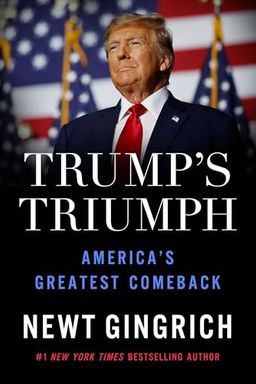
Trump's Triumph cover

Trump's Triumph

by Newt Gingrich

The former speaker of the House depicts the political comeback of President Trump.

From Resistance to Renewal: Trump’s Triumph and Mandate

What does it take to steer a country you believe is drifting away from its core values back toward prosperity and confidence? In Trump’s Triumph, Newt Gingrich argues that Donald J. Trump’s 2024 victory is more than an electoral win—it’s the culmination of a nine-year insurgency against an entrenched establishment and the opening chapter of a governing project he frames as a national renewal. Gingrich contends that Trump’s reelection—following years of investigations, impeachments, lawfare, and even an assassination attempt—confers a rare governing mandate anchored in the MAGA movement’s durability and the electorate’s weariness with inflation, disorder at the border, cultural overreach, and global instability.

The book blends campaign chronicle, policy blueprint, and governing playbook. It starts with the rollercoaster 2024 contest—Biden’s withdrawal, Kamala Harris’s rushed coronation, spikes of media euphoria, and Trump’s recalibration—and then pivots to what Gingrich calls the "Trump Mandate." He outlines why governing is harder than campaigning (and how to succeed anyway), offers a concrete affordability agenda (from energy to taxes), maps a hawkish-but-pragmatic immigration reset, and pushes a larger vision: crush bureaucratic sclerosis through "entrepreneurial government," rewire health care around prevention, reclaim strategic advantage in defense and AI, and seize space as the next great American frontier.

Why this matters now

Gingrich argues the 2024 outcome spared the country from a future of "government domination, economic decay, and aberrant social policies." He frames the stakes as both political and cultural. In his telling, Harris’s abbreviated candidacy exposed a deeper anxiety: would elites pick winners regardless of performance, or would effort and merit prevail? He shares a striking anecdote from a dinner with historian Liz Lev, who suggests a Harris victory would have signaled that merit no longer matters—a cultural breaking point for a nation built on striving. That’s the lens through which he reads Trump’s win: an affirmation of work, resilience, and responsiveness to popular concerns.

What you’ll learn in this summary

You begin with the campaign that nearly veered off the rails as Biden dropped out, Democrats rallied cash and media behind Harris, and Trump had to quickly reframe his case. You’ll see how Harris’s vulnerabilities—on energy, immigration, and consistency—met a Trump operation comfortable in long-form media, nimble with earned attention (think McDonald’s drive-thru and the "garbage truck" stunt after Biden’s "garbage" remark), and relentlessly focused on affordability and security. From there, Gingrich expands into a governing architecture: a movement-and-mandate model (he cites the America First Policy Institute’s policy shop and America’s New Majority Project’s data engine) to convert campaign themes into executive actions, legislation, and cultural change.

Expect a sustained argument that "popular sentiment is everything" (Lincoln’s maxim) and that big, lasting change requires pairing early executive orders with durable statutes and public buy-in (a theme Ronald Reagan and Margaret Thatcher also stressed). Gingrich details a Make America Affordable Again agenda (energy deregulation, a Musk-led Department of Government Efficiency targeting trillions in waste, and tax relief on tips, overtime, and Social Security benefits), a tough-but-legal immigration reset (securing the border while building an earned path for "Dreamers"), and a sweeping call to replace bureaucratic process-worship with entrepreneurial execution (Deming- and Drucker-inflected efficiency, DARPA-like dynamism, and rigorous outcomes over activity).

Core claim

Gingrich’s central claim is that Trump now leads both a political movement and a policy machine capable of delivering rapid executive action and popular, bipartisan-ready legislation—if leaders keep public sentiment at the center and govern like entrepreneurs, not bureaucrats.

The larger frontier

The book widens into national power: health (pivot from "sick care" to lifestyle medicine and prevention), security (prepare for EMP risk, missile defense, and unconventional war), AI and the "endless frontier" (reviving Vannevar Bush’s model for science-led growth), and space (Space Force, Starship, synthetic biology, asteroid mining). The culminating tone is aspirational: use America’s 250th birthday (2026) to renew civic pride and project confidence in a future where Americans work, build, and lead "beyond Earth."

Read this summary to understand how Gingrich stitches a campaign story to a governing plan, why he thinks public opinion—not elite consensus—should be the metronome of policy, and how he believes Trump-world intends to translate "fight, fight, fight" into tangible, measurable outcomes you can feel in your paycheck, your neighborhood, and your sense of national direction.


The 107-Day Whiplash Campaign

Gingrich’s campaign narrative is a compact thriller: Biden’s debate stumble, a Hollywood crescendo (George Clooney’s op-ed), Biden’s extraordinary exit, and Kamala Harris’s swift coronation with a billion-dollar money surge. For the Trump team, it was like "riding a roller coaster blindfolded." Only days earlier, on July 13, 2024, Trump survived an assassination attempt at a Butler, PA rally—turning a fatal headshot into a grazed ear as he turned to glance at a chart. The bandaged entrance at the GOP convention two days later became an icon of resilience and purpose, punctuated by his selection of Sen. J.D. Vance as running mate.

Harris rises fast—and hits turbulence

Harris’s early campaign emphasized biography and "change" messaging, juiced by Divine 9 organizing and glowing media profiles. But key choices undercut that narrative. She bypassed Pennsylvania’s Josh Shapiro—strong in a must-win state and helpful on fracking politics—in favor of Minnesota Gov. Tim Walz, a pick Gingrich calls ideologically comfortable but politically brittle. Walz carried baggage: 2020 riot management, stringent COVID mandates (churches closed while bars and malls operated), extreme positions on abortion and gender policy, and personal exaggerations that collapsed under national scrutiny.

On camera, Harris never found a fluent groove. The CNN joint interview seated Walz closer to the lens—subtly upstaging her—and the mantra "I grew up in a middle-class household" became a meme. The breaking point was a candid moment on The View: asked what she’d do differently from Biden over four years, she replied, "There is not a thing that comes to mind." Gingrich calls that clip "gold"—it punctured her change-agent framing and starred in a flood of ads.

Debates and media asymmetry

Harris exceeded expectations in the Sept. 10 debate—helped, Gingrich argues, by moderators who pressed Trump harder. But Gingrich insists the public judges differently than pundits: Trump’s steadier tone and policy contrast landed over time, and the vice-presidential debate (Vance vs. Walz) further softened the GOP ticket’s image as Vance and Walz shared unexpected comity. Meanwhile, Trump’s media advantage grew outside legacy channels—Joe Rogan’s 3-hour show (33 million listens in days), long-form Hannity town halls, and a constant pipeline of earned media stunts and human moments (like learning to make fries and serving customers at a Pennsylvania McDonald’s).

Signature moments

Skipping the Al Smith Dinner (a Catholic bellwether), a tone-deaf video riffing on a Saturday Night Live sketch, and rejecting conscience protections in medicine combined to alienate faith voters; later, Biden’s "garbage" line about Trump supporters handed Trump a viral counterpunch—rolling into a Wisconsin rally on a garbage truck in a reflective vest.

A coalition on display

Gingrich highlights Madison Square Garden as a tableau of the new Trump coalition: Hulk Hogan followed by Dr. Phil, Robert F. Kennedy Jr. flaying the modern Democratic Party, and Tulsi Gabbard (a veteran) arguing against endless wars. The press fixated on a comedian’s awkward joke; Gingrich argues voters instead noticed a working-class, heterodox, culturally confident bloc forming in real time.

By election night in West Palm Beach—after a nine-year saga of Russia probes, impeachments, January 6 hearings, and courtroom battles—Gingrich frames the result as catharsis and proof that a candidate who works relentlessly, answers questions, and performs can still defeat a better-funded, media-favored opponent. The short sprint ended with a broader verdict: the "revenge tour" framing didn’t stick; affordability, border security, and competence did.

(Context: Campaign postmortems in other cycles—e.g., McKay Coppins on 2012, Jonathan Allen/Amie Parnes on 2016—show similar patterns: media narratives often lag public utility judgments. Gingrich’s version adds the asymmetry of long-form alt-media as a structural advantage.)


The MAGA Mandate: Movement to Machinery

Gingrich insists Trump didn’t just win; he won with a governing mandate built on movement energy and institutional scaffolding. The key is branding around a cause larger than a person. Like Reagan calling his revolution a "rediscovery" of American values, Trump’s "Make America Great Again" morphed from a slogan into identity—hats at rallies, bumper stickers, and, ultimately, a values shorthand: pro-worker, pro-energy, pro-border, pro-police, and proud of the country. Gingrich argues Trump’s rally style doubles as field research: he watches which lines land, which stories break through, and iterates. Immigration, for instance, was elevated in 2015 after an electrifying Phoenix moment when a grieving father described losing his son to an illegal-immigrant crime.

From applause lines to policy

Two organizations, Gingrich writes, fed the machine behind the scenes. First, the America First Policy Institute (AFPI)—Brooke Rollins and Linda McMahon assembled 400+ former Trump officials to build on-term policy muscle. He credits AFPI with helping craft the avalanche of early executive orders and preparing second-term playbooks across energy, border security, education, and more. AFPI’s political arm, America First Works, executed a trench campaign: 5.7 million doors knocked targeting low-propensity voters in swing geographies.

Second, America’s New Majority Project, launched with Home Depot cofounder Bernie Marcus, ran 27 national polls (27,000 voters) plus dozens of focus groups across demographic slices—Latino, Black, Asian, Hindu, and others. The aim: find 70–80% issues that isolate the left (a Reagan tactic). Their finding: the biggest, most decisive gaps were cultural. Voters overwhelmingly reject doctrines that claim America is inherently racist or that moral character is determined by race/sex; they favor equality under the law and merit-based hiring.

Implication: define, then divide

Armed with supermajority issues, Gingrich argues, Republicans can force Democrats into a bind: side with their activist left and hemorrhage moderates, or tack to center and spark an internal war. Inaugural addresses matter in this model, he says, because they signal which "big choices" you’ll elevate. He calls Trump’s 2025 inaugural the most revolutionary in memory—declaring a "Golden Age" agenda, invoking a "national energy emergency," promising a "DOGE" to cut federal bloat, renaming the Gulf of Mexico the "Gulf of America," and calling for a Mars landing—equal parts policy and cultural signal.

Why MAGA still endures

Gingrich’s take: MAGA fuses pocketbook urgency (inflation, energy prices) with dignity politics (respect for work, police, faith, and the flag) and national pride. That combo made lawfare backfire—mug shots became icons—and made long-form conversations (Rogan, rallies) feel like citizens talking back to the "system."

Precedents and contrasts

He compares this to Reagan’s 1984 wedge—Mondale’s "I will raise your taxes" unlocked a 49-state blowout. The method echoes Thatcher’s "win the argument, then win the vote" and Lincoln’s "public sentiment is everything." The difference today, Gingrich argues, is the cultural front: issues like women’s sports, campus antisemitism, and DEI bureaucratization are 70–90% issues that conventional elites dismiss, but voters don’t. MAGA’s mandate, then, is to legislate where possible, regulate where necessary, and keep the public conversation centered on common-sense supermajorities—long enough for habits, expectations, and institutions to reset.

(Context: Movement-to-machinery arcs appear in other eras—e.g., FDR’s Brain Trust and policy shops, or the Heritage Foundation’s Mandate for Leadership in the 1980s. Gingrich positions AFPI/New Majority as that kind of spine for a populist-right realignment.)


Governing Beats Campaigning—If You Listen

Gingrich opens his governing playbook with a sober warning: campaigning is a motorboat; governing is a small craft in a huge, turbulent sea. Quoting the "Breton Fisherman’s Prayer"—"O God, thy sea is so great and my boat is so small"—he recounts how surprise events upend agendas: Carter’s inflation, Reagan’s Iran-Contra, Bush’s 9/11 and Katrina, Obama’s Red Line and Crimea, Trump’s COVID shock, Biden’s Afghanistan exit and October 7. The lesson isn’t "do less;" it’s "plan for detours and keep public support."

The Constitution makes it hard (by design)

Our system deliberately disperses power to avoid tyranny—House vs. Senate cultures, the presidency vs. Congress, and the Court’s backstop (see Montesquieu’s separation of powers). Executive orders are useful early (and Trump deploys many), but "what one pen does, the next can undo." Durable change means statutes, coalitions, and—crucially—citizen consent. Gingrich’s own record: four balanced budgets with Clinton (the only ones in the last century), welfare reform that turned checks into work, and a Reagan tax cut that required wooing one-third of House Democrats.

Gingrich drives home Abraham Lincoln’s maxim: "With public sentiment, nothing can fail; without it nothing can succeed." Reagan called his supporters "Reagan’s regiments" and outsourced pressure to the people ("I shone the light on the American people, and they turned up the heat on Congress"). Thatcher put it bluntly: "First you win the argument, then you win the vote."

Practical rules of the road

  • Translate rallies into coalitions. Don’t bully swing lawmakers with theatrics; give them air cover from their voters. Provide districts with local data and 70–80% issues (e.g., fairness in women’s sports, e-Verify, price transparency in health care).
  • Use EOs to start—but legislate to last. Immigration enforcement, federal workforce rules, and DEI directives can shift fast by EO. But push bills where supermajorities exist. Gingrich calls for pairing "earned media" with Member education to turn media moments into votes.
  • Respect Congress’s psychology. Members pay a personal price to win—money, reputation, harsh press—so treat them as partners, not subordinates. Train White House staff to build, not burn, rapport.

Effort vs. achievement

Gingrich cautions that Washington often confuses activity with accomplishment. Leaders must insist on measurable outcomes—balanced budgets, lower energy prices, fewer illegal crossings—rather than resting on press releases.

The 2026 test

His conclusion is tactical: keep the House in 2026 by making prosperity visible early (energy prices, take-home pay), defining vulnerable Democrats with their own votes (e.g., opposition to protecting girls’ sports or cooperation with ICE on criminal suspects), and reminding Republicans that money raised in the "off year" is five times as valuable as panic cash in October. Gingrich returns to a core principle: if you do what people want—and show your work—you can build a bipartisan governing majority even in a fractious age.

(Comparison: In It Worked for Me, Colin Powell similarly stresses simplicity, clarity, and mission discipline. Gingrich’s twist is partisan math and movement energy—turning public argument into legislative gravity.)


Make America Affordable Again

If you feel like official inflation stats don’t match your grocery bill, Gingrich feels the same. He spotlights the Winston Group’s "presidential inflation rate," which tracks prices from a president’s inaugural month. By late 2024, official inflation sat at ~2.6%, but cumulative prices were up ~20.7% since January 2021—one reason "Bidenomics" didn’t land. Gingrich’s affordability agenda centers on energy, spending discipline, and tax relief you can see in your paycheck.

Energy first: the fastest price-cut lever

Energy costs ripple through everything: shipping, food, housing, manufacturing. Gingrich argues for reversing Biden-era constraints—higher royalties, methane fees, LNG export pauses—to drop gasoline and electricity costs. He notes the U.S. hit record crude production in 2023 (12.9 million b/d), thanks in part to investments made under prior deregulation, but says policy hostility still raised prices by jacking up costs of compliance. The goal is not just more barrels—it’s cheaper barrels. He celebrates "drill, baby, drill" as inflation relief first, geopolitics second.

DOGE: Elon Musk’s war on waste

Gingrich touts a Department of Government Efficiency (DOGE), helmed by Elon Musk, to carve $2T from federal spending over time. Start where the executive can act unilaterally: hundreds of billions in unauthorized recurring outlays; improper Medicare/Medicaid payments (>$100B/year); and rollback of recent executive actions (student debt maneuvers, SNAP expansions) that nonpartisan groups score in the hundreds of billions. He favors moving underused D.C. agency HQs to lower-cost states and auctioning surplus buildings (a board reported HQ occupancy averaging 12% in 2023). Pair that with ending indefinite remote work—return to office or take the eight-month buyout.

Balanced budgets aren’t a fantasy

Gingrich reminds readers: the 1990s balanced budgets happened—even without a constitutional amendment—by focusing on growth, discipline, and bipartisan deals. "Success breeds success" becomes an operating principle.

Tax relief where people feel it

He proposes making the 2017 Tax Cuts and Jobs Act individual provisions permanent (preventing across-the-board tax hikes in 2025), protecting small-business pass-through deductions, and adding targeted relief: no tax on tips (for millions in hospitality), no tax on overtime pay (to reward hustle in a tight labor market), and no tax on Social Security benefits (to stop "double taxation" of seniors). Vance’s idea to raise the Child Tax Credit to $5,000 builds on the 1997 bipartisan credit Gingrich helped pass—arguing it lifted children from poverty and honored families’ sacrifices.

He’s candid on tradeoffs: CRFB estimates big numbers for lost revenue, but Gingrich pairs tax relief with DOGE savings, pro-growth energy, and regulatory pruning to grow the base (a Laffer/Kudlow supply-side frame). The test for you is practical: do you keep more of what you earn, and do prices for gas, groceries, and rent stop outpacing your pay?

(Context: In The Price of Inequality, Joseph Stiglitz emphasizes distributional fairness; Gingrich emphasizes incentive effects and administrative waste. Both agree: system design shapes behavior—Gingrich’s bet is on growth, competition, and cost discipline.)


Borders, Belonging, and a Legal Path

Gingrich threads a needle many voters ask for: stop illegal immigration firmly while welcoming legal immigrants who strengthen America—and resolve the "Dreamers" question fairly. He opens with history: from Franklin’s worries about German-language enclaves to Ellis Island’s orderliness, to the 1924 quotas and shameful Japanese internment, to 1986’s Simpson-Mazzoli amnesty that failed to deliver enforcement. The "Biden deluge," he argues, with 7.5 million illegal crossings, put the issue at the center of 2024—especially as high-profile crimes by illegal entrants horrified swing voters.

Public opinion is unambiguous

Polls from America’s New Majority Project show supermajorities for border security: 77% favor hiring more agents; 70% favor declaring an emergency and deploying Guard/FEMA; 68% want cartels labeled terrorists; 83% want local police to check immigration status for arrestees suspected of being here illegally; and 72% want mandatory e-Verify for employers. Voters, Gingrich says, are done with incentives for illegal entry and want asylum rules tightened.

Day-one actions

He lists Trump’s first-week EOs: reinstate Remain in Mexico; declare a border emergency; authorize military planning at the boundary; end funding for sanctuary cities; accelerate detention capacity; upgrade visa vetting; and designate cartels (e.g., MS-13, Tren de Aragua) as terrorist entities. Gingrich frames this as restoring the rule of law—"secure the border first"—so Congress can tackle complex fixes without incentivizing new waves.

Legal immigration and Dreamers

Gingrich is emphatic: Americans like legal immigration (73% support). He celebrates contributors from Elon Musk to Alexander Hamilton. On Dreamers, he cites polls showing 58–82% support for a border-security-plus-citizenship deal. The path should include clear tests of conduct, work, and allegiance—and be carefully crafted to avoid perverse incentives.

Why this framing works

For you, the calculus is coherence: there’s a humane, generous America that celebrates legal newcomers—and a rules-based America that expects laws to be enforced. Gingrich argues a serious program can honor both. Secure first; deport criminal aliens swiftly; mandate e-Verify to cool the jobs magnet; reform asylum; and then legislate an earned resolution for people brought here as children who are working, contributing, and American in every way but paperwork.

(Comparison: In We Wanted Workers, George Borjas stresses labor-market effects; in Melting Pot or Civil War?, Reihan Salam sketches a similar "high-skill, high-assimilation" pathway. Gingrich’s emphasis is enforcement legitimacy first, then pragmatism.)


From Bureaucracy to Builders

Gingrich’s management philosophy is blunt: America can’t out-administer its rivals; it must out-build them. He contrasts entrepreneurial cultures (set goals, iterate, own outcomes) with bureaucratic cultures (honor process, avoid failure, protect turf). He invokes Antony Jay’s "Yes, Minister" to lampoon civil-service inertia, Edwards Deming’s "continuous improvement" to champion front-line problem solving, and Peter Drucker’s maxim that effectiveness is doing the right things, not merely doing things right.

Exhibit A: NUMMI vs. the old GM

When Toyota took over GM’s Fremont plant in 1984 as a joint venture (NUMMI), it brought Deming’s kaizen culture—4,400 worker ideas for improvements in year one. GM initially wanted to quit, assuming a plant that needed that many fixes was hopeless. Toyota understood the opposite: continuous improvement compounds into excellence. Today, that factory is Tesla’s Fremont plant—a symbol, in Gingrich’s telling, of how entrepreneurial cultures repurpose bureaucratic ruins.

Eight challenges to change

  • No coherent theory for lasting entrepreneurial government—so wins reverse when champions depart.
  • Few "free zones" (like DARPA) immune to creeping red tape.
  • Millions chose stability over change; retraining for faster tempos is nontrivial.
  • Contracting pairs giant bureaucracies with giant contractors—risk-averse, cost-plus cultures (see Boeing’s SLS vs. SpaceX reusables).
  • Citizen-driven innovation (a la Gavin Newsom’s early "Citizenville" ideas) gets blocked by public-sector unions protecting headcount.
  • Training academies teach process, not outcomes; curricula must flip.
  • States/localities need to be co-creators—federalism as an innovation network, not a compliance funnel.
  • Always bias toward new, less expensive, citizen-centric options over "the way we’ve always done it."

A cautionary tale: Baltimore schools

Thirteen Baltimore high schools recorded zero students proficient in math on the 2023 state exam—even as the system spent $1.6B plus $799M in COVID funds. Gingrich calls it "educational homicide": process rich, outcomes poor. His point isn’t to dunk; it’s to demand metrics that match mission.

What this means for you

Expect agencies pushed to define success by citizen outcomes (faster permits, lower costs, cleaner streets), not effort expended. Expect more pilots, more vendor variety, and fewer "must be this big to bid" procurement hurdles. Expect leaders to tolerate "successful failures" (like SpaceX test explosions) that speed learning—because, in Gingrich’s frame, America needs builders more than babysitters.

(Context: In The Startup Way, Eric Ries prescribes "innovation accounting" for big organizations. Gingrich is calling for that playbook at national scale.)


Health, Security, and the New Frontier

Gingrich tackles three big systems—health, defense, and science/space—with the same entrepreneur’s lens: align incentives with outcomes, cut middlemen and red tape, and invest where breakthroughs are real.

Health: from sick care to healthspan

He argues 86% of spending treats chronic disease; prevention and reversal must be the core strategy. He champions lifestyle medicine (Dean Ornish’s program: whole-food plant-based diets, daily exercise, stress management, and group support), recently showing RCT evidence of halting/reversing early Alzheimer’s. Price transparency should be enforced (hospitals backslid under lax enforcement), and PBM middlemen curbed for rebate-driven price inflation. He sees promise in Medicare Advantage’s value-based care but warns against bureaucratic micromanagement and "diagnosis creep" that pads insurer revenue without better outcomes. The mantra: "First save lives, then save money."

Security: from survival gaps to transformation

He names "strategic orphans" America must adopt: an EMP-hardened grid, a real plan for limited nuclear events response, an AI-age industrial base, space dominance, and a missile defense that actually works (learning from Israel’s layered systems). Goldwater–Nichols proved Congress can force beneficial change; he calls for a new acquisition system that prizes speed and learning—"replace, don’t reform"—and a professional-military-education overhaul that teaches transformation, not compliance. Above all, "win wars, don’t just fight them"—a rebuke to 23 years in Afghanistan.

AI & space: the Endless Frontier, again

Revive Vannevar Bush’s 1945 template ("Science: The Endless Frontier"): fund basic research (including a dedicated NIH institute for aging biology), build commercialization pathways, and scale with private capital. AI will transform medicine, logistics, and defense; be wary of Europe’s "regulate, don’t innovate" trap. In space, back Space Force, jettison NASA’s cost-bloated SLS/Gateway model, and ride reusables (Starship) to rewrite exploration economics. He champions synthetic biology (growing materials and medicine off-world), asteroid mining (Psyche’s mind-bending potential), nuclear propulsion for interplanetary travel, tax holidays for off-world manufacturing, and even a national "space lottery" so ordinary Americans can go.

A birthday with purpose

Use America’s 250th (2026) to teach founding principles and preview a dazzling next 250 years—curing diseases, building in space, and renewing civic pride. Gingrich wants the commemoration to be grassroots, tech-enabled, and relentlessly optimistic.

For you, the throughline is hopeful pragmatism: align dollars with results you can see—fewer hospitalizations, safer grids, cheaper launches, more cures—and invite citizens to build alongside government. That, Gingrich argues, is how you turn a mandate into a movement that governs well—and lasts.

(Context: Walter Isaacson’s biographies of innovators, and Andy Kessler’s Eat People, echo Gingrich’s thesis: value accrues to builders who remove friction and multiply capability. The policy question is whether government will empower them—or get out of their way.)

Dig Deeper

Get personalized prompts to apply these lessons to your life and deepen your understanding.

Go Deeper

Get the Full Experience

Download Insight Books for AI-powered reflections, quizzes, and more.