
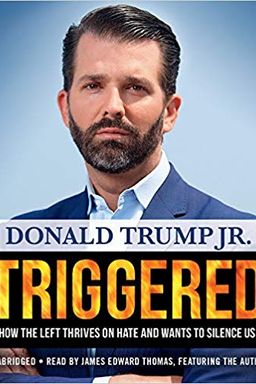
Triggered cover

Triggered

by Donald Trump Jr

Triggered by Donald Trump Jr. offers a provocative critique of left-wing politics in the U.S., challenging their impact on free speech, identity politics, and social media manipulation. Trump Jr. argues that these tactics stifle open dialogue and create a culture of division and censorship, urging readers to defend their beliefs.

America, the Triggered Nation: Why Political Outrage Defines Our Age

Have you ever felt like you couldn't say what you truly think without someone calling you racist, sexist, or bigoted? In Triggered, Donald Trump Jr. argues that America has become a nation where outrage replaces logic, and political correctness has silenced honest debate. He contends that the left’s obsession with victimhood, identity politics, and censorship has transformed our culture into a battlefield—one where free speech and traditional values are constantly under attack.

Trump Jr. uses his own experience as one of the most vilified public figures in modern politics to illustrate how constant outrage conveniently fuels Democratic narratives and the media’s profit machine. But at heart, his message goes beyond partisanship—he’s warning that when emotional outrage replaces critical thought, the foundations of democracy begin to crack.

The Politics of Outrage

The book begins with the idea that the U.S. has traded intellectual discussion for ideological warfare. Trump Jr. describes a society where people become ‘triggered’—experiencing emotional shock when confronted with opposing opinions. Everything, from saying “Merry Christmas” to supporting capitalism, can be labeled offensive. The author frames “trigger warnings” not as helpful signs for trauma survivors but as cultural weapons that enable censorship and suppress dialogue. In his view, progressives have shifted from fighting injustice to controlling language and thought, eroding the core of personal freedom.

This phenomenon is closely tied to his personal life. As Donald Trump’s son, he’s been a target of media hostility, congressional investigations, and online mobs. Yet he wears this as a badge of honor—proof that speaking uncomfortable truths about patriotism, faith, and hard work rattles the establishment. The book challenges readers to see “triggered” liberals not just as opponents but as symptoms of a deeper cultural breakdown where feelings outweigh facts.

Cultural Symptoms: Media, Academia, and Ideology

Trump Jr. portrays an interlocking system: the mainstream media, Hollywood, universities, and the Democratic Party collaboratively indoctrinate Americans into groupthink. Media manipulation, according to him, is the greatest weapon—creating stories like the Russia collusion hoax or the Jussie Smollett scandal to perpetuate outrage and division. Academia reinforces this through hyper-sensitivity on college campuses, safe spaces, “microaggressions,” and an intolerance of conservative voices. Social media platforms—Twitter, Facebook, YouTube—then enforce ideological conformity through shadow banning and selective censorship.

Students and young voters, raised in comfort, have been drawn to socialist ideals without understanding their catastrophic outcomes (he references his grandparents’ experiences under Communist Czechoslovakia). Through vivid contrasts—his grandfather working under surveillance versus millennials protesting capitalism from iPhones—Trump Jr. aims to show how entitlement has replaced effort and ideology has supplanted gratitude.

The Stakes: Patriotism and Freedom

The book urges readers to reclaim patriotism and traditional ideals. It’s not only a defense of his father’s presidency but of “normal Americans”—farmers, factory workers, and families—whom he calls the “Deplorables.” Trump Jr. believes these people embody grit and values that keep America strong, while elites manipulate outrage to maintain control. His populist tone asserts that truth-telling and self-reliance are more revolutionary now than ever in history.

By charting his own transformation—from privileged New Yorker to outdoorsman, hunter, and political warrior—he wants to reconnect readers with pride in work, common sense, and perseverance. The larger question the book asks each reader is: Are you willing to speak freely and defend your beliefs, even when society tells you not to?

Why It Matters

At its core, Triggered is a call to resist intellectual fragility. It insists that real freedom demands courage—the courage to offend, to question, and to stand firm. In Trump Jr.’s eyes, this fight defines whether America remains a democracy of ideas or succumbs to emotional tyranny. Like books such as The Coddling of the American Mind (Haidt and Lukianoff) and 1984 (Orwell), he frames the current moment as a crisis of truth versus ideology. Readers are invited to decide whether they’ll choose resilience or join the crowd that constantly needs a trigger warning to face reality.


Fighting Back: The Trump Philosophy of Conflict

Trump Jr. defines himself—and his father—through the principle of counterpunching. He describes the Russia investigation, fake news, and political attacks not as obstacles but as proof that their movement threatens the establishment. When accused of collusion, he insists the point was never about truth but about destroying a populist president elected without elite approval.

The Art of Counterpunching

For Trump Jr., fighting back is moral duty. He recounts tense moments when even his lawyers urged restraint, but he refused. His philosophy: silence equals surrender. On Twitter, he mocked Adam Schiff’s repeated lies with hashtags like “#FullofSchiff,” turning ridicule into a weapon. It’s political jujitsu—using opponents’ hysteria to expose their hypocrisy. His father, though advising caution once, respected the instinct; after all, Trump built his career by challenging norms, whether in business or politics.

Why Conflict Reveals Truth

Trump Jr. argues that confrontation reveals the rot within institutions. The Russia probe—led by Robert Mueller—illustrated how bureaucracy and bias can morph into tyranny. He paints Mueller as a “puppet of the left” who can’t recall basic facts, like the origins of the Steele dossier. Through sarcastic humor and vivid storytelling, he contrasts those who “spent $40 million hunting ghosts” with working Americans who saw through the charade. Conflict becomes enlightenment: the more outrage aimed at reformers, the more truth surfaces.

The Personal Cost of Resistance

In sharing his experiences—death threats, public humiliation, and relentless media distortion—Trump Jr. humanizes the cost of defiance. Yet he refuses victimhood, reiterating, “that’s not how Trumps operate.” He compares his ordeal with historical witch hunts and portrays his family’s courage as a generational trait rooted in Fred Trump’s immigrant ambition. Like fighters conditioned in business, they thrive under pressure. Each attack becomes motivation to work harder, whether clearing his name or helping his father’s re-election.

This stance mirrors conservative thinkers like Jordan Peterson or Theodore Roosevelt, who see adversity as the forge of character. Trump Jr. encourages readers to treat criticism as confirmation of purpose: if elites hate you, you’re probably doing something right.


The Media and the Manufacturing of Outrage

According to Trump Jr., the liberal media is not a watchdog—it’s a propaganda factory. Drawing on examples from CNN, The New York Times, and online outlets, he explains how journalists manipulate narratives to mislead citizens. He coins the term “fake outrage economy” to describe the endless cycle of scandals built on half-truths and anonymous sources.

Fake News as a Business Model

From the Russia dossier to the Jussie Smollett hoax, he describes a pattern: sensational stories go viral, the media profits from clicks, then quietly retracts when proven false. CNN’s misreporting of his supposed Trump Tower cover-up or NPR’s fabricated timeline serve as case studies. Even when disproven, the emotional narrative sticks. “Facts don’t matter when outrage pays the bills,” he observes.

Outrage as Entertainment

Trump Jr. argues that cable news personalities act less as journalists and more as reality show actors performing moral superiority for views. Lawrence O’Donnell’s false report linking Trump’s loans to Russian oligarchs illustrates how rumor replaces evidence. The author contrasts this spectacle with historical journalism that once pursued truth over ideology (think Walter Cronkite’s era). For modern outlets, accuracy is optional; political theater is the goal.

Social Media’s Weaponization

He further explores how social platforms amplify outrage while silencing dissent. After sharing skeptical tweets about Smollett’s story, Trump Jr. faced backlash labeling him racist. Later, when the attack was proven staged, the same voices vanished. He shows how digital mobs operate like inquisitions—using hashtags instead of torches. Algorithms reward outrage and punishment rather than dialogue, creating what he calls “fauxtrage orchestras.”

His warning aligns with scholars of media literacy: outrage addiction dulls reasoning. Readers are urged to see through emotional manipulation and seek firsthand facts rather than filtered narratives.


Populism and the Forgotten American Worker

One of the book’s central ideas is that Trump’s movement revived forgotten Americans—factory workers, farmers, and tradespeople betrayed by global elites. Trump Jr. recounts campaign events in Rust Belt states, where people told him, “nobody’s listened to us for decades.” He insists Democrats betrayed labor by replacing working-class advocacy with dependency and identity politics.

Democrats' Abandonment of Workers

Through anecdotes of union members like “Rusty” from Wisconsin, Trump Jr. explains how generational Democratic loyalty eroded once workers realized industrial jobs vanished under policies like NAFTA. He contrasts Reagan’s optimism with Obama’s “you need a magic wand” fatalism about manufacturing revival. Trump’s renegotiations, he argues, restored dignity to industries the left deemed obsolete.

The Blue-Collar Billionaire

He calls his father a “blue-collar billionaire”—a businessman who understood working people better than lifelong politicians. Scenes at job sites reveal Trump inspecting foundations and talking with tradesmen, reflecting leadership grounded in tangible work rather than bureaucracy. This, Trump Jr. says, explains why union support shifted Republican for the first time in decades.

Why Populism Matters

Populism, in the author’s view, is moral realism. It values direct labor, self-reliance, and patriotism—the virtues dismissed by elites. He connects this to his own upbringing, working manual labor under his father’s supervision to understand effort and reward. His message to readers: pride in hard work is revolutionary in an era obsessed with victimhood.

This theme parallels works like J.D. Vance’s Hillbilly Elegy, which chronicles working-class alienation amid political neglect. Trump Jr.’s populism offers the opposite perspective—empowerment through pride and faith rather than despair through dependency.


The Rise of Identity Politics

In chapters such as “Miss Gendered” and “A Deadly Form of Hate,” Trump Jr. explores how the left has replaced equality of opportunity with equality of grievance. He mocks modern obsessions with gender pronouns, microaggressions, and cancel culture as the logical conclusion of identity politics gone mad.

From Unity to Fragmentation

He recalls watching universities offer “safe spaces” and gender-neutral pronouns while stifling dissent. Stories like the arrest of a British mother for misgendering a trans activist exemplify, in his view, how emotion overrides reason. By turning personal identity into political weaponry, progressives transform empathy into control.

Victimhood as Virtue

Trump Jr. calls the left’s obsession with oppression “Oppression Olympics,” where moral worth depends on how many identity labels one collects—race, gender, sexuality. He humorously proposes the next Democratic president will be “nonbinary and identify as a dolphin.” Beneath the humor lies concern: victimhood now trumps merit, punishing achievement as privilege.

Freedom Versus Conformity

His stance echoes classic conservative thought (Milton Friedman, Thomas Sowell): true equality comes from opportunity, not forced sameness. He contrasts American individualism with the ideological conformity of communist Czechoslovakia—his personal connection reinforcing that identity politics destabilizes freedom. Readers are challenged to embrace character and competence over labels.


The War on Free Speech and Social Media Censorship

Trump Jr. devotes an entire section to social media’s hidden censorship, or “shadow banning.” He recounts how platforms like Twitter and Instagram suppressed conservative posts—including his own—while amplifying leftist outrage. For him, virtual suppression equals modern tyranny.

How Shadow Banning Works

He describes noticing sudden drops in followers and engagement despite millions of views. After calling out the platforms for bias, his metrics mysteriously recovered. Readers learn practical implications: algorithms decide which voices are visible, which truths survive. This invisible manipulation shapes political outcomes more profoundly than overt propaganda.

Outrage Algorithms

Platforms thrive on engagement—anger equals profit. Trump Jr. explains that left-wing users form digital mobs to “cancel” conservatives, pressuring companies to deplatform them under the guise of “safety.” He cites comedian Kevin Hart and commentator Candace Owens, punished for jokes or false accusations while liberal offenders remain untouched. Hypocrisy, he argues, proves censorship serves ideology, not decency.

Freedom in the Digital Age

He urges reforms reminiscent of journalism ethics—treating social platforms as public squares bound by transparency. Comparing Triggered to Orwell’s 1984, he warns that thought policing now happens through algorithms rather than governments. His call to readers: reclaim independent thought by questioning digital narratives and valuing truth over viral outrage.


Lessons from Heritage and Upbringing

Interwoven through political commentary are personal stories shaping Trump Jr.’s worldview. He traces lessons from his grandfather’s life in communist Czechoslovakia and his father’s work ethic on New York construction sites. These memories serve as living proofs of his arguments about success, freedom, and resilience.

Hard Work, Not Handouts

He recalls being fifteen and clearing land or cleaning docks for minimal pay—training him to earn his way rather than inherit lifestyle. In contrast, socialists promise comfort without effort. His father’s lesson, “You don’t get anything you don’t ask for,” became the family creed against entitlement culture.

Communism’s Personal Legacy

His grandparents lived under a regime that monitored speech and rationed freedom. Visiting them revealed to him the perils of collectivism—the gray sameness, fear, and poverty that follow when government replaces personal responsibility. This backdrop strengthens his conviction that socialism and political correctness share DNA: both suppress individuality for false equality.

From Privilege to Purpose

Trump Jr. contrasts his Manhattan upbringing with his love for hunting, fishing, and rural America. His connection with ordinary Americans during the campaign affirmed that values, not wealth, define character. By merging his family’s story with America’s, he invites readers to rediscover self-reliance and gratitude—a personal antidote to modern cynicism.


Reclaiming Courage and Patriotism

In the closing sections and Trump 2020 chapter, Trump Jr. transforms his commentary into a manifesto. He argues that defending truth, family, and freedom requires courage—the kind his father displays daily amid relentless attacks. Patriotism, he says, isn’t blind nationalism; it’s responsibility for the world’s greatest democratic experiment.

Courage in a Triggered World

He celebrates acts of bravery large and small—from restaurant workers standing up to online mobs to rural voters defying elite ridicule. Emotional sensitivity may dominate headlines, but quiet courage sustains nations. The author urges readers to speak truth even when unpopular, because “flight instinct never developed in the Trump family.”

Patriotism and Progress

Highlighting achievements of the Trump administration—economic growth, prison reform, embassy movement to Jerusalem—he portrays patriotism as action, not sentiment. It’s producing, creating, and restoring pride. His framing echoes classic American optimism (similar to Reagan’s style): work hard, cherish your nation, and resist cynicism.

A Call to Resilience

Ultimately, Triggered insists that outrage culture will fade only when individuals rediscover resilience. Trump Jr. closes with gratitude—for family, freedom, and the American dream—and challenges readers to defend these blessings loudly. His message crystallizes: courage is contagious, and silence is surrender.

Dig Deeper

Get personalized prompts to apply these lessons to your life and deepen your understanding.

Go Deeper

Get the Full Experience

Download Insight Books for AI-powered reflections, quizzes, and more.